
Want to see an asteroid eclipse a star?
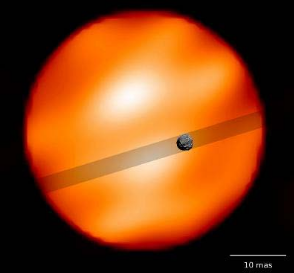
On January 2, 2012, an asteroid is going to transit across the face of Betelgeuse. And if you live in Europe, own a very sensitive telescope, look close and don’t blink, you might be able to see it!
This is all according to a preprint paper published today on the Los Alamos astro-ph preprint website, written by scientist Costantino Sigismondi of the Galileo Ferraris Institute and International Center for Relativistic Astrophysics in Rome. You can download the paper here [pdf].
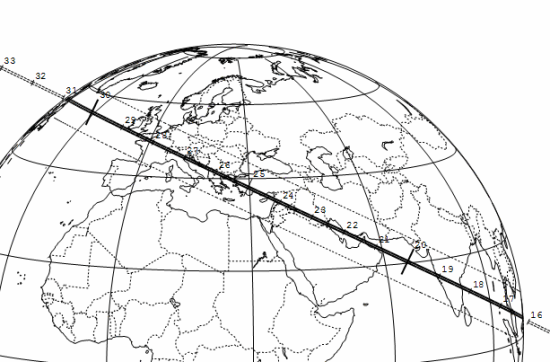
The transit itself will only last 3.6 seconds, and will only be visible along a narrow swath crossing southern India and moving across the Middle East, through parts of Italy, France, and the southwestern most tips of England and Ireland. A map of this path is below the fold.
The asteroid, 2005 UW381, is estimated to be a little less than 2 miles wide. As it crosses in front of the star Betelgeuse’s magnitude will drop by a whopping 0.01 magnitudes. Though this is a tiny change in magnitude, it is in much greater then the kinds of transits that the Kepler Space Telescope is seeing in space. It is also within the range of a good amateur telescope, properly calibrated.
Because Betelgeuse is relatively nearby (approximately 430 light years) and is quite gigantic (650 times the diameter of the sun), it has the largest angular diameter of any star. It was therefore the first star to be directly imaged, showing a face with mottled appearance that astronomers think is are giant starspots. As a red giant star, Betelgeuse more resembles a giant gasbag, with vast bubbles of material rising upwards to its surface like the bubbles in a simmering pot of tomato sauce. Eventually, the star will use up its fuel and collapse into itself, possibly going supernova.
The asteroid transit next week will be a good way for amateur astronomers to test their equipment in order to be able to do their own observations of some of the more visible extrasolar transits of other stars.

On Christmas Eve 1968 three Americans became the first humans to visit another world. What they did to celebrate was unexpected and profound, and will be remembered throughout all human history. Genesis: the Story of Apollo 8, Robert Zimmerman's classic history of humanity's first journey to another world, tells that story, and it is now available as both an ebook and an audiobook, both with a foreword by Valerie Anders and a new introduction by Robert Zimmerman.
The print edition can be purchased at Amazon or from any other book seller. If you want an autographed copy the price is $60 for the hardback and $45 for the paperback, plus $8 shipping for each. Go here for purchasing details. The ebook is available everywhere for $5.99 (before discount) at amazon, or direct from my ebook publisher, ebookit. If you buy it from ebookit you don't support the big tech companies and the author gets a bigger cut much sooner.
The audiobook is also available at all these vendors, and is also free with a 30-day trial membership to Audible.
"Not simply about one mission, [Genesis] is also the history of America's quest for the moon... Zimmerman has done a masterful job of tying disparate events together into a solid account of one of America's greatest human triumphs."--San Antonio Express-News