Orbital tug startup Impulse Space wins contract with satellite company SES

The orbital tug startup Impulse Space has won a contract to use its Helios tug to transport the satellites of the long established Luxembourg company SES to their correct orbit after launch.

The companies announced May 22 that they signed a multi-launch agreement that starts with a mission in 2027 where Impulse’s Helios kick stage, placed into low Earth orbit by a medium-class rocket, will send a four-ton SES satellite from LEO to GEO within eight hours. The announcement did not disclose the vehicle that will launch Helios and the satellite, or the specific SES satellite.

The agreement, the companies said, includes an “opportunity” for additional missions to transport SES satellites to GEO or medium Earth orbits.

This the first satellite tug contract for Impulse’s Helios tug, which is the larger of the company’s two tugs, the smaller version dubbed Mira. While Mira has completed an orbital demo mission, Helios has not yet flown, though it has three planned launches beginning in 2026.

4 comments

Senate schedules vote for confirming Jared Isaacman as NASA administrator

The Senate is now targeting early June for its vote on Jared Isaacman’s nomination as NASA administrator.

Senate Majority Leader John Thune (R-S.D.) filed cloture on Isaacman’s nomination May 22, a procedural move that would set up a vote on the nomination in early June. The Senate is not in session the week of May 26 because of the Memorial Day holiday.

Since his nomination was approved by the Senate Commerce committee in April, Isaacman has been meeting with many other senators. The article at the link does the typical mainstream press thing of pushing back 100% against the proposed NASA cuts put forth by Trump’s 2026 budget proposal, telling us that these senators were generally opposed to those cuts and questioning Isaacman about them, a claim not yet confirmed. It did note something about those senators and those proposed cuts that if true was very startling and possibly very encouraging.

While many of the proposals in the budget, like winding down SLS and Orion, were expected, the scale of the cuts, including a nearly 25% overall reduction in NASA spending, still took many by surprise. [emphasis mine]

In other words, Congress was not surprised by the proposed end of SLS and Orion. It even appears they are ready to give it their stamp of approval.

None of this is confirmed, so take my speculation with a grain of salt. Still, the winds do appear to be blowing against SLS and Orion.

2 comments

Axiom signs deals with Egypt and the Czech Republic

Axiom sent out two press releases yesterday touting separate agreements it has reached with two different countries that will either involve research or a future tourist flight to ISS or to its own station.

First the company announced that it has signed a partnership agreement with the Egyptian Space Agency to partner on a range of space-related research. The language describing this work was typically vague, and is so likely because it depends on the time table for the development and launch of Axiom’s station.

Second Axiom announced that the Czech Republic has signed a letter of intent to fly one of its own astronauts on a future Axiom manned flight. Like the Egyptian press release, view specifics were given, likely for the same reasons.

What both deals signal is that there is an international market for the commercial space stations under development and Axiom is aggressively working to garner that business. Its fourth commercial manned mission, set to launch in early June, carries paid government astronauts from Poland, Hungary, and India. The two new announcements add Egypt and the Czech Republic to the company’s international customers.

2 comments

Johannes – The Most Beautiful Wingsuit Flight I’ve Done

An evening pause: From the peak of the Wetterhorn, 12,106 feet. As always, these videos don’t show the work required to get to that peak, but he does describe it on the youtube page:

We climbed over the Willsgrätli, taking around 4 hours to reach the summit of the Wetterhorn. Holy moly… this climb was serious. We didn’t use ropes, and the heavy backpack caused me some problems in certain climbing sections.

What are you planning to do this Memorial Day weekend?

Hat tip Judd Clark.

6 comments

Boeing and Justice Department reach new deal on criminal prosecution for 737-Max crashes

In order to avoid a criminal trial scheduled for June where Boeing would be on trial for the deaths of 346 people from two 737-Max crashes in 2018 and 2019, the company and the Justice Department have worked out a new plea bargain deal that includes a much larger pay-out to the suing families of the victims.

Under the agreement, Boeing will have to “pay or invest” more than $1.1 billion, the DOJ said in its filing in federal court in Texas on Friday. That amount includes a $487.2 million criminal fine, though $243.6 million it already paid in an earlier agreement would be credited. It also includes $444.5 million for a new fund for crash victims, and $445 million more on compliance, safety and quality programs.

In the filing the Justice Department states it has met with the families to discuss the deal, but it remains unclear whether they will accept it or continue their suit. If the latter it could be that this deal will fail, just as the previous deals in 2021 and 2024. A major sticking point for the families is that Boeing will be allowed to avoid a trial and being convicted for murder and fraud, facts that the company has already admitted to in the previous deals.

0 comments

Cargo Dragon undocks from ISS

That this story is not news anymore is really the story. A cargo Dragon capsule that has been docked to ISS since April 22, 2025 today undocked successfully and is scheduled to splashdown off the coast of California on Sunday, May 25, 2025 in the early morning hours.

SpaceX’s Dragon missions to ISS have become so routine that NASA is not even planning to live stream the splashdown, posting updates instead online. This is not actually a surprise, since NASA has practically nothing to do with the splashdown. Once the capsule undocked from ISS, its operation and recovery is entirely in the hands of SpaceX, a private American company.

For NASA, SpaceX is acting as its UPS delivery truck, bringing back to several tons of experiments. And like all UPS delivery trucks, making a delivery is not considered news.

And yet, this is a private commercial spacecraft returning from space, after completing a profitable flight for its owners! That this is now considered so routine that it doesn’t merit much press coverage tells us that the industry of space is beginning to mature into something truly real and sustainable, irrelevant to government.

0 comments

Astronomers discover a perfect sphere in radio

Radio object Teleios

Using the array of radio dishes dubbed the Australian Square Kilometre Array, astronomers have made the serendipitous discovery of what appears to be a perfect sphere of radio emissions tens of light years in diameter and tens of thousands of light years away and near the galactic center.

The scientists have dubbed the object Teleios, Greek for ‘complete’ or ‘perfect’. The image to the right is that radio image. Though the astronomers posit that it must have been formed from a supernova explosion, there are problems with that conclusion. From their paper [pdf]:

Unfortunately, all examined scenarios have their challenges, and no definitive Supernova origin type can be established at this stage. Remarkably, Teleios has retained its symmetrical shape as it aged even to such a diameter, suggesting expansion into a rarefied and isotropic ambient medium. The low radio surface brightness and the lack of pronounced polarisation can be explained by a high level of ambient rotation measure (RM), with the largest RM being observed at Teleios’s centre.

In other words, this object only emits in radio waves, is not visible in optical or other wavelengths as expected, and thus doesn’t really fit with any theories describing the evolution of supernova explosions. Yet its nature fits all other possible known space objects even less, such as planetary nebulae, nova remnants, Wolf-Rayet stars, or even super-bubbles of empty space (such as the Local Bubble the solar system is presently in).

Baffled, the scientists even considered the possibility that they had discovered an artificially built Dyson Sphere, but dismissed that idea because Teleios emits no infrared near its boundaries, as such a sphere is expected to do.

At present the best theory remains a supernova remnant, though this remains a poor solution at best.

Hat tip to reader (and my former editor at UPI) Phil Berardelli.

7 comments

Astronomers discover another object in an orbit so extreme it reaches the outskirts of the theorized Oort Cloud

Orbits of known Trans-Neptunian Objects

Astronomers analyzing a dark energy survey by a ground-based telescope have discovered what might be another dwarf planet orbiting the Sun, but doing so in an orbit so extreme that it reaches the outskirts of the theorized Oort Cloud more than 151 billion miles out.

This object, dubbed, 2017 OF201, was found in 19 different observations from 2011 to 2018, allowing the scientists to determine its orbit. The map to the right is figure 2 from their paper [pdf], with the calculated orbit of 2017 OF201 indicated in red. As you can see, this new object — presently estimated to be about 450 miles in diameter — is not the first such object found in the outer solar system with such a wide eccentric orbit. However, the object also travels in a very different region than all those other similar discoveries, suggesting strongly that there are a lot more such objects in the distant outer solar system.

Its existence also contradicts a model that proposed the existence of a larger Planet X. That theory posited that this as-yet undetected Planet X was clustering the orbits of those other distant Trans-Neptunian objects shown on the map.

As shown in Figure 2, the longitude of perihelion of 2017 OF201 lies outside the clustering region near π ≈ 60◦ observed among other extreme TNOs [Trans-Nepturnian Objects]. This distinction raises the question of whether 2017 OF201 is dynamically consistent with the Planet X hypothesis, which suggests that a distant massive planet shepherds TNOs into clustered orbital configurations. Siraj et al. (2025) computed the most probable orbit for a hypothetical Planet X by requiring that it both reproduces the observed clustering in the orbits of extreme TNOs.

…These results suggest that the existence of 2017 OF201 may be difficult to reconcile with this particular instantiation of the Planet X hypothesis. While not definitive, 2017 OF201 provides an additional constraint that complements other challenges to the Planet X scenario, such as observational selection effects and the statistical robustness of the observed clustering.

Planet X might exist, but if so it is likely simple one of many such objects in the outer solar system. It is also likely to be comparable in size to these other objects, which range from Pluto-sized and smaller, making it less unique and less distinct.

In other words, our solar system has almost certainly far more planets than nine (including Pluto).

Hat tip to BtB’s stringer Jay.

7 comments

Dawn Aerospace begins offering its suborbital spaceplane to customers

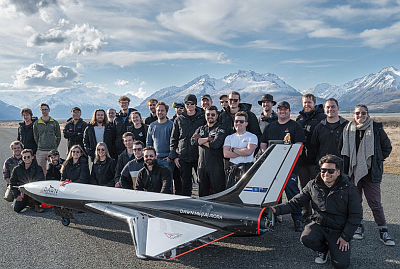
Though the company has only so far flown a small prototype on low altitude supersonic test flights, the spaceplane startup Dawn Aerospace is now taking orders for those who wish to put payloads on its proposed Aurora suborbital spaceplane, targeting a first flight in late 2026.

Dawn Aerospace is taking orders now for the Aurora spaceplane for deliveries starting in 2027. The company has not disclosed pricing for the vehicle, and [CEA Stefan] Powell suggested the company would tailor pricing to each customer. He said that the company estimates, based on market research, that a per-flight price of $100,000 is “absolutely tenable,” and the price could go higher for missions with more customized flight needs. He projects Aurora could fly 100 times a year and has a design life of 1,000 flights, with a total revenue per vehicle of about $100 million.

Though the company had originally touted itself as developing an orbital spaceplane, it recently shifted its goals, at least for the present, to building a very powerful jet comparable in some ways to the X-15, capable of reaching altitudes exceeding 50 miles for short periods and short periods of weightlessness. This capability has some value, and Dawn Aerospace has decided to market it for profit, rather than wait for the orbital version that might be years away.

1 comment

NASA continues to push Biden-era interpretation of Artemis Accords

In a press release today describing another international workshop for the signatories of the Artemis Accords in Abu Dhabi this week, NASA continued to put forth the Biden-era interpretation of the Artemis Accords that is diametrically opposed to the original concept of the accords as conceived during the first Trump administration.

The key words are highlighted in quotes below.

The Artemis Accords are a set of non-binding principles signed by nations for a peaceful and prosperous future in space for all of humanity to enjoy. In October 2020, under the first Trump administration, the accords were created, and since then, 54 countries have joined with the United States in committing to transparent and responsible behavior in space.

“Following President Trump’s visit to the Middle East, the United States built upon the successful trip through engagement with a global coalition of nations to further implement the accords – practical guidelines for ensuring transparency, peaceful cooperation, and shared prosperity in space exploration,” said acting NASA Administrator Janet Petro. “These accords represent a vital step toward uniting the world in the pursuit of exploration and scientific discovery beyond Earth. NASA is proud to lead in the overall accords effort, advancing the principles as we push the boundaries of human presence in space – for the benefit of all.”

…participants reaffirmed their commitment to upholding the principles outlined in the accords and to continue identifying best practices and guidelines for safe and sustainable exploration.

…The Artemis Accords are grounded in the Outer Space Treaty and other agreements, including the Registration Convention and the Rescue and Return Agreement, as well as best practices for responsible behavior that NASA and its partners have supported, including the public release of scientific data.

Many of the highlighted phrases are of course quite laudable, such as the desire for peace and the use of space for the benefit of all. The tone and spin however is very globalist and communist, and leaves out entirely the primary reason Trump created the accords in the first place, to encourage private ownership, capitalism, competition, and freedom in space by bypassing or canceling the Outer Space Treaty’s rules that forbid such things.

According to the release there will be more talks among accord signatories in the upcoming September meeting of the International Astronautical Congress. I highlight this press release and its Biden-era language in an effort to make the Trump administration aware that — at least in space — Biden’s policies apparently remain in charge. While I also know this is not the most important priority for Trump, it is also something he does care about, and these issues are critical for the future lives of those who will soon explore and settle the solar system.

Someone in the Trump administration has got shift NASA back to pushing for private enterprise internationally, rather than the feel-good, empty, and communist agenda of the globalist crowd, as illustrated by the language above. And they need to do it before, or even very publicly at that September International Astronautical Congress.

2 comments
1 183 184 185 186 187 2,927