
War – Low Rider
An evening pause: From the heart of the 1960s and 1970s.
Hat tip Cotour.
An evening pause: From the heart of the 1960s and 1970s.
Hat tip Cotour.
SpaceX today launched 23 Starlink satellites, its Falcon 9 rocket lifting off from Cape Canaveral.
The first stage completed its third flight, landing on a drone ship in the Atlantic.
The leaders in the 2024 launch race:
109 SpaceX
49 China
13 Russia
12 Rocket Lab
American private enterprise now leads the rest of the world combined in successful launches 127 to 75, while SpaceX by itself now leads the entire world, including American companies, 109 to 93.
Courtesy of BtB’s stringer Jay. This post is also an open thread. I welcome my readers to post any comments or additional links relating to any space issues, even if unrelated to the links below.
Posting today will continue to be light. I am wearing bandaging on one wrist that makes typing very slow and extremely difficult. All will go back to normal tomorrow.
SpaceX today announced its plan to fly the next and sixth orbital test flight of its Starship/Superheavy rocket on November 18th, less than two weeks from today.
The next Starship flight test aims to expand the envelope on ship and booster capabilities and get closer to bringing reuse of the entire system online. Objectives include the booster once again returning to the launch site for catch, reigniting a ship Raptor engine while in space, and testing a suite of heatshield experiments and maneuvering changes for ship reentry and descent over the Indian Ocean.
The success of the first catch attempt demonstrated the design feasibility while providing valuable data to continue improving hardware and software performance. Hardware upgrades for this flight add additional redundancy to booster propulsion systems, increase structural strength at key areas, and shorten the timeline to offload propellants from the booster following a successful catch. Mission designers also updated software controls and commit criteria for the booster’s launch and return.
As noted earlier, the FAA has made it clear that no new license is required since this flight plan is essentially the same as the fifth flight.
I will be unavailable until the afternoon, due to a non-emergency medical procedure.
An evening pause: One of the sharpest and clearest performances of this classic Dire Staits song.
Hat tip Mike Nelson.
Courtesy of BtB’s stringer Jay. This post is also an open thread. I welcome my readers to post any comments or additional links relating to any space issues, even if unrelated to the links below.
The resounding landslide victory by Donald Trump and the Republicans yesterday is going have enormous consequences across the entire federal government. As a space historian and journalist who has been following, studying, and reporting on space policy for decades, this essay will be my attempt to elucidate what that landslide will mean for NASA, its Artemis program, and the entire American aerospace industry.
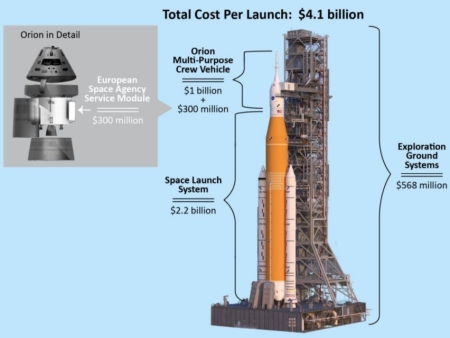
The absurd cost of each SLS launch
The Artemis Program
Since 2011 I have said over and over that the government-designed and owned SLS, Orion, and later proposed Lunar Gateway space station were all badly conceived. They all cost too much and don’t do the job. Fitting them together to create a long term presence in space is difficult at best and mostly impractical. Their cost and cumbersome design has meant the program to get back to the Moon, as first proposed by George Bush Jr. in 2004, is now more than a decade behind schedule and many billions over budget. Worse, under the present program as currently contrived that manned lunar landing will likely be delayed five more years, at a minimum.
For example, at present SLS is underpowered. It can’t get astronauts to and from the Moon, as the Saturn-5 rocket did in the 1960s. For the first manned lunar landing mission, Artemis-4, SLS will simply launch four astronauts in Orion to lunar orbit, where Orion will rendezvous and dock with the lunar lander version of Starship. That Starship in turn will require refueling in Earth orbit, using a proposed fuel depot that has been filled by multiple earlier Starship launches.
Once Starship is docked to Orion the crew will transfer to Starship to get up and down from the Moon, and then return to Earth in Orion.
You think that’s complicated? » Read more
In a process that began in 2018, Ghana has finally approved a new government space policy that shifts bureaucratic control from a government agency not specifically focused on space to a new Ghana Space Agency.
Though Ghana officials repeatedly claim this is to encourage a commercial industry, all this policy decision has done is to create a new government agency to run things. It also appears that to make this change took years of negotiation among all the various government agencies involved, so that everyone could protect their own interests.
Don’t expect much from Ghana in the near future. All this policy does is concentrate power within its government.
The Federal Communications Commission (FCC) on October 18, 2024 issued the first deep space communications license to the private asteroid mining startup company Astroforge for its planned Odin mission to an asteroid.
Asteroid prospecting company AstroForge has been awarded the first-ever commercial license for operating and communicating with a spacecraft in deep space, ahead of its Odin mission that’s set to launch and rendezvous with a near-Earth asteroid in early 2025.
The license, granted by the U.S. Federal Communications Commission (FCC) on Oct. 18, pertains specifically to setting up a communication network with radio ground stations on Earth, to enable commands to be sent up to Odin and data to be transmitted back to Earth. In this case, deep space is defined by the International Telecommunications Union as being farther than 2 million kilometers (1.2 million miles) from Earth.
Other private companies have sent missions to the Moon, but this will be the first to go beyond. Odin will orbit and map the asteroid — not yet chosen — in advance of a larger AstroForge spacecraft, dubbed Vestri, that will land on the asteroid.
One piece of cargo carried by the cargo Dragon to ISS earlier this week is the first cubesat ever to use wood for its side panelling.
Made by researchers in Japan, the tiny satellite weighing just 900g is heading for the International Space Station on a SpaceX mission. It will then be released into orbit above the Earth. Named LignoSat, after the Latin word for wood, its panels have been built from a type of magnolia tree, using a traditional technique without screws or glue.
Researchers at Kyoto University who developed it hope it may be possible in the future to replace some metals used in space exploration with wood. “Wood is more durable in space than on Earth because there’s no water or oxygen that would rot or inflame it,” Kyoto University forest science professor Koji Murata told Reuters news agency. “Early 1900s airplanes were made of wood,” Prof Murata said. “A wooden satellite should be feasible, too.”
The satellite’s frame is still metal, but by using wood for its side panelling the engineers hope to test the feasibility of wood as a in-space construction material.
An evening pause: On election day, I give you the most concise and poetic description of what America has always stood for, first spoken on November 19, 1863. On this day it will either signal “a new birth of freedom,” or a sad funeral speech to a nation that was dedicated to government of the people, by the people, for the people, and successfully proved it for almost 250 years.
Courtesy of BtB’s stringer Jay. This post is also an open thread. I welcome my readers to post any comments or additional links relating to any space issues, even if unrelated to the links below.

Click for original image.
Cool image time! The picture to the right, rotated, cropped, reduced, and sharpened to post here, was taken on August 2, 2024 by the high resolution camera on Mars Reconnaissance Orbiter (MRO).
The scientists describe this as “meandering channels,” which seems appropriate. The downhill grade here is to the southeast. In wider views these channels extend from the northwest to the southeast about 31 miles total (with this location near the center), with the total elevation loss about 3,000 feet.
Note the splash apron around the 4,500-foot-wide unnamed crater as well as how the largest channel seems to terminate suddenly at the crater. Though at first glance it appears this impact occurred after the channels, that some of the channels cut into that splash apron suggests otherwise.
» Read more

No more American Kristallnachts
Based on recent events, I am willing to predict that we shall see much less violence than expected in the days after the election should Donald Trump win. And if those protests occur, they will mostly be concentrated in Democratic Party strongholds where the protesters feel reasonably confident they can get away with it.
I base this optimistic prediction on the trends we have been seeing. As I first noted in April 2024, the strength of these leftist protests has clearly lost steam in the last four years. While in 2020 the protests and looting and violence occurred almost everywhere, destroying many inner cities, in the last year those protests have mostly been confined to college campuses, and have resulted in relatively little damage in comparison.
The reasons have been two fold. First, the authorities, while still generally treating these protesters too gently, have still responded more aggressively. Violent protesters are now arrested. Some face prison terms. Faced with real consequences, this violent leftist protest movement can no longer get the same numbers to turn out.
Second, the protests and violence has declined because of the utter failure of these protests to work. If anything, the looting and destruction has convinced vast numbers of Americans to oppose the left and to now vote with even greater energy against the politicians who support it.
Thought trends have been obvious for months, recently we have had even more evidence that the protests and violence will be less should Trump win. And that evidence is striking.
» Read more
In a letter [pdf] sent to the FCC on October 24, more than one hundred astronomers demanded a complete halt of all launches of low-Earth satellite constellations until a complete environmental review can be done.
The environmental harms of launching and burning up so many satellites aren’t clear. That’s because the federal government hasn’t conducted an environmental review to understand the impacts. What we do know is that more satellites and more launches lead to more damaging gasses and metals in our atmosphere. We shouldn’t rush forward with launching satellites at this scale without making sure the benefits justify the potential consequences of these new mega-constellations being launched, and then re-entering our atmosphere to burn up and or create debris This is a new frontier, and we should save ourselves a lot of trouble by making sure we move forward in a way that doesn’t cause major problems for our future.
Under this premise, Americans would forever be forbidden from doing anything without first having detailed environmental reviews by federal government agencies. Ponder that thought for a bit.
The astronomers’ argument of course is intellectually dishonest and disingenuous, on multiple levels. It is more than evident that these launches and satellites will cause little serious harm to the atmosphere or the environment. What the astronomers really want is to block these constellations so that their ground-based telescopes will be able to continue to see the heavens unhindered.
To hell with everyone else! We need to gaze at the stars and we are more important!
What these Chicken Littles should really do is give up on ground-based astronomy entirely, and start building space-based telescopes of all kinds, and fast. They would not only bypass the satellite constellations, they would get far better data as they would also bypass the atmosphere to get sharp images of everything they look at.
Whether the FCC listens to this absurd demand depends entirely on who wins the election. A Harris administration might easily go along, shutting down not only SpaceX’s Starlink constellation (thus getting political revenge on Elon Musk for daring to campaign against Democrats) but Amazon’s Kuiper constellation as well. Such an action would likely exceed the FCC’s statutory authority, but that won’t matter to these power-hungry thugs.
Trump in turn would almost certainly shut down much of the administrative state’s mission creep into areas of regulation it has no legal business.
The Parker Solar Probe is scheduled to complete its last fly-by of Venus on November 6, 2024, passing only 233 miles above the planet’s surface.
The flyby will adjust Parker’s trajectory into its final orbital configuration, bringing the spacecraft to within an unprecedented 3.86 million miles of the solar surface on Dec. 24, 2024. It will be the closest any human made object has been to the Sun.
That close solar approach will occur on December 24, 2024. Whether the spacecraft can survive is the main question, and we won’t find out until three days later, when it sends a signal to confirm its survival. If successful, it will then attempt to repeat that close fly-by at least two more times.
As for the Venus fly-by, the spacecraft will use one instrument to attempt to peer into Venus’s clouds.
NASA’s Wide-field Infrared Survey Explorer (WISE, later renamed NEOWISE) has ended its fifteen years in orbit, burning up in the atmosphere on November 1, 2024.
In its initial mission it did an infrared survey of the sky, discovering millions of black holes, many of the most luminous galaxies, and numerous brown dwarfs. It was then repurposed to survey the sky for near Earth objects, asteroids that have the potential to impact the Earth, discovering more than two hundred new asteroids while tracking more precisely another 3,000. It did this by repeating its survey over and over so that moving objects could be spotted.
Last night three different rockets took off from three continents.
First, Russia launched two space weather satellites and 53 cubesats, its Soyuz-2 rocket lifting off from its Vostochny spaceport in the far east. The main payload were the two Ionosfera-M satellites, designed to study the Earth’s ionosphere in tandem.
The rocket flew north, over Russia, where its lower stages were dropped into planned drop zones. No word if they crashed near habitable ares.
Next, SpaceX launched an unmanned cargo Dragon to ISS, its Falcon 9 rocket lifting off from Cape Canaveral in Florida. The first stage completed its fifth flight, landing safefly back at Cape Canaveral. The capsule is on its fifth flight, and successfully docked with ISS this morning.
Finally, Rocket Lab launched a “confidential commercial” payload under a contract designed to launch very fast after contract signing, its Electron rocket lifting off from one of its launchpads in New Zealand.
The leaders in the 2024 launch race:
108 SpaceX
49 China
13 Russia
12 Rocket Lab
American private enterprise now leads the rest of the world combined in successful launches 126 to 75, while SpaceX by itself still leads the entire world, including American companies, 108 to 93. Note too that with these launches the world has exceeded 200 launches in 2024, the second time this has ever been done, with the record of 213 launches set last year. This record will almost certainly be broken sometime this month.
An evening pause: Performed live 1968. One of the most beautiful songs ever written.
Hat tip Tom Biggar.