
Jimi Hendrix – The Wind Cries Mary
An evening pause: Performed live 1967.
Hat tip Judd Clark.
An evening pause: Performed live 1967.
Hat tip Judd Clark.
Courtesy of BtB’s stringer Jay. This post is also an open thread. I welcome my readers to post any comments or additional links relating to any space issues, even if unrelated to the links below.

Click for original image.
Today’s cool image returns to the same region yesterday’s cool image visited. The picture to the right, cropped, reduced, and sharpened to post here, was taken on July 21, 2024 by the high resolution camera on Mars Reconnaissance Orbiter (MRO). It was clearly taken to get a close look at this unusual pointy mesa.
MRO elevation data says this mesa is about 800 feet height. The color difference between the north and south flanks suggests the accumulated presence of dust on the north, suggesting the prevailing winds here come from the northeast and blow to the southwest. This conclusion is reinforced by the dark accumulated dust found in the southwest quadrants of all the crater floors in the full image. The wind blows this dust into the craters, where it gets trapped against the southwest crater wall.
Note the mesa’s wide base, with one crater partly eaten away on its eastern edge. The overall shape of this base suggests that it was carved by some flow coming from the southwest, as indicated by the arrow.
» Read more
Even though NASA’s solar sail test mission, dubbed the Advanced Composite Solar Sail System (ACSSS), successfully unfolded its giant sail in late August, engineers have not yet reactivated the sail’s attitude control system because they have detected a slight bend in one of the sail’s four booms.
While the solar sail has fully extended to its square shape roughly half the size of a tennis court, the mission team is assessing what appears to be a slight bend in one of the four booms. This likely occurred as the booms and sail were pulled taut to the spacecraft during deployment. Analysis indicates that the bend may have partially straightened over the weeks since boom deployment, while the spacecraft was slowly tumbling.
The attitude control system was turned off as planned during the deployment, allowing the sail to slowly tumble. It has been kept off longer than expected because the tumbling appears to be helping straighten the bend.
Once the control system is reactivated, the mission will then attempt to use the sail to change its orbit, to actually fly in space using sunlight like the wind.
Though the Space Force is still reviewing the nozzle issue on the second flight of ULA’s Vulcan rocket and has not yet certified the rocket for military operational launches, ULA has begun stacking the next Vulcan for an anticipated military launch of a national security satellite.
On Monday [October 21], ULA shared photos of the 109.2-foot-long (33.3 m) booster being hoisted into the Vertical Integration Facility to begin the stacking process. In the days and possibly weeks to come, the 38.5-foot-long (11.7 m) Centaur 5 upper stage will be added along with four solid rocket boosters and the payload fairings.
It appears that the military has accepted Vulcan for this launch because — despite the nozzle falling off of
a strap-on side booster — the rocket was successful in placing its payload in its precise orbit. The Space Force is simply completing the paperwork required for certification.
No date however has been set, but the company hopes to complete two military Vulcan launches in 2024, so it won’t be that far in the future.
An evening pause: Performed live 2015. The directing however is very mediocre. During the very spectacular piano solo he or she seemed more interested cutting in a lot of random shots rather than showing what was really amazing, the piano player’s performance.
Still, a great performance. Hat tip Cotour.
Courtesy of BtB’s stringer Jay. This post is also an open thread. I welcome my readers to post any comments or additional links relating to any space issues, even if unrelated to the links below.

Have ordinary Americans finally awakened to the
anti-American plans of the Democratic Party?
For the past few weeks early voting data from a variety of states has begun to suggest a major shift in what have been the traditional voting patterns for decades. In the past, Democrats routinely dominating early mail-in voting, while Republicans instead went to the polls on election day.
This election season is seeing an almost Earth-shattering change.
Nor are these three states outliers. A look at a nationwide map of early voting shows that Republicans also lead in Georgia and Arizona. Though the overall numbers nationwide show a Democrat-Republican split of 46% to 36%, the number of early votes from Republicans this election is far higher than in the past.
Though caution must be exercised, and we must recognize that these numbers do not guarantee a win for Donald Trump, what the data suggests however is an amazing newfound voting enthusiasm among Republicans. » Read more

Click for original image.
Since the first comprehensive orbital data of Mars was sent back in the early 1970s by Mariner 9, scientists have generally concluded that many of the features seen at the eastern end of the giant Valles Marineris canyon were caused by one or several catastrophic floods.
The picture to the right, rotated, cropped, and reduced to post here and taken on July 26, 2024 by the high resolution camera on Mars Reconnaissance Orbiter (MRO), provides a good example of why the scientists have come to that conclusion. It shows what the camera team labels a “streamline feature surrounding crater.” I have added the arrows to indicate the presumed direction of flow. The flow went around this 2.5-mile-wide unnamed crater because the impact had compacted it, making it resistent to erosion. The flow however was strong and large enough to wash away the plateau on which the crater sits, as well as cutting into the crater’s southwest rim. In addition, the rim on the southeast was also cut through at some point, this time from what might have been flow eddies as the flood pushed past.
Hence, the theory of catastrophic floods.
SpaceX on October 11, 2024 submitted a request to the FCC to revise its Starlink satellite license to cover a revised plan for its second generation satellites that includes a request to place 29,988 Starlink satellites in orbit.
SpaceX first requests several amendments to the orbital parameters of its Gen2 system between 340 km and 365km altitude to keep pace with rapidly evolving global demand for high-quality broadband. First,SpaceX amends the inclination of its orbital shell at a nominal altitude of 345 km from 46 degrees to 48 degrees. SpaceX also amends its pending Gen2 application to seek authority to operate satellites in its Gen2 system in two additional orbital shells — at 355 km altitude in a 43-degree inclination and at 365 km altitude in a 28- or 32-degree inclination. The total number of operational satellites will remain 29,988 satellites across the amended Gen2 system.
With the exception of its polar shell at 360 km, which will remain unchanged, SpaceX also amends its application to more flexibly distribute satellites in its shells between 340 km and 365 km than requested in its pending application, specifically, in up to 72 planes per shell and up to 144 satellites per plane. While this reconfiguration will result in two additional shells and a higher maximum number of orbital planes and satellites per plane for all but one shell between 340 km and 365 km, the total number of operational satellites in the Gen2 system will remain 29,988 satellites.
In the company’s previous request for this number of satellites, the FCC had approved only 7,500, the full request still pending. We can expect objections from the other big satellite constellations to this request. The FCC’s response remains unclear. There could be legitimate reasons to limit SpaceX request, but it is also possible politics will enter the decision as well, for illegitimate reasons.
Meanwhile, astronomers are already whining about the problems these Starlink satellites will cause to their ground-based telescopes. It seems these so-called brilliant scientists can’t get it through their heads that astronomy from Earth will become increasingly difficult in the coming years — with hundreds of thousands of satellites planned from many satellite constellations, not just SpaceX — while astronomy from space has always been a better choice anyway. Rather than demand regulation or restrictions on these new satellite constellations, they should be pushing hard to developing new orbiting telescopes, now, for launch as quickly as possible.
China today successfully launched three radar satellites, its Long March 6 rocket lifting off from Taiyuan spaceport in northeast China.
The news report from China’s English state-run press made believe this launch was only one satellite, in contrast to its Chinese language press. It also did not provide information on where the rocket’s first stage crashed within China, nor whether any upgrades have been done to the Long March 6’s upper stage to prevent it from breaking apart and scattering low Earth orbit with space junk, as has now happened four times previously.
The leaders in the 2024 launch race:
102 SpaceX
48 China
11 Russia
11 Rocket Lab
American private enterprise now leads the rest of the world combined in successful launches 119 to 71, while SpaceX by itself now leads the entire world, including American companies, 102 to 88.
NASA yesterday invited the media to attend to signing of the Artemis Accords by Chile at the end of this week.
Chile will be the 46th nation to sign. The full list is as follows: Angola, Argentina, Armenia, Australia, Bahrain, Belgium, Brazil, Bulgaria, Canada, Chile, Colombia, Czech Republic, Dominican Republic, Ecuador, Estonia, France, Germany, Greece, Iceland, India, Israel, Italy, Japan, Lithuania, Luxembourg, Mexico, the Netherlands, New Zealand, Nigeria, Peru, Poland, Romania, Rwanda, Saudi Arabia, Singapore, Slovakia, Slovenia, South Korea, Spain, Sweden, Switzerland, the United Kingdom, the United Arab Emirates, the Ukraine, the United States and Uruguay.
Though the Biden administration continues to describe the accords as a means for “reinforcing” the Outer Space Treaty — the opposite of its original intent — a new Trump administration will be well positioned with this very large alliance to force changes in the treaty’s limits to private property and capitalism. All that has to happen is a will to demand it. Some of these nations might balk, but I think most will go along, some quite enthusiastically.
An evening pause: Hat tip Cotour.

Harvard: where you can spend a lot of money
and still get a shoddy education
According to Harvard, donations to the university in 2024 dropped more than $151 million from donations the previous year, with other indications that overall donors and students are fleeing the university due to its anti-Semitic, pro-Hamas, racist DEI, pro-plagiarism, and anti-free speech policies.
Total donations were down by $151 million, or 14%, in fiscal 2024 from the prior year. Within that total, donations to Harvard’s endowment fell by nearly $193 million from a year ago, while donations for current use gifts increased by $42 million in that time frame.
The drop in donations won’t leave Harvard bankrupt, as it still has more than $53 billion in its endowment, giving it a strong foundation for survival, in the near term, if donations dry up entirely.
And they might.
Bill Ackman, a billionaire Harvard alum, said in December that Gay’s “failures have led to billions of dollars of canceled, paused and withdrawn donations to the university. … I am personally aware of more than a billion dollars of terminated donations from a small group of Harvard’s most generous Jewish and non-Jewish alumni,” Ackman said.
More significant however was the 17% decline in student applications as of December 2023. Though the numbers still exceeded application numbers from before the COVID epidemic, the drop now suggests students have reviewed the reality of this college versus its fantasy, and are now beginning to reject it.
Eventually Harvard will have to fix its bankrupt DEI policies as well as diversify its faculity so that not every teacher and staff member is a pro-Hamas anti-Semite who considers America the devil incarnate and all western civilization nothing more than an expression of “white supremacy.” (I know I am exaggerating but I also know sadly not by much.) If it doesn’t it will certainly fade from view, as students find more viable colleges, knowing that a degree from this bankrupt university will no longer get them the high level jobs they want.
Courtesy of BtB’s stringer Jay. This post is also an open thread. I welcome my readers to post any comments or additional links relating to any space issues, even if unrelated to the links below.
An Intelsat communications satellite launched in 2016 has broken up in its high geosynchronous orbit, scattering into as many as 57 pieces of debris.
“U.S. Space Forces-Space (S4S) has confirmed the breakup of Intelsat 33E (#41748, 2016-053B) in GEO on October 19, 2024, at approximately 0430 UTC,” states an alert posted on SpaceTrack, the U.S. Department of Defense’s space-tracking platform. “Currently tracking around 20 associated pieces – analysis ongoing. S4S has observed no immediate threats and is continuing to conduct routine conjunction assessments to support the safety and sustainability of the space domain.”
Douglas Hendrix, CEO of ExoAnalytic Solutions, said the U.S.-based space-tracking company identified 57 pieces of debris Oct. 21 associated with the breakup. “We are warning operators of any spacecraft that we think are at risk of collision,” Hendrix said via email.
This satellite, which served Europe, Africa, and parts of Asia, has had thruster issues since launch, suggesting the breakup might have been caused by similar issues.
At the moment is is unclear whether the debris will threaten other satellites in geosynchronous orbit.
The break-up once again highlights the profit potential for companies capable of removing such space junk. Communications companies like Intelsat as well as others in close orbits would certainly be willing to pay someone to clean things up, for many reasons.

Click for original image.
Though nothing in any image so far from the Mars rover Perseverance matches the rocky terrain that the rover Curiosity has been traversing for the past two years as it climbs Mount Sharp in Gale Crater, as Perseverance has been climbing up the rim of Jezero Crater in the past few weeks it is beginning to get a hint of a future rougher road.
The photo to the right, cropped, reduced, and sharpened to post here and taken on October 20, 2024 by one of the rover’s high resolution cameras, is a good example. It looks uphill in the direction that the rover will travel. Note how as you go higher the ground appears to be more strewn with rocks and boulders. Another image, taken the same day by the rover’s high resolution camera, shows a close-up of an even more boulder-covered landscape.
» Read more

Click for original image.
Time for another cool image on this relatively slow day in the space news business. The picture to the right, cropped, reduced, and sharpened to post here, was taken by the Hubble Space Telescope and released today by the European Space Agency’s press department. From the caption:
Appearances can be deceiving with objects so far from Earth — IC 3225 itself [the galaxy to the right] is about 100 million light-years away — but the galaxy’s location suggests some causes for this active scene, because IC 3225 is one of over 1300 members of the Virgo galaxy cluster. The density of galaxies in the Virgo cluster creates a rich field of hot gas between them, the so-called ‘intracluster medium’, while the cluster’s extreme mass has its galaxies careening around its centre in some very fast orbits. Ramming through the thick intracluster medium, especially close to the cluster’s centre, places an enormous ‘ram pressure’ on the moving galaxies that strips gas out of them as they go.
IC 3225 is not so close to the cluster core right now, but astronomers have deduced that it has undergone this ram pressure stripping in the past. The galaxy looks as though it’s been impacted by this: it is compressed on one side and there has been noticeably more star formation on this leading edge, while the opposite end is stretched out of shape. Being in such a crowded field, a close call with another galaxy could also have tugged on IC 3225 and created this shape. The sight of this distorted galaxy is a reminder of the incredible forces at work on astronomical scales, which can move and reshape even entire galaxies!
What makes the impact on this galaxy of that intercluster medium so astonishing is that medium is so relatively empty of material. The space between galaxies in the Virgo cluster is in all intents and purposes a vacuum far more empty than any that we can create in a chamber on Earth. And yet it was enough to distort this galaxy and cause star formation on the galaxy’s leading edge.

Click for original image.
Cool image time! The photo to the right, cropped and reduced to post here, was taken on November 27, 2023 by Lunar Reconnaissance Orbiter (LRO) and was today featured by the science team. From their caption:
One of the early findings from the LRO mission was the discovery of volcanic features known as Irregular Mare Patches (IMPs) scattered across the nearside. These landforms are generally considered volcanic. However, their ages are hotly debated. They may be as young as 50 million years or as old as 3.5 billion years. The Aristarchus IMP (25.045°N, 313.233°E) is one of the smallest and most enigmatic IMP. The fact that this IMP is found within the Aristarchus crater ejecta suggests it formed after the crater, which is dated at 200 million years.
Alternatively, this IMP may have formed as part of ejecta emplacement from the Aristarchus crater forming impact. However, no other crater ejecta on the Moon exhibits a similar landform.
Astronomers for decades before and since Sputnick have reported what appears to be some activity in the Aristachus region, though none of those reports have ever been confirmed. In LRO’s long mission orbiting the Moon it has not yet detected any obvious changes there, suggesting that there is little or no present activity. These patches however appear to indicate activity in the relatively recent past.
The patches however also indicate activity that seems alien. Why would the lava form in this manner, as rough patch of knobs, sometimes aligned, sometimes not?
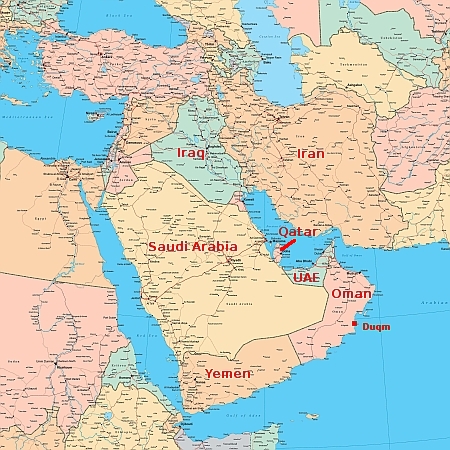
According to an announcement yesterday Oman plans to complete its first launch before the end of 2024 from its proposed new spaceport near the city of Duqm on the Indian coast.
The map to the right indicates its location. Oman has dubbed the spaceport Etlaq, and it is being run by what Oman claims is a private company, the National Aerospace Services Company (NASCOM), but based on what little I can find out, it appears either to be Oman’s space agency, or a variation of the pseudo-companies in China, privately run but very tightly controlled and owned by government officials.
The announcement provided no information about the rocket or launch, which I suspect will be nothing more than a relatively simple suborbital mission, designed to demonstrate they are serious about this spaceport. The news story at the link shows a picture of a very sophisticated rocket resembling India’s GSLV rocket. I think it is a AI image having nothing to do with reality.
This project was first announced in 2023, with more information released in January 2024. It hopes to attract American rocket companies by claiming it is being built to FAA standards.