SpaceX launches NASA space telescope plus four solar satellites; China launches 18 communication satellites

Two launches to report: First, China yesterday successfully completed its first Long March 8 launch from its new launchpad at its coastal Wenchang spaceport, placing 18 satellites for SpaceSail internet constellation, the fifth group so far launched.

China’s state run press noted that the launchpad is designed to allow the Long March 8 rocket to launch every seven days, a pace needed to place these giant Chinese satellite constellations into orbit.

Next, in the early morning hours today SpaceX successfully launched two different NASA science missions, its Falcon 9 rocket lifting off from Vandenberg in California.

The prime payload was SPHEREx, a space telescope designed to make an all-sky survey. The secondary payload was PUNCH, four satellites forming a constellation to study the Sun.

The rocket’s first stage completed its third flight, landing back at Vandenberg.

The leaders in the 2025 launch race:

27 SpaceX
11 China
3 Russia
2 Rocket Lab

As happened last year, SpaceX handily leads the rest of the world, including American companies, in total launches, 27 to 20. This lead will be extended tonight should the company’s next manned Dragon launch to ISS go off as planned.

1 comment

Athena located from lunar orbit

Athena on the Moon
Click for original master image.

Using Lunar Reconnaissance Orbiter (LRO), scientists have now located and photographed Intuitive Machines lunar lander Athena where it sits on its side on the Moon.

The picture to the right, reduced to post here, shows that location with the small arrow. This is definitely on Mons Mouton, the intended landing zone about 100 miles from the Moon’s south pole. However at the best magnification provided by the LRO science team, the rover is not visible. Reader James Fincannon was puzzled by this and downloaded the highest resolution version of this image and sent it to me. I have added it to the picture as the inset. Athena is the little white dot in the center of a small 65-foot-wide crater. Note that its shadow falls in the opposite direction of all the shadows in the craters, as the lander projects upward from the surface while the craters descend downward.

One can’t help questioning the quality of the lander’s landing software, if it ended up picking the center of this small crater to touch down, especially considering there appear to be large relatively clear flat areas all around.

9 comments

Relativity provides detailed video update on the development of its Terran-R rocket

The rocket startup Relativity yesterday uploaded a 42-minute long video on Youtube describing in great detail the status of its Terran-R rocket, providing a great deal of information about its design, construction, and goals, including the significant changes the company has made from its much smaller Terran-1 rocket.

I have embedded that video below.

Several take-aways: First, the video devotes a long segment explaining why the company has abandoned its long expressed goal of making a rocket entirely 3D printed. It found with Terran-1 that 3D printing the rocket’s body and fairing was not cost effective. It took too long and was too expensive. Using aluminum is faster and cheaper, especially as Relativity is no longer doing this in-house. Instead, it appears they are partnering long term with specific outside vendors for the rocket shells, tanks, and domes, as well as the fairings.

Second, the company is aiming to make the rocket’s first stage reusable from the start, making the first landing attempts on the first launch. They also recognize that success will take time and many attempts, similar to SpaceX’s experience a decade ago.

Third, they are pushing to go into major production of the rocket by 2026, so that when they launch the first time they will have more rockets ready to quickly follow up with more launches. This schedule is extremely fast, as they only started rocket development in the spring of 2023.

Finally and most important, the video provides no dates for that first launch. Previous releases from the company had suggested a 2026 first launch, and officials in the video implied that they might be ready by 2026, but no one said so directly. My guess is that 2026 is no longer realistic (not that it ever was), and they are beginning to prepare the public for a later launch date.

One other new development at Relativity not mentioned in the video. The company has named former Google CEO Eric Schmidt as its new CEO, with the company’s founder, Tim Ellis, stepping down as CEO to transition to the company’s board of directors. This change could be related to rumors last year that the company was having problems.
» Read more

1 comment

Astronomers have discovered four sub-Earth-sized exoplanets orbiting Barnard’s Star

Based on data from several ground-based telescopes, astronomers now believe that Barnard’s Star, the nearest single star to our Sun at a distance of about six light years away, has a solar system of at least four sub-Earth-sized planets.

After rigorously calibrating and analyzing data taken during 112 nights over a period of three years, the team found solid evidence for three exoplanets around Barnardโ€™s Star, two of which were previously classified as candidates. The team also combined data from MAROON-X with data from a 2024 study done with the ESPRESSO instrument at the European Southern Observatoryโ€™s Very Large Telescope in Chile to confirm the existence of a fourth planet, elevating it as well from candidate to bona fide exoplanet.

You can read the paper here. The scientists estimate the minimum masses of these exoplanets to range from 19% to 34% that of the Earth, with their maximum mass not exceeding 57% of the Earth. All are believed to be rocky planets orbiting just inside the star’s habitable zone.

Astronomers have been trying to detect exoplanets around Barnard’s Star for more a century. Several previous “discoveries” were later retracted. This result however appears somewhat firm though of course there are a lot of uncertainties in the result.

3 comments

Poland fires head of its space agency

Apparently due to his failures in min-February dealing with debris dropped on Poland from a de-orbiting Falcon 9 upper station, the government has fired the head of its space agency.

The President of the Polish Space Agency, Grzegorz Wrochna, has been dismissed following a botched response to the uncontrolled re-entry of a Falcon 9 second stage that scattered debris across multiple locations in Poland.

It appears Wrochna’s office had sent its reports on the debris to the wrong email address, so that the people higher up in the command chain were not informed properly about what was happening. This failure was then compounded in early March when the space agency’s computer systems were hacked, forcing it to shut down its access to the internet.

You might ask why Poland even has a space agency, and if you do you are asking the right question. The nation does not have “a space program,” which would require an agency. Instead it has a handful of new rocket startups, mostly focused on suborbital flights. All these need is the right legal framework to succeed, not a bureaucracy telling them what to do.

3 comments

Europe’s Hera probe to fly past Mars tomorrow

As part of its journey to the binary asteroid Didymos/Dimorphos, the European Space Agency’s (ESA) Hera probe will slingshot past Mars tomorrow, obtaining images and data of both the red planet and its moon Deimos.

Three instruments will gather data, a navigational camera, and infrared camera, and a spectral camera, with the goal mostly to calibrate the instruments and make sure they are working as designed. The data won’t be available until the next day, when the ESA will hold a webcast unveiling the images.

0 comments

NASA shuts down three unneeded departments, including its DEI office

NASA this week began complying with Trump’s executive orders by finally shutting down its DEI office as well as two other unneeded departments.

NASA’s Office of Technology, Policy and Strategy; the Office of the Chief Scientist; and the Diversity, Equity, Inclusion and Accessibility branch in the Office of Diversity and Equal Opportunity will be shuttered, in compliance with Trump’s executive order, “Implementing the President’s Department of Government Efficiency Workforce Optimization Initiative.”

A total of 23 employees were laid off. All three offices were established during the Biden administration, and provided no real value to the agency. The first two merely gave advice to top management, advice unneeded if the right people are put in charge. The third agency, DEI, was worse than unneeded, because it shifted the agency’s focus from good engineering and space exploration to favoring some races over others in hiring and promotions.

In fact, the DEI office had already been neutered prior to this week’s layoffs, based on the nature of NASA press releases in the past two months. Prior to Trump taking office, almost every single NASA press release touting the work of one or more of its employees would be entirely focused on the race or ethnicity of that employee, with almost every profile featuring a woman or minority. White men need not apply.

Since January 20, 2025, the range of employees featured in these profiles has changed radically. While minorities and women have been profiled, their race and gender is no longer mentioned. Instead, the releases tout their experience, skills, and talent. More important, the releases have now stopped blacklisting white men (who actually make up a majority of NASA’s workforce), highlighting many new and long term such individuals in just the past three weeks. The change has been quite refreshing.

Meanwhile, most of the propaganda press has been lying about these layoffs, attempting to paint them as a major disaster that will destroy NASA’s ability to accomplish anything in the future, with the worse example this headline from the science journal Nature: “NASA begins mass firings of scientists ahead of Trump teamโ€™s deadline”. That headline is a total lie. This was certainly not a “mass firing” and no space scientist was fired. Of those let go from the first two offices, all were managers, one of whom was also a “climate scientist”, not a space researcher.

More layoffs are expected of course under Trump’s campaign to shrink the federal government. If later layoffs follow the pattern of this first one, they will likely improve NASA’s workforce, eliminating the fat so that what remains can be more focused on what needs to be done.

5 comments

SpaceX officials provide cause of loss Falcon 9 first stage after successful landing

Damaged Falcon 9 booster laying on its side on drone ship as it returns to port
The damaged Falcon 9 booster laying on its side
on its drone ship as it returns to port.

At a press conference yesterday, SpaceX officials outlined the results of its investigation into the loss of Falcon 9 first stage when it fell over on its drone ship shortly after a successful landing.

Speaking at a news conference following a flight readiness review for the Crew-10 mission to the International Space Station, Bill Gerstenmaier, vice president of Build and Flight Reliability at SpaceX, said about 85 seconds into the launch of the Starlink 12-20 mission, there was a fuel leak in the first stage booster, tail number B1086, and kerosene sprayed onto a hot component of the engine. He said that caused it to vaporize and become flammable.

Because there wasnโ€™t enough oxygen to interact with the leaked fuel, it didnโ€™t catch fire during the ascent, he said. But about 45 seconds after B1086 landed on their droneship, โ€˜Just Read the Instructions,โ€™ there was enough oxygen available to get into the engine compartment and a fire broke out. โ€œIt subsequently blew out the barrel panel on the side of the rocket, just like it was designed to. The fire was all contained in the engine compartment,โ€ Gerstenmaier said. โ€œEven if we wouldโ€™ve had a problem during ascent, this shows that the fire and the damage would be contained in just a single engine out, which still allows us to accomplish the entire mission.โ€

The company is still working to determine the cause of the leak itself.

Though the article and video at the link make a big deal about the FAA grounding SpaceX’s Falcon 9 fleet, the agency’s actions here were quite trivial compared to its behavior when Biden was president. It grounded the fleet for only a few days, while SpaceX did its initial investigation, and then immediately accepted the above conclusions from SpaceX and lifted the grounding, even though the company has not yet determined the leak’s cause.

1 comment

Space Force awards development contracts to eight startups

The Space Force’s commercial office, dubbed SpaceWERX, announced March 8, 2025 that it has awarded development contracts to eight startups totaling $440 million.

Each STRATFI agreement is worth up to $60 million, with SpaceWERX and several defense agencies contributing up to $30 million per project. Private investors provide matching funds to scale innovations that have already demonstrated viability through prototype development.

The winners โ€” Albedo, Beast Code, CesiumAstro, Gravitics, LeoLabs, Rise8, Umbra and Xona โ€” were announced March 8 at an event at the Capital Factory in Austin, Texas.

Of these companies, Gravitics is probably the most interesting, as it is attempting to become a major American provider of space station modules. It already has a $125 million contract with Axiom to build a small module for that company’s station. This new contract from the Space Force suggests the Pentagon is considering launching its own space station, or possibly attaching a Gravitics module to one of the four private stations presently being built. Below is my present ranking of these four stations:

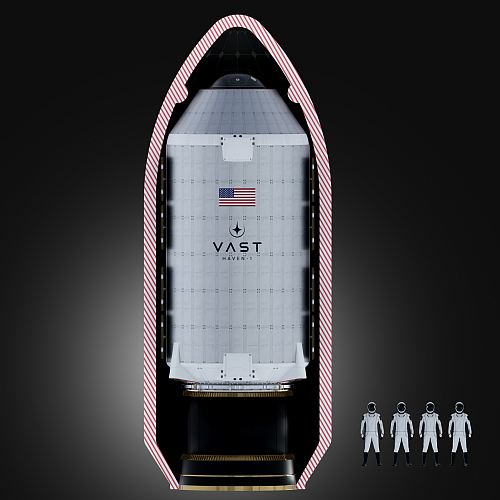
  • Haven-1, being built by Vast, with no NASA funds. The company is moving fast, with Haven-1 to launch and be occupied in 2026 for a 30 day mission. It hopes this actual hardware and manned mission will put it in the lead to win NASA’s phase 2 contract, from which it will build its much larger mult-module Haven-2 station..
  • Axiom, being built by Axiom, has launched three tourist flights to ISS. There are rumors it is experiencing cash flow issues, but it is also going to do a fourth ISS tourist flight this spring, carrying passengers from India, Hungary, and Poland.
  • Orbital Reef, being built by a consortium led by Blue Origin and Sierra Space. Though Blue Origin has apparently done little, Sierra Space has successfully tested its inflatable modules, including a full scale version, and appears ready to start building the station’s modules for launch.
  • Starlab, being built by a consortium led by Voyager Space, Airbus, and Northrop Grumman. It recently had its station design approved by NASA.
2 comments

Blue Ghost activates NASA drill, prepares for hot lunar noon

Map of lunar landing sites
Landing sites for both Firefly’s Blue Ghost and
Ispace’s Resilience

More than a week after landing in Mare Crisium, ground controllers have prepared Firefly’s Blue Ghost lunar lander for surviving the very hot lunar noon while also activating NASA’s LISTER drill, which proceeded to successfully drill down into the lunar surface below the lander.

Mounted below Blue Ghostโ€™s lower deck, NASAโ€™s Lunar Instrumentation for Subsurface Thermal Exploration with Rapidity (LISTER) payload is a pneumatic, gas-powered drill developed by Texas Tech University and Honeybee Robotics that measures the temperature and flow of heat from the Moonโ€™s interior.

I have embedded below the video of this drilling operation. At this moment it appears that nine of the lander’s payloads have completed their tasks successfully, with no indication yet that the tenth playload will have problems. All in all, Firefly has succeeded in establishing itself now as the leading private company capable of launching spacecraft to other worlds.
» Read more

1 comment
1 218 219 220 221 222 2,927