Watch the landing of Intuitive Machines’ Athena lander on the Moon tomorrow

Athena's landing site 100 miles from the Moon's south pole

NASA has now announced its live stream arrangement for the landing of Intuitive Machines’ Athena lander on the Moon tomorrow at 12:32 pm (Eastern).

The live stream will begin about sixty minutes before landing. The NASA live stream is available here. I have also embedded it below.

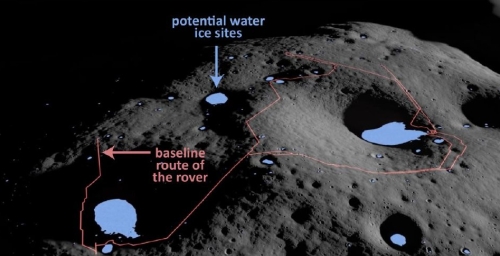
The map to the right shows the landing site by the yellow “X”, about 100 miles from the Moon’s south pole on a high relatively flat plateau dubbed Mons Mouton. This will be the closest any lander has come to the pole, and was the original site chosen for NASA’s now-canceled VIPER rover. If the landing is successful Athena will land close to a small crater that is believed to have permanently shadowed areas. The plan had been to have VIPER travel into it. Now the small Grace hopper that Athena carries will attempt this instead.

This will also be the second attempt by Intuitive Machines to soft land on the Moon. Its first attempt last year was able to land and communicate back to Earth, but the landing was not completely successful. The lander, named Nova-C as well as Odysseus, was moving too fast sideways when it touched down, thus breaking one leg so that the lander fell on its side.
» Read more

1 comment

France opens public comment period for adapting old French Guiana launchpad for commercial rockets

CNES, France’s space agency that now runs the French Guiana spaceport, is now running public meetings for the public to comment on its plans for adapting the old, long-abandoned Diamant rocket pad there for use by a number of commercial rocket startups.

On 17 February, the first of four public consultation sessions into the construction of the new Multi-Launcher Launch Complex (ELM1) at the Guiana Space Centre was held at Kourou Town Hall. This process allows local residents, stakeholders, and organizations to review the project and provide feedback before construction begins. A second session was completed on 23 February, with the remaining two sessions set for 10 and 18 March.

The construction of ELM1 will include common structures like the nodal building, guard post, offices, and storage areas, as well as more specific structures like assembly and preparation buildings, roads, and fences. The project is subject to a building permit, a unique environmental authorization under the regulations for Classified Installations for Environmental Protection, the Water Law, and a request for exemption from the prohibition on the destruction of protected species.

CNES in 2024 approved seven rocket startups to use the site. It later announced its plan to standardize the launchpad so that all users will have to arrive with identical engineering, something that these startups did not like. This comment period will allow them to voice those objections, and likely get the standardization minimized to only those places where it really matters. For example, the impression initially given was that the assembly and preparation buildings would require matching systems from all companies, something that makes no sense.

0 comments

Blue Ghost: Earth’s GPS constellations work on the Moon

Using an engineering test GPS-type receiver built by the Italian Space Agency, engineers have successfully been able to use the GPS-type satellites from two different constellations to pinpoint the location of Firefly’s Blue Ghost lander on the Moon.

The road to the historic milestone began on March 2 when the Firefly Aerospaceโ€™s Blue Ghost lunar lander touched down on the Moon and delivered LuGRE, one of 10 NASA payloads intended to advance lunar science. Soon after landing, LuGRE payload operators at NASAโ€™s Goddard Space Flight Center in Greenbelt, Maryland, began conducting their first science operation on the lunar surface.

With the receiver data flowing in, anticipation mounted. Could a Moon-based mission acquire and track signals from two GNSS constellations, GPS and Galileo, and use those signals for navigation on the lunar surface?

Then, at 2 a.m. EST on March 3, it was official: LuGRE acquired and tracked signals on the lunar surface for the first time ever and achieved a navigation fix โ€” approximately 225,000 miles away from Earth.

Obviously, this is a first-time engineering test. A portable version of LuGRE will now have to be developed. However, this success means that any operation on the near side of the Moon will not need the addition of a new GPS-type constellation in lunar orbit. It also will likely simplify the design of any constellation for providing this capability to the far side.

Meanwhile, Blue Ghost continues to operate as planned on the surface, with all instruments functioning and several already collecting data.

3 comments

March 4, 2025 Quick space links

Courtesy of BtB’s stringer Jay. This post is also an open thread. I welcome my readers to post any comments or additional links relating to any space issues, even if unrelated to the links below.

5 comments

The real underlying battle between Trump and Zelinsky

The kerfuffle last week between the United States and the Ukraine, instigated by the unprecedented ugly end to the press conference that concluded the visit of Ukrainian president Volodymyr Zelensky to the White House, is actually quite understandable if one is willing to consider the perspective of both sides. Unfortunately, I have seen little such analysis anywhere. Instead we get emotional attacks. On the left Trump is a vicious politician who wants to carve the Ukraine up for the benefit of Russia. On the right Zelensky is a corrupt barbarian who simply wants the war to continue forever so that he can steal as much U.S. foreign aid as possible for his own private benefit.

Neither of these conclusions are very helpful. Nor do they provide any insight to what is really going on.

So, what are the different perspectives that caused this confrontation?
» Read more

18 comments

Scientists: X-rays from the Helix Nebula caused by the destruction of a planet

A composite image of the Helix Nebula
A composite image of the Helix Nebula, combining data
from multiple ground- and space-based telescopes.
Click for original image.

Using data collected by multiple ground-bases and space telescopes over decades, scientists now think the previously unexplained high energy X-rays coming from the white dwarf star at the center of the Helix Nebula are caused by the destruction of a Jupiter-sized exoplanet.

The besieged planet could have initially been a considerable distance from the white dwarf but then migrated inwards by interacting with the gravity of other planets in the system. Once it approached close enough to the white dwarf, the gravity of the star would have partially or completely torn the planet apart. โ€œThe mysterious signal weโ€™ve been seeing could be caused by the debris from the shattered planet falling onto the white dwarfโ€™s surface, and being heated to glow in X-rays,โ€ said co-author Martin Guerrero of The Institute of Astrophysics of Andalusia in Spain. โ€œIf confirmed, this would be the first case of a planet seen to be destroyed by the central star in a planetary nebula.โ€

The study shows that the X-ray signal from the white dwarf has remained approximately constant in brightness between 1992, 1999, and 2002 (with observations by ROSAT, Chandra and XMM respectively). The data, however, suggests there may be a subtle, regular change in the X-ray signal every 2.9 hours, providing evidence for the remains of a planet exceptionally close to the white dwarf.

You can read the original paper here. The Helix Nebula is about 650 light years away, and is one of the most studied planetary nebula, believed to have formed when the central star collapsed into a white dwarf.

2 comments

SpaceX reschedules Starship/Superheavy launch to March 5, 2025

SpaceX has now rescheduled the eighth orbital test flight of its giant Starship/Superheavy rocket for tomorrow, March 5, 2025, with its one-hour launch window opening at 5:30 pm (Central).

The new launch time was caused by the launch scrub yesterday for unspecified issues with both the spacecraft.

I have once again embedded below the Space Affairs youtube live feed of this launch. The SpaceX X feed will only be available once it goes live at about 4:40 pm (Central).
» Read more

0 comments

Falcon 9 first stage lost after landing yesterday

According to an update on SpaceX’s website, the first stage of the Falcon 9 that launched 21 Starlink satellites (not 23 as initially reported) yesterday was lost shortly after landing.

The first stage booster returned to Earth and landed on the Just Read the Instructions droneship, which was stationed in the Atlantic Ocean ~250 nautical miles off the coast of Florida. Following the successful landing, an off-nominal fire in the aft end of the rocket damaged one of the booster’s landing legs which resulted in it tipping over.

This is only the second time in years that a first stage has been lost in this manner. After the previous occurrence last year during the Biden administration, the FAA grounded all SpaceX launches for several days, an action that indicated clearly an effort to harass the company for political reasons. I will be very surprised if this happens again, with Trump now in office.

1 comment

Ispace targets June 6, 2025 for the Moon landing its Resilience commercial lander

Map of lunar landing sites
Landing sites for both Firefly’s Blue Ghost and
Ispace’s Resilience

The Japanese startup Ispace announced today that its Resilience commercial lunar lander will attempt its touch down inside the Mare Frigoris region on the Moon on June 6, 2025, as shown on the map to the right.

Should conditions change, there are three alternative landing sites that are being considered with different landing dates and times for each. A decision about landing will be made in advance, but the window for landing is open from June 6 through June 8, 2025.

The company also reports that the spacecraft is healthy and operating exactly as expected.

Though Resilience was launched on the same Falcon 9 rocket that launched Firefly’s Blue Ghost lunar lander, it has taken a longer route to the Moon, which is why its landing will take place three months later.

0 comments

Starship/Superheavy test launch scrubbed

Though the countdown got down to T-40 seconds, the eighth orbital test launch of SpaceX’s Starship/Superheavy was scrubbed today due to a number of issues that popped up relating to both spacecraft.

At the moment we do not know exactly what those issues were, and will likely never get detailed explanations. Nor do we know when the next launch attempt will occur, though SpaceX has additional scheduled opportunities over the next week.

3 comments
1 222 223 224 225 226 2,927