Hugh Laurie – St. James Infirmary
An evening pause: Hat tip Judd Clark.
An evening pause: Hat tip Judd Clark.

What governments believe, even when there
is no evidence to justify it.
In reviewing the many different government actions taken during the COVID epidemic aimed at slowing the spread of the virus, scientists have found that none of these policies accomplished anything.
No matter how we approached these questions, the primary finding was lack of definitive patterns that could support claims about governmental policy impacts. About half the time, government policies were followed by better Covid-19 outcomes, and half of the time they were not. The findings were sometimes contradictory, with some policies appearing helpful when tested one way, and the same policy appearing harmful when tested another way. No claims about the relationship between government responses and pandemic outcomes held generally. Looking at stay-at-home policies and school closures, about half the time it looked like Covid-19 outcomes improved after their imposition, and half the time they got worse. Every policy, Covid-19 outcome, time period, and modeling approach yielded a similar level of uncertainty: about half the time it looked like things got better, and half the time like things got worse.
…Yet scientists used these data to make definitive conclusions.
Claims that government responses made Covid-19 worse are not broadly true, and the same goes for claims that government responses were useless or ineffective. Claims that government responses help reduce the burden of Covid-19 are also not true. What is true is that there is no strong evidence to support claims about the impacts of the policies, one way or the other.
After years of delays and technical problems the European Space Agency (ESA) today announced that it has finally scheduled the first Ariane-6 launch, now to take place on July 9, 2024 from French Guiana.
The press release at the link tries to paint a glowing future for Ariane-6, as illustrated by this quote from Stéphane Israël, CEO of Arianespace.
“With 30 missions in our order book, Ariane 6 has already gained the trust of institutional and commercial customers. We are preparing to make Ariane 6’s second launch by the end of the year, followed by a steady rise to around ten launches a year once we reach cruising speed. It represents a splendid challenge for Arianespace and our partners.”
The simple fact is that Ariane-6 costs too much to launch and is not competitive with the new generation of reuseable rockets. If Amazon’s management had not decided to give it a big launch contract (in order to avoid giving that money to SpaceX), it would have very few payloads to launch. Once those launches are completed expect Ariane-6 to go the way of the dodo and the buggy whip, replaced by a new fleet of competing private European rocket companies capable of doing things faster and cheaper.
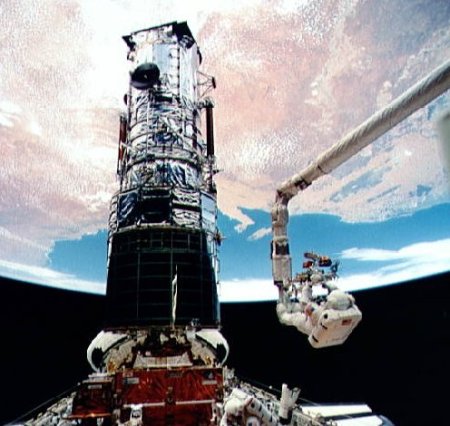
Story Musgrave on the shuttle robot arm during
the last spacewalk of the 1993 Hubble repair mission
After the third safe mode event in six months, all caused by issues with the same gyroscope, engineers have decided to shift the Hubble Space Telescope to what they call one-gyro mode, whereby the telescope is pointed using only one gyroscope, and the remaining working gyro is kept in reserve.
The spacecraft had six new gyros installed during the fifth and final space shuttle servicing mission in 2009. To date, three of those gyros remain operational, including the gyro currently experiencing problems, which the team will continue to monitor. Hubble uses three gyros to maximize efficiency but can continue to make science observations with only one gyro. NASA first developed this plan more than 20 years ago, as the best operational mode to prolong Hubble’s life and allow it to successfully provide consistent science with fewer than three working gyros. Hubble previously operated in two-gyro mode, which is negligibly different from one-gyro mode, from 2005-2009. One-gyro operations were demonstrated in 2008 for a short time with no impact to science observation quality.
While continuing to make science observations in one-gyro mode, there are some expected minor limitations. The observatory will need more time to slew and lock onto a science target and won’t have as much flexibility as to where it can observe at any given time. It also will not be able to track moving objects closer than Mars, though these are rare targets for Hubble.
This NASA press release is carefully spun to hide the simple fact that in one-gyro mode, the telescope will simply not be able to take sharp pictures. » Read more
After many delays and scrubs involving both the rocket and the capsule, ULA’s Atlas-5 rocket today successfully launched Boeing’s Starliner capsule on its first manned mission, carrying NASA astronauts Butch Wilmore and Suni Williams.
I have embedded the live stream below, cued to just before liftoff. The spacecraft will dock with ISS tomorrow, where Wilmore and Williams will spend a week checking out the capsule’s operations before undocking and returning to Earth.
As this was only the third launch this year for ULA, the leader board for the 2024 launch race doesn’t change:
59 SpaceX
26 China
8 Russia
7 Rocket Lab
American private enterprise now leads the world combined in successful launches, 69 to 40, while SpaceX by itself leads the entire world, including other American companies, 59 to 50.
This evening both SpaceX and Rocket Lab completed launches only about an hour apart but on opposite sides of the world.
First, SpaceX this evening successfully launched another 20 Starlink satellites, its Falcon 9 rocket lifting off from Cape Canaveral.
The first stage completed its 20th flight, landing safely on a drone ship in the Atlantic.
Next, Rocket Lab completed the second to two launches for NASA, placing the second Prefire climate satellite into orbit, following the first launch on May 25, 2024. Its Electron rocket lifted off from Rocket Lab’s launchpad in New Zealand.
The leaders in the 2024 launch race:
59 SpaceX
26 China
8 Russia
7 Rocket Lab
American private enterprise now leads the world combined in successful launches, 68 to 40, while SpaceX by itself leads the entire world, including other American companies, 59 to 49.
An evening pause: Normally I hate official music videos. They are almost always boring and predictable adolescent stories that have little to do with the song. I always prefer the live performance, because then you see the artist at work.
This video is an exception, in that it doesn’t do what you expect, and is quite silly in the process.
Hat tip Mitch Masterfix.
Courtesy of BtB’s stringer Jay. This post is also an open thread. I welcome my readers to post any comments or additional links relating to any space issues, even if unrelated to the links below.
It appears Congress wants the telescope, conceived to study potential habitable exoplanets, but it is also micromanaging the project by its legislative language.
This company appears to be on a slow downhill path.
FAA today issued [pdf] the launch license for SpaceX’s fourth test orbital launch of Starship/Superheavy, effective June 4, 2024, thus allowing the company to proceed with its planned June 6, 2024 launch date.
The two-hour launch window opens at 7 am (Central). SpaceX’s live stream will begin 30 minutes earlier. From SpaceX’s Starship website:
The fourth flight test turns our focus from achieving orbit to demonstrating the ability to return and reuse Starship and Super Heavy. The primary objectives will be executing a landing burn and soft splashdown in the Gulf of Mexico with the Super Heavy booster, and achieving a controlled entry of Starship.
To accomplish this, several software and hardware upgrades have been made to increase overall reliability and address lessons learned from Flight 3. The SpaceX team will also implement operational changes, including the jettison of the Super Heavy’s hot-stage following boostback to reduce booster mass for the final phase of flight.
Flight 4 will fly a similar trajectory as the previous flight test, with Starship targeted to splashdown in the Indian Ocean. This flight path does not require a deorbit burn for reentry, maximizing public safety while still providing the opportunity to meet our primary objective of a controlled Starship reentry.
This FAA approval is wonderful news, considering the red-tape delays the agency has previously caused to SpaceX’s efforts. It suggests that officials there are trying hard to speed up their paperwork. If so, the gap between this flight and fifth might be shorter than the three month gap seen between the third flight in March and this flight on June 6th.

This graph, from CDC research, shows that
the number of excess deaths began skyrocketing
in mid-2022, after the jab was rolled out
Two stories this week both add weight to the growing pile of evidence in the past two years that the COVID jab not only did little to prevent the spread of that flu-like virus, it caused more deaths than it prevented.
First, research from Oxford University in Great Britain that studied more one million children aged 5 to 11 found that only those who got the jab would develop myocarditis and pericarditis.
The study did note that this study recorded no deaths from these heart conditions, but one must wonder what the parents of those young children think about that. You used to have a healthy kid who after getting the jab now has a serious heart condition that certainly has the potential of shortening that child’s life.
While the study found the jab seemed to reduce COVID in adolescents, it made no different for younger children. “Vaccinated children … were not substantially different from unvaccinated children in terms of COVID-19 infection and hospitalization.”
In other words, the jab overall did more harm then good among young children. And the harm was significant.
Next, research in the Netherlands of the continuing rise of excess deaths worldwhile strongly suggests once again that it is the jab itself that might be causing it.
» Read more

Arbitrarily cancelled when it comes to
white people in California
They’re coming for you next: Isaac Newman, a history teacher in California, has filed a civil rights lawsuit against his union because it bans whites from running for some leadership positions.
According to Newman’s lawsuit, obtained by Fox, “The Elk Grove Education Association (‘EGEA’ or the ‘Union), which represents teachers and other certificated employees of the Elk Grove Unified School District (‘District’) in Sacramento, California, recently created a position called the ‘BIPOC At-Large Director’ on its executive board (‘BIPOC Position’). This position comes with all the rights and privileges of being an EGEA board member, but under EGEA’s bylaws, only persons who ‘self-identify’ as ‘African American (Black), Native American, Alaska Native, Native Hawai’ian, Pacific Islander, Latino (including Puerto Rican), Asian, Arab, and Middle Eastern,’ can run for the position.”
You can read the lawsuit here [pdf]. It calls this discriminatory policy a violation of both the Civil Rights Act of 1964, which forbids discrimination against “any individual because of his race, color, religion, sex, or national origin” and California’s own Fair Employment and Housing Act.
Newman should win (though this is not certain in this bigoted anti-white nation that we now live). At the same time, expect his life to be hell within the Elk Grove school district. Do not be surprised if he soon quits, because he is almost certainly going to be treated like a pariah by school officials. He dared challange the new bigotry, and that can’t be countenanced in the new Jim Crow America.
The European Space Agency (ESA) has released a request for information from European rocket startups to outline their capabilities and plans so that ESA can assess whether they qualify for future launch contracts.
Currently, ESA is working towards publishing a competitive tender in early 2025 for the award of contracts to allow European launch providers to demonstrate their ability to provide the capacity to serve institutional mission needs. To better define this competitive tender and align the challenge in the best possible way to incentivize providers, ESA has published a Request for Information call. “This Campaign will let economic operators express their views and expectations on the future of European access to space and actively participate in the definition of the European Launcher Challenge,” explains the call.
The call is limited to companies in Europe. The information the companies provide will then be used by ESA to shape the actual contract offers in 2025. The long term goal is for independent and competing European rocket companies to replace the Ariane-6, and provide a fleet of rockets of all types capable of launching European payloads faster and for much less money.
The French startup Aldoria has released a short movie taken by its ground telescopes showing a Russian “inspector” satellite maneuvering close to another geosynchronous satellite.
In a recent operation, Aldoria detected a sudden close approach by the Russian Luch Olymp K-2 (Luch-2) to a satellite positioned in geostationary orbit (GEO). This manoeuvre occurred on April 12, around 35,780 km in altitude, highlighting the increasing complexity of space activities. Luch Olymp 2, known for its unusual manoeuvres was predicted, by Aldoria, to closely approach the satellite prior to the observed manoeuvre. The original Luch-1, launched in 2014, was known for similar abnormal behaviour, creating a heightened sense of vigilance within the space community. Luch-2, like its predecessor, has a history of unusual manoeuvring near other satellites in geostationary orbit, which has also generated suspicions regarding its mission.
You can see the video here.
In the past year it appears the entire aerospace industry in Europe has come alive, no longer captured by the European Space Agency’s government-owned commercial arm, Arianespace. Instead, there are companies popping up everywhere, doing the kinds of entrepreneurial work American companies have been known to do since the founding of the country.
The competition for business and the amount of innovation in space should get very brisk in the next few years.
Over the weekend SpaceX announced on X that it has now delayed by one day its targeted date for the fourth orbital test flight of its Starship/Superheavy rocket, from June 5th to June 6th.
No reason was given for the delay, though the company notes on its webpage for the mission that it is still awaiting regulatory approval.
Musk underlined the company’s readiness to launch however with his own tweet on June 2, stating simply that “Starship is ready to fly.”
From the FAA however we still have silence.
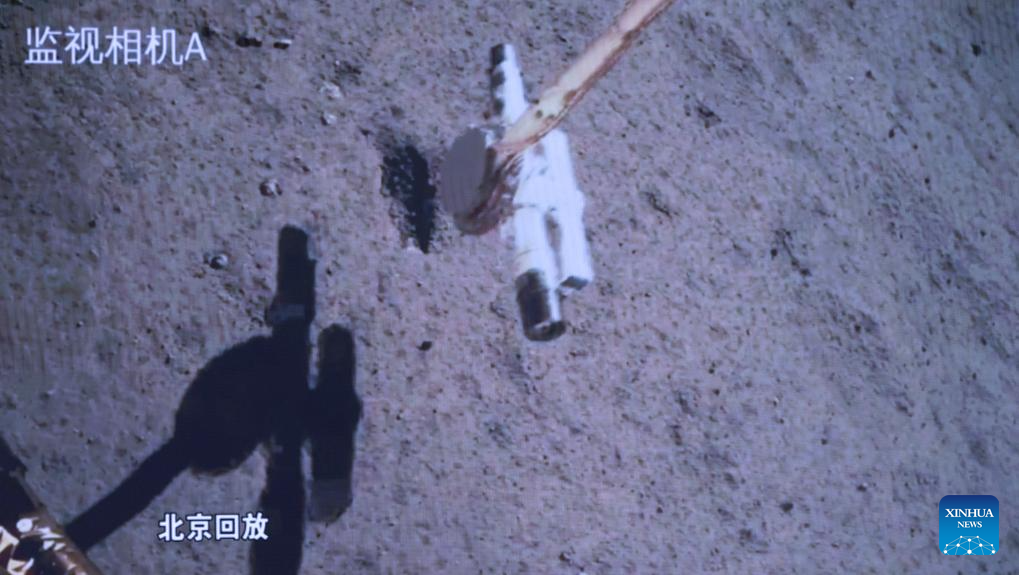
Chang’e-6’s robot arm grabbing ground samples.
Image is a screen capture from mission control
main screen. Click for original.
Early today the ascender of China’s Chang’e-6 lunar probe lifted off the surface on the Moon’s far side, carrying the samples it had obtained both by drilling and the use of a robot arm.
The ascender took off at 7:38 a.m. (Beijing Time) from the moon’s far side. A 3,000-newton engine, after working for about six minutes, pushed the ascender to the preset lunar orbit, according to the CNSA.
The Chang’e-6 probe, comprising an orbiter, a lander, an ascender and a returner — like its predecessor Chang’e-5 — was launched on May 3. The lander-ascender combination, separated from the orbiter-returner combination on May 30, touched down at the designated landing area in the South Pole-Aitken (SPA) Basin on June 2.
The spacecraft finished its intelligent and rapid sampling work, and the samples were stowed in a container inside the ascender of the probe as planned, the CNSA said.
At some point, not yet specified, the ascender will dock with the orbiter-returner and transfer the samples to the returner, which after a period in orbit awaiting the right moment will then separate and head back to Earth.
An evening pause: Performed live October 31, 2022.
Hat tip Judd Clark. I once again must ask for suggestions from my other readers. Judd Clark and Alton Blevins continue to send great stuff, but I really like to have as many people contributing as possible. If you have suggested before you know the rules. If not, state you have something you want to suggest in the comments below, but DON’T post a link to it.. I will email you to get it.
Courtesy of BtB’s stringer Jay. This post is also an open thread. I welcome my readers to post any comments or additional links relating to any space issues, even if unrelated to the links below.
Momentus will fly small experiments that will be flown the company’s Vigoride orbital tugs.
The drop was from about 3-5 feet off the ground.
The company is called Fancy Space, and it apparently has nothing at this point but a cool video.
White died in the Apollo-1 launchpad fire in 1967.
The goal was to achieve the first completely successful docking in space, but the shroud on the target spacecraft only partly released, preventing the docking. Instead, Stafford and Cernan flew in formation, taking great pictures of that spacecraft, looking like “an angry alligator.”
As I have done at the start of every month since I begun this webpage back in 2010, I am posting NOAA’smonthly update of its graph tracking the number of sunspots on the Sun’s Earth-facing hemisphere, adding to it several additional details to provide some larger context.
While April had showed only a small uptick in sunspot activity, in May the sunspot activity on the Sun went boom, setting a new high for sunspots during this solar maximum as well as the highest sunspot count since September 2002. The sunspot count of 171.7 smashed the previous high of 160 this cycle, set in June 2023. This new high underlined was by the large solar flare on May 9th that sent the most powerful geomagnetic storm to hit the Earth’s magnetic field in many decades, producing spectacular auroras in many low latitudes.
» Read more
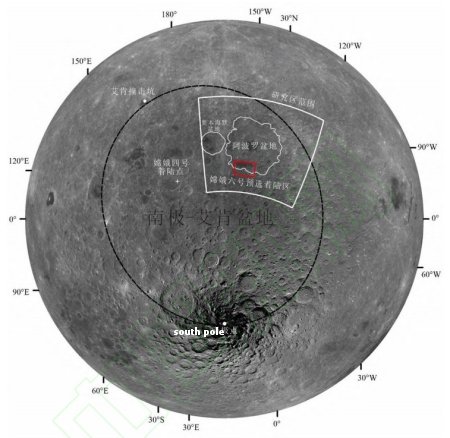
Chang’e-6’s landing zone is indicated by the
red box, on the edge of Apollo Creater
(indicated by the wavy circle).
China’s state-run press yesterday released a short movie created from images taken by its Chang’e-6 lander during its descent to the lunar surface on the far side of the Moon this past weekend.
I have embedded that footage below. The final five frames however are very puzzling, in that they do not appear to show a smooth descent to a specific spot, but appear to jump about wildly. Moreover, the footage does not appear to show the actual landing itself, but appears to stop while the spacecraft is still above the ground.
It is possible that this footage is simply showing the spacecraft’s software searching for a good landing spot, combined with a decision in China not to release footage of the actual touchdown. It could also be that something has gone wrong, and they are stalling about saying so. This last possibility I think very unlikely, but it must be considered, based on the information available.
» Read more
NASA yesterday evening confirmed that the agency, ULA, and Boeing are now targeting June 5, 2024 at 10:52 am (Eastern) for the launch of the first manned launch of Boeing’s Starliner capsule carrying two astronauts to ISS for a two week checkout mission.
Technicians and engineers with ULA (United Launch Alliance) worked overnight and on Sunday to assess the ground support equipment at the launch pad that encountered issues during the countdown and scrubbed the June 1 launch attempt. The ULA team identified an issue with a single ground power supply within one of the three redundant chassis that provides power to a subset of computer cards controlling various system functions, including the card responsible for the stable replenishment topping valves for the Centaur upper stage. All three of these chassis are required to enter the terminal phase of the launch countdown to ensure crew safety.
On Sunday, the chassis containing the faulty ground power unit was removed, visually inspected, and replaced with a spare chassis. No signs of physical damage were observed. A full failure analysis of the power unit will be performed to better understand root cause. Meanwhile, ULA has completed functional checkouts of the new chassis and the cards, and all hardware is performing normally.
These kinds of technical issues happen too often on ULA launches. Company engineers always fix them, but it never appears they fix them permanently. Too often on launches they pop up again, causing more scrubs.
The goal should be to fix them so they never pop up again, and your launches can begin to launch reliably, on time. And we know it can be done, because SpaceX has done it.