
SpaceX seeking $250 million more in investment capital

Capitalism in space: According to anonymous sources, SpaceX is once again seeking more investment capital, this time totaling $250 million.

Last year the company raised $1.33 billion. While not as much as the personal cash that Jeff Bezos has raised for Blue Origin by selling his personal Amazon stock, it has been enough for SpaceX to accomplish far more. Not only is the company about to launch its first manned mission, it has quickly begun assembling its Starlink internet constellation in orbit, while pushing forward on Starship construction.

5 comments

First SLS launch pushed back again to April 2021

NASA on February 20, 2020 finally admitted that the first SLS launch cannot happen in 2020, and set a new target date no earlier than April 18, 2021.

The previous target launch date in November 2020 was always a pure fantasy. NASA just held off admitting it in order to defuse any political consequences for having a program, building SLS, that will end up taking them almost two decades to complete.

This new launch date is likely the most realistic so far, since the hardware for SLS is actually finally coming together. Nonetheless, if anything at all should go wrong along the way, especially with the full static test firing of the core booster of the first stage scheduled for no earlier than August, then expect more delays, possibly lasting years.

14 comments

Engineers to use InSight’s scoop to help digging process

Insight’s engineers, having failed to get its mole pile driver to dig down as planned, now plan to use the lander’s scoop to push on the mole in the hope this will prevent it from popping up with each hammer drive.

[T]he mole is a 16-inch-long (40-centimeter-long) spike equipped with an internal hammering mechanism. While burrowing into the soil, it is designed to drag with it a ribbonlike tether that extends from the spacecraft. Temperature sensors are embedded along the tether to measure heat coming deep from within the planet’s interior.

…The team has avoided pushing on the back cap [at the top of the mole] until now to avoid any potential damage to the tether.

It appears to me that they are running out of options. This new attempt carries risks. It could damage the tether required to obtain underground temperature readings, the prime purpose of the experiment. However, if they don’t get the tether into the ground, this will also prevent the experiment from functioning. Thus, this attempt could essentially be a Hail Mary pass, gambling all on one last all-or-nothing gambit.

14 comments

Airbus to cut 2,362 jobs, citing weak space market

Capitalism in space: Airbus announced this week that it plans to cut 2,362 jobs, citing as the reason โ€œlower performance in spaceโ€ as well as postponed defense contracts.

This quote from the article is revealing:

Airbus Defence and Space is the third satellite manufacturer to announce layoffs in the past 12 months. Thales Alenia Space said in September it was cutting around 6% of its workforce, following Maxarโ€™s February 2019 announcement that it would dismiss roughly 3% of its employees.

The article however also indicates that 2019 saw a big recovery in geosynchronous satellite orders.

Though not stated, I suspect that part of Airbus’s problem is related to Ariane 6, which it is building in a joint partnership with Safran dubbed ArianeGroup. While designed to be less expensive to build, the rocket is not reusable, and its launch price is simply not competitive. Thus, getting contract orders has been very difficult.

Note also that ArianeGroup announced in November 2018 that it going to cut 2,300 jobs by 2022. I wonder if some of these cuts overlap the newly announced cuts.

Either way, these trims might be a good thing as Airbus and ArianeGroup work to cut their costs. Or they could be a bad thing, indicating that both are having trouble making sales. Only time will tell.

5 comments

Ice-filled canyon on Mars?

The ice-filled head of Mamers Valles
Click for full image.

The image to the right, rotated, cropped and reduced to post here, was taken on December 19, 2019 by the high resolution camera on Mars Reconnaissance Orbiter (MRO). Labeled “Head of Mamers Valles”, it shows the very end of one side canyon to this very extensive canyon system made up of the fractured fissures and mesas of chaos terrain.

Mamers Valles itself sits in the transition zone between the northern lowland plains and the southern cratered highlands. This specific canyon is close to those lowlands, at a latitude of 40 degrees north, where scientists believe there are many buried inactive glaciers of ice.

The image reinforces this belief. The entire canyon appears practically filled with what looks like ice. In fact, it almost looks like we are looking down at a frozen lake with a layer of snow on top of it. In this case, the layer is not snow, but dust and dirt and debris that covers the ice to protect it and prevent it from sublimating away.

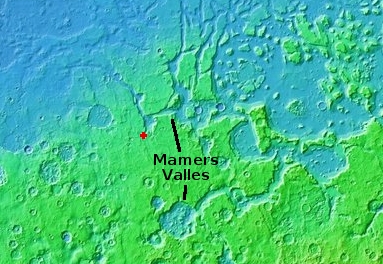
The overview map below shows the location of this canyon, by the red cross, within Mamers Valles.
Mamers Valles

Mamers Valles is actually a very large collection of miscellaneous canyons, flowing into the lowlands. In some areas it looks like very old chaos terrain, with the canyons so eroded that all we see are scattered mesas. In other places the canyons more resemble meandering river canyons sometimes interspersed with crater impacts.

Scientists have analyzed the canyons in Mamers Valles, and from this concluded that they were likely formed from “subsurface hydrologic activity”. which in plain English means that flowing water below ground washed out large underground passages, which eventually grew large enough for their ceilings to collapse and form the canyons we see today.

Yesterday I posted an image of a string of pits that could very well be evidence of this same process in its early stages of canyon formation. In Mamers Valles the process is far more advanced, and the canyons have existed for a long time, long enough for the planet’s inclination to go through several cycles of change, from a low of 25 degrees tilt (what it is now) to has high as 60 degrees. At that high inclination the mid-latitudes were colder than the poles, so that ice would sublimate from the poles to fall as snow in the mid-latitudes, forming active glaciers within canyons such as this.

Now that the planet’s inclination is similar to Earth’s, 25 degrees, the poles are slightly colder than the mid-latitudes, and the glaciers in this canyon are either inactive (if buried) or slowly sublimating away so that the water can return to the poles.

Here however the surface debris appears to be protecting the glaciers, leaving the canyon filled mostly with ice. For future settlers this ice would likely be relatively accessible, and at a latitude where the environment is also relatively mild, for Mars.


5 comments

Yutu-2 finds rocks that appear young

Yutu-2 has found a cluster of small rocks that appear relatively young, with little erosion.

The rocks also also appear as if they came from another place on the Moon.

Closer inspection of the rocks by the rover team revealed little erosion, which on the moon is caused by micrometeorites and the huge changes in temperature across long lunar days and nights. That anomaly suggests that the fragments are relatively young. Over time, rocks tend to erode into soils.

The relative brightness of the rocks also indicated they may have originated in an area very different to the one Yutu-2 is exploring.

Youth in this case is very relative. The rocks might be young when compared to the surface on which they sit, but they still could be more than a billion years olf.

0 comments

Pits indicating a Martian underground river?

A string of pits suggesting a past underground river system on Mars
Click for full image.

Cool image time! As my regular readers well know, I am a caver, and am thus always interested when the high resolution camera on Mars Reconnaissance Orbiter (MRO) takes a close-up of a pit that might also be an entrance to a cave.

The photo to the right, cropped and reduced to post here, was part of the most recent image release from MRO, but was boringly labeled “Arabia Terra” after the region where it is located, one of the largest transition zones on Mars between the northern lowland plains and the southern cratered highlands. When I took a close look, what I found was an intriguing string of pits whose arrangement is strikingly reminiscent of a river tributary system.

The white box indicates one section that I have zoomed into, as shown below.
» Read more

10 comments

NOAA’s aging fleet of sun-observation satellites

In testimony during a Senate hearing on February 12, the head of NOAA’s space weather division admitted that the agency’s ability to monitor the Sun is threatened by its aging fleet of solar satellites, combined with the agency’s slow progress on a large single replacement satellite, presently scheduled for launch in 2024.

NOAA currently uses the Deep Space Climate Observatory (DSCOVR) and NASAโ€™s Advanced Composition Explorer (ACE) spacecraft to collect solar wind data, and uses the ESA/NASA Solar and Heliospheric Observatory (SOHO) spacecraft to observe the solar corona, using those data to forecast solar storms that can affect satellites and terrestrial infrastructure such as power grids.

However, SOHO, launched in December 1995, is well past its design life. In addition, DSCOVR has been offline since June 2019 because of technical problems, forcing NOAA to depend solely on ACE, which launched in 1997. [emphasis mine]

NOAA has been trying, and failing, to build a replacement for ACE for more than a decade. Worse, the agency’s inability to deal with these issues was further revealed by this quote:

Congress has pushed to speed up work on that [replacement] mission, despite NOAAโ€™s assurances about the availability of data from other spacecraft. NOAA sought about $25 million for the mission in its fiscal year 2020 budget request, but Congress appropriated $64 million. NOAA has yet to release its fiscal year 2021 budget request, more than a week after the White House published the overall federal government budget proposal.

Something has been wrong in the management at NOAA now for at least a decade. They can’t seem to get new satellites built, and when they try they can’t seem to do it on schedule and for a reasonable cost. Their weather satellite program has been rife with problems, including cost overruns, schedule delays, and failing satellites.

But why should we be surprised? This kind of mismanagement at the federal government has been par for the course for the past half century.

7 comments

Harvard professor arrested for his work with China

Charles Lieber, the chairman of Harvard’s department of chemistry and chemical biology, has been arrested by the federal government for lying about the work he has been doing for China.

An affidavit accompanying the criminal complaint in Boston further accuses Lieber of making false statements to the National Institutes of Healthโ€”a major funder of his research into nanoscale biological interfaces, such as transistors that can interact with intracellular biological machineryโ€”as well as to Harvard itself, about his connections to [China’s] Thousand Talents program and the Wuhan University of Technology.

The arrest occurred very shortly after a Chinese medical student from Harvard was arrested for trying to smuggle cancer research material from a Harvard-affiliated medical center.

More information here. It appears that Lieber did not tell the truth about how much China was paying him for this work, which by the way was a lot of money, $50K per month plus $150K stipend for living in Wuhan while he helped build them a medical lab.

Hat tip Phill Oltmann.

1 comment

Maiden flight of China’s Long March 5B rocket targeted for April

The new colonial movement: China is now targeting mid-April for the maiden launch of its Long March 5B rocket, which will place in orbit China’s new manned capsule on its first unmanned demo flight.

The article at the link, from China’s normally reticent state-run press, actually provides a great deal of information. First, it outlines the launch schedule for their space station, using the Long March 5B rocket:

China aims to complete construction of the space station around 2022. According to the CMSA, more than 10 missions are planned in the next three years to complete the construction and master technologies for in-orbit assembly and construction of large complex spacecraft, long-term manned spaceflight in near-Earth space and large-scale space science experiments.

…The space station will be a T shape with the Tianhe core module at the center and a lab capsule on each side. The core module — at 16.6 meters long and 4.2 meters in diameter, with a takeoff weight of 22.5 tonnes — will be the management and control center.

Second, the article confirms that the Long March 5B rocket will be used to launch all of China’s manned missions. This means they are dependent on their biggest and possibly most expensive rocket to make things happen, suggesting that either they will have to go slow or they have made a very big commitment to space. The quote above suggests the latter.

Third, the article reveals that their new manned capsule, which will weigh almost as much as a single station module on either their station or ISS, will be capable of carrying six astronauts, and that the descent module is designed to be reusable.

Finally, they confirm once again that they will also be launching “a large optical telescope” that will fly in formation with their space station. An earlier news article indicated that this telescope would have a mirror 12 meters in diameter, which would be five times bigger than the mirror on the Hubble Space Telescope. That same article however also noted major design issues.

Overall, it appears China is about to step out as a major space power, with capabilities that in many ways will exceed anything from either the U.S. or Russia.

2 comments

Astronomers photograph baby stars in Orion

Some of the baby stars surveyed
Click for full image.

Astronomers using two radio telescopes have created multi-wavelength radio images of 300 protoplanetary disks, or proplyds, found in the star forming region in the constellation Orion. The image to the right shows only a small sampling of the proplyds imaged.

โ€œThis survey revealed the average mass and size of these very young protoplanetary disks,โ€ said John Tobin of the National Radio Astronomy Observatory (NRAO) in Charlottesville, Virginia, and leader of the survey team. โ€œWe can now compare them to older disks that have been studied intensively with [the radio telescope] ALMA as well.โ€

What Tobin and his team found, is that very young disks can be similar in size, but are on average much more massive than older disks. โ€œWhen a star grows, it eats away more and more material from the disk. This means that younger disks have a lot more raw material from which planets could form. Possibly bigger planets already start to form around very young stars.โ€

Of the disks photographed, four appear to be extremely young, probably less than ten thousand years, because of their very blobby and irregular shape.

0 comments

SpaceX begins assembling its next Starship test prototype

Capitalism in space: SpaceX has begun the assembly in Boca Chica of its next Starship test prototype, with a targeted launch date in April.

That first test flight is expected to be a 12-mile-high hop, using three Raptor engines.

Do not be surprised if that launch is delays by a few months. At the same time, do not be surprised if it occurs before the summer.

0 comments

Russia and China launch satellites

Today both China and Russia successfully placed satellites into orbit. China’s Long March 2D rocket placed four “technology test” satellites into orbit, while Russia used its Soyuz-2 rocket to launch a military communications satellite.

The leaders in the 2020 launch race:

4 China
3 SpaceX
2 Arianespace (Europe)
2 Russia

The U.S. continues to lead China 6 to 4 in the national rankings.

1 comment

Martian wind-swept buried depressions

Wind-swept Martian depressions
Click for full image.

Cool image time! The photo to the right, rotated, cropped and reduced to post here, was taken on January 3, 2020 by the high resolution camera on Mars Reconnaissance Orbiter (MRO). It shows three strange teardrop-shaped depressions, clearly wind-swept and partly buried by dust and sand.

The location on Mars of these depressions is in the transition zone between the southern cratered highlands and the northern lowlands. This is also a region dubbed the Medusae Fossae Formation, a region where it appears a great deal of volcanic material was laid down during one or more eruptive events 3 to 3.8 billion years ago.

Whether these depressions were formed during those events is impossible to tell from the available data, especially because the underlying bedrock is buried in dust.

Their shape appears to have been caused as the wind slowly exposed three buried peaks of hard rock. The wind, blowing from the southwest to the northeast, would hit the peaks, producing an downward eddy that would churn out dust from the windward side. The wind and dust would then blow around the peaks, creating the teardrop tail on the leeward side to the northeast.

0 comments
1 696 697 698 699 700 1,766