China proposes building two new satellite constellations, each with about 100,000 satellites

China has filed papers with the International Telecommunication Union (ITU) — the international licensing agency comparable to the U.S.’s FCC — to build two new satellite constellations, each with about 100,000 satellites that would be linked as one gigantic constellation.

The filings, submitted to the ITU in late December 2025, are designated CTC-1 (CHN2025-79441) and CTC-2 (CHN2025-79398), each covering 96,714 satellites in 3,660 orbital planes, according to documents posted in the Union’s “as-received” database.

CTC-1 includes both advance publication information (API) and a more detailed coordination request, reflecting progression through different stages of the ITU regulatory process for a single notional Non-Geostationary Orbit (NGSO) system, while CTC-2 currently remains at the API-only stage. Both reference a “new operating agency” as a placeholder for their operating agencies.

Together, the pair represent one of the largest constellation filings ever made, highlighting the growing competition over orbital and spectrum resources.

Both filings appear to be very preliminary, and in fact appear to be an attempt by China to grab control of as much orbital territory and satellite spectrum as possible, to block others from access. Neither has been approved, and won’t be without a detailed review by the ITU.

11 comments

Space station Starlab gets major new investor

Starlab design in 2025
The Starlab design in 2025. Click
for original image.

The consortium led by Voyager Technologies that is building the Starlab space station announced last week that it has obtained a major new investor with more than a billion dollars in assets.

The investor, Seven Grand Managers, is based in New York. The announcement did not specify how much the firm had committed to the Starlab project, but it was clear from this statement that involved significant funds.

Starlab is being built to be commercially viable from Day One,” said Chris Fahy, founder and chief investment officer, Seven Grand. “Our investment recognizes that commercial infrastructure in the post-ISS era is not speculative, but tangible, bankable and poised for growth. Starlab’s world-class management team and strategic partners are unlocking the beginning of this enormous opportunity.” [emphasis ine]

The highlighted quote suggest Seven Grand was impressed with the Starlab concept, a single very large ready-to-go station launched on Starship. Most of the other stations will involve assembly of multiple modules on multiple launches before they are “ready-to-go.” The only other station launching as a single module, Max Space’s Thunderbird, has only recently entered the race, and is thus far behind.

Starlab had previously raised $383 million in a public stock offering, in addition to the $217.5 million provided by NASA. This new private investment capital further strengthens its future, and suggests the station could get built and launched, even if it fails to win a major station construction contract from NASA.

Below are my rankings of the five American space station projects:
» Read more

1 comment

India’s PSLV rocket experiences the second launch failure in a row

India’s space agency ISRO tonight attempted its first launch in 2026 and the first launch of its PSLV rocket since the rocket’s third stage failed during a May 2025 launch.

Unfortunately the rocket’s third stage failed again, near the end of its engine burn. The animation on the mission control displays, based on actual telemetry, showed the stage suddenly tumbling, its engines no longer firing. It appears something catastrophic occurred the end of that burn.

The rocket’s primary payload (a satellite for India’s military) as well as 18 smallsats for a variety of other customers were all lost.

While ISRO last year was able to complete five successful launches of its larger GSLV and LVM rockets, the PSLV was grounded due to that May 2025 failure. Today’s launch was intended to show the third stage problem had been fixed. Instead, it showed that the modifications hadn’t fixed the problem. In fact. it occurred at almost the same time as in the May launch. The link above is cued to just before the stage began tumbling. In May the failure took place 374 seconds into the flight. Today it occurred at 377 seconds into the flight.

0 comments

Former astronaut once again blasts NASA decision to fly Artemis-2 manned

Charles Camarda on the shuttle
Charles Camarda on the first shuttle flight
after the Columbia failure.

The opposition to NASA’s decision to fly humans in the Orion capsule around the Moon with a questionable heat shield continues. Charles Camarda, an engineer and former NASA astronaut who has repeatedly expressed concerns about that heat shield and had been invited to attend the review meeting that NASA administrator Isaacman had arranged to ease his concerns, has now revealed his concerns were not eased in the slightest by that meeting, and that the Ars Technica article by Eric Berger that suggested otherwise was wrong, and that he is still “outraged” at NASA’s bad engineering decisions.

The rage you witnessed was my observing the exact behaviors used to construct risk and flight rationale which caused both Challenger and Columbia Accidents. Using “tools” inappropriately and then claiming results to be “Conservative.” Not to mention the reliance on Monte Carlo simulations to predict failure probabilities which were also proven to be inaccurate by orders of magnitude in my book “Mission Out of Control” which you claim to have read.

I suggest, in the spirit of transparency, you should ask NASA to release just the “Findings” of NESC Report TI-23-01849 Volume I. Finding 1 states the analysis cannot accurately predict crack initiation and propagation at flight conditions. And there was so much more which was conveniently not presented.

In other words, he finds NASA’s engineering claims that Orion’s heat shield will work using a different less stressful return trajectory as it dives back into the atmosphere about 25,000 mph to be false and untrustworthy. Worse, he sees it as proof that this is a continuation of the same culture at NASA that resulted in the Columbia failure.

Some of the exact same people responsible for failing to understand the shortcomings of the Crater Analysis tool (used tiny pieces of foam impacts to Shuttle tiles to predict a strike from a piece of foam which was 6000 larger and which caused the Columbia Accident) were on the Artemis Tiger Team now claiming they could predict the outcome of the Orion heatshield using a tool (similar to CRATER) called the Crack Identification Tool (CIT) which was also not physics based and relied on predictions of the key paramenter, permeability, which they claim to be the “root” cause, pressure, to vary by three orders of magnitude (that’s over 1000x).

In defense of NASA, those engineers had also presented data that showed Orion’s hull was strong enough to survive re-entry, even if the heat shield failed entirely. It is unclear if Camarda’s objections here apply to that data as well.

Regardless, his strong public disagreement with NASA on this once again raises serious questions about the upcoming manned Artemis-2 mission, set to launch sometime in the February to March time frame.

24 comments

SpaceX launches NASA’s Pandora exoplanet space telescope

SpaceX today successfully launched a new NASA space telescope, Pandora, its Falcon 9 rocket lifting off from Vandenberg in California.

Pandora is a smallsat focused on studying 20 stars known to have transiting exoplanets. It will look at each repeatedly to draw as much information about the star and the exoplanet as possible. Also deployed were two other NASA smaller astronomy cubesats.

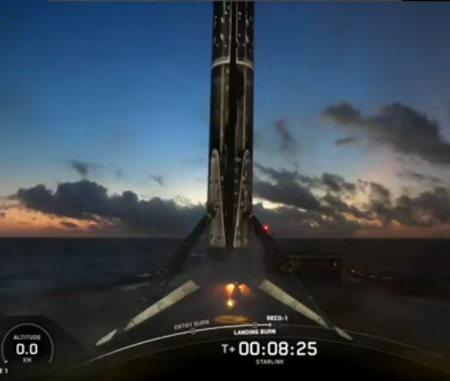
The Falcon 9 first stage completed its 5th flight, landing back at Vandenberg. The two fairing halves completed their first and seventh flights respectively.

At this moment, SpaceX is the only entity to have launched in 2026. This was its fourth launch.

5 comments

Space Force awards nine launch contracts to SpaceX

In announcing its next round of satellite launch awards, the Space Force’s Space Systems Command (SSC) has awarded all nine launches (valued at $739 millon total) to SpaceX, bypassing both Blue Origin and ULA.

SSC awarded the [three] SDA-2 missions to SpaceX for launches projected to begin in [the fourth quarter of fiscal year ’26], and awarded the [two] SDA-3 missions to SpaceX for launches to begin in [the third quarter of fiscal year ’27]. SSC also awarded the [four] NTO-5 launches to SpaceX projected to occur in [the first quarter of fiscal year ’27 and the second quarter of fiscal year ’28]. The total value of these awards is $739M.

It is surprising that SpaceX got all nine contracts. Even though SpaceX charges less than ULA, and Blue Origin’s New Glenn rocket is not yet certified by the Pentagon for operational launches, it has been military policy in recent years to distribute this work to more than one launch provider so as to guarantee a redundancy. ULA exists today for expressly that reason. In the past it would have certainly gotten at least one of these launches.

As for Blue Origin, the Space Force could have awarded it at least one of the later launches in ’27 and ’28, contingent on getting New Glenn certified.

That the Space Force bypassed both companies entirely speaks volumes. It appears it has decided to simply go with the best product now available, and to heck with redundancy.

20 comments

French rocket startup MaiaSpace announces its launch schedule

The French rocket startup MaiaSpace is now planning to launch a suborbital test rocket in 2026 to be followed by its first orbital flight in 2027.

As the company works toward the commencement of commercial operations in 2027, it is planning to launch an initial suborbital demonstration flight in late 2026 to validate key elements of the Maia launch system. The rocket will be launched in its full two-stage configuration and will carry a reduced propellant load, with MaiaSpace aiming for a minimum altitude of 100 kilometres. … “For what concerns our first flight, we will deploy a minimum viable product designed to test critical phases (lift-off, stages separation, engine ignition of the second stage, …) and to validate the key features required for our first orbital flight.”

Maiaspace is a wholly owned subsidiary of ArianeGroup, the Airbus-Safran partnership that builds the Ariane-6 rocket for Arianespace. Its goal with Maiaspace is to quickly develop a small reusable rocket that can compete with the other new European startups in Germany (Isar and Rocket Factory Augsburg) and Spain (PLD).

1 comment

FCC approves SpaceX request to expand Starlink by 7,500 satellites

The Federal Communications Commission (FCC) yesterday approved SpaceX’s request to both expand its Starlink constellation by 7,500 satellites as well as use additional bands of spectrum.

The Federal Communications Commission on Friday approved SpaceX’s request to launch an additional 7,500 of its Starlink Gen2 satellites, bringing the total allowed Gen2 constellation to 15,000. The agency also granted the company’s request to operate in additional spectrum bands and to operate at higher power in other bands between 10.7-30 GigaHertz (GHz), pending the completion of an existing FCC rulemaking where the question is being considered.

…The order also allows SpaceX satellites to use lower orbits, down to 340 kilometers, and provide direct-to-cell service. The company is seeking approval for a separate 15,000-satellite constellation that would provide upgraded direct-to-cell service using spectrum it’s purchasing from EchoStar.

The article notes that under the Trump administration has also revamped the FCC’s grant program, that under Biden canceled an $886 million grant, claiming absurdly that Starlink did not provide service to rural areas. Under the new program “SpaceX is set to serve the most locations of any ISP under the $42.45 billion Broadband Equity, Access, and Deployment program after new Trump administration rules that made it easier for satellite providers to compete for funding.”

Not that SpaceX or any of the other constellations need this government grant. Trump would serve the country better to shut the program down.

9 comments

An outline of NASA’s present schedule leading up to the Artemis-2 manned lunar fly-by mission

Link here. The mission will slingshot four astronauts around the Moon and back to Earth. The update includes lots of details about the rollout, the dress rehearsal countdown, the follow-up, and finally the various launch windows and the requirements that determine them.

This paragraph however about those requirements struck me:

The launch day and time must allow SLS to be able to deliver Orion into a high Earth orbit where the crew and ground teams will evaluate the spacecraft’s life support systems before the crew ventures to the Moon.

That life support system will be making its first flight in space, with four humans as the guinea pigs. Though this is another example of NASA putting schedule ahead of safety (the system should have flown at least once unmanned), it does indicate the agency recognizes the risk it is taking, and has added this extra longer orbit to give engineers time to test the system.

There are three launch windows, within which there are only five available launch dates:

January 31 to February 14 (February 6, 7, 8, 10, and 11)
February 28 to March 13 (March 6, 7, 8, 9, 11)
March 27 to April 10 (April 1, 3, 4, 5, 6)

In 2022, once NASA managers chose their first launch window, they were able to get the rocket off on the first attempt. There were no scrubs or aborts, though prior to that attempt the launch date was delayed numerous time over five years. Based on that past history, it is likely the agency will succeed on its first attempt in February, barring weather issues.

2 comments

ISS crew to return on Wednesday January 14, 2026

The present four-person expedition 11 crew on ISS, which has one member with an undisclosed sudden health issue that needs addressing on the ground, will undock and return to Earth on January 14, 2025 in SpaceX’s Endeavour capsule.

NASA and SpaceX are targeting no earlier than 5 p.m. EST, Wednesday, Jan. 14, for the undocking of the agency’s SpaceX Crew-11 mission from the International Space Station, pending weather conditions. … NASA astronauts Zena Cardman and Mike Fincke, JAXA (Japan Aerospace Exploration Agency) astronaut Kimiya Yui, and Roscosmos cosmonaut Oleg Platonov will splash down off the coast of California at approximately 3:40 a.m. on Thursday, Jan. 15.

Mission managers continue monitoring conditions in the recovery area, as undocking of the SpaceX Dragon depends on spacecraft readiness, recovery team readiness, weather, sea states, and other factors. NASA and SpaceX will select a specific splashdown time and location closer to the Crew-11 spacecraft undocking.

NASA has released no information about the medical issue that canceled a spacewalk and prompted the early return of this crew. We do not even know the name of the impacted astronaut.

7 comments

SpaceX launches 29 Starlink satellites

The beat goes on: SpaceX today successfully launched another 29 Starlink satellites into orbit, its Falcon 9 rocket lifting off from Cape Canaveral in Florida.

This was SpaceX’s third launch in 2026. It remains the only entity globally to complete a launch so far this year.

The first stage of its Falcon 9 rocket (B1069) flew for its 29th time, passing the space shuttle Columbia in the rankings of the most reused launch vehicles:

39 Discovery space shuttle
33 Atlantis space shuttle
32 Falcon 9 booster B1067
30 Falcon 9 booster B1071
30 Falcon 9 booster B1063
29 Falcon 9 booster B1069
28 Columbia space shuttle

Sources here and here.

0 comments
1 68 69 70 71 72 2,928