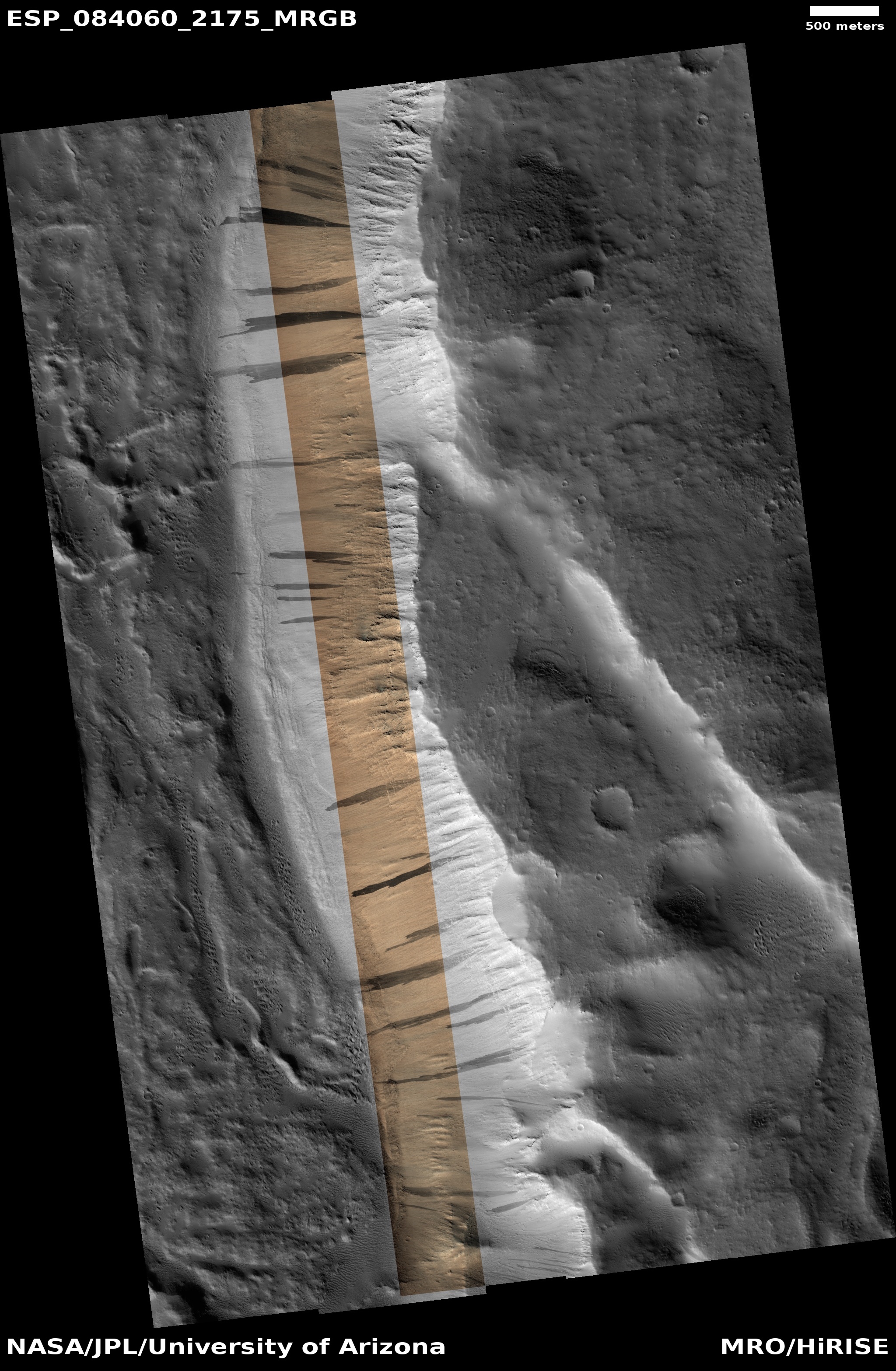
The insane terrain inside Mars’ Death Valley

taffy terrain
Click for original image.

Cool image time! The picture to the right, cropped, reduced, and sharpened to post here, was taken on October 27, 2025 by the high resolution camera on Mars Reconnaissance Orbiter (MRO).

The science team labels this a “twisted surface,” to which I think we all can agree. What we are looking at is a geological feature found only on Mars in only one region that has been labeled “taffy terrain” by scientists. According to a 2014 paper, the scientists posit that this material must be some sort of “a viscous fluid,” naturally flowing downward into “localized depressions.” Because of its weird nature I have posted many cool images of it in the past (see here, here, here, here, here, and here).

In the case of the image to the right, the red dot marks the peak of a small knob, with the green dot on the upper left the low point about 900 feet below. As you can see, the taffy has migrated into the depressions, as some flowing material would.
» Read more

2 comments

Ground-based telescope actually photographs an exoplanet

exoplanet imaged directly
Click for original movie.

Using a new instrument on the Subaru Telescope in Hawaii astronomers have not only discovered a massive exoplanet orbiting a star, they have been able to actually photograph the planet itself.

The arrow in the picture to the right shows that planet. That picture is a screen capture from a short movie complied from five observations taken over several months earlier this year, showing the planet as it orbited the star, the light of which is blocked out so as to not blind the camera. From the press release:

The newly discovered planet, HIP 54515 b, orbits a star 271 light-years away in the constellation Leo. With nearly 18 times Jupiter’s mass, it circles its star at about Neptune’s distance from our Sun. But the star and planet appear very close when seen from Earth; roughly the size that a baseball seen 100 km away would appear. The SCExAO system produced extremely sharp images allowing us to see the planet.

The astronomers also used this new instrument to image a brown dwarf star with a mass equivalent to sixty Jupiters about 169 light years away.

3 comments

Yesterday’s Senate nomination hearing for Jared Isaacman was irrelevant; America’s real space “program” is happening elsewhere

Jared Isaacman
Billionaire Jared Isaacman

Nothing that happened at yesterday’s Senate hearing of Jared Isaacman’s nomination to be NASA’s next administrator was a surprise, or very significant, even if most media reports attempted to imply what happened had some importance. Here are just a small sampling:

To be fair, all of these reports focused on simply reporting what happened during the hearing, and the headlines above actually provide a good summary. Isaacman committed to the Artemis program, touted SLS and Orion as the fastest way to get Americans back to the Moon ahead of the Chinese, and dotted all the “i”s and crossed all the “t”s required to convince the senators he will continue the pork projects they so dearly love. He also dodged efforts by several partisan Democrats to imply Isaacman’s past business dealings with Musk and SpaceX posed some sort of conflict of interest.

What none of the news reports did — and I am going to do now — is take a deeper look. Did anything Isaacman promise in connection with NASA and its Artemis program mean anything in the long run? Is the race to get back to the Moon ahead of China of any importance?

I say without fear that all of this is blather, and means nothing in the long run. The American space program is no longer being run by NASA, and all of NASA’s present plans with Artemis, using SLS, Orion, and the Lunar Gateway station, are ephemeral, transitory, and will by history be seen as inconsequential by future space historians.
» Read more

16 comments

December 3, 2025 Quick space links

Courtesy of BtB’s stringer Jay. This post is also an open thread. I welcome my readers to post any comments or additional links relating to any space issues, even if unrelated to the links below.

5 comments

Weird mottled terrain in the dry tropics of Mars

Mottled ridges
Click for full image.

Cool image time! The picture to the right, cropped, reduced, and enhanced to post here, was taken on October 28, 2025 by the high resolution camera on Mars Reconnaissance Orbiter (MRO). Labeled by the science team as “mottled ridged terrain,” it shows a relatively flat area of scattered broken-up flat-topped ridges and knobs, following no clear pattern of formation.

In trying to research this, I could only find one paper [pdf] discussing this kind of mottled ridges that did a survey of similar features across a large region to the northwest. That paper could not determine what caused such features, but came up with hypothesis. From the abstract:

While it is not possible to determine the precise formation mechanism of these polygonal ridge networks from our new data, their formation can be assessed in terms of three possibly separate processes: (1) polygonal fracture formation, (2) fracture filling and (3) exhumation. We find that polygonal
fracture formation by impact cratering and/or desiccation of sedimentary host deposits is consistent with our results and previous spectral studies. Once the polygonal fractures have formed, fracture filling by clastic dikes and/or mineral precipitation from aqueous circulation is most consistent with our results. Exhumation, probably by aeolian processes that eroded much of these ancient Noachian terrains where the ridges are present caused the filled fractures to lie in relief as ridges today.

To put this in plain terms, the initial polygon-patterned cracks were formed by either an impact or the drying out of the surface (similar to the cracks seen on dried mud here on Earth). Both could have contributed. Then material welled up from below, either lava or mud, that hardened to fill the cracks. Later erosion by wind stripped away the surface, leaving behind these broken ridges.

As always, the location adds some very interesting context.
» Read more

0 comments

Sunspot update: Sunspot activity again crashes far below predictions

It is the start of another month, so it is time again to post my monthly update of the never-ending sunspot cycle on the Sun, using NOAA’s own monthly update of its graph of sunspot activity and annotating it with extra information to illustrate the larger scientific context.

The green dot on the graph below indicates the level of sunspot activity on the Sun’s Earth-facing hemisphere during the month of November. And once again, the Sun surprised us, producing far less sunspots than expected, based on the April 2025 prediction by NOAA’s panel of solar scientists (as indicated by the purple/magenta line).
» Read more

3 comments

France’s space agency CNES found liable for environmental damage at French Guiana spaceport

French Guiana spaceport
The French Guiana spaceport. The Diamant launchsite is labeled “B.”
Click for full resolution image. (Note: The Ariane-5 pad is now the
Ariane-6 pad.)

France’s space agency CNES, which has taken back management from Arianespace of the French Guiana spaceport it owns, has now been found liable for destroying a protected habitat as it began construction to upgrade the old abandoned Diamant rocket launch site into a pad for several of Europe’s new commercial rocket startups.

In March 2022, the regional environmental authority of French Guiana (DGTM) formally informed CNES that it could not begin demolition or earthworks at the Diamant site without first securing the legally required species and water-law authorisations. Despite this, the agency leveled the area in the preceding weeks, with the environmental NGO CERATO discovering the destruction in April 2022.

In August 2022, the DGTM carried out an unannounced inspection of the Diamant site and found further destruction of protected habitats linked to the agency’s PV2 solar farm project. In October 2022, the PV2 project manager informed DGTM that CNES had known about the presence of protected species on the PV2 site since 1 July 2022, yet began earthworks anyway.

In response to repeated flouting of DGTM procedures, the Prefect of French Guiana, the top regional authority, issued a stop-work order requiring CNES to halt all works at both sites.

It appears this stop-work order has contributed to delays in construction. The news now is that the case appears to have been settled.

The agency has been ordered to repair the damage within three years or face a fine of €50,000. It will also be required to finance ecological compensation actions elsewhere on the grounds of the Guiana Space Centre. The conclusion of the lawsuit will allow the agency to fully resume construction at the site, which it had been ordered to stop in late 2022.

In other words, CNES has been told to spend money elsewhere at the spaceport to make the local environmental authorities happy. It remains unclear how these delays have or even will impact the plans of the Spanish rocket startup PLD, which hopes to do the first orbital launch of its Miura-5 rocket from this site in 2026. PLD expects the first flight-worthy Miura-5 to be delivered to French Guiana early next year, so the delays in French Guiana have not yet effected its plans. That might now change if the site won’t be ready as planned.

This whole story however does indicate a fundamental problem within all of Europe’s space regulatory infrastructure that in the future is likely to hinder the development of its new commercial space industry. Europe’s leadership likes its red tape, and has done nothing to reduce it as it has shifted from the government-run model (where it controls and owns everything) to the capitalism model (where it buys what it needs from an independent competing private sector).

2 comments

Russian astronaut kicked out of the U.S. for stealing proprietary SpaceX designs

A Russian astronaut scheduled to fly on the next upcoming Dragon mission to ISS as part of the barter agreement between NASA and Roscosmos, has been removed from that mission after being caught taking pictures of SpaceX equipment in violation of State Department ITAR regulations.

Russian cosmonaut Oleg Artemyev has been removed from the prime crew of SpaceX’s Crew-12 mission to the International Space Station and replaced by fellow Roscosmos cosmonaut Andrey Fedyaev after sources alleged he photographed confidential SpaceX materials in California in violation of US export control rules, according to The Insider on December 2.

The outlet reported that Trishkin also said NASA did not want the controversy around Artemyev to become public, while Artemyev was removed from training at SpaceX’s Hawthorne California, facility last week after allegedly photographing SpaceX engines and other internal materials on his phone and taking them off-site.

The sources for this story all come from within Russia but it appears the story is true. It now appears that when the next manned Dragon launches to ISS in February, Fedyaev will fly instead of Artemyev.

The irony of this is that Russia doesn’t really have the capability of developing a comparable SpaceX rocket using this information. If anything, it would be more likely for Russia to sell the information to China in exchange for military hardware it could use in the Ukraine.

Either way, this violation by Artemyev of ITAR does not speak well for the future of the U.S./Russian partnership in space. It will certainly continue until ISS is retired, but this incident cements the likelihood that it will then end. None of the American commercial stations have shown any interest in signing agreemennts with Russia, though they all have signed numerous international deals, some with former Soviet bloc nations and even former Soviet provinces. After ISS Russia will be on its own.

And based on its inability to develop anything new in the past three decades, don’t expect much from it in space.

15 comments

New data from VLT uncovers numerous debris disks around stars

A sampling of debris disks
Click for original

Using a new instrument on the Very Large Telescope (VLT) in Chile, astronomers have compiled a catalog of 51 potential exoplanet solar systems, all with intriguing debris disks surround the stars with features suggesting the existence of asteroids and comets.

The image to the right shows a sampling of those systems. From the press release:

“To obtain this collection, we processed data from observations of 161 nearby young stars whose infrared emission strongly indicates the presence of a debris disk,” says Natalia Engler (ETH Zurich), the lead author of the study. “The resulting images show 51 debris disks with a variety of properties — some smaller, some larger, some seen from the side and some nearly face-on – and a considerable diversity of disk structures. Four of the disks had never been imaged before.”

Comparisons within a larger sample are crucial for discovering the systematics behind object properties. In this case, an analysis of the 51 debris disks and their stars confirmed several systematic trends: When a young star is more massive, its debris disk tends to have more mass as well. The same is true for debris disks where the majority of the material is located at a greater distance from the central star.

Arguably the most interesting feature of the SPHERE debris disks are the structures within the disks themselves. In many of the images, disks have a concentric ring- or band-like structure, with disk material predominantly found at specific distances from the central star. The distribution of small bodies in our own solar system has a similar structure, with small bodies concentrated in the asteroid belt (asteroids) and the Kuiper belt (comets).

The data from various telescopes both on the ground and in space is increasingly telling us that our solar system is not unique, and that the galaxy is filled with millions of similar systems, all in different states of formation. This hypothesis is further strengthened by the appearance of interstellar comet 3I/Atlas, which despite coming from outside our solar system is remarkably similar to the comets formed here.

1 comment

China’s Zhuque-3 copycat Falcon 9 reaches orbit on first launch; 1st stage crashes

Zhuque-3 at launch
Screen capture from China’s
state-run press

The methane-fueled Zhuque-3 rocket built by China’s Landspace pseudo-company successfully reached orbit today on its first launch, though the attempt to land the first stage vertically for later reuse failed when it crashed near its landing zone.

The reusable rocket, designed by the Beijing-based commercial space company LandSpace, was launched from the Jiuquan Satellite Launch Centre in China’s northwest at noon on Wednesday. After reaching a low-Earth orbit, the first stage of the rocket – the lower section that lifts the vehicle off the ground – appeared to catch fire in the air before crashing near the target recovery site.

I think a video of that failed landing can be seen here, though I cannot be sure, as it appeared to go up on youtube immediately at launch time, almost too soon.

For the Landspace pseudo-company, getting this rocket to orbit on the first try is a major success. It plans several more launches in the coming months, with each attempting a similar landing. Based on SpaceX’s history in this matter, it should not take it long to achieve its first landing success.

The leaders in the 2025 launch race:

158 SpaceX
75 China (a new record)
15 Rocket Lab
15 Russia

SpaceX still leads the rest of the world in successful launches, 158 to 127.

3 comments
1 87 88 89 90 91 2,927