
Dickens: His childhood made him

As a fan of the writing of Charles Dickens I have for a long time been curious about his life, and how he became such a great writer. I finally gained the opportunity to find out more when I recently found in a used book store a copy of the 1979 biography, Dickens: A Life, by Norman and Jeanne MacKenzie.
The book itself is out of print, though you can borrow it from the Internet Archive. This really isn’t that great of a loss, because as a biography it isn’t that good a book. The authors tend to only provide the most superficial aspects of most of Dickens life, rarely delving very deeply.
The early chapters about his childhood however were very much worth reading. Dickens never made a secret of the pain and emotional trauma he experienced when as a boy of twelve his parents — bankrupt and about to be placed in debtors prison — sent him off to live and work in a factory, spending twelve hours a day putting labels on containers for the blacking polish used for boots. That experience shaped many of his novels, including most especially Oliver Twist, David Copperfield, and Great Expectations.
Dickens’ experience however was not as terrible as the tales he told. He rightly felt abandoned by his parents, but this was only for a short few months. He also felt at that time that the situation had condemned him to a life of drudgery, instead of the more educated world he then hoped to join as an adult. As a boy he had been a passionate reader, and had imagined, given the right education, he would make something of himself. Instead, he for that short period thought his life was destroyed.
In truth this bad experience made him. It toughened him. He made friends with his co-workers, all lower class and poorly educated. Already he as a boy had been freely wandering the streets of London in his spare time, learning its best and worst places and the varied people that lived there. Now he was part of that city, living on his own and dependent on his own wits.
And the experience made him determined to never go broke or fall into debt, as his father had. He would make his own way, and always do it so he was not beholden to others. When his parents finally took him back and sent him to a new school, he quickly was able to rise to the top there, using the knowledge of the world and the confidence that knowledge had given him.

George Cruikshank’s illustration of Fagin on
death row, from the first edition of Oliver Twist
This youthful trauma also helps explain his books. For example, it is reflected most strongly in Oliver Twist, only his second published work but the first novel he planned from the beginning. In it you can see Dickens’ childhood as he roved through London, augmented by his forced work experience in the factory. This background helps explain the originality and vibrancy of the book’s characters, especially in describing Fagan and Bill Sykes. Dickens as a young man knew this world, and he was describing it as he saw it.
The biography also revealed one other aspect of Dickens life that I had been unaware of. During this youth he had been attracted to the stage, and for awhile thought he would become an actor. His desire to always be financially secure however drew him instead to journalism, which led naturally to popular fiction writing, because everything he ever wrote sold well. Once established as a successful writer however he made producing and acting in theatrical productions a hobby that earned him a strong positive reputation as an actor. In his last years he used that skill become a renowned solo performer on the stage, drawing large audiences in both Great Britain and the United States by doing staged readings of his various works.
Unfortunately, this biography did not provide me a greater sense of the reality of Dickens’ later life. He married young, had a decades-long family life producing a lot of children, but then he dumped that wife late in life for reasons that the book does not clearly explain. It also fails to tell the reader much why Dickens actually supported his parents, siblings, and others for decades. What were their relationships? Why did he support his parents so if he was so traumatized by that childhood experiences? Sadly, Dickens: A Life doesn’t tells us.
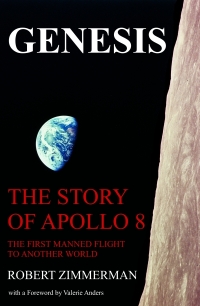
On Christmas Eve 1968 three Americans became the first humans to visit another world. What they did to celebrate was unexpected and profound, and will be remembered throughout all human history. Genesis: the Story of Apollo 8, Robert Zimmerman's classic history of humanity's first journey to another world, tells that story, and it is now available as both an ebook and an audiobook, both with a foreword by Valerie Anders and a new introduction by Robert Zimmerman.
The print edition can be purchased at Amazon or from any other book seller. If you want an autographed copy the price is $60 for the hardback and $45 for the paperback, plus $8 shipping for each. Go here for purchasing details. The ebook is available everywhere for $5.99 (before discount) at amazon, or direct from my ebook publisher, ebookit. If you buy it from ebookit you don't support the big tech companies and the author gets a bigger cut much sooner.
The audiobook is also available at all these vendors, and is also free with a 30-day trial membership to Audible.
"Not simply about one mission, [Genesis] is also the history of America's quest for the moon... Zimmerman has done a masterful job of tying disparate events together into a solid account of one of America's greatest human triumphs."--San Antonio Express-News
Related: It is Galileo Galilei’s adulthood that made him.
GALILEO: THE CHURCH AND TODAY’S “PROGRESSIVES”
“Now what do Galileo Galilei, the Catholic Church and todays “progressives” have in common?
(Galileo di Vincenzo Bonaiuti de’ Galilei (15 February 1564 – 8 January 1642)
Nearly 400 years ago there was a singular man of his age, a true genius, an Objective scientist, a mathematician, an observer of reality the universe and how it in fact operates. A man who knew he was “superior”, was a bit arrogant and overconfident who found himself at odds with and challenging the words in the Bible, the doctrine of the Catholic Church and the power of its CEO / leader, the Pope. ”
https://www.sigma3ioc.com/post/galileo-the-church-and-today-s-progressives
https://static.wixstatic.com/media/e691e8_dcec43ff792f46f1bc69358abb10cf51~mv2.jpg/v1/fill/w_740,h_493,al_c,q_85,usm_0.66_1.00_0.01,enc_avif,quality_auto/e691e8_dcec43ff792f46f1bc69358abb10cf51~mv2.jpg
Imagine how different his life would have been had his younger years been spent in a country with the plethora of welfare programs that exist in the United States today. We likely never would have learned of Charles Dickens.
Mr Z. Nice!
In college Lit (50 yrs ago) it was only Tale of Two Cities; now I’m faced with, and hopefuly up to, the extended works.
As Dickens for you it is Conrad for me, unbelievably prescient and lyrical writing on the human condition. Some may not see it but there is a direct connection from Dickens and Conrad right thru to our contemporary extension of the Cosmos, both technically and humanistically. Thanks, keep on going!
Peter Ackroyd and Claire Tomalin wrote excellent Dickens biographies.
My favorite “appreciator” of Dickens is GK Chesterton.