
NASA releases its space station requirements; opens bidding for the contract to build one or more
NASA today released its “Request for Proposals” (RFP) for awarding construction contracts to build one or more different commercial space stations, with the deadline for submission December 8, 2026.
You can download all the documents for this RFP here. From the RFP cover letter:
This competitive acquisition will result in a Multi-Award Indefinite Delivery, Indefinite Quantity (IDIQ) contract with the ability to issue Firm-Fixed-Priced (FFP) task orders. The contract will have an effective ordering period of 8 years from the contract effective date, and two (2) option periods to extend the ordering period as follows: a 4-year Option Period 1 and a 3-year Option Period 2 for a total potential ordering period of 15 years.
The anticipated contract award date is April 15, 2027, with an effective date occurring on the same day as the award. The contracts will primarily be performed off-site at the Contractor’s facilities; Contractors may perform some aspect of the work on-site at NASA centers as enabled by NASA Collaborations or Government Task Agreements.
The RFP’s Statement of Work (SOW) specifies three types of manned missions NASA hopes to fly to these stations:
- One month missions carrying 3 astronauts (2 from NASA)
- Six month discrete missions carrying 4 astronauts (2 from NASA)
- Repeated six month missions involving crew rotations, as part of an effort to maintain a continuous presence in space, each carrying 4 astronauts (2 from NASA)
The RFP outlines at great lengths NASA requirements, from ground transportation, the number of NASA mission control stations, payload needs, and required cargo, down to even the clothes the companies will supply the astronauts. If I understand the RFP correctly, it states about how much NASA has budgeted yearly for the next decade or so for this space station work, and thus allows the companies bidding to use those numbers as guidance for determining how much they want to bid.
Except for reasonable advice and consultation, the agency is leaving design and construction of each station entirely in the hands of the companies. As noted in the statement of work:
To open the design trade space and encourage innovations and efficiencies in system design solutions, NASA is not dictating a specific destination system architecture and design. Each Contractor must determine the applicable destination system requirements that best serve their target markets and that meet NASA’s utilization needs in LEO.
At the same time, NASA is the big customer, and thus is using its position to make a lot of demands. As far as I can tell at this point, most seem reasonable, an effort to protect the agency’s interests and its astronauts. Nonetheless, these demands might actually make working with NASA a difficult proposition for some of these station projects. As there is a lot of investment capital and customers available for all the stations, outside of NASA, it is quite possible that the losers in the bidding, who don’t get a NASA contract, might not grieve that much. Not working with NASA might give them greater freedom to innovate and obtain more unusual customers.
One more note: The paperwork also expressly states that any contract winners cannot do any work in cooperation with the Russians or Roscosmos on their stations, without first getting NASA’s permission. This does not mean NASA won’t approve, but it does indicate NASA is now done with this American-Russian partnership. Any future cooperation will likely be very limited and involve very specific missions, which will also have to be approved politically by the White House.
To sum up: Come April 15, 2027 we shall find out which space stations NASA will fund, and which will have to go it alone. At that point we will have a somewhat rough idea of the roadmap for manned space exploration in low Earth orbit for the next fifteen or so years.
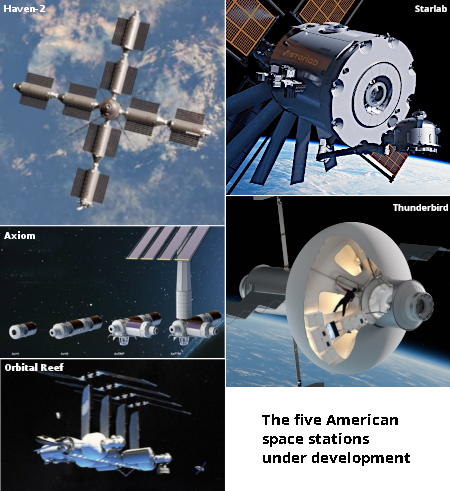
Below I rank the status of the five space stations presently under development.
- Haven-1 and Haven-2, being built by Vast, with no NASA funds. The company plans to launch its single module Haven-1 demo station in 2027 for a three-year period during which it will be occupied by at least four 2-week-long manned missions, one of which will include a French astronaut. It also will fly a manned mission to ISS in ’28 including both a French and Czech astronaut. Additional preliminary deals have been made with the European Space Agency, Lithuania, Colombia, Uzbekistan, Japan, the Czech Republic, and the Maldives for possible astronaut flights to Haven-1. Four biomedical companies have also made deals. The company has raised more than a billion in cash for this work, and has already tested an unmanned small demo module in orbit.
- Starlab, being built by a consortium led by Voyager Space, Airbus, and Northrop Grumman, with extensive partnership agreements with the European Space Agency, Mitsubishi, and others. Though no construction has yet begun on its NASA-approved design, it has raised $383 million in a public stock offering, the $217.5 million provided by NASA, and an unstated amount from private capital, probably in the range of about $250 million. It has also begun signing up station customers, as well as a number of companies to build the station’s hardware and provide the station communications. It also plans a mission to ISS in ’28.
- Axiom, being built by Axiom, has launched four tourist flights to ISS. A fifth mission is now planned for ’27. The company has now raised $625 million in private investment capital. Thales Alenia in Europe has been building its first two modules, with the first scheduled to launch in 2028. The company has also now established a subsidiary in Europe as well as signed Redwire to build solar panels for both modules.
- Thunderbird, proposed by the startup Max Space. It is building a smaller demo test station to launch in ’27 on a Falcon 9 rocket, and has begun work on its manufacturing facility at Kennedy in Florida. Its management includes one former NASA astronaut and one former member of the Bigelow space station team that built the first private orbiting inflatable modules, Genesis-1, Genesis-2, and BEAM (still operating on ISS).
- Orbital Reef, being built by a consortium led by Blue Origin and Sierra Space. This station appears dead in the water. Blue Origin has built almost nothing, and while Sierra Space has successfully tested its inflatable modules, including a full scale version, its reputation is soured by its failure in getting its Dream Chaser cargo mini-shuttle launched to ISS.

On Christmas Eve 1968 three Americans became the first humans to visit another world. What they did to celebrate was unexpected and profound, and will be remembered throughout all human history. Genesis: the Story of Apollo 8, Robert Zimmerman's classic history of humanity's first journey to another world, tells that story, and it is now available as both an ebook and an audiobook, both with a foreword by Valerie Anders and a new introduction by Robert Zimmerman.
The print edition can be purchased at Amazon or from any other book seller. If you want an autographed copy the price is $60 for the hardback and $45 for the paperback, plus $8 shipping for each. Go here for purchasing details. The ebook is available everywhere for $5.99 (before discount) at amazon, or direct from my ebook publisher, ebookit. If you buy it from ebookit you don't support the big tech companies and the author gets a bigger cut much sooner.
The audiobook is also available at all these vendors, and is also free with a 30-day trial membership to Audible.
"Not simply about one mission, [Genesis] is also the history of America's quest for the moon... Zimmerman has done a masterful job of tying disparate events together into a solid account of one of America's greatest human triumphs."--San Antonio Express-News
It seems that the critical corporate need for a company going for a space station is to build a solid business case outside of NASA. The NASA funds having strings and requirements that can easily become a straitjacket. Without that business case though, I guess the NASA route may be necessary.
The three mission profiles are interesting, especially NASA planning for both discrete six-month stays and continuous crew rotations. Leaving the station architecture largely up to the contractors also seems like a sensible way to encourage different commercial models rather than forcing everyone toward an ISS-style design.
Contact (1997)
“The First Rule in Government Spending…”
https://youtu.be/Et4sMJP9FmM?t=44
Interesting idea from that movie clip that partial pressure oxygen environment with zero gravity might help a cancer patient. Current protocols are that Hyperbaric Oxygen Therapy could be better. But zero gravity might be a good Cellular Disrupter.
I might want lunar gravity, so as to not completely waste away.
One day, maybe humans can finally see ring stations.
The problem with ISS is that just about every moment is pre-planned.
I want spontaneity for innovation…where a person can just walk to the zero-gee hub at a moments notice…or use telepresence from a one-gee craft to control a Waldo in a nearby, zero-gee free flyer.
This way, spacewalks would only be used sparingly…to fix a few things.
With only one station, there are wait lists.
A Starship-derivative would make a great ready-made space station that many nations and corporate entities could afford, and new development could be more focused on vehicles to support crew rotation and supply.
Finished with LEO? Filler-up and off to the Moon, or Lagrange points, or NEOs.
Don’t waste resources developing a new ISS that can’t go anywhere. Reuse Starship tech to support industrial and scientific uses, and add new capabilities for exploration.
Even a modified Starship would be too small for many of the more interesting things we could do with a station. SpaceX may also not sell such a modified ship. We should not develop a new ISS, but of the current proposals, that’s mainly just what Axiom is doing. Orbital Reef is likely DOA, while the others are all either substantially bigger, or simply take a different approach than, the ISS.
I am given to understand that the interior volume of Starship and the ISS are very roughly comparable, so would you please give some examples of the kinds of applications that you fell would require significantly more volume.
Note that I am not saying such applications do not exist, but simply that I think there are many that would work quite well with ISS-class volume.
The ISS is about the size of one to two average American homes, and while I agree there are many applications for something about that size, imagine SpaceX is taking a hundred people to orbit aboard a Starship, and some of them want to go to a hotel; some want to visit an observatory; some a microgravity swimming pool; some for a zero-G training program; and some who will later meet up with a cycler on its way to the Moon, Mars, Ceres, wherever. Yes, they could be delivered to a series of space stations, each serving one need, but you end up creating a fair amount of duplicate mass, as well as making it harder to have both artificial gravity and radiation shielding in the same structure, if you limit yourself to something the size of Starship. A wheel a hundred or hundred fifty yards in diameter would be considerably more massive than Starship, and thus could serve as a reasonable docking target for it. One of Varda’s backers has spoken about how early on, they plan to have a constellation-esque approach with dozens of spacecraft producing different goods, but over time, they would switch to have one more massive spacecraft, because that would offer economies of scale with heat, power generation, even the ability to have someone on orbit to maintain and repair hardware.
Please keep this separate from costs and present practicality; I am not assuming it will be free or that it will happen within five years. It won’t. Within fifteen or twenty years, though, our mass to orbit, and our ability to build large structures on orbit, will be such, that producing much larger volumes will be practical. As with everything else, what will drive any of this happening is both cost and being able to find-or make-a market for it. But the toroidal station I mentioned above would, conservatively, offer 28 times the people the same average square footage as Starship would, while being substantially less than 28 times the mass.
You may find Peter Hague’s (an English scientist who writes extensively about space and also posts on X) blog interesting, though you will need either a subscription or to claim a free post https://planetocracy.org/p/the-utility-of-space-stations
The new stations are quite different from each other and ISS, because they are trying to be cost effective and profitable, and most important, they are catering their designs with their customers’ needs in mind. And they have a bunch of such customers, from other nations, ESA, NASA, medical firms, pharmaceutical companies, manufacturing, tourists, and others that don’t come to mind immediately.
I am therefore very optimistic for their future. Like the shuttle, ISS has been a failure because it was never focused on profit.
If memory serves me correctly… ( Which there is every chance it doesn’t! ), but I seem to recall when MIR was being decommissioned there were all manor of ideas floated around about possible uses… Of course, non came to anything.
I had a rather “off the wall” idea for the ISS.. rather than just dumping it in the ocean, fill it full of experiments, get SpaceX or some other company to push it into a Mars like trajectory and test the heck out of it…
This would surely be a great test for the biggest lump of hardware ever to leave earths orbit, and return very valuable science for a relatively modest cost…
Thoughts?
Interesting thought, but not practical. The ISS structure can’t take much G-force so one would need to put together something like a nuclear-electric power module of considerable size to push it gently enough to keep it from shedding bits and pieces on its new journey and still put it on a trajectory to somewhere genuinely much farther away and not just into a higher Earth orbit. This would be expensive and any such power module would have any number of other more reasonable uses for either or both science and human exploration.
The biggest problem, though, is that ISS simply won’t stay functional for very long without a lot of hands-on maintenance. Even if one leaves out maintenance of systems that exist strictly to support human life aboard, it wouldn’t take long before ISS was just a mostly inert chunk of metal heading slowly and expensively for deep space with no real future purpose.
This whole space station situation was so poorly organized from the beginning. I don’t mean just the past couple of years, since NASA realized that ISS was finally not going to have its mission extended any further (but before they thought of extending it from 2030 to 2032). Not only does NASA have a funding problem, but they also have an access problem.
In the beginning, There was heaven and Earth, and NASA said it was good, because they got to put a man in space first. Except they didn’t. Then they got to go to the Moon first, which was somewhat harder to do. And they did. Then they got to put a makeshift, kluged-together space station into space, which they made out of a Saturn IV upper stage, but at least they still had a capsule to get the astronauts there. Then the atmosphere did not behave as expected, and Skylab was lost to Australia’s farmers.
The Space Shuttle was supposed to help, but it cost too much and flew too rarely to be as useful as expected, so it was hard to afford another space station; it was another two decades before we had another space station — another kluge, redesigned several times, and using a conglomeration of several nations — to send astronauts to, every once in a while, with the occasional Shuttle, and even then it took another decade to make the thing operational. The American space station that was supposed to take a decade became an international boondoggle that took a quarter century and three times the money than the amount Congress had balked at in the late 1980s. Transportation to the ISS was always a problem. NASA just didn’t do a good job managing anything about space stations, largely because its master, Congress, is stingy when it comes to space (but very generous when it comes to paying healthy people to not work, to be unproductive).
So, because NASA didn’t oversee the great Boeing company as it developed its Starliner capsule to take people to the ISS, SpaceX’s Dragon is all there is, and SpaceX is growing beyond Dragon and wants to get out of that business and move on to better space projects, projects that We the People have dreamed about since the 1960s and thought that NASA would make come true. Who can blame SpaceX for wanting to end Dragon? They want to end the Falcon series so that they can move on to Starship and all the things that they can do with that spacecraft that they cannot do with Falcon.
A decade ago, critics said that a (partially) reusable Falcon 9 would never break even, because it would take 18 annual flights to do so, but we have seen that it was relatively easy to launch that few times annually. However, they likely cannot launch 18 Dragon flights per year, no matter how many space stations there are, so how are they to make a profit on continued Falcon 9 flights for Dragon?
They only have five Crew Dragons and a limited number of Cargo Dragons, and the Crew Dragons must stay with their crews in order to provide lifeboat service. Assuming we can convince SpaceX to continue flying Dragons and Falcon 9s, how many commercial space stations can Crew Dragon keep supplied with crews at any price? If all we have is Dragon, then can we keep more than two commercial space stations supplied with crews, and can we even keep two supplied?
With launch pads costing a fixed amount of money per year, with that cost divided by a reduced number of launches, Dragon launches likely will cost more, once the other Falcon payloads are moved to Starship. If SpaceX is talked into continuing Dragon flights after the rest of the Falcons are retired in favor of Starship, then the cost for a Dragon flight will necessarily be higher than it is now.
This may not be as bad as it seems. If Dragon costs more, it allows competitors to charge more, too, and that gives a greater incentive for other companies to get into the manned space business. Of course, it could take five or ten years for additional manned spacecraft to come online.
However this all turns out, my point is that NASA didn’t manage the whole space station concept very well, from the stations themselves to the transportation to them. In fact, twice NASA didn’t have manned transportation into space, and that did not do well for America’s space program.
One question being, what will space transportation look like when it is private players for profit? Absent NASA strings, I expect transport vehicles to get lighter and simpler. The up and down taxi may not need even a week of on orbit lifetime. Crew lifeboats may simplify to a degree unexpected at this time. Orbital tugs may become the ship to station transportation taking that burden off of the actual LV. And so on when entire systems are based on utility without any bells and whistles not actually necessary to complete specific tasks.
One thing is certain – the cost of Starliner-on-Vulcan missions is going to be way too high to allow profitable operation of next-gen LEO space stations. So you are correct that the key to profitable operations is radically reducing current logistics costs, for both crew rotations and cargo delivery/downmass return. The only two vehicles likely to be ready to allow such a reduction are Starship at the high end and Stoke Space’s Novas at the low and medium tiers.
SpaceX may well have no interest in building a specialized version of Starship for a relatively low-volume service such as space station logistics. In that case, I think the field will be wide open for Stoke so long as suitable manned and/or cargo vehicles can be developed.
Something a bit lighter than a Gemini capsule could launch crew, two at a time, to LEO space stations and a cargo-only version could carry a few hundred kilograms of stuff both up and back down using the Nova Pathfinder vehicle. The recently announced Nova 2 could easily handle the launch of logistics vehicles larger than Crew Dragon or Starliner and could carry bigger cargo loads as well.
The problem, of course, is that neither class of vehicle currently exists or is even in a design phase. Perhaps Stoke will look to vertically integrate and build one or the other – or both – such spacecraft itself. Or, it could partner with one or more 2nd-parties to do so. Right now, The Exploration Company looks to be the likeliest to be able to provide the necessary capability on a reasonable timeline, but other contenders could certainly appear. Vast is a possibility and so are the now-numerous new outfits building unmanned downmass re-entry spacecraft.
You’re also right that the whole “escape pod” issue needs a clean-sheet-of-paper revisit. The current practice of keeping logistics vehicles on-station as lifeboats is not economically supportable, long-term, and is impractical from a boarding speed standpoint for really sudden emergencies even now. This will just get worse as future stations get larger.