
New changes to NASA’s Artemis lunar plans tell us when it will begin occupying its Moon base as well as replace SLS
According to the power point presentation [pdf] given earlier this month at the International Astronautical Conference in Turkey by Steve Creech, manager for NASA’s Human Landing System program, NASA is now beginning to plan when it will begin sending astronauts to the Moon on long missions, while also giving us a rough idea when SLS will be replaced by private commercial rockets.
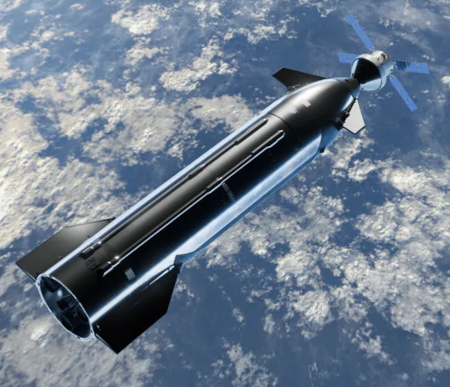
Artist’s rendering of Orion docked to Starship.
First, Creech outlined a delay in the next Artemis manned mission, Artemis-3. The agency now aiming for a third quarter 2027 target date for this manned mission in Earth orbit, testing rendezvous and docking between NASA’s Orion capsule and both SpaceX’s Starship and Blue Origin’s Blue Moon Mk-2 lunar lander. Previously the mission was targeting a 2nd quarter timetable.
The mission plan remains the same. First Blue Origin’s New Glenn will place its Blue Moon Mk-2 manned lunar lander into orbit. Then, after the initial shake-out operations are completed, NASA’s SLS rocket will launch with a manned Orion capsule, carrying four astronauts, who will then rendezvous and dock with Blue Moon, with two entering the lander to test its environmental systems. After undocking, SpaceX will then launch a Starship lander test vehicle on Superheavy. The astronauts will then rendezvous and dock with it, though they will not enter.
Though the presentation provided updates on the status of both landers, based on the information included it remains very unclear either can meet that new third quarter 2027 mission date. NASA plans a press conference at the end of this week, on October 23, 2026, to provide a further update on the status of Artemis-3. We will have to wait till then to see if there have been any changes since Creech’s IAC presentation earlier this month.
Creech’s presentation (hat tip to reader Nate P. for sending it to me) however included several other newsworthy tidbits, with the two biggest items being a rough target date for when Blue Origin will begin launching its upgraded New Glenn-9×4 rocket as well as when NASA plans to begin intermittent occupancy of its Moon Base. These changes, which also made no mention of any additional SLS flights after Artemis-5, strongly suggest NASA is preparing itself and the public for replacing that very overpriced and inefficient rocket with both Starship/Superheavy and New Glenn-9×4.

The changing schedule to NASA’S Artemis program.
Let’s start by outlining the changes that are not so significant but are still important, as they indicated the delays the program faces and NASA’s attempts to speed things up.
First, the first refueling test of two Starships in Earth orbit has now definitely been delayed from the 4th quarter of 2026 to the 1st quarter of 2027. This is not a surprise, based on the present pace of Starship test flights. Right now it appears SpaceX will need the rest of 2026 to do two or three test orbital Starship missions before it is ready to put two Starships in orbit at the same time. It especially needs to get the required multiple launchpads operational and tested.
Second, the first mission of Blue Origin’s unmanned Blue Moon Mk-1 lunar lander is now definitely delayed to late in the 1st quarter of 2027. This not a surprise, as Blue Origin needs to get New Glenn and its launchpad operational again after the May 28, 2026 static fire test explosion, and it plans the first New Glenn flight to carry its Blue Ring orbital tug. In addition, the second and third missions of Blue Moon Mk-1 are now scheduled for the 3rd and 4th quarters of 2027. This is actually an acceleration of the schedule, as previously both were targeting 2028 and 2029 launch dates.
Those are the least significant revisions to the schedule. Now for the more important changes and additions.
First, NASA has now established firm target dates for the first unmanned demo landings on the Moon for both SpaceX’s Starship and Blue Origin’s Blue Moon Mk-2 manned lunar landers. SpaceX’s first Starship lunar landing is aiming for the 4th quarter of 2027, while Blue Origin hopes to do its first Blue Moon landing in the 1st quarter of 2028. Both dates are later than previously announced. One or both must happen and successfully land on the Moon before the actual Artemis-5 manned lunar landing can be definitively scheduled. According to Creech’s presentation, that lunar landing is now tentatively scheduled for “early 2028,” a less firm date than previously announced.
Based on these new target dates, no one should be surprised if the date of that Artemis-5 manned lunar landing slips significantly.
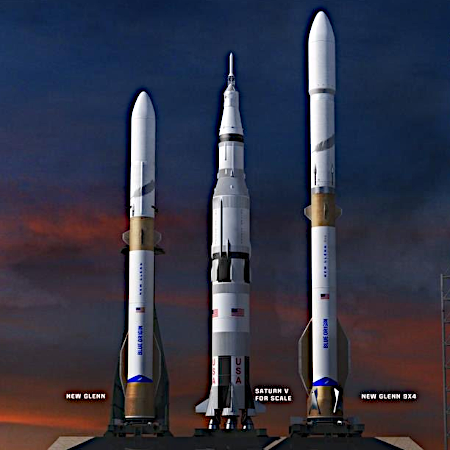
Graphic issued by Blue Origin’s CEO comparing
New Glenn to Saturn-5. Click for source.
Second, Blue Origin now plans to launch its more powerful upgrade of New Glenn, dubbed New Glenn-9×4, in the 4th quarter of 2027. This is the first indication I have seen of Blue Origin’s launch plans for this new rocket, though the company has made it clear it is accelerating development of the launchpads that can accommodate it.
By adding adds two engines to New Glenn’s first stage and two engines to its upper stage, New Glenn-9×4 becomes comparable in power to NASA’s SLS rocket, but with a first stage that is reusable, an ability to launch frequently with a short turnaround, and at a tenth the cost. These attributes also apply to SpaceX’s Starship/Superheavy. Based on this information, it appears NASA hopes to be able to replace SLS after Artemis-5 with these two commercial and privately-built rockets. Congress has only officially funded SLS through that mission, so this supposition on my part is makes sense.
NASA however is being coy about these plans, because it doesn’t want pushback from Congress. Expect it to hold back announcing any cancellation/replacement of SLS until after at least one of these rockets is operational.
Finally, NASA plans to award SpaceX a cargo contract to deliver to the lunar surface no earlier than 2032 a pressurized rover, being developed by Japan’s space agency JAXA.
And maybe the most significant, NASA also plans to award Blue Origin a cargo contract to deliver to the lunar surface no earlier than 2033 a manned habitat. This last announcement finally gives us a tentative date when NASA thinks it will begin occupying its Moon Base on a longer term basis, even if it is on an intermittent basis. Any manned mission beforehand will be short, no longer than a few days.
Below is a full schedule of planned missions in NASA’s Artemis program, revised based on this new information. As I have noted previously and repeatedly, none of these dates should be taken very seriously. As noted in the report above, further delays are guaranteed. This is a very ambitious program, reliant of a lot of new rockets, spacecraft, and technology, all of which needs significant testing first before the actual manned missions can take place.
However, we now have a rough idea of when NASA hopes to start flying astronauts on regular long term missions on the Moon, beginning around 2033.
NASA’s present Artemis program schedule:
- Late 2026:
- November 2026: Moon Base 2: The Griffin lander, built by Voyager (formerly Astrobotic), will be launched on SpaceX’s Falcon Heavy rocket, and targeting the south pole region, Mons Mouton.
- 2027:
- 1st quarter: Duel Starship/Superheavy launch to orbit to test refueling.
- 1st quarter: Moon Base 1: Blue Origin’s Blue Moon Mark-1 (dubbed Endurance) unmanned lunar lander demo flight, to be launched on Blue Origin’s New Glenn rocket. Awaiting repair of New Glenn rocket, following the May 28, 2026 static fire test explosion. Landing: South pole region.
- 1st quarter?: Moon Base 3: Intuitive Machine’s Trinity (Nova-C) lunar lander, will be launched by SpaceX’s Falcon 9 rocket and targeting the Reiner Gamma region near the equator.
- 1st quarter?: Moon Base 3: Intuitive Machine’s Altus-1 lunar orbiter will be deployed prior to Trinity’s landing, acting as a communications relay satellite.
- 2nd quarter?: Firefly’s Blue Ghost mission 2, to be launched by SpaceX’s Falcon 9 rocket, and targeting the far side of the Moon.
- 3rd quarter: Artemis 3: Manned rendezvous and docking tests of Orion in Earth orbit with the manned lunar landers being built by SpaceX and Blue Origin. It remains to be seen if either will be ready.
- 3rd quarter: Blue Origin unmanned Blue Moon Mark-1 delivering the first of two lunar rovers to the south pole.
- 4th quarter: Blue Origin unmanned Blue Moon Mark-1 delivering the second of two lunar rovers to the south pole.
- 4th quarter: Starship unmanned demo mission of human landing spacecraft, to south pole region.
- ? quarter: Capstone-2: Managed by Advanced Space, dual Terran Orbital satelites will test formation flying in lunar orbit.
- 2028:
- 1st quarter: Blue Moon Mark-2 unmanned demo mission of human landing spacecraft, to the south pole region.
- 2nd quarter?: Artemis-4: A manned lunar landing, with Orion launched by SLS and either SpaceX’s Starship launched by Superheavy or Blue Origin’s Blue Moon launched by New Glenn. Targeting south pole region.
- By end of year: MoonFall: Four JPL hoppers delivered to lunar orbit by Firefly’s Elytra lunar orbiter, targeting the south pole region.
- By end of year: Voyager’s Peregrine lander, targeting the Gruithuisen Domes region on near side.
- By end of year: Firefly’s Blue Ghost lander 3, landing site the Gruithuisen Domes region on the near side. Will also include Firefly’s Elytra lunar orbiter
- By end of year:: Intuitive Machines’ Nova-C lander, landing site not yet determined.
- Date and specific mission as yet undetermined: Reconfiguration of a Mars rover equipment to be a lunar rover, dubbed Promise.
- Ispace’s unmanned Ultra lander, funded by Japan’s Ministry of Economy, Trade and Industry, launched on JAXA’s H3 rocket.
- 2029:
- 1st quarter?: Artemis-5: A manned lunar landing, with Orion launched by SLS and SpaceX’s Starship launched by Superheavy or Blue Origin’s Blue Moon launched by New Glenn. Targeting south pole region.
- Intuitive Machines Nova-C lander, launched on a Falcon 9 and targeting the south pole near Mons Mouton.
- Intuitive Machines first Nova-D lander, launch provider not yet determined, targeting the south pole region.
- Ispace’s unmanned Ultra lander, funded by Japan’s Space Strategy Fund, carrying ESA’s Magpie rover to the south pole.
- 2032
- Starship cargo mission to Moon, bringing manned pressurized rover being developed by Japan’s space agency JAXA.
- 2033
- Blue Moon Mk-2 cargo mission to Moon, bringing “lunar surface habitat” for astronaut use.

On Christmas Eve 1968 three Americans became the first humans to visit another world. What they did to celebrate was unexpected and profound, and will be remembered throughout all human history. Genesis: the Story of Apollo 8, Robert Zimmerman's classic history of humanity's first journey to another world, tells that story, and it is now available as both an ebook and an audiobook, both with a foreword by Valerie Anders and a new introduction by Robert Zimmerman.
The print edition can be purchased at Amazon or from any other book seller. If you want an autographed copy the price is $60 for the hardback and $45 for the paperback, plus $8 shipping for each. Go here for purchasing details. The ebook is available everywhere for $5.99 (before discount) at amazon, or direct from my ebook publisher, ebookit. If you buy it from ebookit you don't support the big tech companies and the author gets a bigger cut much sooner.
The audiobook is also available at all these vendors, and is also free with a 30-day trial membership to Audible.
"Not simply about one mission, [Genesis] is also the history of America's quest for the moon... Zimmerman has done a masterful job of tying disparate events together into a solid account of one of America's greatest human triumphs."--San Antonio Express-News
Much depends on SpaceX’s ability to perform on-orbit refueling. Aside from that, there is the usual NASA inclusion of a lot of pieces that are goofy, like the JAXA rover. Last I looked, NASA has a “lunar rover” they keep in a garage over at NASA Clear Lake, and they’ve rolled it out for various public events including a Super Bowl some years ago. I guess it’s warranty has expired…
Hobbling SLS by killing EUS and having no upper stage at all for Artemis III is part of making teething Starship look better.
I’d like to see a Falcon first stage or SuperHeavy alone put Dragon in orbit.
Yes, cancelling EUS was all about hobbling SLS and making Starship look better. Nothing to do with the fact that using it required the new MLP, which was years behind schedule, no reasonable estimate on actual completion and delivery, and that single piece of hardware was on target to cost more than the entire Superheavy/Starship development program. Nope, couldn’t be that. All about crippling the program of record.
Slide 9 shows “Other major HLS milestones” which include 3 incremental steps for SpaceX – Starship v3 flight testing, Starship long duration orbital test, and Starship large-scale cryogenic propellant transfer test – and only ONE milestone for Blue Origin: They land their lander on the moon.
I guess that as far as NASA is concerned Blue Origin can jump straight from rebuilding its blown-up launch pad to a lunar landing with no intermediate checkpoints. (E.g., “flight testing” or “long-duration orbital test”.)
Impressive vote of confidence in Blue Origin, right? (Or maybe I’ve misunderstood something.)
Their first landing is a Mark I Blue Moon that can be sent to the lunar surface without needing rendezvous or refueling.
David Bakin wrote: “Impressive vote of confidence in Blue Origin, right? (Or maybe I’ve misunderstood something.)”
I think you have it right. NASA has confidence in certain companies but not SpaceX. NASA closely oversaw the SpaceX Crew Dragon spacecraft development but not the Boeing Starliner development, because Boeing had so much more manned space experience. I can see NASA closely monitoring the Starship development, because that is such a radically new spacecraft, and the Blue Origin Blue Moon lander is virtually the same as the Grumman lunar lander for Project Apollo. Blue Moon obviously needs no flight testing, long duration orbital testing, or propellant transfer testing; it can go directly to a lunar landing test.
Give me a moment to figure out whether I am being sarcastic …
Slide 8, above the referenced slide, shows that the Mark 1 landing is a Commercial Lunar Payload Services (CLPS) flight. Hmm. Come to look at it, a manned Mark 2 is not shown at all in the timeline. A manned Starship is also not shown in the timeline (slide 7).
That paragraph is not sarcastic, but on the first paragraph I definitely started out intending sarcasm.
What do you classify as “long term mission”? A week, a month?
Likely several months, from three to six, is my guess. My assumption is that until a habitat is established, missions will have to be shorter, though both Starship and Blue Moon might have capabilities that will allow for missions of I think up to a month.
I am guessing however. I have not seen or don’t remember any specifics yet published.
“1st quarter: Duel Starship/Superheavy launch to orbit to test refueling.”
I don’t expect to see a duel between Starships.
I’ll have to dig in and see if the level of capability of the landers for Artemis IV have been defined. Are these going to just be dummies for Orion to dock to, or are they intended to be nearly feature complete with their habitat and controls and such available and functional for the astronauts to board and test? If the former, the dates above seem reasonable. If the latter, I’d be hugely surprised if it doesn’t slip a quarter or two. Based on how long it takes SpaceX to build and outfit a Dragon, I’d expect to see the manned Starship already in production, and that’s not the case.
Duel, eh?
Elon phones down to SpaceX Research: “Hey, can you guys work up a phased plasma rifle in a 40 watt range for me, and make it so we can mount it on Starship?”
The passenger cabin and cargo deck of both the HLS Starship test lander and the one that is to carry crew on Artemis 4 are in production now. Landing leg tests are still ongoing at McGregor, TX. The tankage, engines and the legs can be added to the upper portions fairly late in the game as it doesn’t take long to fabricate the lower 2/3 of a Starship, especially if no TPS tiles need to be attached. Holding off on building that part of the flight hardware for both the test article and the to-be-crewed article allows more test flights in the interim to further refine the design of the V3 lower portion.
I should have mentioned in my earlier comment that neither of the HLS landers now under construction will be the test article for the Orion docking test during Artemis 3. That mission will employ a lightly-modified standard-at-the-time V3 Starship with a docking port on its nose – probably covered by a retractable nose cap similar to the one on Crew Dragon, but made of stainless and with TPS tiles on it.
There won’t be any crew cabin on the Artemis 3 Starship test article so no astronauts will go inside. But there will, apparently, be at least a short test burn of the Artemis 3 Starship’s engines with Orion attached to its nose in order to establish that Starship can do the Trans-Lunar Injection burn planned for Artemis 4 and that Orion can stand being pushed from its nose.
Should be an interesting ride for the crew. They’re mostly test pilots so the eyeballs-out acceleration should be at least moderately familiar.
Love that miniature Starship on slide 5. Has a Starship ever been depicted to actual scale in any NASA presentation? If so, I haven’t seen it.
No powerpoint ever survived first contact with reality.
The dis-organization of the material in the slide deck is a giveaway… this is baffleware!
Robert wrote: “… New Glenn-9×4 becomes comparable in power to NASA’s SLS rocket, but with a first stage that is reusable, an ability to launch frequently with a short turnaround, and at a tenth the cost. These attributes also apply to SpaceX’s Starship/Superheavy. Based on this information, it appears NASA hopes to be able to replace SLS after Artemis-5 with these two commercial and privately-built rockets. ”
Some people at NASA probably cannot wait; they joined NASA to expand into space, not satisfy Congressional districts. It isn’t just the cost of constructing each SLS launch vehicle that is prohibitive to a sustainable lunar base, it is the maximum launch cadence. It takes many months to stack an SLS vehicle, and there are only four bays in Kennedy Space Center’s Vehicle Assembly Building. At best, they can stack only four at a time, so even if they spend huge sums making many SLS vehicles, there is a limit to the launch cadence. To reach the goal of a permanently manned, sustainable lunar base, NASA will need frequent manned and unmanned flights to and from the Moon.
The limit on New Glenn’s launch cadence is driven by the same thing as the limit on the Falcon vehicles: the rate at which they can manufacture upper stages. This rate has yet to be determined, but the Falcon assembly line has been shown to complete an upper stage in just over every other day. Blue Origin may be able to reach a similar rate.
The limit on Starship is driven by the turnaround time for each launch pad combined with the number of launch pads. Many pads are now planned, and SpaceX thinks that they can eventually launch from each pad thrice daily. Even if they cannot reach that pace, it seems clear that they are going to have a rapid turnaround.
Both of these launch vehicles should have impressive launch cadences by 2033, and Rocket Lab’s Neutron should also be operational with a nice launch cadence, allowing it to contribute to unmanned lunar missions.
Some people at NASA probably are married to SLS and don’t want to switch over to commercial launchers. Congress may feel the same way, considering that they designed SLS and directed SLS to use many of the Space Shuttle parts — but this time as expendable, meaning that the entire rocket needs to be completely manufactured for each launch. Congress is happy to make its constituents happy, and some of those are the builders of Space Shuttle parts — now SLS parts.
Jared Isaacman has been restructuring NASA into an organization that can once again do great things. In order to do that with Artemis and its goal on the Moon SLS has to be replaced. Its cost and its launch cadence as well as its payload capacity (incapable of putting a four-man capsule into lunar orbit) are inadequate to perform the goal. Isaacman is well aware that SLS is not the vehicle of the future and that commercial rockets and spacecraft are.