
The human colonization of the solar system is now unstoppable, except by force
The new century will see a renaissance of space exploration as exciting and as challenging as the space race of the 1960’s. And this rebirth will happen under the banner of freedom and private property, the very principles for which the United States fought the Cold War. [predicted in 1998 in Genesis: the Story of Apollo 8, p. 263].
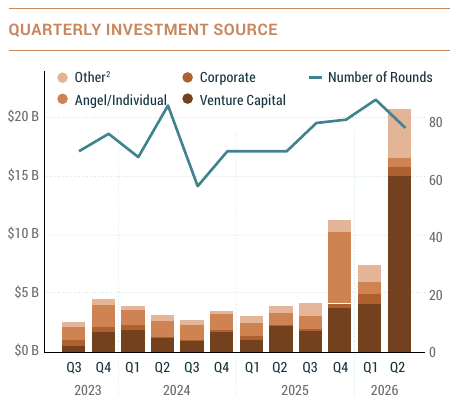
Investment in space since 2023, from the
Space Capital report in July 2026.
More than any other moment since the launch of Sputnik in 1957, the future of the human race’s effort to explore and settle the solar system is right now shining bright and hopeful, with everything converging enthusiastically in a manner that — if nothing is done to forcibly stop it — will make that colonization inevitable.
To understand that convergence, it necessary to understand how radically different this situation is. Unlike every space effort since Sputnik, space exploration is no longer controlled by governments. No longer do innovators and space geeks need to go to lawmakers, their hands out begging for money. Space exploration is now in the hands of private capital, which is quite generously committing a lot of money to fund a lot of space projects — not because these investors want to explore the stars — but because they see a lot of profits to be made.
This fact — that governments no longer control the situation — is what is driving this renaissance. It is also the one fact that might kill it, but I am getting ahead of myself. I must first describe this renaissance, in all its glory.
Rockets
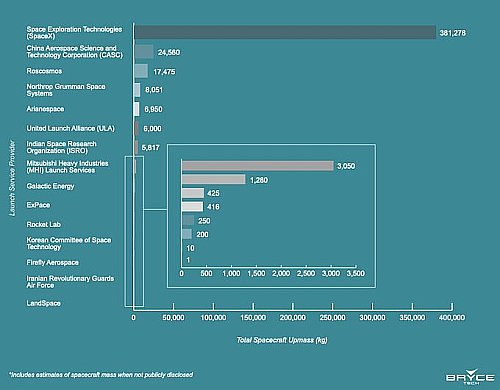
The mass sent to orbit in 2023. Click for original image.
The numbers for 2024, 2025, and 2026 have been comparable.
Above all, we must begin with rockets, because without them nothing in space can happen.
First on the list is of course SpaceX’s Falcon family of rockets, which revolutionized the rocket industry by being the first ever capable of reuse. That capability forced a major lowering in launch costs while making frequent and reliable launches of new payloads possible. For the past three years this rocket has dominated the global launch industry, launching more than the world combined and placing in orbit something like 90% of the total mass. Its development was funded from Elon Musk’s own pocket as well as from NASA.
The company is now building its much larger Starship/Superheavy rocket, intended to be the most powerful rocket ever built but also designed to be reusable with the ability to launch again and again, within hours. Unlike Falcon, its development has almost entirely been funded by private and public investment capital as well as the ample revenue SpaceX is getting from Starlink and its computer divisions. In fact, at this moment the contribution from NASA is relatively minor, only a very small percentage of the total cost.
SpaceX’s reliance on private capital however is not unique. Jeff Bezos’s Blue Origin has built its New Glenn rocket entirely from private capital (most coming from Bezos’s own pocket). Peter Beck’s Rocket Lab has developed both its Electron rocket (flying now for almost a decade) and its Neutron rocket (about to make its first flight) also from private capital. New Glenn and Neutron are both reusable, and will thus help accelerate the drop in launch costs.
Nor are these the only new rockets funded mostly on private investment. There are at this moment at least seventeen different privately funded rockets that are either operational or about to complete their first flights, aimed at garnering whatever commercial and government business they can get. For a more complete outline of this coming wave of rockets, see this September 10, 2026 essay.
But why is so much capital going into developing these rockets? What are they launching? Who are their customers?
Satellite constellations of all kinds

Visualization of just SpaceX’s 2nd generation Starlink constellation.
Click for source.
When it comes to the future in space,, the hot topic recently has been coming launch of several gigantic constellations of data center satellites to serve the computer world of AI and smartphones. SpaceX plans a constellation, dubbed Starmind, of one million satellites. Blue Origin has its own, called TeraWave, comprising more than five thousand satellites. The startup Starcloud wants to build its own 88,000 data center satellite constellation. And Google is developing its own, dubbed Suncatcher, though the numbers and schedule remain unstated at this point.
That’s only a few examples of proposed data center constellations. All have investment capital, and all are on the verge of their first launches. The rocket industry will be hard pressed to meet this demand.
But data center constellations are only the newest entrant in the satellite business. Voice communications remains the first big player, with the industry shifting from geosynchronous satellites providing linkage between ground stations to large smallsat constellations in low orbit providing direct phone-to-cell connectivity. Both SpaceX and AST SpaceMobile already have satellites in orbit providing this service, with SpaceX planning a bigger constellation of 15,000 satellites in the future.
Starlink meanwhile established the viability of satellites for internet access, with Amazon’s Leo and several Chinese constellations now coming on line to compete.
Nor is this all. Commercial imaging satellite constellations, in both radar and optical, have become ubiquitous in recent years, replacing the expensive less capable government constellations. GPS-type constellations, launched by the U.S. the European Union, India, and China, are still needed and are being expanded, with private satellite companies beginning to offer their systems as alternatives. Weather satellite constellations, previously launched only by governments, are now being developed by private companies because they can build them faster and cheaper.
And of course, there are demands for new communications, surveillance, and reconnaissance satellites by the War Department. Most are simply variations of the above constellations, though designed to be more secure for military purposes. Some, such as Trump’s proposed Golden Dome, have unique goals, such as acting as a shield against missile attacks. All however presently have large budgets and are moving at this moment aggressively to get built.
In the next decade this demand should require thousands of launches per year, a demand that should further increase the number of reusable rockets available which in turn will further lower the cost to get into orbit.
Space Stations
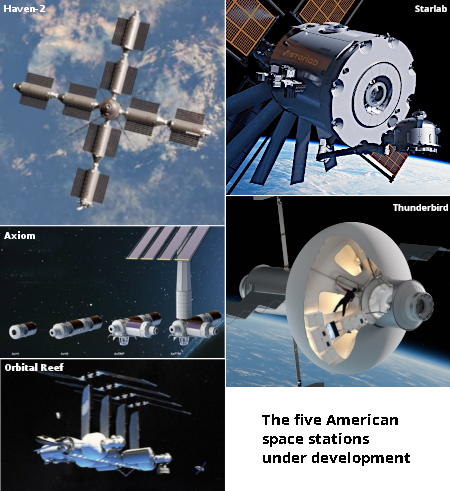
In the United States at this moment there are five commercial space stations under development, as shown to the right. All have all got extensive funding. Two, Vast’s Haven-2 and Max Space’s Thunderbird, are at this point funded entirely by their wealthy owners. Two, Starlab and Axiom, have raised about $1.5 billion in private capital, while also obtaining development contacts from NASA worth a little less than $300 million. The last, Orbital Reef, has also won a development contract from NASA, worth $130 million, but has done very little with it.
All five exist because their owners recognize that there is a lot of potential for making money in space, inside a space station. First, the U.S. and its international partners on ISS are not the only governments that want the prestige of flying astronauts in space. Numerous other countries want to do it also, and in fact in the past three years France, Czechia, Lithuania, Colombia, Uzbekistan, Japan, India, Poland, Hungary, and the Maldives have all signed passenger contracts with Axiom, Vast, and Starlab, with Axiom having already completed four such flights for profit to ISS.
Second, NASA is committed to buying space and passenger service for its own astronauts to one or more of these stations. It issued its request for space station proposals last week, with major contract awards to be issued in April 2027. The agency’s goal is to sustain its own manned program in low Earth orbit by encouraging competition between privately owned and operated space stations.
Third, the pure research done on ISS has demonstrated that valuable products can be produced in weightlessness that cannot be made on Earth, and many companies in a variety of fields, from pharmaceuticals to medical implants to material sciences, want access to an orbital facility to make these products for later sale. The new stations are not only eager to sign them up, Vast, Starlab, and Axiom have already begun to do so (see here, here, and here).
Serving the space stations

All these stations are going to need a range of ferrying services. For manned transportation only SpaceX at present provides this service with its fleet of five manned Dragon capsules. For cargo, both SpaceX’s unmanned Dragons and Northrop Grumman’s unmanned Cygnus capsules are available. The problem for manned transportation is that SpaceX is considering retiring both Dragon and the Falcon 9 rocket that launches it. While I personally doubt this will happen until other alternatives exist, its possibility remains a threat to the operation of these private stations.
Many of those alternatives are either on the verge of becoming operational or will do so in the near future. All have issues, but all are real. Boeing’s Starliner has flown with problems several times. If it can prove out its systems finally and become reliable, it becomes an immediate alternative.
The French startup The Exploration Company is building its Nyx cargo capsule. It has raised $680 million in private capital and has won a contract worth almost a billion dollars from the European Space Agency (ESA) to fly three Nyx missions. The company fully intends to eventually upgrade Nyx to a manned version, in the same manner as SpaceX did with Dragon, but that development is likely several years away.
Northrop Grumman has several times proposed upgrading its Cygnus capsule as a manned alternative. Little development on this option however has occurred because — as an old established space company — Northrop refuses to commit any of its own funds to such work. It wants a contract first. This however could change once one or more space stations begin operations.
Sierra Space’s Dream Chaser reusable cargo mini-shuttle is also an option. It was originally conceived as a manned ferry, but NASA wasn’t confident in its design to go with that concept. In retrospect this decision was a wise one, as an undisclosed technical issue has delayed the first launch of the first Dream Chaser, Tenacity, for more than two years. This undisclosed issue finally had NASA cancel its ISS cargo deal with Sierra Space. Nonetheless, this design concept is a viable one, and if Sierra can fix things it remains a future option for supplying the commercial stations.
And then there are the unknown manned and cargo spacecraft that don’t yet exist. Based on the investment capital going into the private stations, their need for ferrying service is going to become critical in the next decade. It therefore seems certain to me that one or more companies are going to step forward with new ideas, and make it happen. In fact, one of those companies might very well be found in the next area of space development.
Recoverable capsules
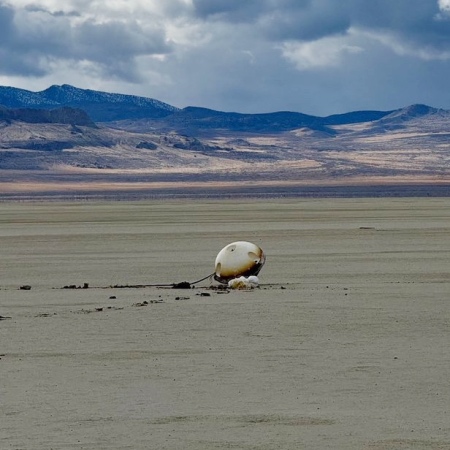
Varda’s first capsule on the ground in Utah in 2024, after completing
an eight-month mission producing the drug ritonavir, which is used
to treat HIV/AIDS.
While the space stations aim to provide large and extended capacity for product manufacture in orbit, the new recoverable capsule industry offers this same capability now, on a smaller scale and for much lower cost. The company Varda was the first, having already flown and recovered six capsules, with SpaceX following with its own test flight of its Starfall capsule.
A half dozen more startups in the U.S. and Europe have now raised capital to compete. In the U.S. Varda and SpaceX have been joined by Reditus, Inversion Space, and Sierra Space, all of whom have raised money or won contracts for putting short-term small recoverable capsules in orbit. In Europe, The Exploration Company in France, Atmos in Germany, PLD in Spain, Genesis in Croatia, and Space Cargo in Luxembourg have also raised capital for the same.
All of capsules these companies are building are relatively small, too small for humans to fly on. All however are developing the precise technology required for ferrying cargo and humans up and down from the commercial stations. We should fully expect that as the profits from their products begin to roll in, one or more of these capsule companies will commit the funds for developing larger capsule designs capable of carrying humans.
Miscellaneous other orbital industries
These miscellaneous industries include a half dozen orbital tug companies, a handful of robotic servicing companies, and a number of companies developing technologies of removing space junk. There are also proposals to provide refueling depots and fueling tankers for refueling satellites periodically.
All have raised capital, and all are either in development, have demonstrated their technology in orbit, or have actually started flying operational missions.
NASA’s Artemis program
While most would think I should list this government program first, because it is the most public part of America’s space effort, I place it last because in truth it is the least likely to succeed, and it acts mostly as an emotional linchpin for fueling all the other investment, innovation, and other industries now being developed above.
However, the way NASA is presently structuring its program is especially beneficial. The agency is no longer attempting to build anything. Instead it is asking the private sector — many of which are the many companies I list above — to do it. It is also not demanding ownership, as it has in the past. Instead, it is buying what it needs from these companies, and letting them develop the product in a manner that will allow them to sell it to others for further profits. As I wrote in the 2017 policy paper, Capitalism in Space,
Ownership … allows the companies to sell their products widely and make profits from it, regardless of whether NASA buys it.
In other words, NASA’s Moon program is now designed more than anything to fuel the growth of this private space sector. This is something it has failed to do very effectively since Apollo.
The threat that can kill it all

“Proclaim liberty throughout all the land unto all
the inhabitants thereof.” Photo credit: William Zhang
Though it is certain that some of these projects and companies will fail, the number and wide variety of their customers and products provides depth and redundancy. Profits are going to be made by building things in space, in one case or another, thus guaranteeing a continuous and never-ending driving force upward. If some fail, others will not. The demand is now simply too high and varied.
Left to its own purposes, freedom and capitalism is now poised to conquer the stars.
What threatens all this new space development however is also its very fundamental nature: it is privately owned, independent, fueled by profit, and not controlled by the government. Governments — and the power-hungry people who are naturally attracted to these political positions — don’t like it when they don’t control things. In fact, the reason this renaissance in space has only occurred now is because, since the 1960s, the governments in both the U.S. and Europe have worked hard to keep control over the space industry. Only in the late 2000s did this finally begin to change, but it has taken almost two decades to wrest power from the government and give it back to the private sector.
All of that could change in a moment, if the wrong people gain power. All of the grand private projects listed above hinge entirely on the choices we make in a few short weeks on election day. For you see, elections always matter, and in this election we are really being presented a choice between this bright future of private enterprise in space and a dark future comparable to that of the failed Soviet Union.
Sadly, the concepts of communism and top-down rule by government have become strongly entrenched within the American Democratic Party. Too many politicians in that party now advocate socialism as their guiding principle of governance. They wax poetic about the socialist utopia they wish to create, where everything is controlled from above by wise government officials who only have our real needs in mind. At the same time, these same Democrats, like Bernie Sanders and Abdul El-Sayed (the Democrat candidate running for the Senate in Michigan), like to use the word “billionaires” as a curse word, advocating the use of government to squelch such people, on the misguided or downright evil idea that because someone has become rich building a business they have somehow robbed others of wealth.

The Democrats to private enterprise: “Great business you got there!
Really be a shame if something happened to it!”
To achieve these goals however they must shut down freedom and private enterprise, because you can’t run things from on top if you allow free competition and innovation to exist outside your central control.
Nor is this just my opinion, it is based on recent history. During the Biden administration this is exactly what the Democrats did to Elon Musk and SpaceX after he announced his support for Republicans in 2022, slow-walking and even blocking the launch licenses SpaceX needed to test Starship/Superheavy, while conducting an aggressive lawfare campaign of investigations against him and his companies by numerous government agencies.
We should therefore have no doubt what the Democrats will do if they regain control of Congress, and eventually the presidency. They have made it clear they resent the success of others outside their control, and they have every intention of clamping down on that freedom, hard.
And while one might not like Donald Trump or the Republican Party, he and that party at this moment are the only political party that is working to encourage private enterprise, freedom, and using the government as a servant of the people. In fact, this renaissance in space is occurring right now precisely because of the policies the Trump administration has initiated since his second term began. As is stated expressly in a Trump executive order issued in December 2025, the goal is to grow ” a vibrant commercial space economy through the power of American free enterprise.” This was reinforced by Trump’s revised national space policy announced in August 2026, and confirmed by repeated orders to reduce red tape impacting both the launch and satellite industries.
This is the choice we face on election day, between the Democrats who want to squelch private enterprise and the Republicans who want to encourage it. I might sound partisan in saying this, but I am only summarizing the positions and actions of the two political parties. Nor will this choice impact only space exploration and this new space sector. It will impact American life across all sectors. Think once again of the Soviet Union and Venezuela, both of which chose the communist model and both of which went bankrupt.
Let me close on a cautious but hopeful note, quoting again from Genesis: the Story of Apollo 8 [p. 265-266]:
As surely as the sun has risen this morning, and as surely as it will set this evening, the human race is going to the stars. Though we might do it for the adventure or profit or the search for knowledge, we will eventually settle down on those barren hills that Frank Borman called “not a very inviting place to live and work.” And when we do, we had better consider the social order that we establish. The Cold War might be over, but it was only a small episode in the never-ending struggle between freedom and tyranny, a battle that began when the first bully found he could use a club to make others do what he wanted.
We now face another episode in that never-ending struggle. I pray Americans will choose wisely.

On Christmas Eve 1968 three Americans became the first humans to visit another world. What they did to celebrate was unexpected and profound, and will be remembered throughout all human history. Genesis: the Story of Apollo 8, Robert Zimmerman's classic history of humanity's first journey to another world, tells that story, and it is now available as both an ebook and an audiobook, both with a foreword by Valerie Anders and a new introduction by Robert Zimmerman.
The print edition can be purchased at Amazon or from any other book seller. If you want an autographed copy the price is $60 for the hardback and $45 for the paperback, plus $8 shipping for each. Go here for purchasing details. The ebook is available everywhere for $5.99 (before discount) at amazon, or direct from my ebook publisher, ebookit. If you buy it from ebookit you don't support the big tech companies and the author gets a bigger cut much sooner.
The audiobook is also available at all these vendors, and is also free with a 30-day trial membership to Audible.
"Not simply about one mission, [Genesis] is also the history of America's quest for the moon... Zimmerman has done a masterful job of tying disparate events together into a solid account of one of America's greatest human triumphs."--San Antonio Express-News
Your comment about the Democrats believing that all wealth is theft (unless it belongs to a socialist, of course) is one reason why my Member of Parliament here in Canada wants to have Elon Musk arrested.
People at that end of the political spectrum truly believe that all the world’s problems can be solved through “wealth re-distribution”, thereby punishing the “hoarders”. The fact that one could become prosperous by earning one’s financial rewards or doing so through saving and investing one’s money and using one’s own initiative and enterprise somehow escapes them. They also forget that prosperity is unlimited and that there’s more than enough to go around for everyone willing to make the effort.
True, the Left /Democrats / DSA Socialists have no idea where wealth and prosperity comes from.
https://www.sigma3ioc.com/post/how-to-destroy-incentive-and-value-define-taxing-the-hell-out-of-millionaires-1
“Wealth, prosperity and value are not just sitting around somewhere waiting for someone to trip over them. Government creates NOTHING. Government is a net negative draw on wealth, value and prosperity. Prosperity, wealth and value are created by free people. The less free and higher taxed the people are the less wealth, prosperity and value there is, there is a direct inverse correlation between the two. ”
They are all parasitic, taxation is parasitic, parasites must be starved.
“Though we might do it for the adventure or profit or the search for knowledge, we will eventually”… do it to escape a global, real-life reenactment of The Camp of the Saints.
Nice piece.
There is one simple trick to handle things if the wrong people gain power, bribery.
That is the only thing that can cut through their ideology but as contradictions are inherent to their ideology, bribery is a core aspect of leftism.
Both Democrats and Republicans have likely been bought and paid for by payday loan userers, lobbiests, etc. Nothing new there.
Need to finance their campaigns to get elected and tell people what they want to hear. Finance doesn’t come without strings, and another word for telling people what they want to hear instead of what they should hear is liar. Payday lender industry is like they buy=here-pay-here car lots, predatory mostly but way short of the funding necessary to buy politicians.
Robert,
Can we stop the Apocalypse and the Second Coming from happening?
Newsweek published a gut-wrenching article called “Belief Watch: Is Obama the Antichrist?”
The day of Obamas election, 20 hours after his win, his state’s lottery drew 666, the Mark of the Beast.
Everybody knows that the Beast is the Antichrist.
LOL, no. No one has EVER or WILL EVER go to space, it is not possible. All NASA space is faked and NASA is a HUGE money-laundering operation for the deep state. There will be no colonization as it is the firmament and the stars and planets are just luminaries- frequency and vibration suspened in the aether causing light. Aether and a non-rotating earth was proven by two experiments in the early 1900’s. The Lorenz and the Michaelson-Morely experiments. Because the devastating proof, Einstein had to fabricate out of nothing- no proof no experiment no basis for anything- his relativity theory in order to debunk it and save the money-grifting, god-stealing lie.
Forgot the /s
Either this guy is a young-earther or a Green like those who fake Feynman’s voice on YouTube to attack Mars travel.
Fundamentalist zealots of either stripe want us back in the Dark Age or the Stone Age.
Shortly after I began graduate studies many years ago, I attended a lecture about the Ulysses solar probe, which, at that time, was still in the planning stages.
In the back of the room, near where I sat, there was someone who was equally as ill-informed as this chap. He asked about how the probe would affect the atmosphere, and stuff like that. I couldn’t figure out if he was trying to be disruptive, was zonked out of his gourd, or wasn’t all there. The presenter didn’t quite know what to make of him, though I’m sure the thought of having him escorted out had crossed his mind.
More recently, on a different website that I check in with, there was a thread about SpaceX and how successful Musk had become. Sure enough, there was someone who wrote something similar to that post, claiming. for example, that it was impossible to put anything into orbit because there isn’t enough helium available to keep stuff out there.
I will never forget Michio Kaku helping spread fear over Cassini.
Some greybeard hippie had his granddaughter out there and she was sobbing…just convinced it was going to poison Earth.
That’s how you get Gretas….each nutty generation spawns kids who don’t think their parents are pure enough.
In my case, my folks were Depression babies who hated space, and watched Hee Haw…which made my teeth grind.
Luckily my parents loved space. Some of my earliest memories are Gemini launches. They also watched Heehaw, as did I. It showcased some amazingly talented musicians and comedians who didn’t fit the otherwise hippiefied 70s straight jacket. I was never a country music fan but wow, could those guys play guitar.
“…YOU FOUND ANOTHER and pffft, you was gawne.” Awesome!
“High Tech Redneck” I did like–but that was more recent.
Roy Clark and the Hee Haw Honeys. ‘Nuff said.
This guy seems to be one of what I have taken to calling “Firmamentarians.” These people are cousins of Flat-Earthers and Young Earth Creationists as there is some commonality in these three respective belief systems, but the Venn diagrams do not totally overlap. All are based on eccentric literalist readings of Old Testament Scripture. Firmamentarians seem to believe that the entire Universe consists of Earth and that everything above us is essentially God’s light show projected on a screen called the Firmament which is supposed to be just barely over our heads, relatively speaking.
I have always found this belief system to be kinda, well, disrespectful of the deity these people claim to worship. I mean, really, how big a deal is Jehovah, God of the Universe, if the best he can do is a mingy single-planet Universe that’s pretty much just a big drive-in theater a few thousand miles across?
They are also behind the “electric universe” cosmology–saying that no nuclear process takes place at stars.
Fusion creates heavier matter from hydrogen without magic wands and halos–and that threatens their fundy nonsense–so they say stars aren’t nuclear.
Now, there is nothing wrong with suggesting that there may be more to cosmology. XENONIT guys thought the solar tachocline might generate dark energy.
Now that I am hoping for….that might be leveraged in some way. Over at phys- there are articles about finer field manipulation, how quantum effects can be given to macroscopic objects, etc.
Still, stars ARE fusion furnaces.
I have to post this as an example of the disconnect in the minds of ALL ideological Moralist Liberals, Leftists, Democrats and just silly minded people. In this instance a woman but women do not have an exclusive on the silly mindedness. They can talk themselves into anything.
https://youtube.com/shorts/pR0TZsyIgao?si=x-TYJqWMRCrlsD_c
This kind of silly minded person can and will justify ANYTHING up to and including murder if they ever again in America attain political power and control. Bank on it.
If not Trump, what?
Think about that statement for one second.
What is the alternative?
You want prosperity?
Just say there is prosperity and there it is, we are all “EQUAL”.
America is a victim of its own success; it has manufactured its own means of destruction in the form of people who have grown up in luxury and are an existential threat to themselves and everyone else.
“LOL, no. No one has EVER or WILL EVER go to space, it is not possible.“
OK, I give up. I seriously can’t tell if that statement and the paragraph that follows it is a genuine belief or an attempt at humor. Please clarify.
PS: If it’s an attempt at humor, it’s not very funny.
I am the only one who down voted him so far..yet I already got two down votes in this thread just for breathing:)
Could you write an article following the theme of this article about private enterprise revolutionizing the space industry addressing in detail the new technologies being developed for new propulsion systems that will enable travel to different planets and enable asteroid mining? Thanks. Vote Republican. Just say no to Socialism/Communism.
Somewhere, Robert A. Heinlein is smiling.
I can see the colonization of the solar system stalling for a long time because the super rich find that they can’t make a profit from it.
What mineral comes from the Moon that cant be found cheaper on Earth?
What product on Mars can be sold at a profit on Earth?
Colonists for those places will have to be similar to the frontiers men who first settled the western Americas in the past or Alaska now.
What could they trade for supplies?
First, I’d like to say you’re making a category error in assuming that to be worthwhile, there has to be something that can be exported to Earth. While yes, that will be beneficial (and it is possible), real value doesn’t come from raw materials, but from the brains to turn those raw materials into useful products.
That said, PGMs are an early target for asteroid mining to specifically return products to Earth, and we’re in the early stages of orbital manufacturing producing goods in demand on Earth, from medicine, to semiconductor substrates, to biomedical products, and beyond. What’s more likely to be shipped from Mars, if it happens, are products like deuterium or platinum. What will be more profitable would be supporting operations in the asteroid belt, and then the growth of the local economy, just as the colonies in North America were ultimately worth far more than the sugar plantations or mines that exported goods to Europe.
Mars colonists can also sell scientific data to space agencies or scientific organizations on Earth, license patents in any one of multiple fields where the pressure of a the environment and lack of sufficient labor forces innovation, and sell more prosaic things such as music, novels, or films and shows produced by Martians, or sell sports subscriptions. All sorts of possibilities here. Martians may also have investments left on Earth that can help pay for deliveries, or be supported by foundations whose goal is Mars settlement.
pzatchok asked:
“What mineral comes from the Moon that can’t be found cheaper on Earth?”
Many, that are positioned so that their components are available at low cost *outside* the bottom of the Earth/Moon gravity well.
That is the key. Bringing hunks of stuff back to Earth will seldom be profitable for the first century or 2 after a Moon settlement is established. Musk is already proposing to use Lunar Silicon as the base resource for building more advanced versions of his StarMind project. StarMind, sending information back to Earth, will then be profitable enough, at low rates, to pay for the acquisition and processing on the Moon, with profit to spare for future projects.
“What product on Mars can be sold at a profit on Earth?”
On Earth?? Why not on the Moon, once the StarMind factories are set up?? The Moon has little, for instance, of Nitrogen, while Mars has 2% of its atmosphere as Nitrogen. The robots won’t need much of it, but humans that follow them there certainly will, since we don’t want to follow in Apollo’s wake quite so closely as to repeat some larger version of the capsule 12 Apollo fire risk, even in lower lunar gravity.
This is the sort of stratagem that will create profit in a Solar System-wide market network.
This isn’t the 19th century. There are no outer space equivalents of gold and beaver pelts. What will pay for settlement of the Moon is manufacture and launch of data center satellites. The same seems likely to be true of Mars as well.
“What product on Mars can be sold at a profit on Earth?”
Q: How do you get whatever is valuable into the market on earth and make a profit?
If they remain in space, then the market must exist there.
In my opinion I think the thing that may cause a “halt” or significant pause in human space colonization of the solar system is a tragedy involving the loss of several persons. I think this will be the result of insufficient preparation for the rigors of space flight. What we see now with SpaceX’s almost effortless ability to move tremendous amounts of cargo into LEO and also their ability to ferry humans to and from the ISS will be very difficult for others to replicate. As Mr Z has pointed out NASA itself has been almost reckless in how they have pushed humans into space without fully verified systems (tiles falling off Artemis just the flight before is just one example).
The pressure for progress will make someone forget or push too hard on something that will cause a tragedy perhaps on a reentry. OR we may see an issue that we cannot avoid – macro sized meteoroid impact on a crewed station, or a large solar flare that is too large to shield; impacting a space station that cannot get its crew off before being severely affected. OR an impact between two spacecraft – one untracked. etc.
I am in no way hoping for any of this nor do I want to see any of this progress slow. However, I think the issue will be the reaction of the public to such a tragedy, and the way our media will fan these flames if it happens. As Elon says: “Space it hard”. That has not changed and will not change. The accelerating number of efforts to get humans to orbit and keep them there simply increases the chances of mistakes. The astronauts of the sixties and seventies knew this and Bob has written about how these men and their wives faced those risks. But the Soviets were a driving force for taking such risks. Challenger and Columbia brought home the realities of space being hard. We also saw the halt of the shuttle for 2+ years. Resuming flight was completely within the realm of the government – they could go or not on their call. A tragedy in commercial space could cause a huge call for government reinvolvement that could stifle the pace of a commercial space as we see it accelerating today.
I think the reality of the situation exists somewhere between the Zmans unbridled enthusiasm for Capitalism in space and what you propose, an inevitable tragedy or failure that will tend to stifle progress for a while anyway.
Humanity is certainly at least going to the moon at this time in history, I think that is for sure.
I would go for a week.
Where after the moon and how long in the future? Maybe not as quantifiable a time line.
Your fear that a tragedy will slow things down is counter to what has actually happened following earlier tragedies. In every case — Apollo 1, Salyut 1, Soyuz 1, Challenger, Columbia — the accident and deaths ended up acting as a spur, increasing the urge to return to space. All caused delays of course in order to pin down the cause of the failure and fix it, but all were followed by more enthusiasm for space travel.
These of course were all government failures, which for its own self interest had to respond positively afterward. How the government would respond to a failure by a private company is more uncertain. I think the public’s response would be positive overall, but very negative in connection to the specific company involved.
Consider the early history of jets. The de Havilland Comet was the first to fly, but it had a design flaw in its windows that caused crashes. The company went under, but jet travel continued to thrive.
Cotour is correct.
The first colonists on either the moon or mars will be totally dependent on shipments from Earth. They will be grubbing for water and food first.
It will take years for the first colonists to get settled and be totally self sufficient.
After that then large scale mining will be possible.
This would be a moderate investment unless those billionaires want to speed it up. More investment faster development.
What and when do the billionaires get their investment back? They don’t. Not for many years.
If you claim mining on the moon and shipping it back would be cheaper then mining on Earth you are wishing.
If you think scientific research and patents will turn a profit your dreaming again. China and countries like them will just steal your research and patents and make more money at it than you.
What are the Earth and its people offering the nations and billionaires who finance the first 100 years of these colonies existence?
Is Elon being offered leadership over all the lands he is investing in?
The first permanent colony willing to support an army of some type will rule the whole planet or moon.
Thats the real reward in the long run.
It will more than likely take centuries for colonists to be autarkic, which is not a problem. Most nations on Earth are not. You are still assuming that raw materials are the key to success. If that was the case, Singapore, Hong Kong, South Korea, Taiwan, Germany, Japan, and other entities with limited or no real reserves should be poor. Instead, they are among the wealthiest nations on Earth. That said, space mining doesn’t need to wait on having colonists, and it won’t. The companies currently designing (and building) hardware for lunar and asteroid mining are planning wholly robotic systems.
Do you think wealthy people become, and, more importantly stay wealthy through trying to make a quick buck? There are multiple answers to this–one of them being that a colony need not necessarily carry a hundred percent of its costs, so long as there’s someone with an outside source of income willing to pay for it; and any competent corporation will be developing business plans whose payback can vary tremendously depending on what field of the economy they’re working in, using the cost of goods sold, net present revenue, and many more economic tools we’ve developed over the decades to help us invest our resources.
Who is arguing this? Ultimately it depends on what you’re mining, where it’s being used, and what scale you’re operating at. Perhaps the one element worth shipping to Earth right now is helium-3, while something like lunar oxygen would, at the very least, take a couple of decades to become competitive with Earth-launched LOX in most orbits. It’s far more likely that, should we mine the Moon, most of its raw materials will be used either on the Moon itself or in space.
There’s a bunch of unexamined assumptions in here, but the short reply to you is: no. This is not true. China and Russia are not able to steal everything on Earth right now, and it will be considerably harder to steal from people so remote and separated from us by the speed of light. It’s possible, yes, but considerably more difficult. And there are means of reducing the damage of IP theft.
Civilization is far more than just a balance sheet. As for Musk, if you ask people who know him well, what he wants isn’t temporary political power, it’s glory. Renown. If he succeeds in making the settlement of Mars possible, people will know his name for millennia. Conversely, political power fades, and fades fast. Can you name the leaders of France, Germany, and the UK at the end of the First World War? I can, but that’s quite rare these days. Compared to those leaders, Einstein is very well-known, and even appears on kids’ t-shirts.
Lots of water ice on Mars, which can be used for shielding, water, propellant and agriculture as long as the settlers bring power. The farther out you go in the solar system, the more water ice there is.
Soil chemistry on Mars is funky, perchlorates which will be a problem. To be fair, charged lunar dust will also be a problem – frothed glass, not unlike fresh volcanic ash. We might find a minimum ‘g’ level for human health colonizing moon and Mars. Skeptical about 1/6 g being acceptable. 1/3 might not be either.
Think the large scale mining will be the near earth / earth crossing asteroids. High percentage of volatiles on a bunch of them. Speculation by the asteroid guys (John Lewis, et al) is fully half of them are expended comets, which also means they are rich in hydrocarbons.
People will go because they want to get away and be self sufficient. Should be a lot of fun, though deadly in its own special way. Cheers –
Robert,
Excellent essay. You describe the major new businesses in space over the past quarter century and show that citizen investment in space is growing rapidly, that a citizen space program is developing and growing in the U.S.. We the People are taking control of what happens in space, fostered by government policies that reverse the policies that were put in place in the 1960s, which hindered citizen investment in space operations. The momentum is in place, and investors are eager to get into this realm of business.
With the actions (or lack of action) by the U.K.’s CAA, we see that government can still hinder launch and operations in space, despite the statement of that government that it wants a healthy citizen space program. The actions are heard much louder than the words.
“ Space exploration is now in the hands of private capital, which is quite generously committing a lot of money to fund a lot of space projects — not because these investors want to explore the stars — but because they see a lot of profits to be made. ”
This investor motivation is much more powerful than the government’s motivation, which I cannot explain, because it is somewhat mysterious. The military aspects of space are obvious, a military advantage over adversaries and enemies. The civil aspects, exploring the planets and the stars, is not as obvious. The investors in this free market, however, get to live better lifestyles, but then so do their customers, which is why the customers pay for the products. Everyone wins with free markets, because they would not purchase the things that reduce their lifestyles.
Two decades ago, at the time of NASA’s Commercial Orbital Transportation Services contracts (COTS), investors were reluctant to invest in space, because NASA was the monopoly and the monopsony, making investment in space difficult to profit from. This is why Kistler was unable to gain outside investment in time to meet the NASA contract’s first milestone. Kistler lost the contract and went out of business, and the contract went to Orbital Sciences (now part of Northrop Grumman) to develop the Cygnus resupply capsule. Orbital had been successful in that first milestone, because they had been in the space business successfully for two decades and knew the business well, so investors were easier to convince to take the risk. At that time, Orbital was one of the few, rare citizen-space success stories, SpaceX was not yet a success story, but it was able to gain enough confidence that it met the outside-investment milestone. There wasn’t the great amount of confidence in and excitement of commercial space as we have today, and many people were skeptical that Orbital and SpaceX could succeed with their ISS resupply missions. Cubesats were just coming along, and many or most of them were being launched by government, such as the national intelligence agencies.
It is a different world today, with investors seeing profits and companies eager to do business in space. We the People have proved ourselves in the space arena. What a difference a couple of decades make.
“Sadly, the concepts of communism and top-down rule by government have become strongly entrenched within the American Democratic Party. ”
The Democratic Party has always favored control. It was founded specifically to defend the institution of slavery, the ultimate control over other people. One of the concepts that corrupts people in government is the idea that government exists to solve problems, an idea that is easy to conceive, because so many people petition government to solve some problem or another. A major consequence of government solving problems is that in order to give that advantage to one person or group, government has to reduce (take from) the rights of another person, group, or everyone. In order to assure problem solving, it is best to have more control rather than less, and that control makes it easier to reduce the rights of those whose problems government is not solving.
“… [Democrats] like to use the word ‘billionaires’ as a curse word, advocating the use of government to squelch such people, on the misguided or downright evil idea that because someone has become rich building a business they have somehow robbed others of wealth.”
Democrats don’t demonize the rich that remain loyal to The Party. Trump was a favorite, right up until the moment when he announced that he was running for president as a Republican, at which time he became the hated Orange Man Bad. Musk was favored, especially for solving the electric car problem, right up until he announced that the Democratic Party had moved so far to the left that the Republicans were more in line with his ideologies, then he — and his cars — became the evil devil. For Democrats, it isn’t your wealth or what you do that matters, it is your loyalty to The Party. This attitude is just like other left-wing parties, such as the Communists or the Nationalist Socialist German Workers Party. As long as you are under control, what you do and what you’re worth are unimportant.
“Space exploration is now in the hands of private capital, which is quite generously committing a lot of money to fund a lot of space projects — not because these investors want to explore the stars — but because they see a lot of profits to be made. This fact — that governments no longer control the situation — is what is driving this renaissance.”
You have said in the recent past that the American space program is no longer NASA but is SpaceX. This post — essay — supports my addendum to your space program comments: America’s current space program is not just SpaceX but is all of America’s commercial space companies.
SpaceX certainly looks like a space program, and I admit that it is one. It has launch capability and a great number of satellites. It has goals that no one has achieved before, from space-based data centers (already using Starlink satellite downtime, such as over the Atlantic, Indian, or Pacific oceans, for computation), to a lunar base for mining and manufacturing, to a colony on Mars.
The rest of the American space program is filled in by other space companies. Space stations and orbital manufacturing may be launched by SpaceX launch vehicles, but they are only rented by the companies that operate those stations or perform that manufacturing. Investment in space is exploding, but it will be a few years or a decade before it is so big that no government can kill it. Once We the People start depending upon the products manufactured in space, in the way that we are already dependent upon communications and navigation satellites, that industry will also be bulletproof.
NASA may have lost its leadership role as a space program because the government (including NASA) changed space policy to encourage a commercial space industry that did not depend upon government (e.g. NASA, NOAA, War Department, etc.), as their sole customer, but NASA was a terrible leader for the past half century. Congress has not funded NASA at a level that would allow it to make great achievements in space, so NASA has had to make terrible compromises on its major projects, such as the Space Shuttle, the ISS, Constellation, and SLS. Each has been a disappointment, because it failed to live up to expectations. Artemis is another problem for NASA, because it is dependent upon SLS and Orion to do things that they were not designed to do and thus are inadequate for the task.
As SpaceX focuses on the technologies and methods needed to spread man into the solar system — to make man multi-planetary — other companies are filling in other niches, other technologies, and other methods in order to achieve other goals. SpaceX may seem to be America’s current space program, but the other space companies round out the field, making our space program more than the limited areas that SpaceX focuses on.
A good role for NASA is to continue exploring the things and places that the commercial companies are not yet ready to explore, such as asteroids and the moons of the gas giants.
Mining the moon is not for materials to be used on Earth but for materials to be used in space, saving a fortune on launch costs, at around $150 or so per pound, and this is the key to SpaceX’s proposed million-satellite data-center constellation. If each of these satellites has the same mass as a Starlink V3 satellite, then the cost to launch them from the Earth would be around three trillion dollars. A lunar base and manufacturing plant and the cost to launch from the Moon is likely to cost less than that, and replacement satellites would continue indefinitely. A lunar base and manufacturing facility could pay for itself surprisingly quickly and become bulletproof from death by government.
As they solve their many problems, Mars colonists are likely to come up with many intellectual properties that are valuable to earthlings, and if the Chinese were really stealing every technology, then no one would still be filing patents. We have created an abundance of patents from our exploration of space over the past three-quarters century, from rocketry to insulation to chemistry, and even medicines.
Interestingly, Billionaire Musk’s stated purpose for colonizing Mars was not to make further profits but to make mankind multi-planetary. It seems that Marxists are not the only ones that are not greedy;* many entrepreneurs just wanted to contribute to mankind and feed their families but inadvertently discovered that wealth is a byproduct of making a useful product. Musk, for instance, founded Space Exploration Technologies (SpaceX) in order to create a less expensive launch vehicle so that Mars could be explored inexpensively enough that civilians, rather than governments, could afford to do it. It turned out to be such a good idea, improving the lives of we earthlings, that now he is despised — by many of the same ones who have paid him and benefitted — for having made money on that idea. Go figure. As with other despised industrialists through history, this will not stop him from continuing to benefit mankind. A Mars colony could quickly become bulletproof from government death quads.
___________
* Or maybe Marxists are greedy and project that greed onto everyone else.
The DNC needs to drop the Talarico weirdos.
What they might do instead is to copy Lizzie (nurse) Fletcher, who replaced Culberson.
There are religious types–even if they aren’t firmament/flat-earthers– who look at space as a waste.
I have heard more than a few biddies…Trump women coming from church services mind you—talking about how Musk thinks he’s a god or something.
Those of us who are space advocates…..we are seen as no different than Fauci by many …which is worrisome.
Unlike Travis Taylor, Elon is awkward socially. I hope someone like Ellie in Space can stop this trend.
There was a scene in the Astronaut Farmer–I think it was–where a schoolmarm had this attitude toward the protagonist…the old “that’s nice, dear.”
I wish Shotwell–someone–would do some outreach.
Bezos tried with the all female passenger stunt–but Olivia Munn dumped all over it….so Bezos went back into hiding before speaking to Fox recently.
It can’t come from us.
I love Dagen McDowell…she is a real space buff and not enough is being done with her.
Timpf seems to have the same guardian angel I have, since we both have sorry luck.
She made the mistake in using the “over-educated” invective in her rants–which you know had Safire, Kilpatrick and Krauthammer spinning in their graves.
Jeff,
You have replied to me, but I don’t know how to respond, because your disjointed, non sequitur statements don’t seem to have any relation to anything that I said.
Bob,
You mention colonization in reference to space and I was wondering if you, a historian with a broad background, could offer a historical perspective of past terrestrial colonists. Coming to America or going to the West seemed to be a high mortality process. Not only many would die from many things but it was likely not pleasant (trying to eat, avoid other humans from harming them). So, yes, they might be motivated to get religious or economic freedom, but it seemed highly fraught with the chance of death/distress. Do you have any idea how they came to terms with this? Have we as a civilization lost this? Going to move families off-world seems to have high mortality and distress too. At least the people bringing their families to the old West had air and water. Do we wait until off-world has become “safe” or do people just decide to go and have their families “do it”?
I have already written a whole book addressing your question. It is called Conscious Choice: The origins of slavery in America and why it matters today and for our future in outer space. You can get it at any bookseller. Or you can get an autographed copy from me direct.
I think you will find it worthwhile.
Cool. Thanks!