August 18, 2026 Quick space links
Courtesy of BtB’s stringer Jay. This post is also an open thread. I welcome my readers to post any comments or additional links relating to any space issues, even if unrelated to the links below.
Note: X now requires log in to view videos with sound. You can get around this by clicking on the three dots at the top right to get the embed code. Ask for the code for an “embedded video.” The video will then be available for watching with sound.
- NASA selects four companies to provide it payload processing when needed
The companies are All Points Logistics, Blue Origin, Firefly, and L3Harris.
- Viasat awards Rocket Lab the subcontract to build the satellite bus for Space Force
The bus is essentially a satellite’s service module, providing power and attitude control. No money amount was provided.
- Intuitive Machines wins $600 million satellite contract from undisclosed customer
It appears the company will build multiple satellite components for a larger constellation, though all details have been kept remarkably vague.
- On August 17, 1877 astronomer Asaph Hall discovered Phobos, the larger of Mars’ two moons
The tweet includes a wonderful picture of the moon, taken much more recently by Mars Reconnaissance Orbiter.
- On August 17, 2017 LIGO detected gravitational waves from the merger of two neutron stars
The tweet provides a nice summary of what was learned.
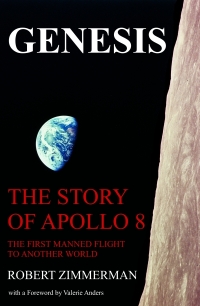
On Christmas Eve 1968 three Americans became the first humans to visit another world. What they did to celebrate was unexpected and profound, and will be remembered throughout all human history. Genesis: the Story of Apollo 8, Robert Zimmerman's classic history of humanity's first journey to another world, tells that story, and it is now available as both an ebook and an audiobook, both with a foreword by Valerie Anders and a new introduction by Robert Zimmerman.
The print edition can be purchased at Amazon or from any other book seller. If you want an autographed copy the price is $60 for the hardback and $45 for the paperback, plus $8 shipping for each. Go here for purchasing details. The ebook is available everywhere for $5.99 (before discount) at amazon, or direct from my ebook publisher, ebookit. If you buy it from ebookit you don't support the big tech companies and the author gets a bigger cut much sooner.
The audiobook is also available at all these vendors, and is also free with a 30-day trial membership to Audible.
"Not simply about one mission, [Genesis] is also the history of America's quest for the moon... Zimmerman has done a masterful job of tying disparate events together into a solid account of one of America's greatest human triumphs."--San Antonio Express-News
Lost plastic process
https://phys.org/news/2026-08-plastic-gas-reforms-cooled.html
Methane capture
https://phys.org/news/2026-08-materials-capture-methane.html
Scott Manley on heat shields
https://m.youtube.com/watch?v=HxaPVRh3Bgs
Artemis II, tiles, and more.
Bad news, guys:
“Katalyst Space is calling off its effort to reboost NASA’s Swift gamma-ray observatory because of ongoing attitude control problems with its Link spacecraft.” – Jeff Foust
https://x.com/jeff_foust/status/2090141194328121345
He links to the Katalyst announcement:
https://www.linkedin.com/posts/following-continued-monitoring-and-assessment-share-7495902427280310272-2261/
A valiant effort by Katalyst engineers.
Yes. We were all hoping for a Project Hail Mary-type happy ending, but space, as the saying goes, is hard.
That said, Katalyst has certainly shown itself to have some moves. That cannot help but benefit it going forward. Kudos to all involved.
The real question, in my mind, is what to do about what has been a longstanding history of episodic project initiations with no long-term succession planning by the astronomy/astophysics boffins at NASA. And the manned space and ISS operators for that matter. Having shot themselves in the feet in this fashion so many times already, the wonder is that any of them have any toes left at all at this late date.
The solution, I think, lies in separating the responsibility for requirements definition from that of managing the provision of ways and means. The former function is, quite properly, the purview of scientists. But the latter is better left to career engineers and project managers, plus appropriately capable contractors.
As preposterous as it now seems, the boffins were perfectly content to fool away two decades and let Swift reach a crunch point without any evident effort to gin up a replacement far in advance of need. If the ability to quickly detect and react to sudden bright flashes at the extreme upper end of the electromagnetic spectrum is an ongoing essential – or even just a nice-to-have – it behooves those who make a career out of explaining such things to maybe exert themselves a bit more to insure such ability does not suddenly stop. By rights, there should have been a Swift successor already on-orbit and working for some years now. But there is not. And thereby hangs a tale.
One hopes that, among his myriad other efforts to de-stultify and re-invigorate NASA, Administrator Isaacman can devote a bit of his time and energy to institutionalizing appropriate concern for the ongoing provision of identified key capabilities.
Following up on my last, NASA now has an announcement up, detailing what happens next:
https://www.nasa.gov/news-release/nasa-updates-next-steps-for-commercial-swift-boost-mission/
You can skip publishing these comments by me, Bob, when you post about it. Sorry, my email is being sketchy out on the road here.