
Germany’s space agency DLR delivers one prototype leg for Europe’s Callisto grasshopper
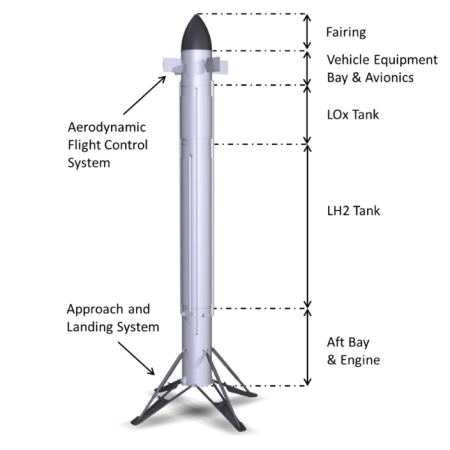
Callisto’s basic design
Government in-action: After a decade of work, the German space agency DLR this week finally delivered for testing a prototype leg of the Callisto grasshopper-type demo rocket, intended by the European Space Agency (ESA) to demonstrate vertical take-off and landing.
On 9 October, the Institute of Structures and Design announced that it had delivered a qualification model of the demonstrator’s landing leg to the Institute of Space Systems in Bremen. According to a 3 December 2024 update, the leg will now undergo a series of tests at the Institute’s Landing and Mobility Facility, including deployment, touchdown, and vibration testing.
Once the qualification test campaign is complete and the landing leg design has been validated, the Institute of Structures and Design will proceed with the construction of the four flight-ready legs.
Note again that Callisto, as shown to the right, was proposed as a joint ESA and JAXA project in 2015. Only now, a decade later, as DLR delivered one prototype leg. The first test hop has been repeatedly delayed, so that now it is now not expected to happen until 2027, and that rocket will not even be an operational version, it will simply be a small scale prototype.
Meanwhile, SpaceX has landed its Falcon 9 first stage hundreds of times, and reused them dozens of times. Other companies are flying or building their own reusable rockets, and hope to fly operational versions next year.
The contrast between this government project and the private sector is quite embarrassing. What makes it even more embarrassing is that it is par for the course, and yet so many people still look to the government as the god who can get things done. When will people learn?

On Christmas Eve 1968 three Americans became the first humans to visit another world. What they did to celebrate was unexpected and profound, and will be remembered throughout all human history. Genesis: the Story of Apollo 8, Robert Zimmerman's classic history of humanity's first journey to another world, tells that story, and it is now available as both an ebook and an audiobook, both with a foreword by Valerie Anders and a new introduction by Robert Zimmerman.
The print edition can be purchased at Amazon or from any other book seller. If you want an autographed copy the price is $60 for the hardback and $45 for the paperback, plus $8 shipping for each. Go here for purchasing details. The ebook is available everywhere for $5.99 (before discount) at amazon, or direct from my ebook publisher, ebookit. If you buy it from ebookit you don't support the big tech companies and the author gets a bigger cut much sooner.
The audiobook is also available at all these vendors, and is also free with a 30-day trial membership to Audible.
"Not simply about one mission, [Genesis] is also the history of America's quest for the moon... Zimmerman has done a masterful job of tying disparate events together into a solid account of one of America's greatest human triumphs."--San Antonio Express-News
Well, they do now have (prototype) leg to stand on.
Robert wrote: “The contrast between this government project and the private sector is quite embarrassing.”
SpaceX, for instance, used its Grasshopper to test the capabilities of the rocket to guide itself back to the ground and did not bother with retractable landing legs until later. The hard part was what needed researching first. They used a fixed landing structure that looked inelegant but was serviceable. Why a government operation thinks that it needs to design the finished product then test whether it works is a mystery. I like SpaceX’s method of sneaking up on the final design during the development phase. It seems like this should take longer, but counterintuitively it does not. SpaceX does not have to worry that everything works properly before beginning the test program and working out some of the more pesky (long pole*) problems before getting to some of the less pesky problems.
SpaceX has interesting philosophies, from “the best part is no part,” explaining how to implement “keep it simple, stupid,” to “if you don’t have to add parts back in, you didn’t take off enough parts,” which explains why at SpaceX failure is not only an option, during development, it is a necessity.
Like Starship, the Space Shuttle was a dramatic change in design than had ever been done before. What could the Shuttle have been had NASA been given the budget to do a similar development program to make that craft work as well as had been intended? How much more advanced in space could we be right now? This is a major difference between government projects and civilian projects. Government works only to a budget (like THX1138) and civilians work to a goal. Apollo was an exception, where the goal was more important than the budget.
_____________
* Long pole: the thing that holds up the show, or the circus tent, or in this case holds up the project.