Hayabusa-2’s last working ion engine fails
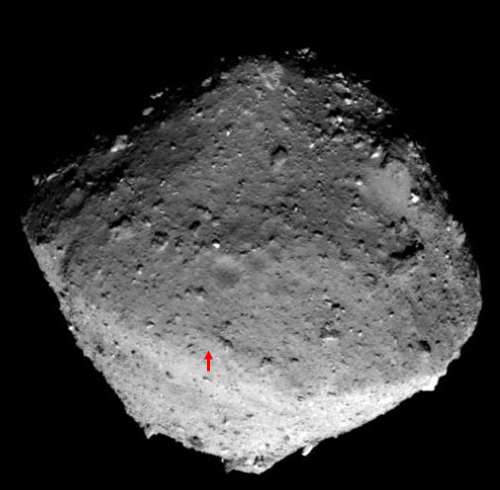
Ryugu as seen by Hayabusa-2 shortly before it grabbed
samples from the surface in 2019. Arrow indicates planned touchdown
site.
Though the last ion engine on the Japanese asteroid probe Hayabusa-2 has now failed, engineers think they can improvise a method to keep the spacecraft under control as it heads to a 2031 rendezvous with the tiny 32-foot-wide asteroid 1998 KY26, which some have suggested might instead be the failed Soviet Mars probe Phobos-1.
Of Hayabusa2’s four ion engines, A, C and D had degraded substantially, so engine B, which had been preserved during its journey to and from Ryugu, has been mainly used on the extended mission. After the B engine broke down in mid-August, JAXA unsuccessfully attempted to fix it.
The ion engine consists of an ion source and a neutralizer, and both must operate simultaneously for navigation. A close examination found that the B engine’s ion source has failed while its neutralizer is functioning. Meanwhile, the neutralizers of the C and D engines have broken down, but their ion sources are functioning. Therefore, JAXA decided to switch the circuit to combine the B engine’s neutralizer with the D engine’s ion source to resume the operation of the B engine.
This was the technique engineers used when a similar failure occurred on Japan’s first asteroid probe, Hayabusa-1. The difference is that with Hayabusa-1 the problems occurred early in the mission, when the spacecraft was young and still relatively healthy. Hayabusa-2 however has been in space for more than a dozen years, has returned samples from the rubble pile asteroid Ryugu, and flew past the asteroid Torifune. For it to last another five years under these conditions remains questionable.

On Christmas Eve 1968 three Americans became the first humans to visit another world. What they did to celebrate was unexpected and profound, and will be remembered throughout all human history. Genesis: the Story of Apollo 8, Robert Zimmerman's classic history of humanity's first journey to another world, tells that story, and it is now available as both an ebook and an audiobook, both with a foreword by Valerie Anders and a new introduction by Robert Zimmerman.
The print edition can be purchased at Amazon or from any other book seller. If you want an autographed copy the price is $60 for the hardback and $45 for the paperback, plus $8 shipping for each. Go here for purchasing details. The ebook is available everywhere for $5.99 (before discount) at amazon, or direct from my ebook publisher, ebookit. If you buy it from ebookit you don't support the big tech companies and the author gets a bigger cut much sooner.
The audiobook is also available at all these vendors, and is also free with a 30-day trial membership to Audible.
"Not simply about one mission, [Genesis] is also the history of America's quest for the moon... Zimmerman has done a masterful job of tying disparate events together into a solid account of one of America's greatest human triumphs."--San Antonio Express-News
12 years is a good run!
If the Imperial Japanese Navy had been as good at damage control as the Hayabusa team they would have given us a considerably tougher time in the Pacific 1941-45.