LRO snaps picture of crater created by Falcon 9 impact on Moon
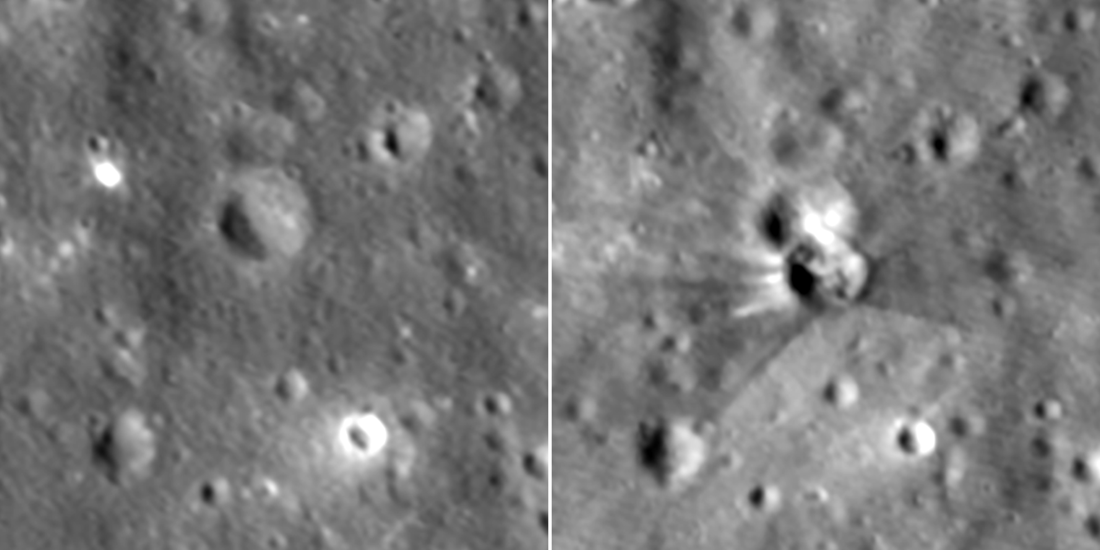
Before and after images. Click for original.
The science team for NASA’s Lunar Reconniassance Orbiter (LRO) today released high resolution before and after pictures of the location on the Moon where a Falcon 9 upper stage crashed on August 5, 2026.
They were able to locate the impact point using data provided by South Korea’s Danuri lunar orbiter, which took the first impact images but from a greater distance and from the side.
The new crater (19.4759°N, 266.7138°E, 511 meters elevation) is 18 meters in diameter and is less than 3 meters deep (constrained with a shadow measurement). The distinctive V-shaped ejecta pattern on the south side of the crater is consistent with natural impactors hitting the Moon at low angles relative to the surface. In this case, the booster impacted at about 31° from horizontal; the forbidden zone (bright area on the south side of the crater) seen here is consistent with low-angle natural impacts. Other spacecraft impacts, such as the large Apollo Saturn S-IVB stage craters, do not always follow the same rules as natural impacts. This deviation may be due to the relatively odd mass distribution within a rocket. Upon impact, most of the booster consists of empty fuel tanks with a very heavy engine at one end. The final shape of the crater and the distribution of ejecta might be affected by the orientation of the booster upon impact (i.e., heavy end down, on its side, light end down, or somewhere in between). If the heavy end hits first, perhaps the crater and ejecta behave more like a natural event.
Why the mixed dark and bright ejecta? The Moon is covered in a layer of soil, known as regolith. Over time, the top portion of the regolith is constantly bombarded by the solar wind, galactic cosmic rays, and micrometeorite impacts. These external forces tend to darken and redden the regolith to a depth of roughly 50 centimeters. As an asteroid, or rocket body, first contacts the regolith, particles are jetted out at high velocity. As the body buries itself and explodes, it throws out deeper subsurface material, forming an ejecta blanket around the crater rim. In the Falcon 9 crater, the darker, streaky material was likely derived from the mature upper 50 centimeters of the regolith. In contrast, the brighter material near the crater rim came from the deeper, immature portion of the regolith (>50 centimeters below the surface).
As noted previously, such impacts have occurred before, and are not of much consequence, other than the scientific data outlined above. When lunar bases are established the issue will be of more concern.
On Christmas Eve 1968 three Americans became the first humans to visit another world. What they did to celebrate was unexpected and profound, and will be remembered throughout all human history. Genesis: the Story of Apollo 8, Robert Zimmerman's classic history of humanity's first journey to another world, tells that story, and it is now available as both an ebook and an audiobook, both with a foreword by Valerie Anders and a new introduction by Robert Zimmerman.
The print edition can be purchased at Amazon or from any other book seller. If you want an autographed copy the price is $60 for the hardback and $45 for the paperback, plus $8 shipping for each. Go here for purchasing details. The ebook is available everywhere for $5.99 (before discount) at amazon, or direct from my ebook publisher, ebookit. If you buy it from ebookit you don't support the big tech companies and the author gets a bigger cut much sooner.
The audiobook is also available at all these vendors, and is also free with a 30-day trial membership to Audible.
"Not simply about one mission, [Genesis] is also the history of America's quest for the moon... Zimmerman has done a masterful job of tying disparate events together into a solid account of one of America's greatest human triumphs."--San Antonio Express-News
Scientific instruments should be able to detect the presence of aluminum at the impact site, at a minimum.
Is that a piece of the rocket, in the crater?