
NASA approves unmanned Starliner cargo mission for December 2026
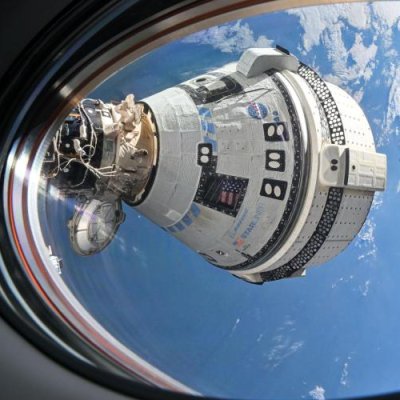
Starliner docked to ISS in 2024.
In a press conference today, NASA announced it has approved an unmanned cargo mission for Boeing’s Starliner capsule for no earlier than December 2026 and to use that flight as an engineering test to see if the fixes to the capsule’s systems work before authorizing two more manned Starliner missions to ISS.
They have dubbed this cargo mission Starliner-1, apparently to erase the memory of the previous problematic Starliner flights.
You can watch the press conference here. From the press release:
The uncrewed Starliner-1 has the potential to fly in December of this year or January 2027. It will serve as an engineering evaluation mission to verify improved thermal environments, obtain necessary performance data for system qualification, and identify residual risk ahead of crewed missions.
They detailed at great length the work that has been done to pinpoint the cause of the thruster issues, due apparently to corrosion issues on the ground before launch. The thrusters are being replaced with new materials. So have other components. The uncrewed cargo mission is expressly aimed at testing these fixes. As both NASA Jared Isaacman and NASA astronaut Woody Hoburg noted, Boeing’s Starliner program had been hardware and testing poor. To paraphrase their words, you need to test to make sure your hardware will work. Boeing apparently didn’t do this. The cargo flight is to do this kind of flight testing.
Though NASA wants to fly at least two more Starliner manned flights, they will not be approved before this test flight, and only afterward if the agency is satisfied with the flight’s results.
It also appears that NASA is picking up the tab for this cargo flight, treating it as one of the six manned flights in Boeing’s original NASA contract, leaving only five manned flights left. When asked about the cost for the fixes and the cargo mission, and who was paying for it, Dana Weigel, (manager of NASA’s ISS program) vaguely said the cost was $359 million, the same as the other manned missions, and she did so in a manner clearly designed to avoid saying who paid for it. Sadly, no one in the press corps followed up for clarity.
However, this $369 million is not an add-on to NASA’s contract with Boeing. Boeing will essentially fly one less manned mission now within the terms of its contract.
In addition, NASA and Boeing will be working to certify ULA’s Vulcan rocket for manned flights, since the six Atlas-5 rockets that Boeing has purchased from ULA for its Starliner missions are getting old and cannot be replaced with new Atlas-5s because the rocket is retired. Boeing needs another rocket to get Starliner into orbit on future flights. This action is also to deal with the possibility that SpaceX will eventually retire crew Dragon and Falcon 9.

On Christmas Eve 1968 three Americans became the first humans to visit another world. What they did to celebrate was unexpected and profound, and will be remembered throughout all human history. Genesis: the Story of Apollo 8, Robert Zimmerman's classic history of humanity's first journey to another world, tells that story, and it is now available as both an ebook and an audiobook, both with a foreword by Valerie Anders and a new introduction by Robert Zimmerman.
The print edition can be purchased at Amazon or from any other book seller. If you want an autographed copy the price is $60 for the hardback and $45 for the paperback, plus $8 shipping for each. Go here for purchasing details. The ebook is available everywhere for $5.99 (before discount) at amazon, or direct from my ebook publisher, ebookit. If you buy it from ebookit you don't support the big tech companies and the author gets a bigger cut much sooner.
The audiobook is also available at all these vendors, and is also free with a 30-day trial membership to Audible.
"Not simply about one mission, [Genesis] is also the history of America's quest for the moon... Zimmerman has done a masterful job of tying disparate events together into a solid account of one of America's greatest human triumphs."--San Antonio Express-News
I’m grateful to Eric Berger for asking that question. The pity is, he should not have had to have asked it in the first place. It had to be dragged out of Dana Weigel. I think Berger wanted to follow up with clarification on the other funding questions, but it seemed like NASA wanted to get out of the press conference while saying as little as possible, so follow-up opportunities were not smiled on.
Anyway, it does seem like NASA HQ has shifted its vibe on Starliner. A year ago, I don’t think they were keen to put any more money toward Starliner, and frankly, top leadership seemed fed up with Boeing, and for good reason. But now, with Crew Dragon seemingly likely to wind down in 2030, I think they really are a bit panicky. And that means that Boeing suddenly has more leverage than they did before.
Speaking of which…
The scuttlebutt is that NASA may be paying for at least a major part of this tab, too. Again, Boeing suddenly has more leverage. But they haven’t said anything official yet.
Later during the press conference John Mulholland (vice president and program manager, Boeing Commercial Crew) stated that Staliner-2 (to be piloted by Woody Hoburg) is expected in mid-2028. I guess we’ll see if that actually sticks. (Probably not!)
By the way, there’s now a transcript of the Q&A session, for those who want to read it (and not have to sit through the video of the thing):
https://forum.nasaspaceflight.com/index.php?action=dlattach;topic=47917.0;attach=2549518;sess=0
It appears the deal NASA struck with Boeing is that it would treat the cargo mission as an operational manned mission, paying the company the money that contract specified for such missions. NASA however would deduct that from the total missions in Boeing’s contract.
In other words, NASA has not really laid out any extra cash. It is now merely paying what it would have for the first manned Starliner flight, following the manned demo mission, but doing it as a unmanned test flight.
Overall I think this is a smart deal by Isaacman.
Overall I think this is a smart deal by Isaacman.
Considering that NASA will need a post-Dragon vehicle in order to continue its space station program (using commercial stations after ISS is decommissioned), NASA needs something like Starliner, and there are no alternatives in the works, at this time.
I think it is a good move on SpaceX’s part to make sure that the world is not dependent upon them for all transportation into space. From the company’s point of view: they want to move on to other projects. From the world’s point of view: they need alternatives and competition in order to assure low prices and advancements in technology.
If Dragon really is going away, I agree, this is probably the best thing Isaacman can do now.
I think I’d still rather see Boeing sell the whole program to a competent and resourced aerospace company, but that’s obviously a whole ‘nother discussion.
I hope that 370 million a flight is a profit for Boeing, but I just don’t think it is.
At this point it just does not matter.At that price no private company is going to hire them with that rocket. Not when other options are out there.
By the time Boeing gets good at launching things with this rocket Space X will be fully proven and operating. Insurance companies will ask for their customers to use Space X instead.
Minor edit in last sentence of third- from-last paragraph: “the press corps”
Fixed. Thank you.