October 13, 2026 Quick space links
Courtesy of BtB’s stringer Jay. This post is also an open thread. I welcome my readers to post any comments or additional links relating to any space issues, even if unrelated to the links below.
- Amazon is reportedly planning to bundle its Leo satellite internet service with Amazon Prime subscriptions
Makes sense, but not yet confirmed.
- Relativity Space provides an update on the development of its Terran-R rocket
While the company continues to target a launch before the end of the year, this update suggests to me that the launch will slip into early 2027.
- The head of ESA lobbies for €10 billion to build ESA’s own manned capsules
The article was clearly conducted by someone whose knowledge of the space industry is very shallow, but it still gives us a sense of where Europe’s space agency hopes to head.
- Another new Chinese rocket pseudo-company appears, dubbed Spaxus
Its proposed rocket would have a spaceplane as an upper stage. As the tweet notes, no hardware exists as yet. As Jay notes, we are now in “round 2 of the vaporware rockets” from China.
- On October 13, 1969 the Soviet Union launched Soyuz-8, part of a mission involving three Soyuz spacecraft in orbit simultaneously
The plan had been to have Soyuz 7 and 8 dock while Soyuz-6 filmed it. No docking occurred because of a pressure test prior to launch damaged their rendezvous electronics.
- Video of the first chopstick catch of Superheavy on October 13, 2024, on the very first attempt
This remains one of the most majestic engineering achievements by anyone ever.
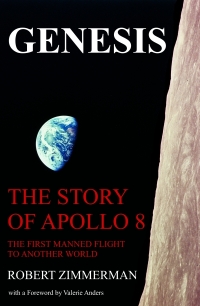
On Christmas Eve 1968 three Americans became the first humans to visit another world. What they did to celebrate was unexpected and profound, and will be remembered throughout all human history. Genesis: the Story of Apollo 8, Robert Zimmerman's classic history of humanity's first journey to another world, tells that story, and it is now available as both an ebook and an audiobook, both with a foreword by Valerie Anders and a new introduction by Robert Zimmerman.
The print edition can be purchased at Amazon or from any other book seller. If you want an autographed copy the price is $60 for the hardback and $45 for the paperback, plus $8 shipping for each. Go here for purchasing details. The ebook is available everywhere for $5.99 (before discount) at amazon, or direct from my ebook publisher, ebookit. If you buy it from ebookit you don't support the big tech companies and the author gets a bigger cut much sooner.
The audiobook is also available at all these vendors, and is also free with a 30-day trial membership to Audible.
"Not simply about one mission, [Genesis] is also the history of America's quest for the moon... Zimmerman has done a masterful job of tying disparate events together into a solid account of one of America's greatest human triumphs."--San Antonio Express-News
There is new technology for scanning rods for reactors:
https://techxplore.com/news/2026-10-3d-imaging-technique-nuclear-fuel.html
The largest, fast-spinning asteroid yet found:
https://phys.org/news/2026-10-vera-rubin-observatory-largest-ultra.html
It is 1.6 miles across (2.5 km for metric heathens) and makes a full rotation in four minutes.
So how far out can a tube (or how far down a circular tunnel) be for one gee?
The gravity at the outer edge would be barely eight percent of Earth’s; you aren’t getting 1g anywhere, no matter how long of a tunnel you dig unless you spin the asteroid at a faster rate. Or, you can extend a structure nearly ten miles out from the asteroid’s surface, with a tangential velocity at the tip of 876 miles per hour. You can use an online calculator like SpinCalc to verify these figures. The angular velocity will be 0.239 rpm, and centripetal acceleration is, of course, 1g.
All right, how about 2025 MN45?
https://www.space.com/astronomy/asteroids/vera-rubin-observatory-discovers-the-fastest-spinning-asteroid-ever-and-its-huge
It spins once every 2 minutes or so.
Cables were used to cut the Kursk in half after the torpedoes with HTP blew out its bow.
You could thus turn the rotational velocity and make it translational….by turning it into a bola and releasing one end of the mass.
The cutting cable and bola cables could come off a spindle inside Starship and pass through the pez dispenser.
Chomper might be too limber…. maybe fill Starship ‘s nose with extra propellant and mount a longitudinal payload bay box along its length?
Also—Scott Manley just released a video on Jared and the NASA Blackbird.
Skylon engines were to use hydrogen of course….but what about methane?
In place of the D-21 drone, maybe an LNG cylinder along the top?
Scott showed a vertical aerospike atop the NASA craft…it looked like a massive vertical stabilizer. He mistakenly said it was a test for X-35….that was Joint Strike Fighter that is now F-35.
Scott probably meant X-33/VentureStar/aero ballistic rocket as per LockMart.
That was to be a hydrogen burner too, so I don’t know if they used a hydrocarbon fuel in lieu of that or not.
Jared is a jet guy at least.
Fast spinning asteroids could become transportation hubs by powering fairly low tech beanstalks. Using them as virtual gravity assists for transportation elsewhere.
Jeff Wright asked: “So how far out can a tube (or how far down a circular tunnel) be for one gee?”
This can be calculated from a standard dynamics equation:
a = r x w^2
where:
a is acceleration = 10 m/s^2 (1 G)
r is radius
w is rotation = 2 x π / (4 x 60 (1/seconds))
r = a / w^2 = (10 m/s^2) / (2π/240 (1/s))^2
r = 14,600 m = 14½ km = 9 miles
Subtract the radius of the asteroid to find the distance above the surface:
9 miles — 0.8 miles = 8.2 miles
Bonus:
The acceleration at the surface of the asteroid is
a = (1,250 m / 2) x (0.026 1/s)^2 = 0.85 m/s = .085 G
Thus, if the asteroid is not dense enough to generate about 1/12 G, then nothing will stick to the surface. If it is the density of rock, then the surface gravity is around 0.0002 G, not quite enough to hold any boulders, rocks, sand, or dust. The speed of the surface of the asteroid, at the equator, is:
v = 2π x rev/hr x r
v = 6.28 x 15 x 1,250 m = 118 km/h
v = 73 miles per hour or about 110 ft per second
where v is equatorial velocity.
Of course, this all assumes a spherical asteroid in a vacuum.
If Amazon is going to compete with Starlink in the residential consumer market it’s going to have to gin up, from scratch, a cadre of installers who can attach the terminals to customer dwellings. That’s a bit more involved than just dropping a box on a porch. Setting up the installation capability is likely going to be a key brake on overall deployment speed for the Amazon LEO network.
Agree with Robert Z. about Relativity’s first test flight. That September update doesn’t suggest capability to launch being achieved during the remainder of this year. Looks like Berger’s Law applies yet again.
You say that, but just dropping off a box is exactly how Starlink started, too. The early adopters are going to be those willing to do the install themselves. Plus those vendors that already install Starlink probably won’t mind some added business from installing other companies’ devices. It’s not like we’re talking radically different tech here: antenna on the roof, controller/router in the house, maybe some mesh network nodes inside if the house is big enough, plus some software config.
Can’t say for sure that you’re wrong. The key thing is probably whether SpaceX’s deals with installers are exclusive or not. Still, any way one cares to slice it, Amazon has got itself a considerable stern chase on its hands.
€10 billion is a big ask, and so far there’s no evidence that member states are willing to grant that kind of money to ESA – not least given dire fiscal state of the key states. Color me skeptical that Aschbacher will be able to obtain anything more than limited study funding.