
October 8, 2026 Quick space links
Courtesy of BtB’s stringer Jay, plus the first from reader Nate P. This post is also an open thread. I welcome my readers to post any comments or additional links relating to any space issues, even if unrelated to the links below.
- A interview of NASA’s Moon Base Program Manager Carlos Garcia-Galan
Not much new information, but Garcia-Galan provides a good short summary of NASA’s overall Moon Base plans.
- NASA official touts a meeting yesterday with forty different Artemis Accords signatories
I suspect the meeting was mostly NASA officials outlining its lunar plans so that these partners can assess where they might have an opportunity to participate.
- The Royal Swedish Academy of Sciences awards this year’s Nobel Prize in Physics to Francis Halzen
He led the project to build the IceCube neutrino telescope in the ice at the South Pole.
- A quick summary of SpaceX’s emerging construction plans at its new Pecan Island spaceport in Louisiana
The tweet calls the spaceport “the Vermilion Parish complex”. While this is the parish where it is located, I am not sure yet if that is the name SpaceX has chosen.
- ISRO completes integration and testing of the first Gaganyaan capsule
The unmanned test flight will lift-off one month after the next GSLV launch, presently scheduled for the October-November time frame. In other words, before the end of this year.
- On October 8, 2012 SpaceX’s first operational Dragon cargo mission to ISS lifted off from Cape Canaveral
It successfully reached orbit despite the explosion of one Falcon 9 1st stage engine during launch. It was also not the first Dragon mission to ISS. It has been preceded by a successful demo mission in May 2011 (details here and here).
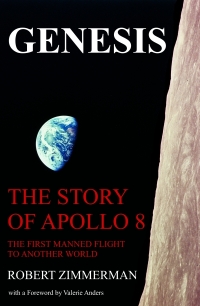
On Christmas Eve 1968 three Americans became the first humans to visit another world. What they did to celebrate was unexpected and profound, and will be remembered throughout all human history. Genesis: the Story of Apollo 8, Robert Zimmerman's classic history of humanity's first journey to another world, tells that story, and it is now available as both an ebook and an audiobook, both with a foreword by Valerie Anders and a new introduction by Robert Zimmerman.
The print edition can be purchased at Amazon or from any other book seller. If you want an autographed copy the price is $60 for the hardback and $45 for the paperback, plus $8 shipping for each. Go here for purchasing details. The ebook is available everywhere for $5.99 (before discount) at amazon, or direct from my ebook publisher, ebookit. If you buy it from ebookit you don't support the big tech companies and the author gets a bigger cut much sooner.
The audiobook is also available at all these vendors, and is also free with a 30-day trial membership to Audible.
"Not simply about one mission, [Genesis] is also the history of America's quest for the moon... Zimmerman has done a masterful job of tying disparate events together into a solid account of one of America's greatest human triumphs."--San Antonio Express-News
The news item about the Nobel Prize in Physics reminds me of an American ham whose callsign is K1JT, otherwise known as Dr. Joseph Hooton Taylor. He’s, perhaps, best known among radio amateurs for creating the weak signal digital radio program WSJT as well as being a co-creator of the FT8 digital mode.
And by the way, he also won the Nobel in 1993 for his work on pulsars, sharing it with Russell Alan Hulse. That work eventually led to the discovery of gravitational waves.
On materials for hypersonics
https://techxplore.com/news/2026-10-industrial-torch-fuels-faster-materials.html
Elon is about to go into the mobile phone business.
https://www.basenor.com/blogs/news/spacex-lands-800-mhz-spectrum-starlink-mobiles-carrier-play-gets-real
As he accumulates more money, I hope he can restart CRT production cassettes….spearheading a return to physical media would put him in solid.
Zuckerberg and others are squarely of the “own nothing” crowd. Starship is retro itself.
I think a book about pulse-Orion had a heavy barber’s chair it it. I’d like to see him do that.
He’s already in the mobile phone business and has been for awhile now. This latest spectrum acquisition is just part of SpaceX’s plan to become a free-standing cell service provider without needing any partnerships with terrestrial carriers.
When SpaceX get Starship up and running reliably, we can finally begin sending nuclear waste to the sun.
There is no such thing as nuclear waste. (The term was created to prevent people from stealing it) It’s the most energy dense substance on earth, and with breeder reactors can be recycled for more energy.
Fire up a reactor and you can power in aircraft carrier, submarine, spacecraft or entire city for the next 20 years!
If you wish to throw away the most valuable metal on planet earth, Throw it to Mars! They will need all the energy they can get.
I ask out of ignorance not conflict:
If you do that..if you reprocess the “waste” into usable fuel with breeder reactors, what is left once the new fuel is exhausted? How radioactive? How much? Can it be reprocessed again?
Thanks.
Available sources can answer your question better than I. The question challenges me to look it up and reacquaint what I remember.
Although breeder reactor was first done in Idaho, other nations have built prototypes and the French are the only ones to my knowledge use a breeder reactor to create more uranium fuel out of spent fuel. (Uranium 235 and plutonium, which is used in nuclear batteries, from re-processed swollen 15% spent rods that just sit in cooling pools near the reactor site heating water and wasting their energy)
https://energyeducation.ca/encyclopedia/Breeder_reactor
The process is slow and inefficient with 1.2 ratio of conversion. (although the process is different, reactors and breeding reactors both produce power)
To answer your question from the link above;
“The amount of time for a breeder to produce enough material to fuel a second reactor is called its doubling time.[3] Present goals for a breeder reactor’s doubling time is 10 years, which means it would operate for 10 years producing energy and breeding fissionable material, after which this material could be used to produce the same energy output for another 10 years“
“In 1966, France opened a reprocessing facility in La Hague, dedicated to extracting uranium and plutonium from the spent fuel rods to be converted into usable fuel for subsequent fuel rods. Since opening, the plant processed over 20,000 tonnes by the 2000s and has reprocessed over 30,000 tonnes of fuel, consistently on pace with that predicated by analysts in the 80s, demonstrating its consistency as a reprocessing plant. [5,6]“
Thorium seems to be better for this process;
“Thorium hasn’t been used in large scale reactors, however some reactors have used it successfully in the past. A light water breeder reactor in Shippingport, Pa. USA operated for 5 years, and by the end of its operation it had 1.4% more fissile fuel than it began with.”
The energy released from splitting atoms is considerable, although they’re creating heavier elements… Lighter elements like nitrogen and helium are also produced. It takes thousands of years to completely use up uranium products. A little bit goes a long ways for a long time making it most valuable energy source mankind has come across yet. They keep promising better reactors like a Tolamac reactor which they’ve spent hundreds of billions of dollars on, building at least 77 different prototype reactors that have all failed. None have proven a safe way to contain the energy of a hydrogen bomb slowing down the nuclear reaction to make it feasible.
” . . . IceCube neutrino telescope in the ice at the South Pole.”
A little curious if Mr Cube has ever visited. Maybe for the next album cover shoot.
Maybe he’ll visit Next Friday.
A new way to detect the gravitational pull of small objects
https://phys.org/news/2026-10-sensor-gravitational-tiny.html
That will be of use in finding space debris….finding missing probes for return….so the can go in museums.