Redwire gets contract to build solar arrays for Axiom’s second space station module
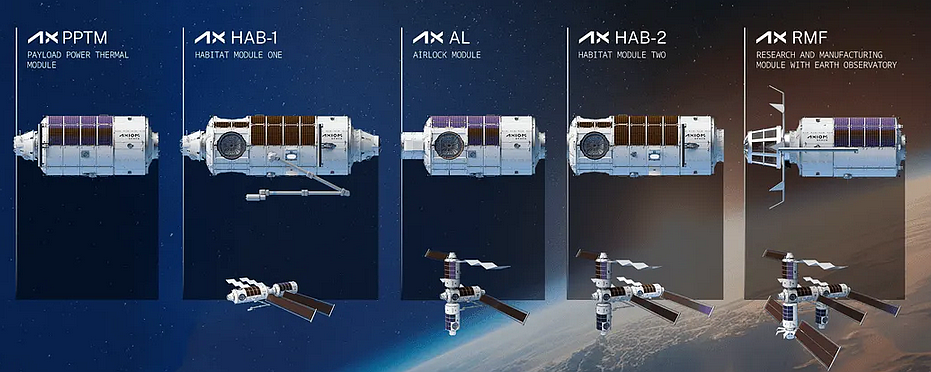
Axiom’s module assembly sequence
Axiom yesterday awarded Redwire a second contract to build the solar arrays for its second space station module, having previously in 2025 awarded the company the contract to build the arrays for the first module.
The press release provided no information as to contract price or schedule, but did say this about the status of Axiom’s first two modules:
Axiom Station’s first module is currently undergoing final assembly at Thales Alenia Space, in Turin, Italy, after which the module will be transferred to Houston for integration and testing and ultimately transferred to the Kennedy Space Center in Florida for launch. Axiom Space is planning to launch the first module in 2028. The second module is preparing to undergo final assembly at Thales Alenia Space and is planned to launch less than a year after the first, where it can loiter on orbit until ready to dock with the first module. Together, these two modules will form a four crew-capable, operational free-flying space station.
The plan is to initially attach these modules to ISS, transfer much of ISS’s equipment into Axiom’s modules for NASA, and then detach to fly as an independent station before ISS is retired and de-orbited in 2030. Though this schedule remains unchanged since the last update, the schedule remains very tight to get everything done before ISS goes away.
Hat tip BtB’s stringer Jay.
My updated rankings of the five American space stations presently under development:
- Haven-1 and Haven-2, being built by Vast, with no NASA funds. The company plans to launch its single module Haven-1 demo station in 2027 for a three-year period during which it will be occupied by at least four 2-week-long manned missions, one of which will include a French astronaut. It planned manned mission to ISS in ’28 will also include both a French and Czech astronaut. It has also made preliminary deals with Lithuania, Colombia, Uzbekistan, Japan, the Czech Republic, and the Maldives for possible astronaut flights to Haven-1, as well as four biomedical companies. It has raised more than a billion in cash for this work, and has already tested an unmanned small demo module in orbit.
- Starlab, being built by a consortium led by Voyager Space, Airbus, and Northrop Grumman, with extensive partnership agreements with the European Space Agency, Mitsubishi, and others. Though no construction has yet begun on its NASA-approved design, it has raised $383 million in a public stock offering, the $217.5 million provided by NASA, and an unstated amount from private capital, probably in the range of about $250 million. It has also begun signing up station customers, as well as a number of companies to build the station’s hardware and provide the station communications. It also plans a mission to ISS in ’28.
- Axiom, being built by Axiom, has launched four tourist flights to ISS. A fifth mission is now planned for ’27. The company has now raised $625 million in private investment capital. Thales Alenia in Europe has been building its first two modules, with the first scheduled to launch in 2028. The company has also now established a subsidiary in Europe as well as signed Redwire to build solar panels for both modules.
- Thunderbird, proposed by the startup Max Space. It is building a smaller demo test station to launch in ’27 on a Falcon 9 rocket, and has begun work on its manufacturing facility at Kennedy in Florida. Its management includes one former NASA astronaut and one former member of the Bigelow space station team that built the first private orbiting inflatable modules, Genesis-1, Genesis-2, and BEAM (still operating on ISS).
- Orbital Reef, being built by a consortium led by Blue Origin and Sierra Space. This station appears dead in the water. Blue Origin has built almost nothing, and while Sierra Space has successfully tested its inflatable modules, including a full scale version, its reputation is soured by its failure in getting its Dream Chaser cargo mini-shuttle launched to ISS.

On Christmas Eve 1968 three Americans became the first humans to visit another world. What they did to celebrate was unexpected and profound, and will be remembered throughout all human history. Genesis: the Story of Apollo 8, Robert Zimmerman's classic history of humanity's first journey to another world, tells that story, and it is now available as both an ebook and an audiobook, both with a foreword by Valerie Anders and a new introduction by Robert Zimmerman.
The print edition can be purchased at Amazon or from any other book seller. If you want an autographed copy the price is $60 for the hardback and $45 for the paperback, plus $8 shipping for each. Go here for purchasing details. The ebook is available everywhere for $5.99 (before discount) at amazon, or direct from my ebook publisher, ebookit. If you buy it from ebookit you don't support the big tech companies and the author gets a bigger cut much sooner.
The audiobook is also available at all these vendors, and is also free with a 30-day trial membership to Audible.
"Not simply about one mission, [Genesis] is also the history of America's quest for the moon... Zimmerman has done a masterful job of tying disparate events together into a solid account of one of America's greatest human triumphs."--San Antonio Express-News