
Russia to upgrade its still incomplete Rassvet satellite constellation
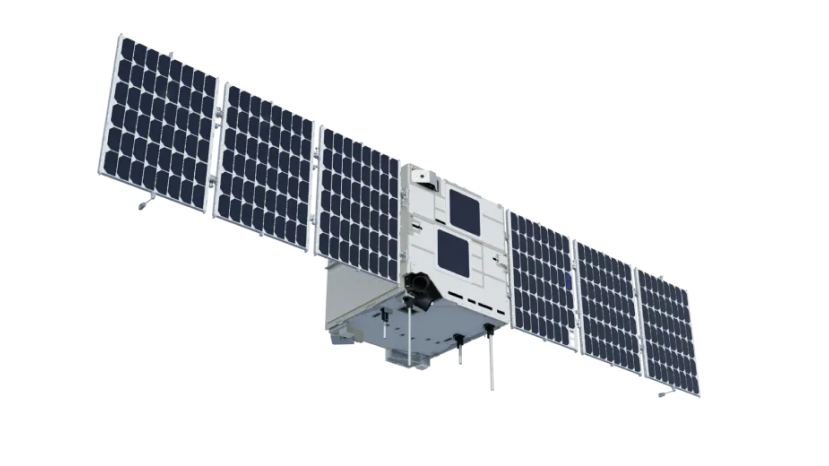
Rassvet-3 satellite from Bureau 1440’s website. Click
for original. Note that this website presently appears dead.
According to a recent filing submitted to the International Telecommunication Union (ITU), Russia is proposing an upgrade to the satellites in its still incomplete Rassvet satellite constellation, supposedly built by an independent Russian company called Bureau 1440.
The filing describes a constellation of 374 spacecraft operating at an altitude of about 800 kilometers, spread across 17 orbital planes with 22 satellites in each. … Rassvet-4 appears to be an upgraded version of Rassvet-3 rather than an entirely new platform, potentially incorporating lessons from the first 32 Rassvet-3 satellites launched in March and July 2026.
The Rassvet-3 satellites so far launched have not done well. Of the first 16 satellites launched in March, one quickly fell back to Earth, while only 12 reached their planned orbit. In the second group of 16 launched in July, one has also been lost and another is struggling to stay in orbit. Of the remain 14, none have reached their intended orbits. That means out of 30 only 12 operated as intended.
The announced goal was to launch 700+ by 2035. This new ITU filing suggests the Rassvet-4 constellation will be smaller, which means it could become operational sooner. Much of this is guesswork, as Russia has not released much information about either Rassvet version, other than to indicate it is intended to give it the same kind of communications capability Starlink/Starshield provides the U.S. and the Ukraine.
Russia’s pace of Rassvet launches is also worthy of note. When Roscosmos was launching OneWeb satellites on its Soyuz-2 rocket back before its invasion of the Ukraine ended that contract, it was doing about one launch per month in 2021. Furthermore, in the Soviet era Russia routinely launched 70 to 100 times per year. In recent years it has struggled to get to 20 annual launches, and recently can barely top a dozen. Right now it appears it can only do about two Rassvet launches per year. At that pace it will take decades to deploy the full constellation.
The pace will likely pick up at some point, but then it faces the concerted effort of the Ukraine to attack both the Russian launch site at Plesetsk as well as the Soyuz-2 rocket factory inside Russia. The former has severely limited its ability to launch as planned.

On Christmas Eve 1968 three Americans became the first humans to visit another world. What they did to celebrate was unexpected and profound, and will be remembered throughout all human history. Genesis: the Story of Apollo 8, Robert Zimmerman's classic history of humanity's first journey to another world, tells that story, and it is now available as both an ebook and an audiobook, both with a foreword by Valerie Anders and a new introduction by Robert Zimmerman.
The print edition can be purchased at Amazon or from any other book seller. If you want an autographed copy the price is $60 for the hardback and $45 for the paperback, plus $8 shipping for each. Go here for purchasing details. The ebook is available everywhere for $5.99 (before discount) at amazon, or direct from my ebook publisher, ebookit. If you buy it from ebookit you don't support the big tech companies and the author gets a bigger cut much sooner.
The audiobook is also available at all these vendors, and is also free with a 30-day trial membership to Audible.
"Not simply about one mission, [Genesis] is also the history of America's quest for the moon... Zimmerman has done a masterful job of tying disparate events together into a solid account of one of America's greatest human triumphs."--San Antonio Express-News
Two questions/comments:
Will they be able to honor the practice of not infringing on the other satellites in orbit?*
Will they want to honor the practice of not infringing on other satellites?
*-Except when practicing their warfare in space techniques.
The tattered remnants of Russia’s various space “programs” continues to be an ever-shrinking bouquet of diminishing expectations. Maybe someone with the time to do so and a level of interest that greatly exceeds my own could check to see if the prediction markets offer any propositions having to do with the date upon which Russia ceases to be capable of launching anything to orbit or beyond.