September 15, 2026 Quick space links
Normally courtesy of BtB’s stringer Jay, but work has called him away for the next week or so. I ask my readers to email me links for tomorrow and until Jay returns.
This post is also an open thread. I welcome my readers to post any comments or additional links relating to any space issues, even if unrelated to the links below.
- Isar Aerospace finalizes deal to launch its Spectrum rocket from Spaceport Nova Scotia
This is merely finishing the paperwork, following the successful launch of Spectrum from Norway two weeks ago. It suggests as Isar ramps up its launch cadence it will include launches from this Canadian location.
- The Philippines’ space agency completes a meeting to review the regulatory requirements of its international space treaties
It seems agency officials are working to coordinate the paperwork done by “various government agencies.”
- Leadership changes at Luxembourg’s space agency
The new officials all come from Luxembourg’s private space sector, and should therefore continue that nation’s pro-capitalist policies.
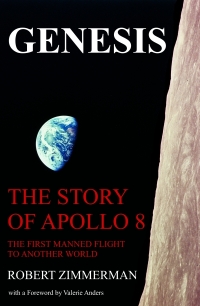
On Christmas Eve 1968 three Americans became the first humans to visit another world. What they did to celebrate was unexpected and profound, and will be remembered throughout all human history. Genesis: the Story of Apollo 8, Robert Zimmerman's classic history of humanity's first journey to another world, tells that story, and it is now available as both an ebook and an audiobook, both with a foreword by Valerie Anders and a new introduction by Robert Zimmerman.
The print edition can be purchased at Amazon or from any other book seller. If you want an autographed copy the price is $60 for the hardback and $45 for the paperback, plus $8 shipping for each. Go here for purchasing details. The ebook is available everywhere for $5.99 (before discount) at amazon, or direct from my ebook publisher, ebookit. If you buy it from ebookit you don't support the big tech companies and the author gets a bigger cut much sooner.
The audiobook is also available at all these vendors, and is also free with a 30-day trial membership to Audible.
"Not simply about one mission, [Genesis] is also the history of America's quest for the moon... Zimmerman has done a masterful job of tying disparate events together into a solid account of one of America's greatest human triumphs."--San Antonio Express-News
For what’s supposed to be a future spaceport, the site in Nova Scotia doesn’t have much. One would think that there would be preparations to build a booster preparation facility or a launch blockhouse. After all, the company did suggest that it would, someday, be capable of handling boosters such as the Ukrainian Tsyklon.
Now that Carney’s busy schmoozing with the EU and recently signing a 100-year agreement with Ukraine, perhaps things will pick up soon…..
Has this been posted here?
https://youtu.be/NVPZ5FAE5hM?si=bdHTitmzz1IOC3-Q
An incredible interview. I had never heard of Jeffrey Hoffman.
Hoffman was an astronaut during the early part of the space shuttle program. I recall him being a frequent guest on the CBC radio program Quirks and Quarks during the 1980s and ’90s.
I am finding what he has to say absolutely fascinating.
Having a satellite deploy a tether to deorbit itself without propellant. Grok says CubeSats now have deorbit kits with one of the methods being a tether. ( “Tethers Unlimited’s Terminator Tape is the best-known flight example.”)
He also cautions that daily Starship launches could foul the atmosphere, saying that being in orbit and looking down on the planet shows how fragile and thin the atmosphere actually is.
And Arthur C. Clarke and Olaf Stapledon get laudatory mentions. The Fountains of Paradise, Childhood’s End, and Stapledon’s Last and First Men.
“”It’s so small! This air which is keeping us alive is thinner than your skin! It’s a sliver! It’s immeasurably small…”
William Shatner post-flight 13 October 2021
Daily, or even hourly, Starship launches aren’t going to foul the atmosphere. Even if carbon emissions were a real problem, which they aren’t, space launch is and will remain small fraction of the emissions of other segments of the economy. Hydrogen, by the way, would not improve matters.
Yes, tethers are possible, but have many challenges. It’s far more common for satellites to be brought down by atmospheric drag or by thrusters. Starlinks actively deorbit themselves using their solar electric system, for example.
Actually, passive braking of cubesats has been in the works for some time. I believe the FCC made it mandatory about 2 years ago. Along with that, their altitudes has been restricted to around 400 km, making re-entry easier.
That applies not just to American satellites but, from what I understand, any that are launched from the U. S. So, if I, as a Canadian radio amateur, want to put a cubesat into orbit but not deal with that limit, I’d have to look to another country to put it into space.
That means that, at least for the foreseeable future, satellites such as AMSAT OSCAR 7 (AO-7), which has an altitude over 1400 km, won’t be flying out there any time soon. By comparison, the Russian RS-44 is at roughly the same distance out, doesn’t have that restriction.
Hoffman is cautious regarding Artemis. He says “Artemis is much more challenging than Apollo and has only a fraction of Apollo’s budget.”
His idea on using a Moxie device in the Venus atmosphere to create oxygen and carbon monoxide which inflates a balloon that floats 50 km above the surface sounds awesome.
I asked Grok if solar arrays on a balloon buoyant craft could generate electricity that powered a propeller – it said yes. But it is pretty windy up there (100 m/s) and sulfuric acid does not sound very nice. Grok says my idea of engineering a bacteria to use photosynthesis to consume the CO2 does not work because there is no water in the Venetian atmosphere.
There are new ways to break down CO2
https://phys.org/news/2026-09-plasma-electricity-methanol-butane-chemicals.html
https://phys.org/news/2026-09-crystal-capture-similar-molecules.html
Useful here and on Mars both
Oxygen is a lifting gas in Venus’s atmosphere, you don’t intrinsically need propellers or engines to stay aloft. Sulfuric acid can be protected against. It’s not that Venus has no water, it just doesn’t have enough to remove the carbon dioxide. A more likely, though still difficult, solution, is placing an enormous sail between Venus and the sun to block light, and freeze the carbon dioxide.
Though all this neglects how difficult it is to deorbit into Venus’s atmosphere in the first place, and the paucity of easily accessible raw materials. It’s cool, but I don’t think we’ll put people into the Venusian atmosphere any time soon. Certainly not before we settle Mars.
My thought was something along the lines of a combination of LOFTID/HAVOK type inflatable.
A gondola is not needed in that Earth’s sea-level pressure atmosphere is indeed a lifting gas–but a large inflatable also makes for fluffy, low wing-loading.
I never bought into Powell’s Airship-to-orbit, but I could see Airship-from-orbit….a slow-boat to Venus, with perhaps a trapeze type catch like on early US airships.
Good retirement home where sky-burial/cremation are achieved together…sliding off the plank, as it were.
HLLVs would orbit the airship in LEO….fill it up… maybe with hexanitrogen. Once inflated, it can spiral out of Earth’s gravity well.