September 3, 2026 Quick space links
Courtesy of BtB’s stringer Jay. This post is also an open thread. I welcome my readers to post any comments or additional links relating to any space issues, even if unrelated to the links below.
- A description of the September 1-2, 1859 solar flare dubbed the Carrington Event, after the English astronomer Richard Carrington
It still is the most powerful solar flare yet recorded, that was also aimed right at the Earth. The tweet is a bit of foolish fear-mongering, because the grid and other technology has been preparing for this for more than a half century. There is little to worry about.
- On September 3, 1976. 50 years ago today, Viking 2 landed at Utopia Planitia on Mars
Both Viking landers were mistakenly focused on searching for life, when we simply didn’t know enough about Mars for such a search. As such, they didn’t tell us as much about Mars as they could have. And the results from their search of life to this day remain inconclusive.
- On September 3, 2006 Europe’s SMART-1 lunar orbiter was deliberately crashed into the lunar surface
It was a technology test mission.
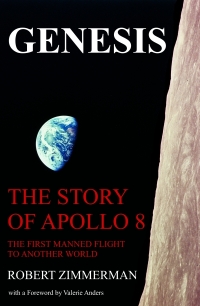
On Christmas Eve 1968 three Americans became the first humans to visit another world. What they did to celebrate was unexpected and profound, and will be remembered throughout all human history. Genesis: the Story of Apollo 8, Robert Zimmerman's classic history of humanity's first journey to another world, tells that story, and it is now available as both an ebook and an audiobook, both with a foreword by Valerie Anders and a new introduction by Robert Zimmerman.
The print edition can be purchased at Amazon or from any other book seller. If you want an autographed copy the price is $60 for the hardback and $45 for the paperback, plus $8 shipping for each. Go here for purchasing details. The ebook is available everywhere for $5.99 (before discount) at amazon, or direct from my ebook publisher, ebookit. If you buy it from ebookit you don't support the big tech companies and the author gets a bigger cut much sooner.
The audiobook is also available at all these vendors, and is also free with a 30-day trial membership to Audible.
"Not simply about one mission, [Genesis] is also the history of America's quest for the moon... Zimmerman has done a masterful job of tying disparate events together into a solid account of one of America's greatest human triumphs."--San Antonio Express-News
Re: Ongoing Launch Totals
So, the Falcon 9 has 9 rocket engines. The Starship SuperHeavy combo has 39.
4 x 9 = 36
Once in regular service,* will each Starship SuperHeavy launch count as 4 launches. (Yes, yes, this is a bit tongue-in-cheek) At least until we can document the total tonnage of each Starship mission.
*- Just writing, thinking about Starship SuperHeavy in regular service brings a smile.
To Mercury
https://phys.org/news/2026-09-pair-spacecraft-closer-mercury-decade.html
No moons for Venus
https://phys.org/news/2026-09-doesnt-venus-moon.html
“On September 3, 2006 Europe’s SMART-1 lunar orbiter was deliberately crashed into the lunar surface”
Where was all the Euro-hate? That doesn’t sound very ‘Green”. And what will Lunar environmentalists call themselves? The ‘Greys’? Oh yeah; already taken.
This is true, sadly. The Viking landers *did* tell us a good deal about the Martian atmosphere and how water existed on Mars, but those biological instruments took up a large chunk of the 91kg devoted to the Viking landers’ science payload allotment. It is arguable, in fact, that we got more science out of the Viking *orbiters* than we did the landers.
The greatest achievement of Viking may have been technical: NASA and JPL managed to successfully deploy two orbiters in Mars orbit and two very large landers on its surface, something which (all apologies to the ill-fated Soviet Mars 3 mission) had never been done before, and has often failed since; the engineering lessons learned from that heavily shaped all subsequent U.S. missions to Mars. I mentioned before that my aunt Judy was at JPL at the time and was a software engineer for Viking; a little bit of her is sitting on the Mars surface today. Sadly, she just passed away, and I am hip deep in putting her mortal remains to rest on *this* planet…do think of her, and all the brilliant engineers at JPL who worked on this program when you think of “Viking” today. They earned their paychecks, several times over.
The problem of the search for life is something which has been bedeviling NASA planetary science for a long time. Throwing the “life” tag on missions has long been perceived as a way to secure funding on the Hill, no matter how improbable the prospects or inadequate the means. The driving force behind John Culberson’s congressional crusade to push through Europa Clipper was Culberson’s absolute conviction that Europa’s subsurface oceans *must* be teeming with life. With Viking, however, that gamble had blowback, when the super expensive Viking fleet (about $7 billion in 2026 dollars) found no signs of life, and as a result NASA planetary science basically shrivelled up and died for several years. It was that reaction, in fact, which spurred Carl Sagan and Louis Friedman to go found the Planetary Society…
Oh well, perhaps Viking 2 will someday be repurposed as a gate guard at the Starfleet warp drive development laboratory that’s due to be built at Utopia Planitia in about two centuries. :)
“”The tweet is a bit of foolish fear-mongering, because the grid and other technology has been preparing for this for more than a half century. There is little to worry about.””
And yet, Trump is worried. He declared an emergency last year.
https://www.govinfo.gov/content/pkg/DCPD-202500447/pdf/DCPD-202500447.pdf
“(i) analyze sufficiently varied grid conditions and operating scenarios based on historic events to adequately inform the methodology;
(ii) accredit generation resources in such conditions and scenarios based on historical performance of each specific generation resource type in the real time conditions and operating scenarios of each grid scenario;“
Most transformers are manufactured in foreign countries, with years of backlogged orders.
Executive order 14420 “declared emergency” was issued a few days ago to promote the electrical equipment to be produced inside the United States for security reasons.
“At the center of the order are concerns that foreign-produced equipment incorporated into the power grid could contain vulnerabilities capable of being exploited for sabotage, unauthorized access or disruption. The bulk-power system supports electricity delivery to critical infrastructure, emergency services, defense operations and other essential functions across the country.”
“Under the order, certain purchases and installations of foreign-produced bulk-power system electric equipment will generally be prohibited when transactions involve foreign nationals and present specified security risks. Restrictions can also extend to critical software and digital capabilities associated with that equipment.”
Apparently they found digitally activated kill switches inside large transformers that were made in China or other countries with Chinese technology. It would’ve also prevented a restart after a nuclear strike or Carrington event? Allowing this nations enemies to take advantage of the nationwide black out.
What Trump was worried about had nothing to do with solar activity. He was focused on threats from hostile powers.
Nuclear EMP or flare–fried electronics are to be avoided.
From what I understand a real Nuclear caused EMP would requite quite a few things to line up in nature before the bomb would be able to start anything bigger than a firefly light of power to get to the ground.
“Both Viking landers were mistakenly focused on searching for life, when we simply didn’t know enough about Mars for such a search. As such, they didn’t tell us as much about Mars as they could have. And the results from their search of life to this day remain inconclusive.”
I don’t think it was a mistake at all. It gave us a reality check. Until Viking, there was a strong belief that the universe was rife with life. Mars was suspect number one, ever since Schiaparelli reported seeing canals on Mars (he said “channels,” but it looked like the English word for canal, and that was good enough for the press, which apparently has never been good at reporting reality). Since canals are intentionally built and channels can be natural, like the English Channel, Schiaparelli was clearly seeing the results of a civilization attempting to move water to where it was badly needed for agriculture.
With the popular belief that Mars held life, there were proposals for communicating with the people of that planet, using huge fields of light to “morse” signals from Earth’s night side. It was easy to believe that Mars had sent an invasion force to Grover Mills, New Jersey, one October night, scaring the hell out of the residents in the area.*
Searching for life on Mars was not a mere funding trick, it was a popular task for our first Mars lander. To land on Mars without searching for life would have been foolish. That the search provided contested results demonstrates that we really didn’t know much about such investigations; it isn’t just that we didn’t know enough about Mars for such a search. SETI has been researching this topic for decades; just how do we search for extraterrestrial life? How do we find it if it is there, and how do we know if it isn’t there?
We learned a lot from the Vikings, but some were not the lessons we thought we would get. That’s what happens when we launch new technologies and new adventures. Should we have searched for life since then in order to resolve the inconclusive results of the Vikings? Perhaps.
________
* Seriously: 30 years ago, I worked for a year a couple miles east of there, and the people at that satellite factory said that the Grover’s Mill population was still sensitive about the whole thing. Oh what an effect a throwing a dart at a map can have.