
SpaceX calls for more cooperation from other nations to avoid satellite collisions
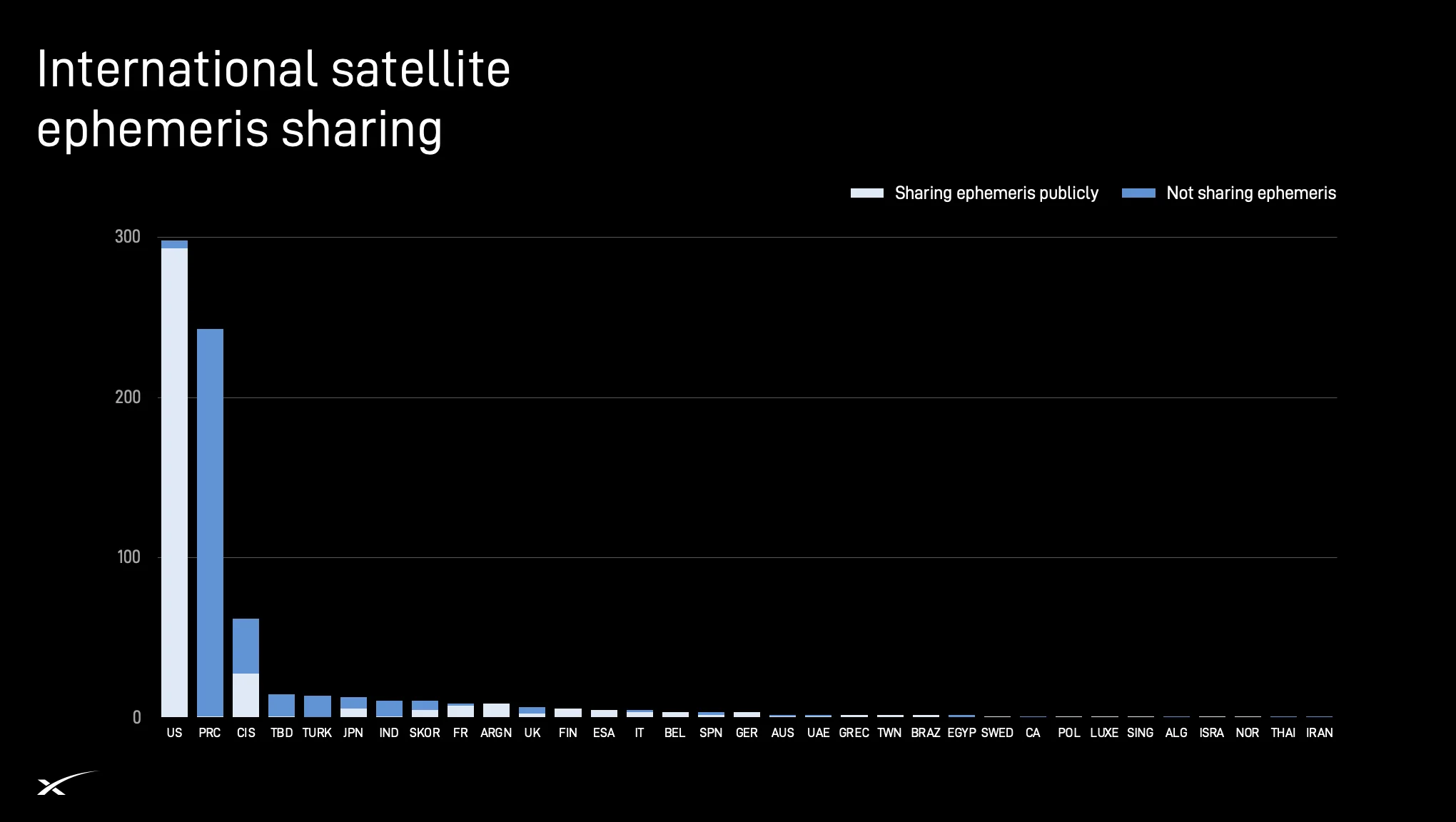
Orbital data shared or not shared by others. Click for original image.
In both a lecture held today at the International Astronautical Federation conference in Turkey by SpaceX official Mike Nicolls as well as a major press release by the company, SpaceX advocated for more cooperation by nations and companies to in order to more effectively prevent satellite collisions.
The graph above is from the press release and Nicoll’s presentation, and shows in white those nations and companies that publicly share their orbital data so that others can make sure their satellite paths do not conflict. Blue indicates those who do not share data, with China (PRC) and Russia (CIS) the biggest culprits, with China releasing almost nothing and Russia about half. SpaceX meanwhile releases almost all its satellite orbital data, the only exceptions being the national security launches it does for the federal government. As noted in the press release:
Operating safely in space requires knowing the trajectories of other nearby objects, to be able to effectively mitigate upcoming conjunctions. This requires satellite operators to share their ephemeris, typically by either publishing their own propagated trajectories, or proactively announcing their upcoming manoeuvres. Today, SpaceX operates at these standards and will continue to do so as our Starlink constellation grows, and we begin deploying the Starmind constellation next year. However, not all operators fly by these standards, with many still performing maneuvers without sharing their intentions ahead of time.
Not sharing satellite manoeuvres ahead of time can result in dangerous close approaches, that would otherwise have been easy to avoid. As the population of satellites in LEO continues to grow, we encourage every operator to adopt similar practices to prioritise the sharing of information and space safety.
In its presentations today SpaceX noted several examples where others satellite operators suddenly did unannounced maneuvers that required the company to quickly respond with its own maneuvers to guarantee no collision would occur. As noted in the release:
There is a simple solution to this issue if all operators proactively share planned ephemeris before the burn and then publish what actually happened afterwards. While the community has seen progress on this front, there are still considerable gaps, with many manoeuvring objects still not publishing their manoeuvres ahead of time.
SpaceX has created a webpage called Space-Safety.com for this purpose, using data collected by Starlink and making it available to all satellite users. Others can add their own data to the page. The company hopes this action will encourage countries like China to begin acting responsibly. And if not, the data from Starlink’s own systems will help everyone else track the non-players.

On Christmas Eve 1968 three Americans became the first humans to visit another world. What they did to celebrate was unexpected and profound, and will be remembered throughout all human history. Genesis: the Story of Apollo 8, Robert Zimmerman's classic history of humanity's first journey to another world, tells that story, and it is now available as both an ebook and an audiobook, both with a foreword by Valerie Anders and a new introduction by Robert Zimmerman.
The print edition can be purchased at Amazon or from any other book seller. If you want an autographed copy the price is $60 for the hardback and $45 for the paperback, plus $8 shipping for each. Go here for purchasing details. The ebook is available everywhere for $5.99 (before discount) at amazon, or direct from my ebook publisher, ebookit. If you buy it from ebookit you don't support the big tech companies and the author gets a bigger cut much sooner.
The audiobook is also available at all these vendors, and is also free with a 30-day trial membership to Audible.
"Not simply about one mission, [Genesis] is also the history of America's quest for the moon... Zimmerman has done a masterful job of tying disparate events together into a solid account of one of America's greatest human triumphs."--San Antonio Express-News
This is a good next step but the obvious answer is to have the satellites coordinate these maneuvers without human intervention. Right now, Space-Track finds out, then notifies the satellite owners, then they need to talk, then they need to act, then that data has to get to the satellite on the next comms pass. Soon, the time lag will become longer than the time needed to make the correction. It would be better to adopt a ‘rules of the road’ and all satellites follow them, making corrections themselves and relaying the changes as before and after.
Maybe one day. Hopefully not before a major incident occurs.
The PRC/CCP would not care if there was a Kessler Syndrome event as it would trap humanity on Earth so that they could be better ruled. The Kessler Syndrome is where satellite collisions create an essentially impenetrable orbital shell.
I am sure Elon had this done in good faith…but news of this will be twisted–that he is trying to get others to do his work for him…that it is all his responsibility.
I initially didn’t like the idea of mega-constellations, but I’ve warmed to it over time
Sort of like Enterprise-D with the tiny secondary hull.
SpaceX select American English, you’re an American company. Maneuver
Who the heck is TBD? People’s democratic republic of ‘To Be Determined’?
We pay space force good money. Don’t they track all these objects, and could they publish the data? We wouldn’t know unplanned maneuvers, but it seems where everything is orbiting now should be achievable.
Perhaps a “Roberts Rules of Orbit” for near Space?