
SpaceX confirms September 22, 2026 launch date for 14th Starship/Superheavy orbital test
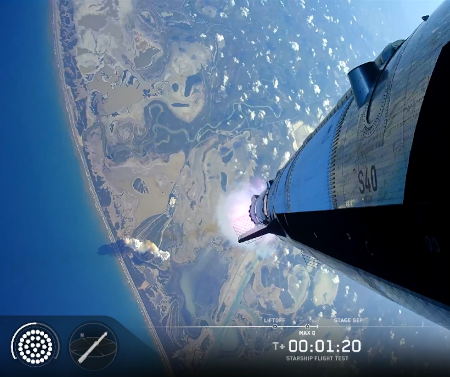
Starship/Superheavy, shortly after launch on July 24, 2026,
looking down at Boca Chica
SpaceX today finally officially confirmed the September 22, 2026 launch date for the 14th orbital test flight of Starship/Superheavy, with the launch window opening at 7:15 a.m (Central).
In doing so it provided the first specific details of the mission.
Starship’s initial orbital mission is expected to fly at an altitude approximately 275 km above Earth and complete approximately six orbits around the planet over the course of a nearly 10-hour flight, with splashdown targeted in the Pacific Ocean to the west of Chile.
During those orbits, the ship will deploy 26 Starlink version 3 satellites, three of which will also have cameras for photographing Starship and its heat shield. One Raptor-3 engine will then be fired to bring Starship down as planned in the Pacific, during which the ship will test several new tile designs as well as re-use three tiles from the previous flight, the first time this has been done.
Superheavy meanwhile will once again return for a vertical soft splashdown in the gulf off the coast of Texas. During the previous flight there were problems with “ice clogging” that prevented some engines from firing properly, resulting in a hard splashdown. On this flight they will be testing a variety of modifications intended to eliminate that problem.
If all goes well, the company should be able to fly the next mission relatively quickly — in about a month or so — as all the testing on the Starship and Superheavy prototypes for that mission have already been completed. Nor should be we surprised if that mission is extended, lasting two-plus weeks, to test Starship’s systems for long enough to go to and from the Moon. That flight should also include attempts to catch and recover both Starship and Superheavy.

On Christmas Eve 1968 three Americans became the first humans to visit another world. What they did to celebrate was unexpected and profound, and will be remembered throughout all human history. Genesis: the Story of Apollo 8, Robert Zimmerman's classic history of humanity's first journey to another world, tells that story, and it is now available as both an ebook and an audiobook, both with a foreword by Valerie Anders and a new introduction by Robert Zimmerman.
The print edition can be purchased at Amazon or from any other book seller. If you want an autographed copy the price is $60 for the hardback and $45 for the paperback, plus $8 shipping for each. Go here for purchasing details. The ebook is available everywhere for $5.99 (before discount) at amazon, or direct from my ebook publisher, ebookit. If you buy it from ebookit you don't support the big tech companies and the author gets a bigger cut much sooner.
The audiobook is also available at all these vendors, and is also free with a 30-day trial membership to Audible.
"Not simply about one mission, [Genesis] is also the history of America's quest for the moon... Zimmerman has done a masterful job of tying disparate events together into a solid account of one of America's greatest human triumphs."--San Antonio Express-News
44 tons of Starlink V3 sats.
That’s basically double what a Falcon 9 can do.
And this is just a test flight, not even full load. What a flex this is.
It’s also more than the previous flight, which suggests Starship can carry more than we’re seeing, SpaceX has just chosen not to do that, rather than it being a genuine limitation.
Each version 3 satellite is 10x more capable as well as bigger
26 of the V3s is certainly a useful payload. When an earlier thought was 3 of the V3s and a ship catch, it seemed a bit less than confident of Starship capabilities. It will be interesting to see what the actual payloads of fully operational Starships will turn out to be. Almost certainly more than the 50 tons detractors come up with. And almost certainly less than the 300 tons that proponents go with.
Volume is what sets Starship apart from FH…more useful for dense loads like fuel-fat tugs/ISS de-orbit modules
Who’s said 300 tons? The most I’ve seen, at least for full reuse, is 200 tons with Starship V4.
I’ve seen the claim on several blogs. NSF and Space review among them. 200 is far more realistic.
Maybe expendable. If it’s nobodies saying 300 tons (by which I mean no one inside of SpaceX) then I see no reason to give those claims credence.
Sea Dragon was supposed to do 500 tons, with first stage recovery
“with the launch window opening at 7:15 a.m (Central).”
That’s 5:15 a.m. my time, and I had planned to sleep in a little later than that, that day. But, for the opportunity to see several new developmental experiments, I’ll get up that early. A ten-hour flight means that reentry will be around 3 p.m. my time, so either I take a nap during the flight or take one after
landingsplashdown.The ice-clogging that they experienced seems to come from their use of combustion products for autogenous tank pressurization. Because combustion produces carbon dioxide and water, they are backfilling the tanks with these gasses, both of which freeze at temperatures higher than the liquid oxygen, and the water freezes at a temperature higher than the liquid methane. No wonder they have a problem; preventing the ice is unlikely, so they have to somehow manage it as it gets to the drainpipes. a secondary problem is that as the gases condense, the pressure in the tanks decreases. What a tangled web they wove when at first they chose autogenous tank pressurization from the exhaust gasses rather than the propellants themselves.
Missing this coming Mars transit window takes some of the pressure off of the necessity to refill propellant tanks on orbit, but it also gives SpaceX two years of not much to do, so their plan to set up facilities on the Moon gives them something to do while they wait for the next Mars transit window. A bonus to SpaceX coming from this new lunar focus is the flight experience and the landing experience traveling to and landing on the Moon before trying to not tip over when landing on Mars.* They might even be able to improve their robots on the Moon before sending them to Mars. I have not been one to advocate going to the Moon in order to learn how to live and work on Mars, but missing this coming transit window makes the Moon before Mars a more desirable path, as it does not slow down the Mars mission.
Once SpaceX starts to catch and reuse its Starship vehicles, monthly launches could quickly turn into weekly launches, resulting in even more flight experience, including learning how to transfer one or two hundred tonnes of LOX and CH4 from one orbiting vehicle to another.
The second half of this decade should become very exciting, and that is worth waking up at five a.m. in the morning to watch the latest development.
__________
* A bonus to the rest of us is lunar experience that focuses on operations and productivity, which is something that NASA will do ever so much slower than a private commercial company will do, because NASA does not have to produce a profit — and worse is that NASA discourages profits coming from its own operations. For NASA’s entire existence, the goals have been different than those of the National Advisory Committee for Aeronautics (NACA) that was the agency’s foundation. The NACA was created to assist America’s aircraft industry advance the state of the art, to maintain its world’s leadership in aviation, and it worked very well. Once NASA took over, advancements in aviation slowed, and what little aviation research NASA performed has done little to advance American aviation. This is why it is often said that aeronautics is the little “a” in NaSA.
Blue Origin has stated that it wants to operate on the Moon and use its resources, but that company has been proceeding slowly. SpaceX is a company that acts quickly and is willing to do what it takes to make revolutionary advancements to the state of the art of various technologies. SpaceX shoots high and goes big, and so far that has paid off in ways that no other company has enjoyed. Their plan is not just to put man on Mars but to colonize it, another high shot at a big goal. Meanwhile, NASA has spent six decades talking about putting a man on Mars, and Blue Origin’s big plan is to put a base on the Moon. These latter two goals seem big, but the first goal makes them seem small. The last half of this decade may be exciting, but the next decade will be even more so.
NASA is slave to whatever moron in in the White House, who always kills his opponents projects–that’s why NASA Chiefs should be lifetime appointments with a 1% earmark so no politician can derail steady progress. And propulsion the #1 priority
The ISS, Shuttle, and SLS all contradict your claim, Jeff.
NASA isn’t going to get 1% of the budget or have a lifetime administrator, or be independent of oversight. You will take this wish to your grave. Plus, it’s just not necessary. The private sector is growing by leaps and bounds, already is far bigger than NASA, and while working with the agency is fine, is not dependent upon it to succeed. What really matters is expanding our economy into space, and making it a place we can settle. Not propulsion or any other individual field, except under the aegis of a more transcendental vision.