The tail of interstellar comet 3I/Atlas was richer in nitrogen than solar system comets
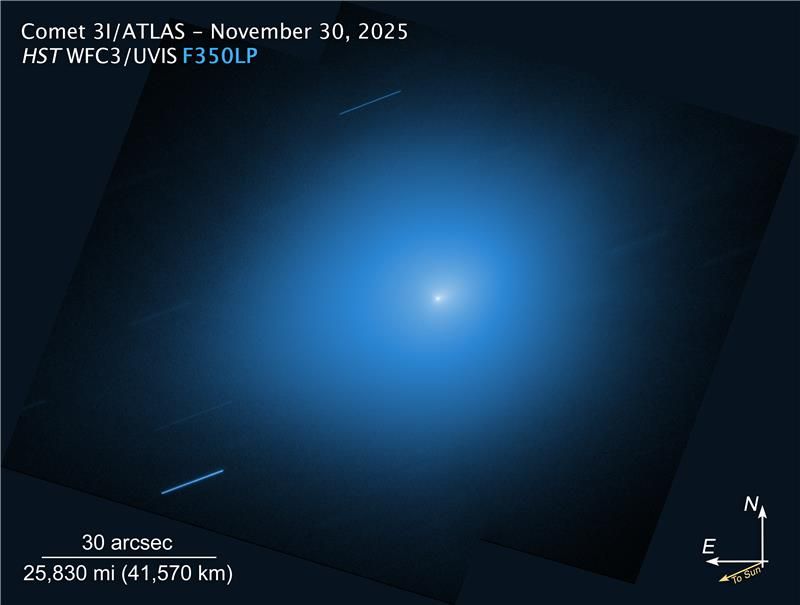
Comet 3I/Atlas as seen by Hubble
in November 2025. Click for original.
Data gathered using a new instrument on the Herschel telescope on the Canary Islands has found that the tail of interstellar comet 3I/Atlas is richer in nitrogen than solar system comets, and thus the comet was likely to have formed in a very cold environment.
From the paper’s abstract:
We present WHT/WEAVE-LIFU observations of 3I/ATLAS, performed post-perihelion on 2025 November 30 and 2025 December 2. We simultaneously detect the ions N, CO, CO, HO, and CH located in an antisolar tail. Using common fluorescence factors, we determine abundance ratios of these species in the tail. In particular, the N/CO ratio allows us to constrain the lower-limit N/CO0.001, indicating that 3I/ATLAS is N-rich compared to Solar system comets, a property which can be linked to cold formation conditions.
In other words, the comet likely formed far from its sun, in the equivalent of that star’s Oort cloud.
There is a lot of uncertainty here, but this data point and the conclusions do make sense, based on everything we presently know about comets and their formation. It also illustrates how alike these interstellar comets have been to our own solar system comets, despite the differences. The data strongly suggests that comet and solar system formation are similar everywhere within the galaxy.
On Christmas Eve 1968 three Americans became the first humans to visit another world. What they did to celebrate was unexpected and profound, and will be remembered throughout all human history. Genesis: the Story of Apollo 8, Robert Zimmerman's classic history of humanity's first journey to another world, tells that story, and it is now available as both an ebook and an audiobook, both with a foreword by Valerie Anders and a new introduction by Robert Zimmerman.
The print edition can be purchased at Amazon or from any other book seller. If you want an autographed copy the price is $60 for the hardback and $45 for the paperback, plus $8 shipping for each. Go here for purchasing details. The ebook is available everywhere for $5.99 (before discount) at amazon, or direct from my ebook publisher, ebookit. If you buy it from ebookit you don't support the big tech companies and the author gets a bigger cut much sooner.
The audiobook is also available at all these vendors, and is also free with a 30-day trial membership to Audible.
"Not simply about one mission, [Genesis] is also the history of America's quest for the moon... Zimmerman has done a masterful job of tying disparate events together into a solid account of one of America's greatest human triumphs."--San Antonio Express-News
Cannot wait for the speculation, and outright declaration, by certain scientists and professors, that all of this nitrogen is just further proof of the aliens involved with the 31/Atlas. After all, the Earth’s atmosphere has a huge amount of nitrogen. Meanwhile, the rest of us can just take in each new piece of information and say “cool,” give us more.
Absolutely fascinating… The high nitrogen content hints at perhaps a similar environment as our own system, which bodes well for life… But nitrogen is relatively inert… Which doesn’t bode so well for life…. A bunch of water content or organics would be much more relevant to the search for life elsewhere. As Bob would say “the uncertainty of science”
The best option by far would be to have a sample return mission hanging around in orbit ready to blast away to the next extra solar object spotted… And if the current observed cadence is typical , with the Roman telescope we should find many more…. We just need the will… Be it NASA, ESA, or JAXA, or a collaboration… This would be a genuinely scientificly important mission.
Keep fingers crossed!