
Treaty to allow American launches from Canada remains unsigned
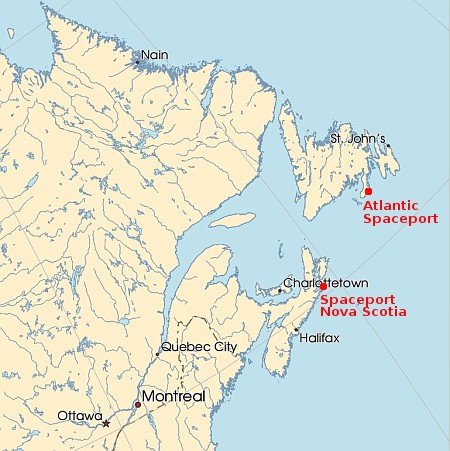
Proposed Canadian spaceports
While the Canadian parliament is moving to pass a bill that appears aimed at streamlining and easing liability issues for future launch and re-entry operations inside that country, a separate agreement with the U.S. to allow American rockets and satellites to launch from Canada remains stalled and unsigned, more than two years after it was negotiated.
The Technology Safeguards Agreement (TSA) with the United States, which governs how U.S. launch technology can be used on Canadian soil, remains unsigned more than two years after the two countries finished negotiating it.
Under a TSA, the host country (Canada), agrees to protect U.S. launch hardware and data on its territory, through measures such as controlled areas at launch sites and limits on who can access the technology. The agreement is needed before U.S.-origin rockets can fly from Spaceport Nova Scotia, the site Maritime Launch Services (MLS) is developing near Canso.
… Canada announced in August 2024 that “substantive negotiations” had been completed.
Those negotiations however occurred during the Biden administration. It appears that the Trump administration is hesitating signing the deal, for a whole range of possibly reasons, including the generally poor relations between Trump and Canada’s leftist government during Trump’s second term. It is also possible Trump is uninterested in helping these Canadian spaceports, preferring instead the launch business goes to American launch sites.
Until this bill is signed, American rocket companies cannot launch from either of Canada’s two proposed spaceports. Neither can satellite companies put their payloads on the rockets of other countries, launched from those sites.
As for the new Canadian bill designed to ease liability and regulation on space operations, a first reading leaves me skeptical about whether it will achieve its goals. While the liability clauses seem beneficial, the regulatory language is complicated and confusing, and leaves a lot of room open to misuse by government officials.

On Christmas Eve 1968 three Americans became the first humans to visit another world. What they did to celebrate was unexpected and profound, and will be remembered throughout all human history. Genesis: the Story of Apollo 8, Robert Zimmerman's classic history of humanity's first journey to another world, tells that story, and it is now available as both an ebook and an audiobook, both with a foreword by Valerie Anders and a new introduction by Robert Zimmerman.
The print edition can be purchased at Amazon or from any other book seller. If you want an autographed copy the price is $60 for the hardback and $45 for the paperback, plus $8 shipping for each. Go here for purchasing details. The ebook is available everywhere for $5.99 (before discount) at amazon, or direct from my ebook publisher, ebookit. If you buy it from ebookit you don't support the big tech companies and the author gets a bigger cut much sooner.
The audiobook is also available at all these vendors, and is also free with a 30-day trial membership to Audible.
"Not simply about one mission, [Genesis] is also the history of America's quest for the moon... Zimmerman has done a masterful job of tying disparate events together into a solid account of one of America's greatest human triumphs."--San Antonio Express-News
Personally, I doubt that there will be an agreement with the U. S. so long as Trump is in office. The TDS up here has become like a religion now.
How bad is it? There’s a reason why a certain body of water is now called Lake America and that’s because a certain Canadian provincial premier deliberately and rudely insulted Trump.
I agree with Mr. Z that this treaty’s non-execution is most likely a case of malign neglect on the part of the Trump administration. But even from a strictly non-partisan US perspective, signing treaties with a nation that may not even exist a few years hence can perhaps be regarded as simple caution.
I do not follow Canadian politics with minute attention, but it seems to me that the question of whether or not Alberta will skedaddle out of the Dominion and whether any other provinces or territories follow its lead seems likely to be settled well before Trump leaves office. In the event of a “Wexit” of Western Canada, the whole geopolitical situation north of the US border is likely to get pretty spicy before it settles back into some shape consistent with reality – as opposed to Ontarian delusions of grandeur.
Both of Canada’s notional spaceports, in any case, are physically located in the Maritime Provinces. Exactly what the status of these provinces would be after a notional Wexit is anything but clear from where I currently stand.
Any thoughts on such matters from an actual citizen of the Dominion with actual skin in this game would be of interest.
The best reason to support a Wexit of Alberta, is how much it would piss off the Quebecios that Alberta got out first. (Spoken as a Canadian, sick and tired of Quebec whining).