
Vast signs Greece as the third passenger for its manned mission to ISS in ’27
The space station startup Vast yesterday announced a deal with both the European Space Agency (ESA) and Greece to fly a Greek astronaut as the third passenger on the company’s manned short-term mission to ISS in 2027. Previously Vast had signed deals with France and the Czech Republic for two of the other passenger seats.
Subject to Multilateral Crew Operations Panel (MCOP) review and approval, Dr. Adrianos Golemis, who has worked as a flight surgeon for ESA, will serve as Mission Specialist. The MCOP’s decisions are reached through a consensus among representatives from all five space station partners: NASA, ESA, Roscosmos, the Japan Aerospace Exploration Agency, and the Canadian Space Agency. Pending approval, Golemis will become the first Greek astronaut to conduct a mission on the International Space Station.
Artist rendering of Haven-1 with docked
Dragon capsuleGolemis is expected to join ESA Astronaut Thomas Pesquet of France and ESA Project Astronaut Aleš Svoboda of the Czech Republic for the mission. Pesquet has been named Commander and Svoboda is slated to serve as Pilot. The final crew member will be announced soon, with training beginning shortly thereafter.
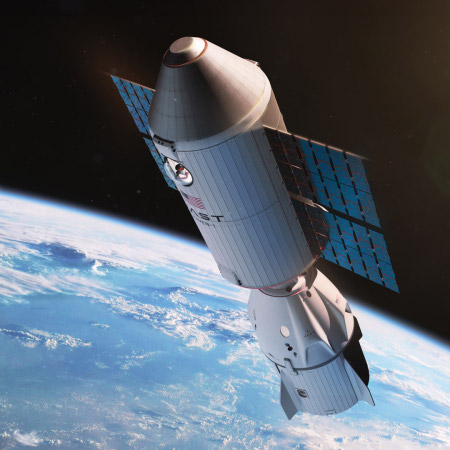
France’s deal also includes a second astronaut flight to Vast’s Haven-1 single module station (as shown in the graphic to the right), also scheduled for launch next year.
All these deals demonstrate again that there is a strong market for the five American space stations presently under development. The customers are out there, from governments, private citizens, and a host of companies that see profits from manufacturing in space.

On Christmas Eve 1968 three Americans became the first humans to visit another world. What they did to celebrate was unexpected and profound, and will be remembered throughout all human history. Genesis: the Story of Apollo 8, Robert Zimmerman's classic history of humanity's first journey to another world, tells that story, and it is now available as both an ebook and an audiobook, both with a foreword by Valerie Anders and a new introduction by Robert Zimmerman.
The print edition can be purchased at Amazon or from any other book seller. If you want an autographed copy the price is $60 for the hardback and $45 for the paperback, plus $8 shipping for each. Go here for purchasing details. The ebook is available everywhere for $5.99 (before discount) at amazon, or direct from my ebook publisher, ebookit. If you buy it from ebookit you don't support the big tech companies and the author gets a bigger cut much sooner.
The audiobook is also available at all these vendors, and is also free with a 30-day trial membership to Audible.
"Not simply about one mission, [Genesis] is also the history of America's quest for the moon... Zimmerman has done a masterful job of tying disparate events together into a solid account of one of America's greatest human triumphs."--San Antonio Express-News
A less optimistic analysis: https://m.youtube.com/watch?v=Cmts5S2dq-Y&pp=ygULZWFnZXIgc3BhY2U%3D
With a comment by friend of this site Richard Malcolm.
I hope at least one company succeeds.
Eager Space–likely a favorite of SLS haters here–now is dumping on the idea of private space stations.
I never paid him much mind anyway….that kind of negativity only hobbles things by nipping at heels.
What specific arguments did he make? How would you address them?
Jeff Wright,
The Eager Space guy dumped on commercial space stations a year ago. His recent video only confirms his opinion. I think he is right about the difficulty that the space stations will have, but for a different reason. He thinks that they will be too expensive for anyone to use, and he assumes that NASA is almost the only customer. I think that there will be plenty of customers, many of whom are already signing up, but that If Crew Dragon is the only means of transport to the stations, then there won’t be enough of them to keep the space stations as busy as the demand is shaping up to be. In my mind, it is vitally important for Starliner to come online, and it would be good to have a crew version of Dream Chaser, too. The Indian manned spacecraft could help fill in the demand, but India plans its own space station, so that may take up much of India’s own spacecraft time.
Since I am not a fan of the Eager Space guy, I must not be one of the SLS haters here. That is good to know.
I don’t think that the Eager Space guy is all that negative, but I do think that he is realistic, doing his own due diligence in analyzing the space industry and the physics involved. I’ve seen a few of his videos, and I think that he describes the rocket equation (and its tyranny) fairly well. Several people are doing videos about the space industry, but I pay attention to only a few of them. Some are very good at explaining their topics and choose good topics to explain. Others do not have styles that hold my attention or do not seem to do as much research as they should.
It does not matter if his videos are negative or positive. His opinions do not hobble or facilitate things such as space stations. That is for reality to do. Investors will invest, whatever he says, and customers will come or not, whatever he says. If he is right, and space stations are too expensive for the customer base, then his opinion did not make that happen. If I am right, and there are not enough manned spacecraft to tend the space stations, then my opinion did not make that happen, either.
Space is hard, expensive, and dangerous. Even at SpaceX prices, space is not so cheap, but it is affordable for more projects than were practical at the higher prices and the lower availability of two decades ago. However, it is still important for the dreams to remain realistic so that we do not waste precious taxpayer money or squander the limited venture capital funding by chasing less productive dreams. I am very happy that we are finally beginning to get manufacturing from space, because as the products start rolling in, we earthlings will begin to appreciate the resource that is space and its long-duration free fall. It is these resources that commercial space stations are intended to provide for companies and countries eager to use space to good advantage.
By making money on the low hanging fruit, then the profits will supply even more capital available for later types of space products. Doing the most efficient missions now provides money, ideas, and incentives for the future.
Speaking of space stations:
https://m.youtube.com/watch?v=Avdu03jp0qk&ra=m
This approach means you could use the current pez-dispenser set-up of Starship.
Quite virus-like, in that magnets allow self-assembly.
Some of those even look like Moon-landers….