The Senate cries “Uncle!” on SLS and big goverment with its latest NASA authorization bill

I usually pay relatively little attention to the NASA authorization bills that Congress passes periodically, because these bills are generally nothing more than opportunities for the loudmouths in Congress to use them as a bullhorn to puff themselves up to the public and press. Almost never do such bills really have any real impact on the future, or if they do, that impact is often unintended and negative, as Congress is by and large ignorant about these matters and has priorities counter-productive to getting anything substantive accomplished.

I pay even less attention to authorization bills that have only been approved by a committee, and have not yet been voted on by either house. Such bills are ephemeral and the stuff of fantasy. It is nice to know what’s in them, but until such bills are actually approved by both houses of Congress and signed by the president, their language is even more unworthy of serious attention.

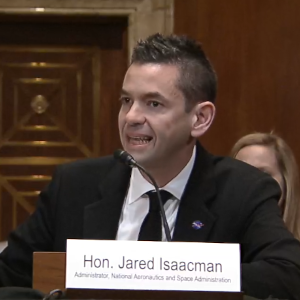
Have the pigs in the Senate learned to stop gorging themselves?

Nonetheless, the NASA authorization bill that was just approved by the Senate Commerce committee is worth reviewing, but not for the reasons that has interested the rest of the mainstream and even the aerospace press.

True, the bill extends ISS until 2032. True, it fully supports the commercial private space stations being built to replace it. True, it endorses NASA administrator Jared Isaacman’s restructuring of the Artemis program. True, it rejects all of Trump’s proposed cuts to NASA’s science programs. And true, it strongly endorses a Moon base as a first step to colonizing Mars.

All of these facts are significant, but to focus on each specifically — as it appears the entire press has done — is to miss the forest for the trees.
» Read more

The American Revolution, as seen from across the Atlantic

The First Salute by Barbara Tuchman

As this year is the 250th anniversary of the signing of the Declaration of Independence, it seems fitting to review a history about the Revolutionary War. In fact, I intend to do a few more such reviews in the coming months.

Let’s start however with a book that looks at that Revolution from a very different perspective.

Historian Barbara Tuchman is most well known for her early classic, The Guns of August, a book that was made famous when John Kennedy repeatedly referred to it during the Cuban missile crisis. Kennedy’s recommendation not only brought the book to the attention of the general public, it made Tuchman’s career. From that day forth, her work has always been received with accolades and enthusiasm and uncritical respect.

I am here however to break that bubble, though only partly. I just finished reading The First Salute, Tuchman’s 1988 history of the Revolutionary War. Rather than tell the tale from the point of view of the Americans, as done by most historians, Tuchman’s work looks at the war from the point of view of Europe, and thus gives us a much larger and very worthwhile context.

For this I compliment Tuchman highly. Though it is well known that the arrival of the French fleet off the coast of Virginia was crucial in forcing the British army to surrender to Washington at Yorktown, the background behind that arrival has generally been given short shrift by historians. Tuchman does not, describing in detail the political maneuvering necessary between the American envoys in France and France’s government to make that fleet happen. She also describes the attitudes of the Dutch and Spain to the war, and how and why they eventually moved to support America, even though there were many reasons for them to stay out.

Her book also gives us the British perspective, revealing the amazing and continuous failures of its government and generals to wage the war with any enthusiasm or skill. It appears almost from the start that the British had no great desire to win, and that malaise and overconfidence more than anything resulted in their eventual defeat.

For example, the British never took Washington or his army seriously. » Read more

While Democrats rage against the American/Israel war on Iran, the PEOPLE celebrate

Without doubt there remain great risks and real constitutional issues involved the present military campaign by both the United States and Israel to destroy the Islamic leadership in Iran. First, it is almost impossible to force a change in power solely by air power. This has been tried numerous times, with little success. Killing the leaders of this terrorist Iranian government is a positive step, but it remains entirely unclear whether this war can produce a better government there.

Second, as much as there might be legal precedents that allow President Trump to initiate this action without direct congressional approval, it continues a dangerous trend ceding power away from Congress and to the presidency, in direct opposition to the intentions of the Founding Fathers in their writing of the Constitution. They very much were opposed to giving any president the power to start a war unilaterally.

Pro-U.S. and Israeli demonstrations by Iranians
Click here and here for original videos.

Having stated the reasonable objections to this military action, however, we must now take a look at the two images to the right to see its immediate and very positive consequences. Both pictures are from videos of very spontaneous demonstrations on February 28, 2026 by Iranian refugees celebrating the American/Israeli attacks against Iran.

The top picture is a screen capture from a demonstration in Georgetown, DC. The bottom picture is a screen capture from a demonstration in Austin, Texas.

Note the flags in both pictures. There are numerous flags of Iran (the version during the Shah’s rule, not the version from the Islamic Revolution). There are many American flags, of course, since these demonstrations are in America.

What is most revealing however are the Israeli flags, being enthusiastically waved by Iranians. Clearly the decades of hate against Israel and Jews by the mullahs in Iran has not had any impact on these Iranian refugees. In fact, in the video of the bottom picture they are chanting “Thank you, Bibi!”, referring to Israel’s leader Benjamin Netanyahu as the camera pans across the crowd.

Moreover, these demonstrations took place in two Democratic Party strongholds, cities where pro-Hamas demonstrations have been routine, including rioting and violence against Jews and anyone who dared suggest Israel’s actions in Gaza might be justified.

Nor are these two demonstrations an exception. They have been the rule across the United States and Europe, as well as in Iran itself. The public — the ordinary people for whom governments are meant to serve — seem very much in favor of what President Trump and Netanyahu are doing in Iran. And they are expressing that support of both America and Israel quite unequivocally. If this doesn’t indicate to the world that Israel and the rest of the Middle East can live together in peace and mutual cooperation, nothing can.

This conclusion is further supported by the response by almost every Arab nation in the Middle East, most of whom started off quite willing to let the U.S. and Israel do this deed, with no opposition or with covert support. Now, because of Iran’s indiscriminate attacks on Arab nations, they have all publicly joined the war, allying themselves not with the Islamic nation of Iran but with the U.S. and Israel.

I would not be surprised if Saudi Arabia soon signs the Abraham Accords. Nor would I be surprised if most of the last remaining Arab nations that have not yet done so join Saudi Arabia.

We could very well be seeing a major realignment of alliances in the Middle East that could really really harbinger the beginnings of real peace in that region. Imagine: Israel at peace with all its neighbors, because the Arabs have finally recognized that it is to their own best interest to do so as well.

Sunspot update: Sunspot activity tumbles in February, including the 1st blank days since ’22

The uncertainty of science! It is the start of the month, and thus time for another sunspot update, using NOAA’s monthly graph of the sunspot activity on the Earth-facing hemisphere, updated by NOAA to include the activity in February but annotated with extra information by me to illustrate the larger scientific context.

Last month I lambasted NOAA’s solar science panel for its consistently failed predictions, and made a tentative prediction of my own, suggesting the ramp down to solar minimum might not be occurring as they had predicted in April 2025.

This month I can lambast myself, because the Sun in February saw a significant drop in sunspots, including three consecutive days in which the Sun was blank of spots, for the first time since 2022. This drop supports the NOAA panel prediction and makes my prediction look foolish, but it also suggests the ramp down is continuing to go faster than predicted.
» Read more

Isaacman announces major reshaping of Artemis program

Major reshaping of the program
The program is being changed

During a update press conference today on the status of SLS, NASA administrator Jared Isaacman announced some major changes to the next three Artemis missions.

Isaacman began his remarks by blasting the slow launch cadence of the SLS rocket, noting that all previous NASA launch vehicles averaged about three months between launches, not three years. In order to shorten the SLS cadence to as short as ten months, he has eliminated the upgraded upper stage for SLS, required for the Artemis-3 lunar landing mission. They will standardize the equipment now being used for all further missions. It also suggests the upgraded mobile launcher — needed for that upgraded upper stage — is being canceled, though the officials refused to confirm this. It is far behind schedule and over budget.

Second, Artemis-3 will no longer be a lunar landing. It will instead fly in ’27 as a manned low-Earth-orbit mission to test rendezvous and docking with one or both of the lunar landers being built by SpaceX and Blue Origin. The flight will also test the spacesuits the astronauts will use on the later lunar mission, including possibly a spacewalk.

This change also appears to eliminate the need for Lunar Gateway, though this decision was not stated. Without that upgraded first stage, SLS cannot reach lunar orbit as intended. It appears the plan is to launch crew in Orion and transfer them to the lander in Earth orbit, and transport them to the Moon in those vehicles.

Third, the goal will then be to do two lunar landings in ’28 on Artemis-4 and Artemis-5. It was also clear that this is merely a target, and things could change after the ’27 mission.

These changes all make great sense and face basic reality. It never made sense to attempt the lunar landing after only one manned Artemis mission. The changes also shift focus from SLS and Orion to the rockets and spacecraft being made by the private sector. It attempts to meet Trump’s goal of landing on the Moon by ’28, but also gives the last three budgeted SLS missions a better and more realistic program. Whether SLS as designed can do this remains unclear, but no matter what, this clearly lays the groundwork for that shift from SLS to the private sector.

The officials also made it clear that this plan is still in flux, and will change depending on what happens in the next year or so.

NASA’s corrupt Aerospace Safety Advisory Panel: NASA must be bigger and have more control!

Orion's damaged heat shield
Orion’s damaged heat shield after 2022 flight.
ASAP “Move along! Nothing to see here.”

NASA’s Aerospace Safety Advisory Panel (ASAP) today released its annual report, and once again it demonstrated why I have been calling it corrupt and a waste of money for years.

The report can be read here [pdf], but let me warn you that its findings have nothing to do with ASAP’s original purpose (created after the 1967 Apollo 1 launchpad fire that killed three astronauts), to look at NASA projects to make sure the agency is not ignoring specific safety issues.

Instead, as it has done repeatedly in recent years, the panel focused on management goals and larger strategic issues, and as usual concluded that the best way to do things is to make NASA bigger with more control over the entire space industry.
» Read more

NASA on Starliner: Too much freedom caused the failure!

Starliner docked to ISS
Starliner docked to ISS in 2024.

NASA today released its final investigation report on the causes behind the Starliner thruster issues during that capsule’s only manned mission in ISS, issues that almost prevented the spacecraft from docking successfully and could have left it manned and out-of-control while still in orbit.

You can read the report here [pdf]. NASA administrator Jared Isaacman made it clear in his own statement that the Starliner incident was far more serious than originally let on.

“To undertake missions that change the world, we must be transparent about both our successes and our shortcomings. We have to own our mistakes and ensure they never happen again. Beyond technical issues, it is clear that NASA permitted overarching programmatic objectives of having two providers capable of transporting astronauts to-and-from orbit, influence engineering and operational decisions, especially during and immediately after the mission. We are correcting those mistakes. Today, we are formally declaring a Type A mishap and ensuring leadership accountability so situations like this never reoccur. We look forward to working with Boeing as both organizations implement corrective actions and return Starliner to flight only when ready.”

A Type A mishap is one in which a spacecraft could become entirely uncontrollable, leading to its loss and the death of all on board. Though Starliner was NOT lost, for a short while as it hung close to ISS that result was definitely possible. Its thrusters were not working. It couldn’t maneuver to dock, nor could it maneuver to do a proper and safe de-orbit. Fortunately, engineers were able to figure out a way to get the thursters operational again so a docking could occur, but until then, it was certainly a Type A situation.

The report outlines in great detail the background behind Starliner’s thruster issues, the management confusion between NASA and Boeing, and the overall confused management at Boeing itself, including its generally lax testing standards.

The report’s recommends that NASA impose greater control over future commercial contracts, noting that under the capitalism model that NASA has been following:
» Read more

Only the power-hungry truly lust for war

Russell McClintock's Lincoln and the Decision for War

Today is “President’s Day”, a meaningless holiday created by our stupid lords in Congress in order to denigrate George Washington by devaluing the holiday celebrating his birth, February 22nd, by applying that holiday to all presidents, from great to the trashy. This fake holiday also acted to devalue any remembrance of Abraham Lincoln’s birthday on February 12th, as it forced many states that used to celebrate that holiday separately to fold that celebration into today as well.

I don’t accept Congress’s stupid holiday. Instead, I separately try each year to honor both Washington and Lincoln on their actual birthdays, because without these great men the nation of my birth would never have become the great and free and prosperous place it became.

In honor of Lincoln today, I thought I’d post a short review of Russell McClintock’s fine 2008 history, Lincoln and the Decision for War. McClintock took a decidedly different look at the Civil War by focusing not on larger events, but specifically at the time period between the election of Lincoln on November 6, 1860 and the beginning of the Civil War in April 1861.

What many forget with the passage of time is that the Civil War did not start instantly with Lincoln’s victory. For six months furious negotiations took place between politicians from the North and South, with Northern politicians desperately trying to somehow convince the southern states not to secede from the Union. McClintock details those negotiations, including Lincoln’s own efforts in numerous ways to placate the most radical southern states.

You see, as much as Lincoln opposed slavery — and he truly did — he was far more committed to the American Constitution and the nation it had created. If he had to let the issue of slavery take a back burner to saving the Union, he was quite content to do so. More important, as McClintock shows, if the southern states hadn’t seceded and had stayed part of the Union, their power bloc in Congress would have been strong enough to block any anti-slavery action by Lincoln anyway. He really didn’t have sufficient political power in Congress to change anything.

For the South, none of these actual facts about Lincoln mattered. The South had developed Lincoln Derangement Syndrome, and was not going to allow itself to be ruled by Lincoln no matter what, even if that rule was weak and ineffectual. As noted by the Ohio’s radical anti-slavery senator Ben Wade in a speech on the Senate floor on December 17, 1860:
» Read more

What life was really like in the American wild west

Vanished Arizona by Martha Summerhayes

Though I read a lot of good, detailed, and well-researched histories, I repeatedly find that if I really want to get a sense of the reality of times past, it is necessary to read something that was written by a person who lived at the time, and was an actual witness to great events.

When you do this you instantly cut through the political narratives that color all histories, whether sincere or not. Historians writing generations later bring their own viewpoint to the subject, colored by subsequent history shaped by what the original players did. So, to really understand those original players fairly, you really need to hear their side of the story, from their own lips.

Thus, I was thrilled recently when I came across a used copy of Vanished Arizona: Recollections of the Army life of a New England Woman by Martha Summerhayes. The book covers her memories from 1870 to 1900 as the wife of Jack Summerhayes, an officer in the American military stationed in the western United States, with the bulk of the story centered in Arizona.

This is an amazingly readable book. More important, it tells this story of army life from the perspective of the women who lived it. Most histories cover the battles and important events that Summerhayes’s husband Jack participated in, from defeating the Apaches and Geronimo to establishing the first settlements in early Arizona. Martha Summerhayes instead tells the story from her perspective as a woman living in an isolated fort in the hot desert wilderness of Arizona. The story is riveting, and revealing as well.

In reading her work now, 150 years later during the first half of the 21st century, I noted two important things.
» Read more

Midnight repost: How the localized nature of Democrat vote tampering will influence the 2022 election

The news during the past few weeks revealing scads of new evidence proving the 2020 presidential election was stolen from Donald Trump in Georgia reminded me of my 2022 essay, now reposted below. What I described in that essay was the exact tactic the Democrats used in Georgia, most specifically in Fulton County that covers the heavily Democratic Party dominated city of Atlanta. In some parts of that county Democrats were so dominant that they could work under the radar, and fudge the vote aggressively.

Though a number of my election predictions in this essay turned out wrong, the essay does provide the basics of what happened in 2020, and could still happen in 2028 and beyond, if a real effort is not made to regain some control of this election tampering. And not surprising, the Democrats are now opposing any such reforms with great enthusiasm, using their slander and demagoguery tactics to rile up their base, helped enthusiastically by the propaganda press that works as their public relations arm.

————————
How the localized nature of Democrat vote tampering will influence the 2022 election

Based on the ample evidence of election fraud, corruption, and vote tampering done repeatedly by Democrats nationwide during the 2020 election, we can expect these politicians and their minions to commit similar election crimes in the upcoming 2022 mid-term elections, especially because the effort by some Republicans to reform their state election systems in the key purple states was so effectively blocked by Democrats, by many quisling Republicans, and by a willing leftist press.

It is however important to understand where that election tampering was done in 2020 in order to understand the election fraud to come, as well as creating a strategy to prevent it. As real estate agents like to say, “Location is everything!”, and it appears this applies to election fraud as well.
» Read more

Midnight repost: Truth, Justice, and the American Way

Tonight Diane and I decided to watch again the 1978 Richard Donner movie, Superman. The overall film is lighthearted entertainment that captures the myth of this super-hero perfectly. However, it has two scenes that remain among the best moments in movie history (which you can watch here and here). The first captures the myth in every way. The second shows us that Superman truly stood for the best in America.

In watching the movie tonight again and reliving the myth I grew up with — that great things are possible if you believe and follow sincerely Superman’s motto of “truth, justice, and the American way” — I decided to repost my essay from 2020 where I attempted to explain what that motto really meant.

Enjoy!
———————

The heroic Superman as envisioned in the 1950s
George Reeves as the heroic Superman as envisioned
in the 1950s television show, emulated later by Richard
Donner in his 1978 movie. Click for show’s opening credits.

Truth, Justice, and the American Way

The words spoken during the opening credits of a 1950s children’s television show:

Faster than a speeding bullet.
More powerful than a locomotive.
Able to leap tall buildings in a single bound.
Look up in the sky!
It’s a bird.
It’s a plane.
It’s Superman!

Yes, it’s Superman, strange visitor from another planet who came to Earth with powers and abilities far beyond those of mortal men.

Superman, who can change the course of mighty rivers, bend steel in his bare hands, and who, disguised as Clark Kent, mild-mannered reporter for a great metropolitan newspaper, fights a never-ending battle for truth, justice, and the American Way.

That television show was obviously Superman, starring George Reeves, and these opening words expressed the mythology and basic ideals by which this most popular of all comic-book super-heroes lived.

I grew up with those words. They had been bequeathed to me by the American generation that had fought and won World War II against the genocidal Nazis, and expressed the fundamental ideals of that generation.

Much of the meaning of these fundamental ideals is outright and clear.
» Read more

Midnight repost: Genocide is coming to America

Today I came across this tweet:

Brandon Straka Tweet
Click to see video in tweet.

The comparison between the tactics of the Nazi storm troopers and our modern Antifa thugs is apt. It illustrates the time we now live in. It also immediately made me want to repost my 2020 essay, Genocide is coming to America. That essay sadly remains pertinent, because the same unwillingness of decent Germans to believe the Nazis were a threat is the same unwillingness of too many modern Americans to believe the same thing about Antifa and the Democratic Party (which now enthusiastically uses Antifa as its storm troopers).

Worse, we now have a large minority of Americans who support this violent behavior. To them, violence is wholly justified against those who disagree with them. The proof of this horrible fact was demonstrated in the 2025 elections, where in Virginia a Democrat won his election despite openly wishing death not only on a Republican but on that Republican’s children, while in New York an anti-Semitic communist won election as mayor.

————————-
Genocide is coming to America

In my last visit to Israel in 2018, my brother and sister-in-law took me sight-seeing to the northern parts of Israel near the Sea of Galilee. On our first night, we stayed at the home of one of their older friends, a man in his seventies.

That night we sat around their kitchen table so that they could catch up on family matters. At one point in the conversation our host reminisced about an older woman, now gone, who he had known in his childhood in the 1950s who had lived in Germany before and during World War II and had survived a concentration camp.
» Read more

Isaacman: SLS stands on very thin ice

Though NASA administration Jared Isaacman continues to support unequivocally NASA’s planned Artemis-2 ten-day manned mission around the Moon — presently targeting a March launch date — in a statement today on X he revealed that he also recognizes the serious limitations of the SLS rocket.

And it takes two-plus years between launches
And it also takes two-plus years between launches

The Artemis vision began with President Trump, but the SLS architecture and its components long predate his administration, with much of the heritage clearly traced back to the Shuttle era. As I stated during my hearings, and will say again, this is the fastest path to return humans to the Moon and achieve our near-term objectives through at least Artemis V, but it is not the most economic path and certainly not the forever path.

The flight rate is the lowest of any NASA-designed vehicle, and that should be a topic of discussion. It is why we undertake wet dress rehearsals, Pre-FRR, and FRR, and why we will not press to launch until we are absolutely ready.

These comments were also in connection with the first wet dress rehearsal countdown that NASA performed with SLS/Orion in the past few days, a rehearsal that had to be terminated early because of fuel leaks. NASA now plans to do another wet dress rehearsal, requiring it to push back the Artemis-2 launch until March.

I think there is more going on here than meets the eye.
» Read more

Lawrence of Arabia: Truth is sometimes stranger than fiction

Larence in Arabia

One of the 20th century’s greatest movies is David Lean’s 1962 epic Lawrence of Arabia. The story it tells — of the clash of cultures, of war, and of colonization — combined with the personal story of T.E. Lawrence during World War I, is one of high drama that is unforgettable to anyone who has ever seen it.

Yet, the events it tells seem too dramatic to be believed. Did Lawrence actually rescue a man in the desert, by himself and against the advice of his Arab allies who knew better? Did he actually later execute that man coldly to prevent a tribal war that would have destroyed the Arab revolt against the Ottoman Empire? Did he actually lead those Arab tribes across a deadly desert to take the town of Aqaba from the rear?

And did he actually lead that Arab revolt so successfully that it took Damascus ahead of the British, only to lose it because that medieval tribal culture knew nothing about modern technology?

For years I wondered about these questions and tried to find out. I read T.E. Lawrence’s own memoir of his time there, The Seven Pillars of Wisdom, and found it to be unclear and obscure, answering none of my questions. Other histories about World War I merely touched upon these events, treating them as a minor side show. And histories about the Middle East during that time seemed uninterested in telling this part of the story.

So, the questions remained: Did these events really happen? They seemed too good to be true.

I have now discovered that these stories are not only largely true, the reality of T.E. Lawrence’s life and his time in Arabia was even stranger than I could suppose. I learned this from Scott Anderson’s fine biography of Lawrence, Lawrence in Arabia: War, Deceit, Imperial Folly, and the Making of the Modern Middle East. Anderson not only unveiled Lawrence in all his inexplicable glory in this book, he made clear the complex political background that shaped the Middle East, and made it as we know it today.
» Read more

Sunspot update: Maybe solar maximum isn’t over?

The uncertainty of science! It is time for another sunspot update. It is also time to note that once again the Sun appears to be confounding the predictions of NOAA’s solar science panel. Below is NOAA’s monthly graph of the sunspot activity on the Earth-facing hemisphere, updated by NOAA to include the activity in January but annotated with extra information by me to illustrate the larger scientific context.

Since April 2025 that science panel has been predicting that the solar maximum has passed and the Sun was beginning the ramp down to solar minimum, now expected to occur around 2031-32. And in the ten months since, sunspot activity has appeared to more or less track that prediction, as indicated by the purple/magenta curve line on the graph below.

It now appears that this prediction might very well have been premature.
» Read more

Artemis-2 proves NASA learned nothing from the Challenger and Columbia failures

NASA: an agency still avoiding reality
NASA: an agency that still avoids reality

Our bankrupt new media continues to fail us. NASA is about to send four astronauts on a ten-day mission around the Moon in a capsule with questionable engineering, and that media continues to ignore the problem. Mainstream news outlets continue to describe the mission in glowing terms, consistently ignoring that questionable engineering. In some cases the stories even make believe NASA has fixed the problem, when it has not.

The most ridiculous example is an article yesterday from an Orlando outlet, Spectrum New 13: “How the lessons learned from the Challenger disaster apply to Artemis rockets”. It focuses entirely on the O-ring problem that destroyed Challenger, noting repeatedly that NASA has fixed this issue in its SLS rocket.

Of course it has. That’s the last war, long over. Engineers fixed this issue almost four decades ago. The article however dismisses entirely the new engineering concern of today, Orion’s heat shield, which did not work as expected during its own test flight in space in 2022. It covers this issue with this single two-sentence paragraph:

However, during re-entry, it broke up into chunks instead of burning away. This issue pushed back the Artemis II and III missions, but NASA has stated it has resolved the problem.

NASA however has not resolved the problem. It is using the same heat shield now on this manned mission, and really has no reason to assume it will work any better, even if the agency has changed the re-entry flight path in an effort to mitigate the heat shield’s questionable design.

You see, NASA with Artemis-2 is doing the exact same thing it did prior to both the Challenger and Columbia accidents. » Read more

The profound life’s work of Richard Rodgers

Sometimes in art there are times when culture, timing, talent, and teamwork combine to produce a magic that is eternal and beyond measure. For Richard Rodgers and Oscar Hammerstein, that time occurred from 1943 to 1959, when these two men created a string of musicals so grand that each

would become not just familiar but universally beloved, played over and over again until the words and melodies had become meshed, it seemed, with one’s very existence. To have one’s complete score memorized by a whole population would, it would seem for a composer, to have been all that life has to offer.

This quote comes from Meryle Secrest’s fine 2001 biography of Richard Rodgers, Somewhere for me: a biography of Richard Rodgers. It tells a story of a man who from childhood was obsessed with writing music, who struggled for decades to write musicals where the music and song flowed naturally from the plot and characters, and who changed with time as time changed him. Outside of his music and his commitment to it, he was however a very normal man, with a marriage that at times was stormy but held together despite those storms.

But it is Rodgers’ best music — written for the lovely words of Oscar Hammerstein — for which we most remember him. I grew up in the 1950s and 1960s, so I lived at a time when these Rodgers and Hammerstein musicals were being memorized by a whole population. As a child my parents subscribed to a musical record club, which sent them a new album every month. I would spend hours listening to the songs from Oklahoma, South Pacific, The Sound of Music, the King and I, and Carousel. And on television I got to see Julie Andrews in a live production of Cinderella.

In listening to these songs, I quickly realized, even as a child, that there was something deeply profound in those words and music, touching something deeper than mere beauty, a more fundamental but utterly inexplicable aspect of our existence. As I wrote in 2018 when I posted an evening pause of Juanita Hall singing Bali Ha’i from South Pacific,
» Read more

Blue Origin’s proposed TeraWave constellation: Is it really competition with SpaceX?

TeraWave logo

Blue Origin announced yesterday that it going to build a major satellite constellation — dubbed TeraWave and comprising more than 5,000 satellites — to provide internet service to the globe while also providing data center capability for those companies that wish to establish space-based cloud computing facilities.

It plans to begin launching satellites in 2027.

As I noted in today’s quick links below, such a story would normally merit a full post, “but considering Blue Origin’s inability to get almost anything off the ground, this proposal doesn’t deserve that much coverage at this point.” I just can’t get excited about any Blue Origin proposal, until they actually start launching it. For almost a decade this company has been making these kind of grand announcements, and has only so far managed to achieve one, its New Glenn rocket. And that has come years late and at a pace that is glacial.

Not surprisingly, the mainstream propaganda press immediately went bonkers over this proposal, immediately declaring most absurdly that TeraWave is already a major challenger to SpaceX’s Starlink constellation. Here are just a few very typical examples:

This adulation by the mainstream press of Bezos is far from unusual. For reasons that baffle me, the propaganda press has consistently considered any project proposal coming from a Jeff Bezos’ company to instantly be God’s gift to humanity. For more than a decade now it has been touting Blue Origin as the company that SpaceX needs to beat, flipping reality on its head. Now it ranks Blue Origin’s TeraWave constellation a major Starlink rival, when it is at least two years from even launching its first satellite.

There is one aspect of this story however that does deserve to be highlighted because it appears no one else is noticing it, which is why I after some thought I decided to write this full post. » Read more

“A new empire has sprung into existence, and there is a new thing under the sun.”

The words I quote in the headline above were spoken during a sermon by Pastor Manasseh Cutler on August 24, 1788 at the just established settlement of Marietta, Ohio, founded only six months previously by a small group of New England pioneers, with the goal of beginning the settlement of the American west now available following the end of the war of independence against Great Britain.

The Pioneers by David McCullough

It may be emphatically said that a new empire has sprung into existence, and there is a new thing under the sun. By the Constitution now established in the United States, religious as well as civil liberty is secured.

Some serious Christians may possibly tremble for the Ark, and think the Christian religion in danger when divested of the patronage of civil power. They may fear inroads from licentiousness and infidelity, on the one hand, and from sectaries and party divisions on the other.

But we can dismiss our fears, when we consider the truth can never be a real hazard, where there is a sufficiency of light and knowledge, and full liberty to vindicate it.

Cutler’s words come from David McCullough’s 2019 history, The Pioneers, describing the effort of Cutler and a small group of New Englanders to re-create a new New England in the wilderness north of the Ohio river.

Not surprisingly, McCullough’s book is quite readable, as are all his works. What made it a revelation to me is that it revealed an aspect of this early American settlement of the west that I had been ignorant of. It wasn’t just any old Americans moving west to found new communities. At the beginning it was specifically the descendants of the Pilgrims and Puritans in New England, actually organizing consciously to repeat the same thing as their ancestors, sending a group of God-fearing religious families west to build a new city on a hill, for the future of America and for their children.

Cutler himself had been crucial in lobbying Congress to establish the laws necessary to allow these first first settlers to buy land and begin settlement. He and a group of former revolutionary soldiers from New England had worked up a plan, and sent Cutler to New York and Philadelphia to convince Congress to pass the Northwest Ordinance of 1787, establishing the legal framework for settling the vast territories now open to American north and west of the Ohio river. Cutler himself wrote much of that bill, making sure it included articles requiring freedom of religion and no slavery.

In the early spring of 1788 the first group of twenty-two settlers arrived, and within a very short time they had established a town and community. By the time Cutler arrived in the late summer, the colony was so well established that families were arriving to build their own farms.
» Read more

Isaacman makes it official: Artemis-2 will fly manned around the Moon, despite Orion’s heat shield concerns

Orion's damage heat shield
Damage to Orion heat shield caused during re-entry in 2022,
including “cavities resulting from the loss of large chunks”

In a tweet yesterday afternoon, NASA administration Isaacman essentially endorsed the decision of the NASA managers and engineers in its Artemis program who decided they could live with the engineering issues of Orion’s heat shield (as shown in the image to the right) and fly the upcoming Artemis-2 mission around the Moon carrying four astronauts with that same heat shield design.

Isaacman’s statement however suggests to me that he is not looking at this issue as closely as he should.

Human spaceflight will always involve uncertainty. NASA’s standard engineering process is to identify it early, bound the risk through rigorous analysis and testing, and apply operational mitigations that preserve margin and protect the crew. That process works best when concerns are raised early and debated transparently.

I appreciate the willingness of participants to engage on this subject, including former NASA astronaut Danny Olivas, whose perspective reflects how serious technical questions can be addressed through data, analysis, testing, and decisions grounded in the best engineering judgment available. [emphasis mine]

The highlighted sentence is fundamentally incorrect. » Read more

The first preliminary research into landing a Mars helicopter in the Starship landing zone

Map of rotorcraft images in Starship landing zone

In early November 2025 I posted a cool image from Mars Reconnaissance Orbiter (MRO) that had the very provocative label “Characterize Possible Rotorcraft Landing Site”. While this was not the first such image taken by scientists using MRO to scout out potential landing zones for future Mars helicopter missions (see here and here), this particular image was one of several taken recently that were all within the candidate landing zone for SpaceX’s Starship spacecraft, focused specifically on the low Erebus mountain chain that sits within this part of Mars’ northern lowland plains.

In the January image download from MRO, I found another such image, taken on December 1, 2025. The map to the right shows that Starship candidate landing zone, with all the images taken for SpaceX indicated. The inset adds all the recent images taken for this “possible rotorcraft” mission, including the December image and the previous four (here, here, here, and here), with orange representing images already obtained and yellow those requested but pending.

I decided I needed to find out more, and tracked down the scientist who had requested the images, Eldar Dobrea of the Planetary Science Institute in Arizona. In response to my email, he explained:
» Read more

The global launch industry in 2025: The real space race is between SpaceX and China

In 2025 the worldwide revolution in rocketry that began about a decade ago continued. Across the globe new private commercial rocket companies are forming, not just in the United States. And across the globe, the three-quarters-of-a century domination by government space agencies is receding, though those agencies are right now pushing back with all their might to protect their turf.

Dominating this revolution in 2025 in every way possible however were two entities, one a private American company and the second a communist nation attempting to imitate capitalism. The former is SpaceX, accomplishing more in this single year than whole nations and even the whole globe had managed in any year since the launch of Sputnik. The latter is China, which in 2025 became a true space power, its achievements matching and even exceeding anything done by either the U.S. or the Soviet Union for most of the space age.
» Read more

The up and down tale of two rocket startups, Vector and Phantom

Jim Cantrell and cars
Jim Cantrell at Vector in 2017, shown in front of
one of his side businesses, fixing and refurbishing race
cars and rare luxury sports cars (located then at Vector).

The tales of rocket startups are often fraught with ups and downs of all kinds, often traveling in circles that no one can ever predict. This is one such tale.

In the mid-2010s there was a rocket startup called Vector, based here in Tucson, founded by a guy named Jim Cantrell. At that time Cantrell pushed the company in the style of Elon Musk, going very public for publicity and to raise investment capital.

He was remarkable successful at both. Unfortunately, his engineers were not as successful at engine building. After years of effort they all realized that their rocket engines were under-powered, and wouldn’t be able to get the rocket into orbit. In 2019 the company’s biggest investor backed out, Cantrell left the company, and new owners took over, hoping to rebuild.

Flash forward to 2021, and Jim Cantrell has reappeared with a new rocket company, Phantom Space, also based in Tucson, raising $6 million in seed capital. In the next four years he obtained a small development contract from NASA, completed two more investment rounds raising first $22 million and then around $37 million, and began development of a new orbital rocket, dubbed Daytona. The company also began work on its own small satellite constellation, PhantomCloud (more on this later).

As for Vector, there was little to report during those four years. The only update said the company was buying engines from the rocket engine startup Ursa Major, the same company Phantom was using.

It is now the end of 2025, and the fate of these two companies has once again intertwined, in a most ironic manner. Last week I learned from Jim Cantrell that Vector had closed shop, and that its last remaining assets, some of which Cantrell himself had helped develop when he headed Vector, had been bought by Phantom. This includes several unused rocket stages, the vertical rocket test stands, a lot of computers, and hardware.
» Read more

There is little good will on the left, and the right seems eager to lose it too

Good will toward men
This is what the Christmas season stands for.

The New Testament words celebrating the birth of Jesus are clear and bright, and are repeated by everyone in these weeks before the holiday: “Glory to God in the highest, and on earth peace, good will toward men.”

The colloquial phrase people normally say this time of year is usually “Peace on Earth and good will toward men!”, with the hope that both will come to all.

It appears unfortunately that the idea of “good will” is vanishing from American society, and maybe for all of western civilization. Good will means you treat all persons with respect, even if you disagree with them. You also hope that everyone achieves the best they can in their personal lives, even your enemies. You don’t wish harm on others, only oppose anyone from doing harm to others.

Such good will once dominated American society. Just think of the 1946 film It’s a Wonderful Life! to get a taste of that American culture. In politics, there was often fierce debate, but after the Civil War especially the culture decided it was better to talk things out with good will to all then to grab guns and kill each other.

And most of all, during each year’s Christmas season the desire to promote good will was everywhere, in everyone’s hearts and minds.

This ideal now appears to be vanishing. On the left that vanishing began with the election of Donald Trump in 2016, and has accelerated since. You cannot have a reasonable or rational discussion with practically anyone on the left about Trump. He is the devil incarnate to them, and anyone who even expresses the slightest positive thought about him must be blackballed, slandered, and even killed.

Think I am exaggerating? The widow of Charlie Kirk doesn’t think so. Neither does Donald Trump, who survived two assassination attempts. Nor does someone like Elon Musk, who now readily admits he can no longer appear in public out of fear of violence because of his support of Trump in the 2024 election.

A more benign but equally ugly example of this lack of good will occurred just last week — in the midst of this year’s Christmas season — and the anger and hate didn’t just come from the left. Watch the vile behavior of this leftist woman in a Walmart when she saw an senior citizen and Target worker wearing a Charlie Kirk “Freedom” t-shirt (warning: her language is decidedly obscene):
» Read more

New Trump executive order today guarantees major changes coming to NASA’s Moon program

Change is coming to Artemis!

The White House today released a new executive order that has the typically grand title these type of orders usually have: “Ensuring American Space Superiority”. That it was released one day after Jared Isaacman was confirmed as NASA administrator by the Senate was no accident, as this executive order demands a lot of action by him, with a clear focus on reshaping and better structuring the entire manned exploration program of the space agency.

The order begins about outlining some basic goals. It demands that the U.S. return to the Moon by 2028, establish the “initial elements” a base there by 2030, and do so by “enhancing sustainability and cost-effectiveness of launch and exploration architectures, including enabling commercial launch services and prioritizing lunar exploration.” It also demands this commercial civilian exploration occur in the context of American security concerns.

Above all, the order demands that these goals focus on “growing a vibrant commercial space economy through the power of American free enterprise,” in order to attract “at least $50 billion of additional investment in American space markets by 2028, and increasing launch and reentry cadence through new and upgraded facilities, improved efficiency, and policy reforms.”

To achieve these goals, the order then outlines a number of actions required by the NASA administrator, the secretaries of Commerce, War, and State, as well as the Director of the Office of Management and Budget (OMB) and the Assistant to the President for Domestic Policy (APDP), all coordinated by the assistant to the President for Science and Technology (APST).

All of this is unsurprising. Much of it is not much different than the basic general space goals that every administration has touted for decades. Among this generality however was one very specific item, a demand to complete within 90 days the following review:
» Read more

A ray of hope during a weekend of horror

This past weekend was truly a weekend of horror. There were two mass murder terrorist attacks, one in Australia against Jews celebrating Hanukkah and another at Brown University in Rhode Island in a classroom. In California someone drove up to a home with a Hanukkah display, cursed the home-owners for being Jewish, and sprayed the home with bullets. And in Amsterdam masked Jew-haters attacked a Hanukkah concert.

Meanwhile, two previously popular major rightwing pundits, Tucker Carlson and Candace Owens, have gone off the deep end, falling into the same rabbit-hole of anti-Semitism and conspiracy madness based on slanders and lies. In the case of Candace Owens, that madness has her make absurd and vicious accusations against the family and friends of Charlie Kirk, claiming without evidence that they were somehow complicit in his murder.

Nor have I even scratched the surface of the ugliness and incivility and violence and barbarism that seems to have overwhelmed civilization in the past decade.

Bringing the cultural principles of the First Amendment back to America
Bringing the cultural principles of the
First Amendment back to America

And yet, buried within the horrors of this past weekend I stumbled by accident upon a ray of hope. And believe it or not, that hope comes from one of our most disgraced and for decades most biased mainstream news outlets, CBS News. It seems that outlet’s new editor-in-chief, Bari Weiss, is attempting to abandon the one-sided, 24/7 leftwing perspective that has dominated that news organization (as well as all of America’s so-called “intellectual” culture) for decades.

Instead, she is advocating openness and a willingness to let many different opinions and ideas be heard.

There had been indications she would do this when she was hired, based largely on her open approach to reporting that forced her out of her job at the New York Times and became the hallmark of her work at her own subsequent news outlet, The Free Press.

Her position was made quite clear during a CBS Mornings interview on December 12, 2025, embedded below, where she plugged a CBS News Townhall aired on December 13, 2025 in which her guest was Erika Kirk, the widow of Charlie Kirk.
» Read more

The two American launches today set a new global annual launch record exceeding 300+

Liberty enlightens the world
Now liberty is enlightening the solar system!

Two American companies today successfully completed launches from opposite sides of the globe, and in doing so set a new global benchmark for rocket launches in a single year.

First, Rocket Lab placed a Japanese technology test smallsat into orbit, its Electron rocket taking off from one of its two launchpads in New Zealand. The satelliite, dubbed Raise-4, was built by Japan’s space agency JAXA and carries eight different experimental payloads from a variety of academic and industry entities, including a test of a new solar sail design.

SpaceX then followed, launching another 27 Starlink satellites, its Falcon 9 rocket lifting off from Vandenberg Space Force Base in California. The first stage completed its 9th flight, landing on a drone ship in the Pacific.

The leaders in the 2025 launch race:

165 SpaceX (a new record)
83 China
16 Rocket Lab (a new record)
15 Russia

SpaceX now leads the rest of the world in successful launches, 165 to 136.

More significantly, with these two launches the total number of successful orbital launches in 2025 has now exceeded 300, for a present total of 301. To put the spectacular nature of this number in perspective, until 2020 it was rare for the world to exceed 100 launches in a year, especially after the fall of the Soviet Union. Most often, the total each year ranged between 50 to 80 launches.

Those numbers are now history, and it has been competition and freedom that has made all the difference.
» Read more

Academia makes its first comprehensive attempt to plan science missions to Mars using Starship

Figure 2-2 from the NAS report
Figure 2-2 from the National Academies
of Science report

A new report released today by the National Academies of Science, entitled “Highest Priority Science for the First Human Missions to Mars,” is essentially the first attempt by the planetary science community to plan its future science missions to Mars using the gigantic capabilities that SpaceX’s Starship is expected to provide them.

You can download the report here.

Even though the report made the search for life on Mars its big priority — a bugaboo that NASA and the science community trots out repeatedly to garner clicks from the ignorant propaganda press — this report is radically different then all previous similar NASA studies proposing future Mars exploration, as indicated by the graphics from figure 2-2 of the report to the right. Unlike those past studies, which were badly limited by the inadequate capabilities of any spacecraft NASA could send to Mars, this new report recognizes how much the game is changed by SpaceX’s Starship.

First, the new panel did not attempt to place any limit on any landing zones. Earlier reports had forbidden landings in the high latitudes or high altitudes because of the risks to NASA’s proposed landers. Starship overcomes much of those risks, giving researchers much greater flexibility.

Second, the focus of the missions will not be solely devoted to scientific or geological research, as had been the case for all previous similar reports by NASA and the academic community. Instead, the proposed research goals includes important engineering and human exploration requirements outside of science, including efforts to use the resources on Mars itself as well as find locations better suited for human habitation. Once again, the vastly greater capabilities of Starship influenced this change.

Even more important, the study doesn’t assume the future missions will be unmanned, as all previous NASA reports have done. In fact, it does the opposite, proposing multiple 30-day manned missions, as shown in the graphic. One set of three missions would go to three different locations, while another set of three missions would focus on one place in particular.

Much of this shift towards manned flight I think stemmed from the presence on the panel of representatives from the private companies SpaceX and The Exploration Company (a French startup), as well as an engineer from the National Academy of Engineering. Previously studies were almost always entirely dominated by planetary scientists, so the goals outlined were always focused on their interests. Now the idea of human exploration has become prevalent.

The panel’s work was clearly also influenced by the realization that SpaceX’s Starship is not only far more capable, its first flights are just around the corner. SpaceX plans sending it numerous times to Mars in the very near future, as shown in the graphic below that Elon Musk released during a presentation in May 2025.
» Read more

SpaceX launches 29 more Starlink satellites, sets new record for Falcon 9 reuse, dominates the world in rocketry

First stage after landing for the 32nd time

SpaceX today launched another 29 Starlink satellites, its Falcon 9 rocket lifting off from the Kennedy Space Center in Florida.

The first stage of its Falcon 9 rocket (B1067) flew for its 32nd time, a new record for a Falcon 9 first stage. As shown in the rankings below of the most reused launch vehicles, this stage is now just one flight from tying the space shuttle Atlantis:

39 Discovery space shuttle
33 Atlantis space shuttle
32 Falcon 9 booster B1067
30 Falcon 9 booster B1071
29 Falcon 9 booster B1063
28 Falcon 9 booster B1069
28 Columbia space shuttle

Sources here and here.

Nor will it be long before SpaceX’s fleet surpasses all the shuttles.

Meanwhile in the 2025 launch race SpaceX’s dominance is overwhelming, as shown by the leader board:
» Read more

1 2 3 55