China to launch next space station September 15

Despite the launch failure this week of a different rocket, China is moving forward with the launch of its second space station test module, Tiangong-2, now set for September 15.

Original built as a back up to Tiangong-1, TG-2 is expected to be identical in size to the previous Chinese station launched in 2011. Having an increased payload capacity, the new station will use its improved living conditions to verify key technologies, such as on-orbit propellant resupply using the new Tianzhou logistics vehicle. TG-2 will also be used to conduct space science experiments on a relatively large scale compared to China’s previous efforts. Tiangong-2 will also be equipped with a new robotic arm and will be accompanied by the small Banxing-2 satellite for technology demonstrations. It will also capture images of the new station in orbit.

Once in orbit China will then follow quickly with a 30 day manned mission.

3 comments

Want to buy a used NASA robot? You can!

Link here. The robot was developed in the 1960s to test spacesuits, though because it leaked oil it was never used.

In fact, this particular 1960s NASA project appears to be a perfect example of “engineers gone wild!” The website explains that the robot was an attempt to replace human test volunteers.

Unfortunately, pressure suits aren’t like coveralls. They’re complex pieces of engineering. A human can provide qualitative information about how (un)comfortable a suit is, but cannot gauge the forces involved with the precision and accuracy that an an engineer needs. In addition, testing pressure suits with volunteers can be grueling, unpleasant and even painful.

In the end, however, the robot didn’t work and the testing was done by humans, probably for a lot less than the $175,000 they spent (in 1960s dollars) to build two of these robots. One however is now being auctioned off, and could serve wonderfully as a great piece of interesting artwork in someone’s home.

0 comments

Opportunity’s steep downhill path

An update on Opportunity: The panorama I have created below from two images taken by its navigation camera and transmitted from Opportunity today, shows the steepness of the slope in Lewis and Clark Gap down which engineers are thinking of sending Opportunity. It appears also that Opportunity has moved closer to the gap since my post on Friday outlining the rover’s future travels.

I have not followed Opportunity’s entire journey on Mars close enough to say whether this will be the steepest downhill slope the rover has ever attempted. If not I suspect it is close to the steepest. I also suspect that they are still unsure whether they are going to attempt it, and are creeping slowly towards it to assess the situation.

Lewis and Clark Gap within Endeavour Crater's rim

7 comments

Opportunity’s future travels on Mars

Opportunity's future path

Approaching the gap

Having spent a lot of time recently analyzing the travels of Curiosity in Gale Crater and in the foothills to Mount Sharp, I decided this week that I also needed to do the same with Opportunity at Endeavour Crater.

The image above is a panorama that I have assembled from images taken by Opportunity’s navigation camera on Sol 4477 (sometime last week). To the right is a panorama assembled from images taken by the navigation camera several days later, on Sol 4481, after Opportunity had moved closer to the gap shown in the first picture above. The inset in the image above shows the location of the image on the right. The X shows Opportunity’s approximate position.

Below the fold is the most recent orbital mosiac showing Opportunity’s recent travels near Endearvour Crater and in Marathon Valley, cropped and annotated by me to indicate the areas seen by the two panoramas above. The red dot shows Opportunity’s present position.
» Read more

2 comments

Budget constraints and technical challenges delay commercial crew

A NASA inspector general report released today cites both budget constraints imposed by Congress as well as technical challenges that will delay the first commercial manned mission to ISS until 2018.

When the commercial crew program began, NASA hoped to have routine flights by 2015, but that slipped in large part due to congressional underfunding in the early years. OIG noted today that its 2013 report found that adequate funding was the major challenge for the program. Congress has warmed up to the program, however, and now is approving the full President’s request so funding is not the issue it once was. Technical challenges now are the major hurdle according to today’s report.

The companies’ systems must be certified by NASA before beginning routine flights to ISS. Boeing anticipates receiving certification in January 2018 with its first certified flight in spring 2018, and SpaceX is working toward late 2017 for its first certified mission, the OIG report says. But it is skeptical: “Notwithstanding the contractors’ optimism, based on the information we gathered during our audit, we believe it unlikely that either Boeing or SpaceX will achieve certified, crewed flight to the ISS until late 2018.”

The report has been written prior to yesterday’s Falcon 9 launchpad failure, which will certainly impact the schedule negatively.

Essentially, the report claims that the program was delayed initially by about two to three years because of the refusal of Congress to fund it fully. The delays to come will be instead because of the technical challenges. While I tend to agree with this assessment, I also note that government reports like this are often designed to generate more funds for the agencies involved, not find a better way to do things. If we are not diligent and hard-nosed about how we fund this program I worry that with time commercial crew will become corrupted by the government’s sloppy and inefficient way of doing things, and become as bloated as Orion and SLS. This is one of the reasons I never complained when Congress short funded the program previously, as it forced the companies involved to keep their costs down.

0 comments

First science results from Juno

Storms at Jupiter's pole

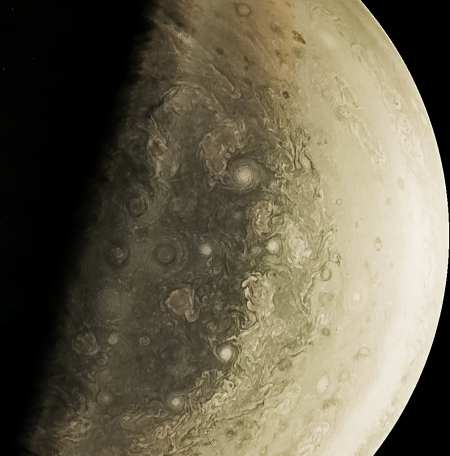
The Juno science team today released the mission’s first science results gathered during its first close fly-by of Jupiter.

I have cropped on the right one of their full images to focus in on two of the strangely shaped storms Juno imaged during its pass. This image is of the northern pole. They also have some fascinating images of the south pole storms as well. Unlike the equatorial regions, which on gas giants have what appear to be parallel coherent bands of weather, the poles appear very chaotic, with the storms forming shapes that have not been seen in any other atmosphere in the solar system. They also found a hexagon-shaped weather feature in the pole.

The first link above also included data from the spacecraft’s other instruments, showing the gas giant’s complex atmosphere in a variety of other wavelengths.

5 comments

NASA sets InSight’s new launch date to Mars

NASA has now set 2018 as the new launch date for its Mars InSight mission.

The mission was originally supposed to launch in 2016, but missed that launch window when significant problems cropped up during construction of the spacecraft’s French-built prime instrument. NASA has now taken much of the responsibility for building that instrument away from the French and given it to JPL.

The SEIS instrument — designed to measure ground movements as small as half the radius of a hydrogen atom — requires a perfect vacuum seal around its three main sensors in order to withstand harsh conditions on the Red Planet. Under what’s known as the mission “replan,” NASA’s Jet Propulsion Laboratory in Pasadena, California, will be responsible for redesigning, developing and qualifying the instrument’s evacuated container and the electrical feedthroughs that failed previously. France’s space agency, the Centre National d’Γ‰tudes Spatiales (CNES), will focus on developing and delivering the key sensors for SEIS, integration of the sensors into the container, and the final integration of the instrument onto the spacecraft.

The cost for the changes and reschedule is estimated to be more than $150 million, adding to the budget strain in NASA’s science programs already caused by the overruns from the James Webb Space Telescope.

1 comment

The surface of Ceres lacks water

The uncertainty of science: Despite significant evidence that water ice has helped form specific features on Ceres, other data collected by Dawn suggest that there is not much ice on the surface.

Angular polygonal craters on the surface suggest that Ceres’ crust is fractured, furthering the conclusion that the near-surface crust β€œmust be both brittle enough to fracture and strong enough to retain fractures for long periods of time.”

β€œBased on our analysis, the crust of Ceres is too strong to be dominated by ice,” said Debra Buczkowski of the Johns Hopkins Applied Physics Laboratory in Laurel, Maryland, the study’s lead author. β€œWhile surface features such as the lobate flows show that water ice is present in the dwarf planet’s upper crust and on the surface in some locations, it appears not to be a major factor in creating surface features.”

In addition to studying the surface, researchers drew conclusions about the dwarf planet’s interior makeup. Beneath a strong crust composed of rock, ice and salt hydrates lays a water-rich mantle and a silicate core. Evidence of cryomagmatism is found in the floor-fractured craters, while Ahuna Mons and other domical features have been shown to be cryovolcanic in nature. These surface features suggest that Ceres has been geologically active at some point in its past, perhaps even its recent past.

Note that in just two days, Dawn researchers released two press releases, the first noting that water ice played a significant role in molding major features on Ceres, and the second noting that the surface doesn’t have much water ice. How’s that for a nice demonstration of the uncertainty of science?

0 comments

Did China today have a launch failure?

A scheduled Chinese launch today has apparently ended in failure, though exactly what happened remains presently unknown.

China was early this morning expected to launch its Gaofen-10 Earth observation satellite from Taiyuan, following the issuance of an airspace exclusion zone days in advance. However, it seems the launch did not go to plan. Gaofen-10, nominally part of the ‘CHEOS’ Earth observation system for civilian purposes, was due to be launched on a Long March 4C rocket between 18:46 and 19:11 UTC on Wednesday (02:46-03:11 Thursday Beijing time). China usually releases information of launches once payloads are successfully heading towards their target orbits around an hour after launch. Much earlier, spectators and insiders often share details and photos of the launch on social media.

However, many hours after the launch window passed there was still silence, with the launch timing and location of the Taiyuan Satellite Launch Centre apparently limiting opportunities for outside viewers.

The launch however was not scrubbed, as first stage launch debris was found as expected along the flight path, suggesting that some failure occurred with the upper stage.

Like today’s Falcon 9 failure, this Chinese failure could have a rippling effect on their ambitious plans this fall, including the launch of their next space station followed by a 30-day manned mission.

1 comment

On the radio

On Sunday evening I will be doing another long appearance on Coast to Coast with George Noory. I expect the first hour will talk about SpaceX and commercial space, and the second on some of the more recent planetary missions, both on-going and forthcoming.

6 comments

Ahuna Mons, Ceres’s biggest mountain, is an ice volcano

Ahuna Mons

Using data from Dawn scientists have concluded that Ceres’s biggest mountain, Ahuna Mons (shown on the right), was created by water volcanism.

“Ahuna is the one true ‘mountain’ on Ceres,” said David A. Williams, associate research professor in Arizona State University’s School of Earth and Space Exploration. “After studying it closely, we interpret it as a dome raised by cryovolcanism.” This is a form of low-temperature volcanic activity, where molten ice β€” water, usually mixed with salts or ammonia β€” replaces the molten silicate rock erupted by terrestrial volcanoes. Giant mountain Ahuna is a volcanic dome built from repeated eruptions of freezing salty water.

The implications of this fact are important, as it suggests that Ceres’s interior was warm enough for long periods, enough to melt ice. Where that heat came from however is a mystery, considering the dwarf planet’s small size.

1 comment

The Earth’s oldest fossil?

The uncertainty of science: Geologists this week announced the discovery of what they think is the Earth’s oldest fossil, approximately 3.7 billion years old.

While the press as usual is going gaga over this announcement, it should be noted that many others in the field have expressed significant doubts.

But the discovery involves some of the most physically tortured rocks on Earth, which have been squeezed and heated over billions of years as crustal plates shifted. The pressure and heat recrystallizes the rocks, erasing much of the fine-scale detail that researchers normally use to identify fossilized stromatolites β€” so the work is already triggering heated debate. β€œI’ve got 14 queries and problems that need addressing before I’ll believe it,” says Roger Buick, a geobiologist at the University of Washington in Seattle.

5 comments

Falcon 9 explodes on launchpad

During a standard prelaunch static test firing today a Falcon 9 rocket exploded on the launchpad.

Obviously, this will put a hold on all of SpaceX’s upcoming efforts.

  • Falcon Heavy: Since the explosion was almost certainly caused by a failure in the first stage, they will have to hold off that first Falcon Heavy demo launch scheduled for this fall, since it uses three first stages strapped together.
  • Reused Falcon 9: Similarly, the first launch of a recovered Falcon 9 first stage, also set for the fall, will likely have to be delayed until they determine what went wrong today.
  • Reused Dragon: NASA had indicated that one of the cargo missions to ISS next year would reuse a previously flown Dragon. Though this explosion has nothing to do specifically with Dragon, the capsule is launched with a Falcon 9, and thus cannot fly until this investigation is over.
  • Falcon 9: SpaceX had been attempting this year to up its launch rate to more than one per month. That will now not happen.
  • Red Dragon: SpaceX has said it plans to fly a test Dragon to Mars in 2018, the next launch window. While this explosion will delay the company’s plans over the next year, I expect SpaceX will not cancel that 2018 launch. They have enough time to investigate this failure and fix the cause without missing that window.
  • Elon Musk’s Mars speech: Finally, Musk is scheduled to make a major speech on September 26 at the International Aeronautical Congress (IAC) in Guadalajara, Mexico, outlining his company’s future plans to fly to Mars. He almost certainly will have to rewrite that speech.

This launchpad explosion is bad news for SpaceX but it is also very puzzling. I cannot remember the last time a rocket exploded on the launchpad during a static fire test. Failures have in recent years always occurred during the actual launch, when the rocket is flying and is thus exposed to large dynamic forces which can cause the engineering to go screwy. For a rocket to explode at the moment it ignites its engines suggests a very fundamental design fault, which seems unlikely considering the number of launches and static fires SpaceX has completed with the Falcon 9, including numerous prelaunch tests of the rocket’s first stage, both on the launchpad and at the company’s test facility in Texas prior to shipment to the launchpad.

Update: SpaceX has now said that the problem occurred near the rocket’s upper stage during fueling, prior to the actual ignition of the engines.

This news is both good and bad. The good news: It means that the failure had nothing to do with the much tested Merlin engines, which would have suggested a fundamental design flaw previously unseen. That is now clearly not the case. The bad news: The update suggests that the problem might be related to SpaceX’s high density, high pressure fueling, which by lowering the temperature of the tanks allows them to load more fuel and oxidizer. This novel approach, only introduced last year in order to give the rocket greater fuel capacity, might have a design problem that they had not anticipated.

14 comments
1 1,020 1,021 1,022 1,023 1,024 1,751