September 2, 2025 Quick space links

Courtesy of BtB’s stringer Jay. This post is also an open thread. I welcome my readers to post any comments or additional links relating to any space issues, even if unrelated to the links below.

1 comment

Trump once again moves Space Force HQ from Colorado to Alabama

During his first term as president, Donald Trump attempted to move the headquarters of the Space Force Colorado to Alabama. That move, announced in January 2021, never happened, first because it came so late in his term and second because Biden had no interest in making it happen and eventually rescinded it in 2023.

Today Trump reinstated that decision, once again announcing that the Space Force headquarters will move to Huntsville, Alabama.

The politics for this change have been and will continue to be complicated. Alabama’s lower cost of living would save the government money, but the defense industry is also well clustered in Colorado due to the military’s space operations that have been there for many decades.

In general I have never quite understood Trump’s desire to do this. I suspect there are some quid pro quo agreements in the background with Alabama politicians: “If you bring the Space Force to Alabama, Mr. Trump, we will back you on your other plans.” Then again, Trump might simply want to punish the increasingly leftist haven of Colorado.

Either way, it is now likely to finally happen. Trump 47 has been moving fast on all his initiatives, and is aided in this by a staff that is largely supportive (unlike during Trump 45).

15 comments

European Commission calls for a fast launch capability from its new rocket startups

The European Union

Capitalism in space: As part of Europe’s major shift from its traditional government-run space program that could accomplish little to a commercial and independent space industry, the European Commission has now launched a study asking that new private sector to develop a fast launch capability able to put satellites in orbit quickly and on demand.

In the preamble to the call published on 10 July, the Commission notes that due to an increasing number of threats, both human and natural in origin, spacefaring actors must not only develop sovereign access to space but also create “systems capable of placing satellites into orbit quickly to meet urgent demands.”

In an effort to develop this capability, the European Commission’s Directorate-General for Defence Industry and Space will commission three parallel studies. The primary objectives of the ten-month studies are to identify the commercial and institutional needs for such a capability within the EU, define suitable and affordable solutions across ground and launcher systems, and outline a roadmap towards achieving an operational service. The total budget for the call is €1.95 million, with up to €650,000 available for each study.

The American military has been pursuing this capability now for almost a decade, repeatedly issuing contracts to startups as well as established companies to demonstrate a fast launch. Except for SpaceX, the established companies have not been very successful in doing this. Among the startups, the results have been more promising, with Rocket Lab especially demonstrating the ability to install a payload and launch within days.

Though the European plan still appears to be seeped in bureaucratic requirements and top-down management, it is also working to encourage a robust competitive commercial sector with multiple companies, each producing their own variations on the problem. All told, the trend remains positive.

0 comments

An interesting look at why the British government decided to eliminate its space agency

Gone, and likely soon to be forgotten

Link here. The article depends almost entirely on anonymous sources, but unlike most propaganda news stories which typically use such sources to push one pro-government perspective, this article includes sources from a range of viewpoints.

According to those sources who wanted the UK Space Agency (UKSA) gone, the agency was eliminated last month because it simply had not been very effective in building up Great Britain’s space industry. First, it was too focused on doing what the European Space Agency wanted.

The U.K. has had a different approach to space than its European counterparts, such as Germany, France and Italy, the source explained. Historically, the U.K. has dedicated most of its resources to the European Space Agency (ESA) rather than pursuing a multipronged approach involving a strong domestic space program and bilateral partnerships independent of ESA. Therefore, over 80% of UKSA’s budget has been placed into ESA. The perception in the government was that UKSA was acting more in line with ESA’s wishes than with the U.K. government’s needs, the source added.

Second, it not only did nothing to alleviate the red tape hampering the industry, its existence added a layer that made things worse. Numerous studies and hearings before Parliament in the past five years have bewailed the situation. The inability of the rocket companies to get launch licenses — for years — proved their correctness.

Meanwhile, the anonymous sources opposing the agency’s elimination argued that without it Great Britain will be in a weaker position negotiating with its ESA partners as well as projecting itself internationally in the space field.
» Read more

6 comments

September 1, 2025 Quick space links

Courtesy of BtB’s stringer Jay. This post is also an open thread. I welcome my readers to post any comments or additional links relating to any space issues, even if unrelated to the links below.

1 comment

“What the heck?!” glaciers on Mars

Overview map

Another
Click for original image.

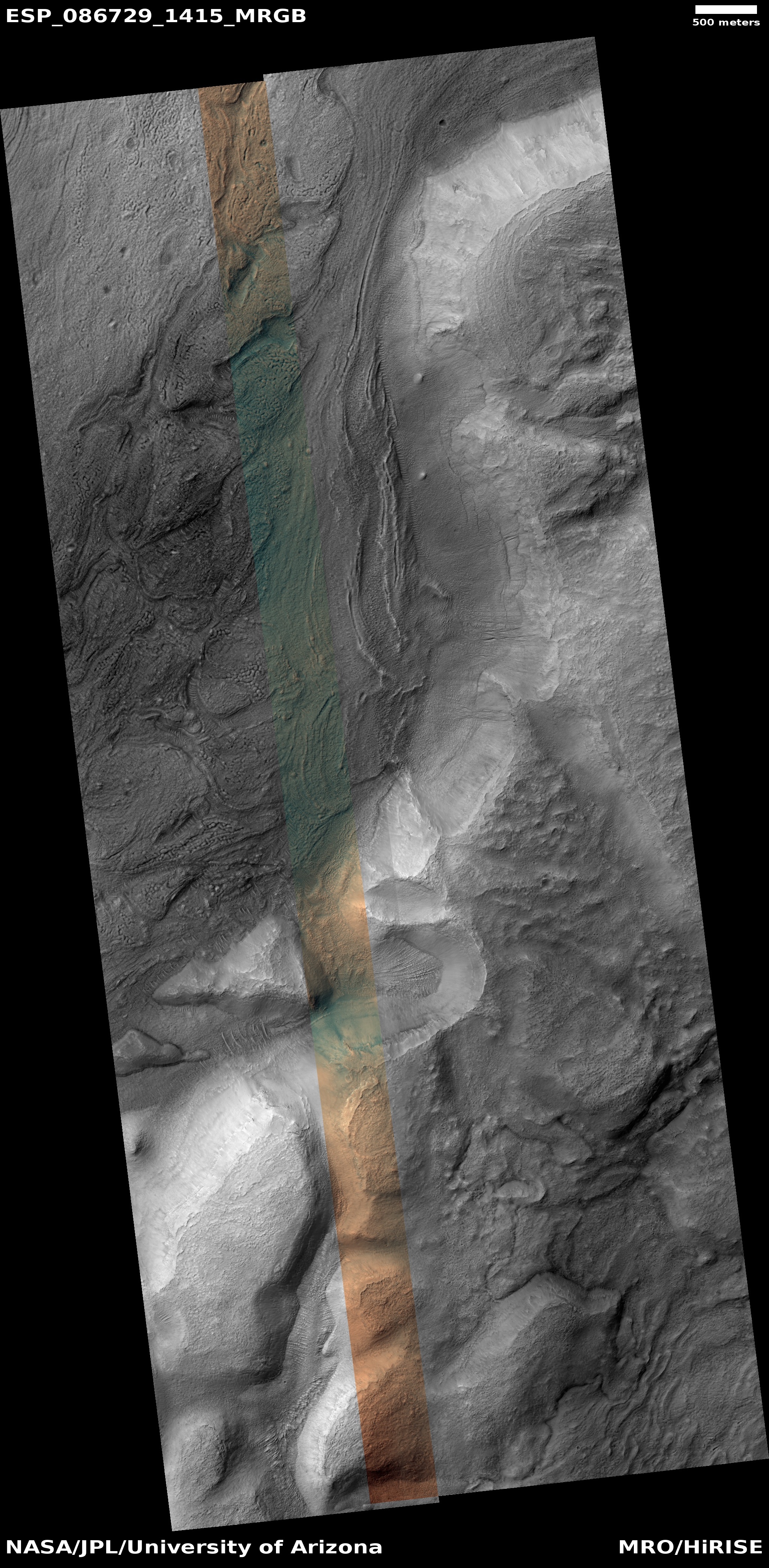
Cool image time! The picture to the right, cropped, reduced, and sharpened to post here, was taken on June 29, 2025 by the high resolution camera on Mars Reconnaissance Orbiter (MRO). It falls into what I call my “What the heck?!” category of Martian land-forms, simply because their shape is so strange and inexplicable it is difficult to conceive a geological process that could create them.

Nor does it help much that we know what these land-forms are made of. The white dot on the overview map above marks the location, inside the 2,000-mile-wide northern mid-latitude strip I label glacier country, because almost every image taken shows glacial features. In this case, this strange geology is located on the floor of a canyon that is part of a large region of chaos terrain, a landscape typical of glacier country. This floor, as well as all the low areas, seems filled with glacial flows. This particular canyon appears to roughly flow downhill to the northwest, though the downhill grade in the entire region varies widely in all directions.

Based on all the orbital data, these flows are glacial in nature, the ice protected by a thin top layer of dirt and debris. The strange features at the top of all the small mesas in the picture above suggest that the wind possibly blew off the dirt and debris, exposing the ice and allowing it to sublimate away. This in turn produced the knobby hollows at the top of each mesa.

I am guessing, and no one should trust my guess considering I only make believe I’m a geologist on the internet.

3 comments

Juice successfully completes Venus fly-by

The European orbiter Juice, on its way to Jupiter, successfully completed its fly-by of Venus on August 31, 2025, zipping 6,923 miles above the planet’s surface to get some of the velocity needed to get to Jupiter in 2031.

It still has to do two more fly-bys of Earth before it has enough speed to reach Jupiter.

There were no science observations during the Venus fly-by, as the spacecraft had to be oriented so that its large high gain antenna would protect its instruments from the Sun’s heat. It appears however that the science team has confirmed the spacecraft is in fine shape using its medium-gain antenna.

Once in orbit around Jupiter the spacecraft’s prime mission will be to do numerous fly-bys of the large icy Galilean moons, Europa, Ganymede, and Callisto. Its data will also reinforce what Europa Clipper will learn while it does the same, beginning in 2030.

0 comments

South Korea’s space agency requests big 15% budget increase

South Korea’s space agency KASA today submitted its proposed budget for 2026 that included a 15% budget increase which would bring its funding to just under $8 billion.

According to the national space agency, the proposed funds will be concentrated in six major areas, which include the strengthening of space transportation capacity and new technology acquisition, advancing satellite-based communications, navigation and observation, as well as fostering future space industries through exploration.

The largest requested increases would be for developing new satellite constellations and rockets.

When the South Korean government established this agency in in 2024, it said its goal was to foster private enterprise. The agency itself repeated that assertion in January 2025 when it announced its long term plans. In both cases, however, I sensed a lack of sincerity in these assertions. The government wanted wanted to help build a prosperous aerospace industry, but it clearly wanted to do so with it in control.

Today’s budget request again reinforces my suspicions. KASA might want to encourage a commercial space industry, but it remains unclear whether it will let the private sector develop the satellites and rockets independently, or pay for the development while insisting it owns and controls everything.

Based on past history at NASA, my instincts say KASA will use this big budget to build an empire for its managers. Stay tuned to see if my instincts are correct.

0 comments

Scientists pinpoint the origin of the energetic electrons thrown out by the Sun

Infographic about Solar Orbiter data
Click for original image.

Using Europe’s Solar Orbiter probe, scientists have now successfully identified the two sources of the energetic electrons accelerated at high speed by the Sun, and in doing so also determined why those particles sometimes arrive later than expected.

The Sun is the most energetic particle accelerator in the Solar System. It whips up electrons to nearly the speed of light and flings them out into space, flooding the Solar System with so-called ‘Solar Energetic Electrons’ (SEEs). Researchers have now used Solar Orbiter to pinpoint the source of these energetic electrons and trace what we see out in space back to what’s actually happening on the Sun. They find two kinds of SEE with clearly distinct stories: one connected to intense solar flares (explosions from smaller patches of the Sun’s surface), and one to larger eruptions of hot gas from the Sun’s atmosphere (known as ‘coronal mass ejections’, or CMEs).

“We see a clear split between ‘impulsive’ particle events, where these energetic electrons speed off the Sun’s surface in bursts via solar flares, and ‘gradual’ ones associated with more extended CMEs, which release a swell of particles over longer periods of time and over broader angular ranges,” says lead author Alexander Warmuth of the Leibniz Institute for Astrophysics Potsdam (AIP), Germany.

The researchers observed 300 events between November 2020 and December 2022 at many different distances from the Sun, allowing them to clock their travel times. The graphic above illustrates what they found.

5 comments

Exoplanet detected inside gap in accretion disk surrounding a Sunlike star

Exoplanet in gap of disk

For the first time since 2018, scientists have obtained a clear detection of an exoplanet inside the accretion disk surrounding a Sunlike star. Furthermore, the planet sits inside a gap in that accretion disk, the first time such an exoplanet has been found.

The image to the right, taken from figure one of the research paper [pdf], shows the exoplanet, dubbed WISPIT 2b. The star, located about 435 light years away, has a mass only slightly larger than our Sun, and is considered a close match. The planet itself is estimated to be about the mass of Jupiter, though its orbit within that gap is much farther away, 57 astronomical units versus 5.2. It is these details that make the discovery significant. From the paper’s conclusion:

As the planet resides in the cleared gap and its mass is consistent with the modeled planet mass required to open such a gap, we argue that it likely formed in situ through core accretion and that there is no rapid migration on dynamical timescales. Future follow-up observations of WISPIT 2b with ALMA and [Webb] will enable studies of its atmosphere and the impact of the embedded planet on the disk’s gas kinematics and surface density structure. This will allow us to calibrate ALMA observations of other embedded planet candidates, to unlock the full potential of this complementary technique.

…The discovery of WISPIT 2b embedded in the gap of a seemingly unperturbed disk demonstrates, for the first time, that wide-separation gas giants, discovered by direct imaging around older systems, can indeed form in situ. Thus, WISPIT 2b marks a promising starting point to study wide separation planets in time.

It has long been theorized that gas giants can form much farther from their star, and then migrate inward as the system evolves. This discovery counters that supposition, or least demonstrates that it does not have to occur in every new solar system.

The image also shows that the accretion disk has a second gap farther out, as well as a cleared area close to the star, comparable in size to our solar system. Though other exoplanets have not been detected yet, these gaps suggest they exist, thus indicating that a solar system comparable to our own is now forming.

3 comments

SpaceX launches another 28 Starlink satellites

The beat goes on! SpaceX this morning successfully launched 28 more Starlink satellites, its Falcon 9 rocket lifting off from Cape Canaveral in Florida.

The first stage completed its 23rd flight, landing on a drone ship in the Atlantic.

The leaders in the 2025 launch race:

110 SpaceX
48 China
12 Rocket Lab
11 Russia

SpaceX now leads the rest of the world in successful launches, 110 to 84.

4 comments
1 134 135 136 137 138 2,914