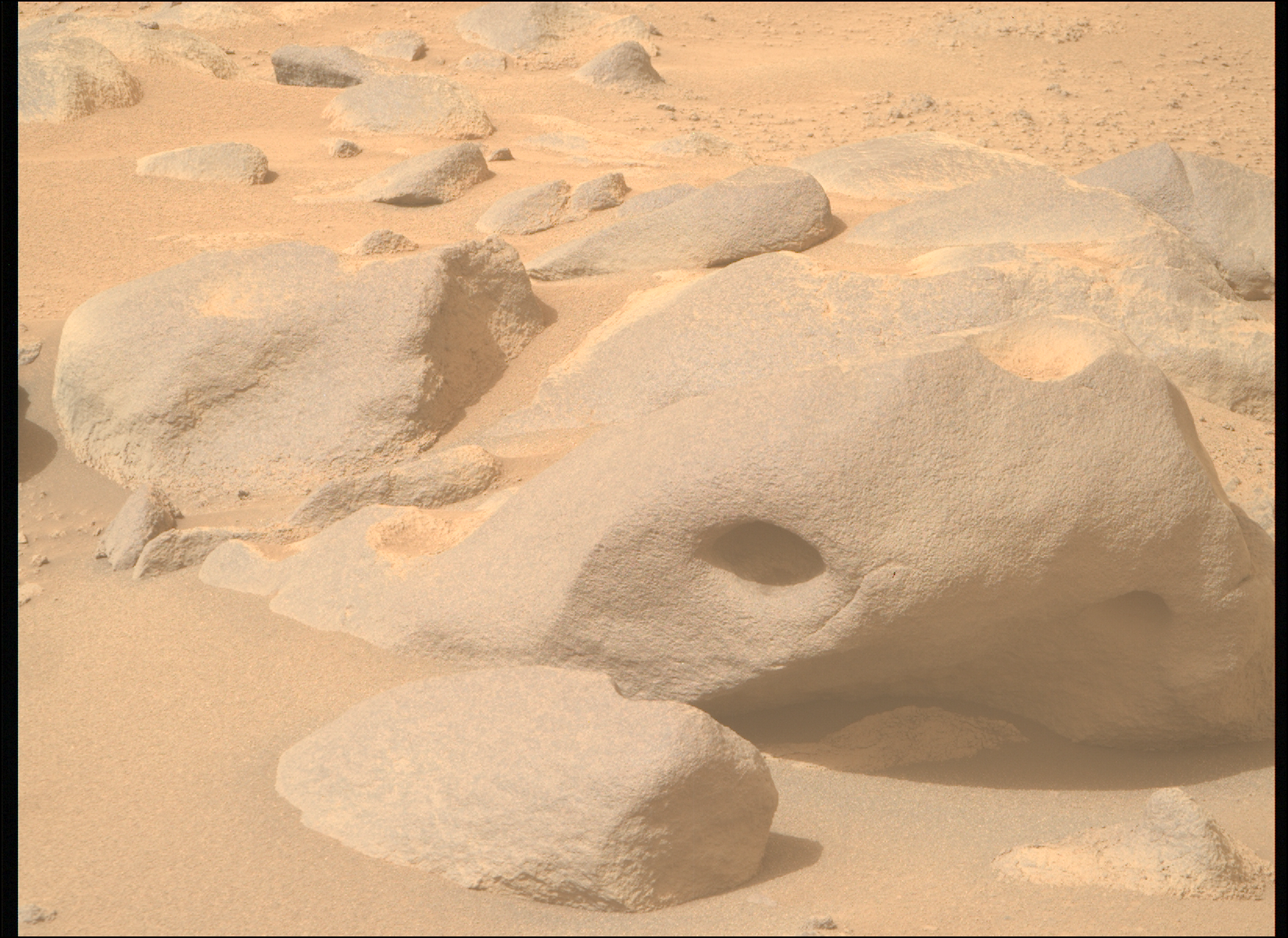
January 8, 2025 Quick space links

Courtesy of BtB’s stringer Jay. This post is also an open thread. I welcome my readers to post any comments or additional links relating to any space issues, even if unrelated to the links below.

  • China touts its own Mars sample return mission, Tianwen-3, targeting 2028
    The mission has been kept very simple by scaling up what China’s engineers learned in doing its two lunar sample return missions. Or to put it another way, they will almost certainly fly at least two of these missions before NASA even comes close to deciding how it get Perseverance’s samples back.
0 comments

Graceful beauty found within the mid-latitude glaciers of Mars

Overview map

Graceful beauty found within the glacial mid-latitudes of Mars
Click for original image.

Cool image time! The picture to the right, rotated, cropped, reduced, and sharpened to post here, was taken on October 27, 2024 by the high resolution camera on Mars Reconnaissance Orbiter (MRO).

The red dot on the overview map above marks the location, about 35 miles southwest of the rim of 80-mile-wide Moreau Crater. This location is also deep within the 2,000-mile-long northern mid-latitude strip I label glacier country, as almost every high resolution picture from MRO shows glacial features.

This picture is no different, in that it shows the typical lineated parallel grooves seen on the surface of glaciers both on Earth and Mars, and especially found on glaciers flowing within a narrow canyon, as this glacier is. The parallel grooves are caused by the waxing and waning of the glacier. Each layer represents a past period when ice was being deposited on the surface, with the grooves indicates times when that ice was sublimating away. The graceful curves of the grooves is due to the drift of the glacier itself downhill.

This canyon is about seven miles wide at this point, formed from the confluence of two southerly tributaries to the south. The downward grade is to the north, but the low point is not where you would expect, out into the northern lowland plains. Instead, I have marked the low point in the inset with a white dot, inside the canyon itself. It appears this glacier drains into this low spot, but then this debris-covered ice appears to vanish.

It can’t really vanish, but there is a geological mystery here that involves the alien nature of Mars. For some reason the glacier dies at this point, its material sublimating away. Is there a drainage here that sends the ice to the north by underground passages? Your guess is as good as mine.

The lineated nature of this glacial flow however is no mystery in one respect. It is quite beautiful, as seen from space.

0 comments

Oman plans three more suborbital launches in ’25 from its proposed spaceport site

Middle East, showing Oman's proposed spaceport
The Middle East, showing the location of
Oman’s proposed spaceport at Duqm.

Oman is now planning three more suborbital launches from its proposed spaceport site at Duqm on the coast of the Indian Ocean, intended to further sell the location as a viable spaceport for use by others.

The first launch, of which little was revealed, took place in early December. What Oman’s state-run has revealed about the rocket is this:

Measuring 6.72m in length and weighing 123kg when fuelled, the rocket was developed with strict adherence to environmental and safety standards. … The Duqm-1 project involved 15 Omani engineers and technicians, who gained valuable experience in the space industry. While the rocket components were manufactured abroad, assembly took place locally, reflecting Oman’s efforts to transfer and localise advanced technologies.

I suspect the planned launches in 2025 will involve a similar-sized rocket. Though I know through various sources that Oman has been trying to encourage American rocket startups to consider this location, no deals have been made because of the State Department’s strict ITAR rules that are designed to prevent hostile nations from stealing American technology. The location however is a good one, and other Middle Eastern Arab nations might begin to consider it for their own rocket programs.

1 comment

Blue Origin fined by the Florida Department of Environmental Protection for using its launch deluge system

Because it conducted a static fire test using its launchpad deluge system in September 2024, before the Florida Department of Environmental Protection (FDEP) had issued it a permit, the department has now fined Blue Origin $3,250.

The actual permit was subsequently approved in November 2024.

The story is very reminiscent of the red tape treatment SpaceX has been getting at Boca Chica. I am certain Blue Origin’s deluge system uses potable water (confirmed in the comments below), which will do no harm to the environment — proven by decades of government launches at both Cape Canaveral and the Kennedy Space Center. Yet, FDEP accuses the company of dumping “untreated industrial wastewater [in]to the environment.”

This story kind of proves that leftist politicians and activists can never stay bribed. Bezos for years has cozied up to the left with major donations to leftist organizations, including many many environmental groups. But when he finally gets ready to launch they are still ready and willing to make his life difficult.

It seems to me that Governor Ron DeSantis of Florida should have a conversation with the officials at FDEP that issued this fine, explaining to them that the real problem was likely that permitting was taking longer than it should, especially when everyone knows such deluge systems cause no harm. The permit should have been approved instantly.

6 comments

India appoints a new leader for its space agency ISRO

After two-plus very successful years under the leadership of S. Somnath, the Indian government has now appointed a new chairman for its space agency ISRO, V. Narayanan.

Narayanan’s journey with ISRO began in 1984, and he has functioned in various capacities before becoming Director of the Liquid Propulsion Systems Centre (LPSC), which Narayanan heads, is engaged in the development of liquid, semi-cryogenic and cryogenic propulsion stages for launch vehicles, chemical and electric propulsion systems for satellites, control systems for launch vehicles, and transducers development for space systems health monitoring.

The term for this job in India is never more than three years, which explains this change at what seems a somewhat inappropriate moment, with ISRO gearing up to fly its first manned mission while preparing more missions to the Moon. It means that Narayanan will be in charge during that manned mission in 2026, should it fly on time.

0 comments

Japan identifies a Chinese hacker group as the source of 210 attacks since 2019

The Japanese government has now identified a Chinese hacker group — dubbed “MirrorFace” and likely working with government support and direction — as the source of 210 attacks from 2019 to 2024.

Investigations by the agency’s National Cyber Department and police nationwide found that the malware used by MirrorFace was similar to that employed by the “APT10 Group,” a hacker organization said to be associated with China’s Ministry of State Security.

The targets also aligned with China’s areas of interest and the attacks coincided with Chinese working hours, ceasing during the country’s long holidays, police noted.

Though Japan’s space agency JAXA was a major target, it appears the hackers had many successes with other government agencies, including those related to national security.

This story only adds weight to the previous reports [pdf] of Chinese hacks of JPL, whereby China got the plans of our Spirit and Opportunity Mars rovers and used that information to design Zhurong, its first rover to go to Mars.

0 comments

SpaceX launches more Starlink satellites; delays 7th Starship/Superheavy launch several days

Early today SpaceX successfully launched another 21 Starlink satellites, including 13 with direct-to-cell capabilities, its Falcon 9 rocket lifting off from Kennedy in Florida.

The first stage completed its 3rd flight, landing on a drone ship in the Atlantic.

Elon Musk also indicated around the same time that the initially scheduled 7th Starship/Superheavy launch on January 10th has been delayed a few days into next week.

The 2024 launch race:

3 SpaceX
1 China

0 comments

January 7, 2025 Quick space links

Courtesy of BtB’s stringer Jay. This post is also an open thread. I welcome my readers to post any comments or additional links relating to any space issues, even if unrelated to the links below.

5 comments

BepiColombo to fly past Mercury again on January 8, 2025

BepiColombo will do its sixth close fly-by of Mercury on January 8, 2025, zipping by its surface by only 183 miles.

It will use this opportunity to photograph Mercury, make unique measurements of the planet’s environment, and fine-tune science instrument operations before the main mission begins. This sixth and final flyby will reduce the spacecraft’s speed and change its direction, readying it for entering orbit around the tiny planet in late 2026.

BepiColombo is more than six years into its eight-year journey to planet Mercury. In total, it is using nine planetary flybys to help steer itself into orbit around the small rocky planet: one at Earth, two at Venus, and six at Mercury. Making the most of this sixth close approach to the small rocky planet, BepiColombo’s cameras and various scientific instruments will investigate Mercury’s surface and surroundings.

Once the spacecraft arrives at Mercury two years hence it will split into two orbiters in complementary orbits, the Mercury Planetary Orbiter built by Europe and the Mercury Magnetospheric Orbiter built by Japan.

4 comments

NASA is considering two options for getting Perseverance’s Mars samples to Earth

The previous plan for Mars Sample Return

In a press briefing today, NASA officials announced it is considering two options for getting Perseverance’s Mars samples to Earth sooner and what it hopes will for less money.

In the first option, NASA would use already available and operational rockets to launch a larger rover to Mars, landing using a sky crane similar but larger than the one used successfully by both Curiosity and Perseverance. This rover would also have nuclear power system used by those rovers, as well as an arm similar to theirs, simplifying the design process. Under this option it appears NASA is abandoning the use of a helicopter for retrieval, as had previous been considered.

In the second option, NASA would rely on what administrator Bill Nelson called “the heavy-lifte capability of the commercial sector.” He specifically mentions SpaceX’s Starship/Superheavy and Blue Origin’s New Glenn, but added that they are looking at the capabilities of the entire private sector right now.

In both operations, the retrieval rover would clean on Mars the outside of the cores to prevent them from contaminating Earth with Martian particles. Previously that cleaning process was to take place in space on the way back. They claim this change also simplifies things.

The final decision on which option to choose is now scheduled for 2026. NASA likely wishes to see more progress with getting Starship/Superheavy as well as New Glenn operational before deciding.

Note that at this press conference very little was said about the Mars ascent rocket, presently supposedly being built by Lockheed Martin. This is essentially building a full scale rocket only slightly less powerful that Earth-based rockets by a company that has never done it before. It seems the second option is likely going to include other options and other rocket companies for this task. The lack of mention suggests NASA was uncomfortable with mentioning this possibility.

In general, this project still feels incomplete and poorly thought out. Major components — such as the ascent vehicle — have not been worked out properly. The officials claimed these changes would make it possible to bring the samples back in the ’35-’39 time frame but I don’t believe it. What it does do is guarantee a large cash influx to NASA, something administrator Bill Nelson lobbied for during the conference, for the next decade-plus. And I think that was the real goal.

11 comments

Toyota invests in rocket startup

In a positive sign that Japan’s rocket industry is beginning to join the private sector, Toyota yesterday announced that it is investing $44 million in the rocket startup Interstellar Technologies.

Interstellar had been more visible about five years ago, and then disappeared. I figured it had died having run out of cash. It appears it is coming back now in Japan.

2 comments
1 252 253 254 255 256 2,916