France to award four rocket startups launch contracts worth as much as 400 million euros

Capitalism in space: According to a story today at the European Spaceflight website, the French government will later this week announce contract awards to four different rocket startups worth as much as 400 million euros.

The four launch startups that will receive a combined €400 million in subsidies are HyPrSpace, Latitude, Sirius Space Services, and the ArianeGroup subsidiary MaiaSpace.

The HyPrSpace OB-1 and Latitude Zephyr rockets will be the smallest of the lot and will be capable of delivering between 100 and 200 kilograms to low Earth orbit. The Sirius 1, Sirius 13, and Sirius 15 rockets will be capable of delivering between 175 and 1,100 kilograms to orbit. The Prometheus-powered Maia rocket is expected to be the most powerful, with a payload capacity of up to three tonnes when launched in its expendable configuration.

All four companies however will only receive a small upfront payment, with the bulk of the award only paid if a company achieves a maiden launch by 2028.

That the French government is now signing deals with new private and independent launch companies and not with Arianespace, the commercial arm of the European Space Agency (ESA) that has always been dominated by the French, is a major development. Up until now most of the action encouraging independent rocket companies has come from Germany and Spain. That France has now joined the party signals the almost certain death knell to the failed two decade-long effort by Arianespace to make a profit, even when it controlled about 50% of the launch market.

Expect the government monopoly of Arianespace to fade away in the next five years. Expect it to be replaced with a thriving industry of mulitple rocket companies, all charging less and coming up with new ways to lower cost.

2 comments

South Texas booming due to arrival of SpaceX

Link here. The article details the major tourism and industry dollars that have come into existence in the Brownsville region since SpaceX established its Boca Chica launch facility, including major development now underway to cater to the tourist business of travelers eager to get a close look at a Starship/Superheavy launch.

The article gives a sense of the reality on the ground. While the anti-Musk activist groups sue SpaceX in their attempt to shut down Starship/Superheavy development, claiming it is harming the region, stories like this put the lie to those claims.

Hat tip to Robert Pratt of Pratt on Texas.

7 comments

The tangled view of astronomers

A protostar in formation
Click for original image.

The uncertainty of science: The picture to the right, cropped, reduced, and sharpened to post here, was taken by the Hubble Space Telescope as part of a survey of young stars surrounded by an edge-on dust disk. From the caption:

FS Tau is a multi-star system made up of FS Tau A, the bright star-like object near the middle of the image, and FS Tau B (Haro 6-5B), the bright object to the far right that is partially obscured by a dark, vertical lane of dust. The young objects are surrounded by softly illuminated gas and dust of this stellar nursery. The system is only about 2.8 million years old, very young for a star system. Our Sun, by contrast, is about 4.6 billion years old.

The blue lines on either side of that vertical dust lane are jets moving out from FS Tau B. The caption says their asymetrical lengths are likely due to ” mass is being expelled from the object at different rates,” but it just as easily be caused by the angle in which we see this object, making the nearer jet seem longer than the one behind.

That astronomers cannot move around such an object and see it from many angles explains the headline of this post. We can only see astronomical objects from one angle, and when they are complex objects such as this one, a large part of the research problem is disentangling the shapes we see into a coherent picture. Spectroscopy helps a lot, as it provides information about the speed and direction of different parts of the object, but even this can be enormously complicated and difficult to interpret.

Remember these facts when you read news reports about astronomical research. No matter how certain the press release sounds, its certainty is always tempered by many unknowns, some very pedestrian but fundamental.

0 comments

UK Space Agency proudly grows

The United Kingdom Space Agency today announced that it is opening four new offices in four different cities, giving it a brand new headquarters as well as a total of five regional offices.

The new HQ at Harwell is due to open in June, while offices at William Morgan House in Cardiff and Space Park Leicester will open in April, with the office at Queen Elizabeth House, in Edinburgh, opening later in the summer.

In addition, the agency will retain its offices in London and Swindon.

Will this expansion alleviate the serious red-tape issues in the United Kingdom that killed Virgin Orbit and have delayed launches at its two new spaceports in Scotland? I have my doubts. The licensing problems in the UK have centered on the number of different agencies and offices that must issue approvals to private space companies. While it might make sense for the UK Space Agency to hire more people, if anything it should be streamlining its operations to one central place.

It appears instead that this bureaucracy is doing what all government bureaucracies do, expanding and growing at the cost of private enterprise. I don’t see how opening many different small offices can possibly help make the licensing procedure faster or easier.

3 comments

Boom’s one-third-scale prototype supersonic jet finally takes off

The private startup Boom has finally flown its third-scale prototype supersonic jet, dubbed XB-1, on its first short flight, taking off on March 22, 2024 from the flight test facility in Mojave, California.

Following behind was Test Pilot Tristan “Geppetto” Brandenburg in a T-38 chase plane to observe the flight and confirm altitude and speed. With a length of 62.6 feet (19 m) and a wingspan of 21 ft (6 m) , the XB-1 achieved an altitude of 7,120 ft (2,170 m) and speeds up to 238 knots (273 mph, 440 km/h) under the force of its three GE J85-15 engines generating a maximum thrust of 12,300 lbs.

According to Boom, once its aerodynamic characteristics and flight worthiness are confirmed, the XB-1 will increase speed until it is flying on later tests in excess of Mach 1.

This prototype supersonic test plane was first unveiled in 2020, four years ago, but runway taxi tests did not begin until 2023. I suspect the Wuhan panic contributed to the three year delay between unveiling and first tests, though this is speculation.

The goal is to build the first commercial superonic passenger plane since the Concorde. At present Boom has a contract from United for fifteen Boom 12-passenger planes, plus development deals with Boeing, and Japan Airlines.

9 comments

Antenna for joint NASA-ISRO radar satellite needs fix, delaying launch

The large deployable antenna for a joint NASA-ISRO radar satellite, dubbed NISAR, that was targeting a spring launch will require an extra coat of reflective material, thus delaying the satellite’s launch until the second half of this year.

In a March 22 statement, NASA said a new launch date for the NASA-ISRO Synthetic Aperture Radar (NISAR) mission will be set at the end of April because of work to protect the spacecraft’s reflector, an antenna that is 12 meters across when fully deployed, from temperatures when in its stowed configuration. “Testing and analysis identified a potential for the reflector to experience higher-than-previously-anticipated temperatures in its stowed configuration in flight,” NASA said in the statement. To prevent those increased temperatures, a “special coating” will be applied to the antenna so that it reflects more sunlight.

That work, NASA said, requires shipping the antenna, currently with the rest of the NISAR spacecraft in India, to a facility in California that can apply the coating. NASA did not state how long the process of applying the coating, as well as shipping the antenna to California and then back to India, will take.

It appears that the need for this additional coat was discovered during environmental testing by ISRO engineers in India as part of its preparation for launch on India’s GSLV rocket. Based on the JPL website for this mission, it appears this antenna system was built by JPL.

NASA is providing the mission’s L-band synthetic aperture radar, a high-rate communication subsystem for science data, GPS receivers, a solid-state recorder and payload data subsystem. ISRO is providing the spacecraft bus, the S-band radar, the launch vehicle and associated launch services.

Though the purpose of the final environmental testing prior to launch is specifically to find such issues and correct them, the question remains why this issue occurred. One can’t help wondering if the many management problems detailed at JPL in several reports (here, herej, here) might have contributed, including the organization’s total commitment since 2022 to Diversity, Equity, and Inclusion quotas, making skin color and sex the primary qualifications for hiring, rather than skill, education, or talent.

1 comment

SpaceX launches more Starlink satellites

The beat never ends: SpaceX last night successfully launched another 23 Starlink satellites, its Falcon 9 rocket lifting off from Cape Canaveral.

The first stage successfully completed its nineteenth flight, landing successfully on a drone ship in the Atlantic. This stage is now the third that has completed a record nineteen flights. One wonders when a stage will reach twenty.

The leaders in the 2024 launch race:

29 SpaceX
12 China
4 Rocket Lab
4 Russia

American private enterprise now leads the rest of the world combined in successful launches 34 to 22, while SpaceX now leads the entire world, including American companies, 29 to 27.

2 comments

Russians launch three astronauts to ISS

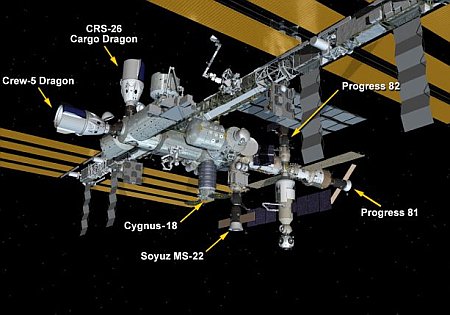
The Russians today successfully launched three astronauts to ISS, its Soyuz-2 rocket lifting off from Baikonur in Kazakhstan.

The Soyuz is scheduled to dock with ISS on March 25, 2024. The Russian and Belarus astronauts will stay on board ISS for about two weeks, returning to Earth on an Soyuz-2 capsule that is presently docked to ISS, taking with them an American who has just completed six months in space. The American on today’s launch will now start her own six month mission, and will return in September with two Russian astronauts who are presently on a year long mission, one of whom will likely set a new duration record for a woman.

The leaders in the 2024 launch race:

28 SpaceX
12 China
4 Rocket Lab
4 Russia

American private enterprise still leads the rest of the world combined in successful launches 33 to 22, while SpaceX remains ahead of the entire world, including American companies, 28 to 27.

1 comment

Vivaldi – Spring

An evening pause: Seems the perfect piece of music to herald in the first weekend of spring. This is first movement of Vivaldi’s The Seasons. Performed here by Alana Youssefian and the Voices of Music.

2 comments

March 22, 2024 Quick space links

Courtesy of BtB’s stringer Jay. This post is also an open thread. I welcome my readers to post any comments or additional links relating to any space issues, even if unrelated to the links below.


0 comments

Martian vent or sink?

A Martian vent or sink?
Click for original image.

Cool image time! The picture to the right, rotated, cropped, reduced, and enhanced to post here, was taken on January 29, 2024 by the high resolution camera on Mars Reconnaissance Orbiter (MRO).

Though the scientists label this image showing “channels”, what I see is either a vent or a sink, with the channels to the south indicating past flows either coming out of the depression or into it. The uncertainty exists because the surface grade in this region is essentially flat. There is a lot of small up and down variations, but overall it is very difficult to determine the general trend, suggesting that when the depression and channels formed the grade was different, and there is no way from this data to determine the angle at that time.

Were the flows that created the channels lava or water or ice? Knowing the grade when these channels formed would help answer this question, but other research now suggests the latter.
» Read more

0 comments
1 402 403 404 405 406 2,914