Mexico’s president says it will investigate SpaceX for doing salvage operations off its coast

Mexico to SpaceX:
Mexico to SpaceX: “Nice business you got here. Shame
if something happened to it.”

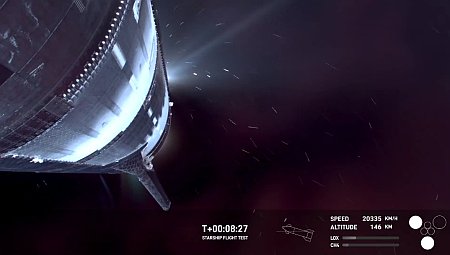
You can’t win with these people: First Mexico’s president Claudia Sheinbaum complained loudly about the debris that landed or washed up on its beaches after several of SpaceX’s Starship/Superheavy test launches, demanding an investigation followed by sanctions against the company.

Now Sheinbaum is complaining and demanding a new investigation about SpaceX’s effort the last two weeks to salvage and remove that debris from the ocean off its coast.

During a passage of her daily press conference, Sheinbaum said the agencies are analyzing whether the company has to be sanctioned after its unit tasked with clearing debris from the Starship launch, located in the Gulf of Mexico, worked without proper authorization. “We are investigating but the Environment, Navy, Digital Transformation, Government and Foreign Relations secretariats are conducting their research. The study is practically done,” Sheinbaum said.

Navy Secretary Raymundo Pedro Morales Angeles said the company hired by SpaceX to retrieve debris from its Starship rocket was allowed to enter the country but didn’t fulfill the requirements to work and ended up leaving the country.

If this behavior doesn’t prove Sheinbaum’s lust for power and control, nothing will. She doesn’t really care about Mexico’s beaches or environment. If she did, she would celebrate SpaceX’s salvage operations. What she really doesn’t like is that someone is doing something without her permission. She is the boss, and SpaceX better remember that!

22 comments

Rocket startup IRocket mergers with investment company

The rocket startup IRocket has now gone public by merging with the special purpose acquisition company (SPAC) BPGC, with the latter committing $400 million in investment capital in the merged company.

Innovative Rocket Technologies Inc. (iRocket), a next-generation reusable space rocket developer, and BPGC Acquisition Corp. (BPGC), a special purpose acquisition company sponsored by The Hon. Wilbur Ross, the 39th U.S. Secretary of Commerce with more than 55 years of private equity and investment banking experience, and BPGC Management LP, an independent private equity firm dedicated to opportunistic buyouts and special situations transactions in the global industrials, materials and chemicals sectors, jointly announced today that they have entered into a definitive Merger Agreement and Plan of Merger dated July 22, 2025, in connection with the previously-announced letter of intent.

Upon closing, the combined company will operate under the name iRocket Technologies Inc. and the parties will plan to list the combined company on Nasdaq.

The press release at the link makes a lot of very ambitious claims about the company’s proposed rocket, claims that so far appear to be nothing more than nice PowerPoint graphics.

iRocket’s Shockwave launch vehicle is uniquely designed for recovery and reuse of all of its stages. Just as airplanes fly multiple flights, iRocket will Recondition, Reload, and Relaunch™ its rockets in under 24 hours. iRocket’s patented liquid rocket engines will maintain high efficiency through descent as well as ascent. iRocket’s engines will be fueled with sustainable liquid oxygen and methane, which burns cooler, imparts less stress on components, and further supports iRocket’s unique 24-hour turn-around time. Being on a leading edge with its rocket engine expertise, iRocket is also developing solid rocket motors that will transform boosters, missiles, and interceptors.

The company has been around since 2018, yet as far as I can determine has never launched anything. One would hope that something real will begin to finally happen with this infusion of significant new capital.

1 comment

Study identifies range of interference produced by Starlink satellites

In analyzing about 76 million radio images produced by the new Square Kilometer Array (SKA) in Australia scientists have found within them signals produced by SpaceX’s Starlink satellites.

PhD candidate and study lead Dylan Grigg said the team detected more than 112,000 radio emissions from 1806 Starlink satellites, making it the most comprehensive catalogue of satellite radio emissions at low frequencies to date. “Starlink is the most immediate and frequent source of potential interference for radio astronomy: it launched 477 satellites during this study’s four-month data collection period alone,” Mr Grigg said. “In some datasets, we found up to 30 per cent of our images showed interference from a Starlink satellite.”

Mr Grigg said the issue wasn’t just the number of satellites, but the strength of the signals and the frequencies they were visible at. “Some satellites were detected emitting in bands where no signals are supposed to be present at all, such as the 703 satellites we identified at 150.8 MHz, which is meant to be protected for radio astronomy,” Mr Grigg said. “Because they may come from components like onboard electronics and they’re not part of an intentional signal, astronomers can’t easily predict them or filter them out.”

The researchers were careful to note that SpaceX has been following all international regulations, and that these signals are not a violation of any law or regulation. Further, they emphasized that “Discussions we have had with SpaceX on the topic have been constructive.”

Because many other such constellations are now being launched — with several from China that normally does not negotiate these issues like SpaceX — the scientists want new international regulations imposed to protect their work.

More and more it seems astronomers should simply move their operations into space or the Moon, where such issues will not exist. Getting above the atmosphere and away from our modern technological society provides so many benefits for research the move should be a no-brainer. That it is now also much cheaper to do it (thanks to SpaceX) makes the move even more practical.

For some reason however the idea seems too difficult for many astronomers to fathom.

1 comment

JAXA/Mitsubishi test upgraded engines for H3 rocket

Japan’s space agency JAXA, working with Mitsubishi, successfully completed today a static fire test of new more powerful engines to be used on its new H3 rocket, thus eliminating the need for solid-fueled boosters with the goal of reducing the rocket’s cost.

Thursday’s test involved the sixth H3 rocket, which is a Type 30 test vehicle that has three main engines and no boosters. The three main engines were fired for 25 seconds while the rocket remained attached to the launchpad. JAXA will check acceleration, temperature and other data collected during the test.

This new version of the H3 is expected to do its first launch before the end of 2025. If successful, the launch price compared to JAXA’s now retired H2A rocket will be cut in half, to about $35 million, a number that will almost be competitive with the Falcon 9. SpaceX officially charges about $70 million per launch, but it is believed it could reduce that price significantly — some estimate to as low as $20 million — and still make a profit.

0 comments

July 23, 2025 Quick space links

Courtesy of BtB’s stringer Jay. This post is also an open thread. I welcome my readers to post any comments or additional links relating to any space issues, even if unrelated to the links below.

6 comments

Curiosity amid the boxwork

Curiosity amid the boxwork, looking uphill
Click for original image.

Overview map
Click for interactive map.

Cool image time! The panorama above, cropped to post here, was taken on July 20, 2025 by the left navigation camera on the Mars rover Curiosity. It looks uphill to the south into the canyon that Curiosity will eventually travel, with the white chaotic upper flanks of Mount Sharp on the horizon. The mountain’s peak itself is out of view, about 25 miles away.

The overview map to the right provides the context. The blue dot marks Curiosity’s present position, on the northern edge of the large patch of very distinct boxwork ridges visible from orbit. You can see these ridges in the foreground of the panorama above.

The yellow lines indicate the approximate area covered by the panorama. The red dotted line roughly indicates the rover’s future travels. At the moment, however, it is going nowhere, as the science team is focused on studying these boxwork ridges in the hope they can determine their origin. Such features are usually associated with cracking later filled with lava, with the polygon-shaped cracking usually associated with a formerly wet environment drying.

0 comments

Rocket Lab’s new Neutron rocket faces red tape delays at Wallops

Proposed dredged channel
Proposed dredged channel. Click for original.

We’re here to help you! Rocket Lab appears to be having regulatory problems getting approvals to transport hardware for its new Neutron rocket to its new launchpad at the Mid-Atlantic Regional Spaceport (MARS) on Wallops Island in Virginia, delays that might prevent it from launching as planned later this year.

It appears the company needs to dredge a deeper channel to ship the heavier Neutron hardware into Wallops, but it has not been able to begin work because of approval delays by the federal government.

The dredging project was approved by VMRC [Virginia Marine Resources Commission] in May, but the company has yet to start digging because it’s still awaiting federal sign-off from the Army Corps of Engineers.

Lacking this approval and unable to get the channel ready for this year’s launch, the company is seeking permission to use a stop-gap different approach to transport the hardware through these shallow waters.

Kedging, a little-known nautical method, is used to ensure the barges can safely navigate the existing shallow channel. Workers would use a series of anchors and lines to steer the barge through the shallow waters. The company is seeking permission to use this method through the end of June 2026 or until the dredging work is complete, whichever comes first.

Lacking an okay to do even this alternative approach, Rocket Lab will be forced to transport the hardware using “ramps and cranes,” an approach that is impractical in the long run for achieving a profitable launch pace. It also would likely result in not meeting its targeted launch date before the end of 2025 for the first Neutron launch.

8 comments

One of China’s big satellite constellations appears in trouble

According to a report in China’s state-run press today, one of the giant satellite constellations China is building to compete with SpaceX’s Starlink constellation is in trouble, and will likely fail to meet its international licensing requirement to place more than six hundred satellites in orbit by the end of 2025.

Only 90 satellites have been launched into low Earth orbit for the Qianfan broadband network – also known as the Thousand Sails Constellation or G60 Starlink – well short of the project’s goal of 648 by the end of this year.

Under international regulations to prevent spectrum hoarding, satellite operators must deploy a certain proportion of their constellation within set times after securing orbits and radio frequencies.

Shanghai Yuanxin Satellite Technology, the company leading the project, plans to deploy more than 15,000 satellites by 2030 to deliver direct-to-phone internet services worldwide.

To meet its license requirement, it require a launch pace for the rest of ’25 of about 30 satellites per month, something that the article says is unlikely due to “a severe shortage of rockets” in China.

This story might also explain why China’s government yesterday ordered all its rocket pseudo-companies to speed up their test schedules, pushing to launch their new rockets for the first time this year instead of in 2026. The Xi government’s order appears to be trying to address this rocket shortage.

9 comments

Senegal to sign Artemis Accords

According to a NASA announcement today, Senegal will become the 56th nation to sign Artemis Accords tomorrow.

The full list of nations now part of this American space alliance: Angola, Argentina, Armenia, Australia, Austria, Bahrain, Bangladesh, Belgium, Brazil, Bulgaria, Canada, Chile, Colombia, Cyprus, Czech Republic, Denmark, Dominican Republic, Ecuador, Estonia, Finland, France, Germany, Greece, Iceland, India, Israel, Italy, Japan, Liechtenstein, Lithuania, Luxembourg, Mexico, the Netherlands, New Zealand, Nigeria, Norway, Panama, Peru, Poland, Romania, Rwanda, Saudi Arabia, Senegal, Singapore, Slovakia, Slovenia, South Korea, Spain, Sweden, Switzerland, Thailand, the United Kingdom, the United Arab Emirates, the Ukraine, the United States and Uruguay.

It remains unclear whether the second Trump administration has taken a new interest in using this alliance to renew the accords’ original goals, of encouraging private enterprise and property rights in space. The Biden had shifted the purpose away from those goals towards the more globalist approach represented by the Outer Space Treaty.

2 comments

Trump administration moving to reduce rocket launch environmental regulations

FAA logo

According to a draft executive order that has not yet been released, the Trump administration is planning a major revision of the FAA’s environmental and launch regulations that has badly impacted rocket companies, with the goal of streamlining licensing.

The order would give Trump even more direct control over the space industry’s chief regulator by turning the civil servant position leading the FAA’s Office of Commercial Space Transportation into a political appointment. The last head of the office and two other top officials recently took voluntary separation offers.

The order would also create a new adviser to the transportation secretary to shepherd in deregulation of the space industry.

…The draft order also seeks to restrict the authority of state coastal officials who have challenged commercial launch companies like SpaceX, documents show. It could lead to federal officials interfering with state efforts to enforce their environmental rules when they conflict with the construction or operation of spaceports.

The order would also have the secretary of transportation ‘reevaluate, amend, or rescind’ sections of Part 450, the FAA licensing regulations that it imposed during the Biden administration that was supposed to streamline licensing but ended up adding considerable new red tape which contributed significantly to squelching the new launch industry that had popped up during the first Trump term.

As is usual for the propaganda press, the article at the link implies that these changes would result in horrible environmental consequences as well as increased safety risks to the public. What it does not note is that these changes appear to simply return the regulatory framework back to what existed prior to the Biden administration, a framework that had existed for more than a half century previously. The environment and public safety did just fine under those more freedom-oriented rules. I am sure both will do just fine again.

This order might also help explain Trump’s decision to withdraw Jared Isaacman as NASA administrator and appoint Transportation Secretary Sean Duffy as interim NASA administrator. The order puts much of this work on his head, and having him in charge of NASA will likely aid that work.

2 comments

July 22, 2025 Quick space links

Courtesy of BtB’s stringer Jay. This post is also an open thread. I welcome my readers to post any comments or additional links relating to any space issues, even if unrelated to the links below.

1 comment
1 120 121 122 123 124 2,411