July 9, 2025 Quick space links

Courtesy of BtB’s stringer Jay. This post is also an open thread. I welcome my readers to post any comments or additional links relating to any space issues, even if unrelated to the links below.

10 comments

Sightseeing near Starship’s candidate Martian landing sites

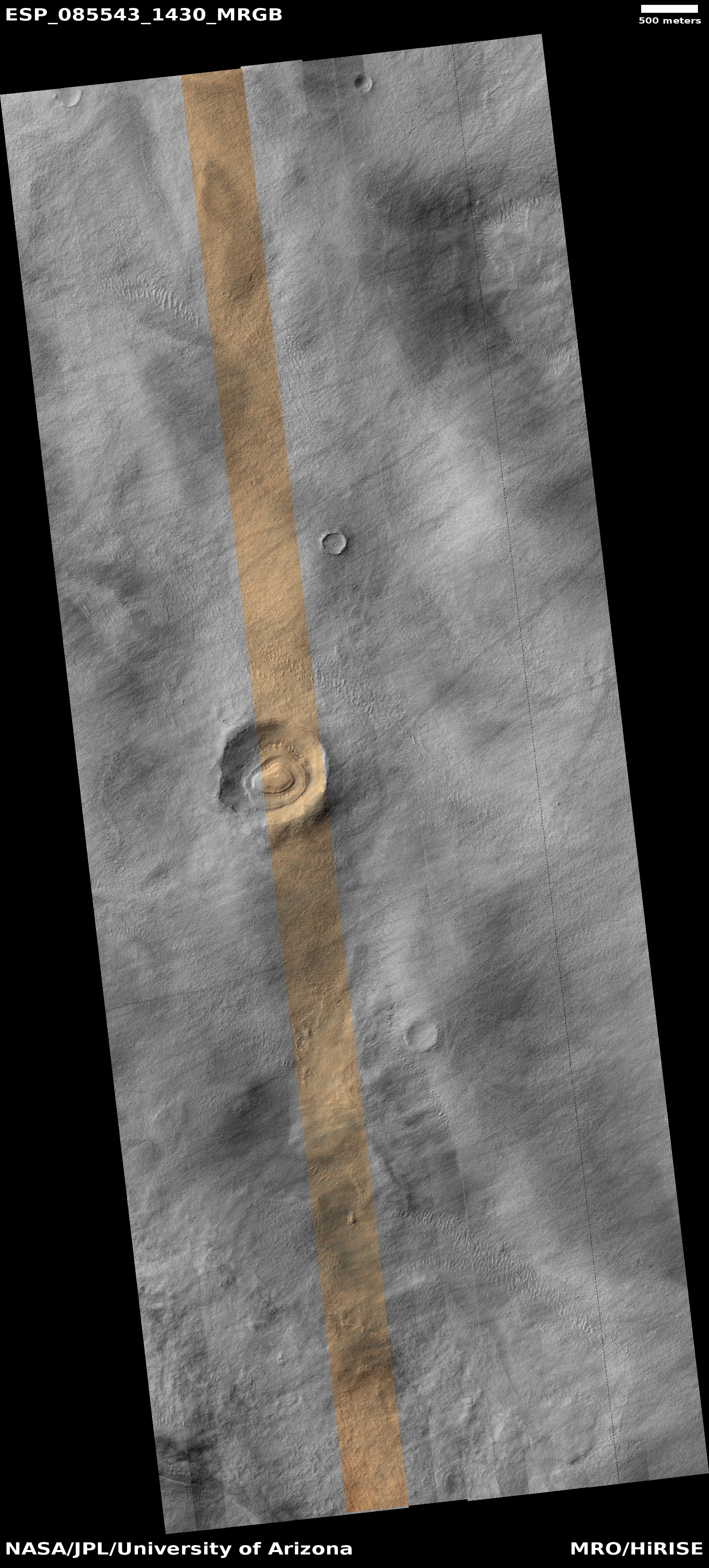
An interesting mesa near Starship's Martian landing zone
Click for original image.

Today’s cool image takes us sightseeing in the region on Mars that SpaceX has chosen for its prime landing zone for its Starship spaceship. The picture to the right, cropped, reduced, and sharpened to post here, was taken on May 29, 2025 by the high resolution camera on Mars Reconnaissance Orbiter (MRO), and shows a 465-foot-high unusually shaped mesa in this region.

The full resolution inset at the bottom of the picture focuses at the strange tilted layers on the southern slope of this mesa. Apparently the layers at this spot were pushed sideways so they lie significantly angled to the horizontal. Though it isn’t clear from this picture, it is possible that the mesa itself is made up of similar tilted layers, hidden below the surface. We can see the tilt only on the mesa’s southern flank because erosion has apparently exposed it.

Note also the black stain that surrounds the mesa. Though this might be caused by wind distributing dust, such stains have also been seen at a location where scientists suspect an inactive hot spring might exist, as well as another location where there may have been relatively recent volcanic activity.

Is this stain caused by any of these processes? In situ exploration would probably be necessary to find out. And we may soon actually have spaceships landing here in the relatively near future with the capability to do this.
» Read more

1 comment

Coalition of space companies begs Congress to fund office designed to track satellites

A coalition of 450 space companies has now submitted letters to both the House and Senate begging Congress to not kill the funding for an office in NOAA created during the first Trump administration and designed to help manage satellite traffic in orbit.

A coalition of space industry associations representing hundreds of companies is urging Congress to reject Trump Administration plans to kill the nascent Traffic Coordination System for Space (TraCSS). Developed through NOAA’s Office of Space Commerce, TraCSS began beta testing last fall to provide data to civil and commercial satellite operators to avoid collisions. Just as the system is finally taking shape, it is targeted for elimination in the FY2026 budget request. The Senate Appropriations Committee takes up that proposal on Thursday when it marks up the Commerce-Justice-Science (CJS) bill that includes NOAA.

This new office was first conceived as a replacement for the tracking that the U.S. military has been doing since Sputnik was launched in 1957, information that it provides free to the industry. It appears Trump in his second administration has now concluded this new NOAA office is essentially redundant and therefore unnecessary.

The letters to the House [pdf] and Senate [pdf] urge Congress to reinstate the $65 million in spending for this NOAA office, but offer no suggestions on what to cut to fund this extra cost. Instead, like all such lobbying efforts, it expects Congress to simply print money to pay for the expense.

Meanwhile, it remains a valid question why this additional office is needed if the military has been doing the job quite successfully for the last three-quarters of a century. The letters argue this is a job better suited to a civil agency, but why? The military has to do it anyway for security reasons. Why waste money on a duplicate effort?

6 comments

ESA tests parachutes and guidance system for its proposed Space Rider reusable mini-shuttle

The engineering
Click for original image.

The European Space Agency (ESA) revealed today that it has completed drop tests from a helicopter of an engineering vehicle of its proposed Space Rider reusable mini-shuttle — similar in concept to the U.S. military’s X-37B — testing the spacecraft’s parachutes and re-entry guidance system.

The drop-test campaign had two objectives: the qualification of the parachutes used to slow the spacecraft during descent, and to test the software that controls the parafoil, guiding the Space Rider’s reentry module to its precise landing site. Space Rider models were dropped from a CH-47 Chinook Italian Army helicopter from altitudes ranging from 1 to 2.5 km, at the Italian military’s training and experimentation area Salto di Quirra.

The press release provides no movie of any of the drop tests, and the images it provides are almost all taken from very far away, making it impossible to see in detail what the engineering vehicle looks like. Only one picture clearly shows it, and that is what I have posted to the right. This is not a model of a spacecraft, but a square box carrying the parachutes and sensors.

Note also that ESA was doing similar drop tests last summer of a similar model. Apparently they aren’t yet ready to test the real thing.

This X-37B copy was first tested by ESA in 2015 and by 2017 the agency was promising it would be flying commercially by 2025. A decade later and they have not yet begun testing a full scale spacecraft. In addition, ESA has established some very complex rules about who can use it commercially, rules so complex I predict few will be interested.

Europe might be trying to adopt capitalism and freedom as its model, but in many ways it behaves as if it hasn’t the foggiest idea what it is doing.

6 comments

ISRO successfully tests thrusters to be used on its manned Gaganyaan capsule

India’s space agency ISRO last week successfully completed two tests of the attitude control thrusters that will be used on its manned Gaganyaan capsule.

In a statement issued on Wednesday, ISRO said that the short-duration tests, lasting 30 seconds and 100 seconds respectively, were aimed at validating the test article configuration. The space agency stated that the overall performance of the propulsion system during the hot tests had been normal and aligned with pre-test predictions.

It was also noted that during the 100-second test, the simultaneous operation of all Reaction Control System (RCS) thrusters in various modes—both steady state and pulsed—along with all Liquid Apogee Motor (LAM) engines had been successfully demonstrated.

The first unmanned test flight of Gaganyaan is presently targeting a launch in the last quarter of 2025, with two more unmanned test flights in 2026. The manned mission of one to three days would follow in 2027.

0 comments

COVID health slanderer gets fired for wishing death on Texans because Texas voted for Trump

Christina Propst, spreading different lies at a town hall meeting during the COVID panic
Christina Propst, spreading different lies at a town
hall meeting during the COVID panic. Click for video.

Fight! Fight! Fight! A Houston pediatrician, Christina Propst, has now been fired because she expressed glee that some Texans might die in this week’s flash floods there because Texas had the nerve to vote for Trump in the 2024 election.

Her exact words:

May all visitors, children, non-MAGA voters and pets be safe and dry.
Kerr County MAGA voted to gut FEMA.
They deny climate change.
May they get what they voted for.
Bless their hearts.

The implication was that she really didn’t care that some kids died as well. She hates Trump that much.

This is not the attitude a health organization wants from its pediatricians, whose job it is to treat children. Within hours her employer, Blue Fish Pediatrics, suspended her, then quickly followed up by firing her.

This story though has a greater context. » Read more

13 comments

Canadian rocket startup hopes to fly first suborbital launch from its proposed Newfoundland spaceport in August

Nordspace's proposed spaceport
Nordspace’s proposed spaceport. Click for original.

Though details remain slim, the Canadian rocket startup Nordspace now says it is targeting an August launch of its hopes to fly first suborbital launch from its proposed spaceport in August.

NordSpace’s Taiga rocket isn’t going to reach orbit when it launches in August, but it’s a big step toward the company’s ultimate goal. Taiga is a small, liquid-fueled, hypersonic launch vehicle capable of carrying just over 110 pounds (50 kilograms) above the Karman Line. This summer’s shakedown cruise will be a low-altitude demonstration of Taiga’s capabilities.

The map to the right indicates the location of the spaceport, near the town of St. Lawrence on the southern coast of the island of Newfoundland.

Whether this launch occurs is very uncertain. For example, a previous report in January 2025 about this launch site suggested that government approvals were still required. It is not known if those approvals have been obtained.

Nordspace is the second company in Canada to propose offering a combined spaceport/rocket service. The other, Maritime Launch Services, first appeared almost a decade ago, but has never gotten off the ground. Nordspace first announced its plans in July 2024, so achieving a first test launch in 2025 will clearly place it ahead of Maritime.

7 comments

SpaceX gets launch contract from Globalstar

As it appears right now to be the only American rocket company capable of taking on new launch contracts, SpaceX today was awarded a new launch contract from Globalstar to launch its third generation set of satellites.

The press release is not clear about the number of satellites or launches involved, but either way the deal signals SpaceX’s continuing dominance. For larger satellites it has no real competitors. Not only are its launch prices the cheapest, none of its competitors are capable of adding new customers to their launch manifests. In fact, those competitors, ULA, Arianespace, and Blue Origin, are having trouble simply getting their rockets off the ground on a regular basis.

This situation however is likely to change by two years, assuming the new rockets being developed by Rocket Lab, Stoke Space, and Relativity finally begin flying.

0 comments

Spanish high altitude balloon company to fly tourist flights from South Korea

The Spanish high altitude balloon startup Zero-2-Infinity has now established an office in South Korea with the intention of flying tourist flights from there for a ticket price of about $60k per flight.

Zero 2 Infinity plans to begin its Korean operations with a project called “Byul” — the Korean word for star — which offers a symbolic farewell for pet lovers. The initiative will invite volunteers to send the ashes of their deceased furry companions into the stratosphere, carried in star-shaped, biodegradable capsules. The company aims to begin collecting participants this September, with the first near-space release scheduled for December in Korea.

Byul will apparently be a smaller balloon with no human passengers. The company claims it has already test flown a larger helium balloon with humans aboard to an altitude of 6 miles, and again unmanned to 20 miles. If so it has done so with no publicity at all. This announcement today appears more a push to raise the $70 million the company says it needs to develop this manned balloon capsule.

3 comments

SpaceX launches 28 Starlink satellites

After an unusual pause of launches of several days (likely due to the July 4th weekend), SpaceX last night successfully launched by placing another 28 Starlink satellites into orbit, its Falcon 9 rocket lifting off from Cape Canaveral in Florida.

The first stage completed its 22nd flight, landing on a drone ship in the Atlantic.

The leaders in the 2025 launch race:

85 SpaceX
36 China
10 Rocket Lab
8 Russia

SpaceX now leads the rest of the world in successful launches, 85 to 63.

0 comments

July 7, 2025 Quick space links

Courtesy of BtB’s stringer Jay. This post is also an open thread. I welcome my readers to post any comments or additional links relating to any space issues, even if unrelated to the links below.

16 comments

Returning to Mars’ glacier country

Overview map

Returning to Mars' glacier country
Click for original image.

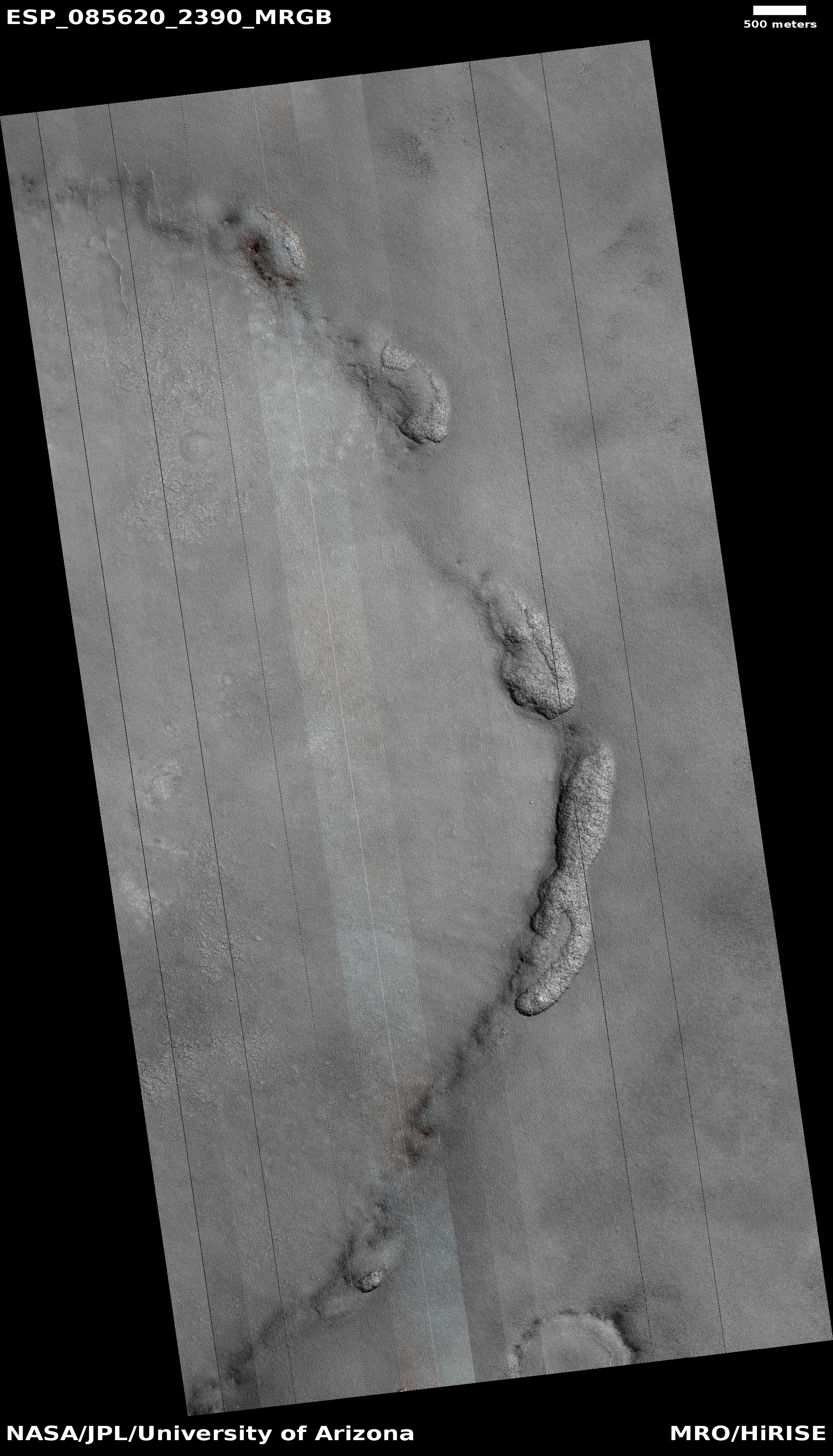
Today’s cool image illustrates again why I rail against those who still claim Mars is dry. The picture to the right, cropped, reduced, and sharpened to post here, was taken on June 2, 2025 by the high resolution camera on Mars Reconnaissance Orbiter (MRO).

The picture was labeled simply as a “terrain sample” by the MRO camera team, which almost always signifies that it was taken not as part of any specific science research project or by request by a scientist, but to fill a gap in the camera’s schedule in order to maintain its proper temperature. When such a gap-filler picture is required, the team tries to pick interesting features in that time frame, but don’t always succeed.

In this case, that time frame placed MRO over the northern mid-latitudes and a region I label “glacier country” because practically every picture taken in this region shows glacial features. This picture is no exception. The white dot in the overview map above marks the location, in the Protonilus Mensae area of the 2,000-mile-long strip of glaciers. The arrow in the picture itself shows the downward grade of the glacial flow. The small 2,000-foot-wide crater appears as if the impact occurred on soft ice, and the stippled terrain surrounding it appears to resemble the feature geologists have labeled “brain terrain”, a surface feature unique to Mars and associated with near surface ice, though its exact formation process is not yet understood.

Nor have I cherry-picked this image to prove my point. Its glacial-like features are very typical for this region of Mars. Note for example the inset with the larger crater to the northeast. It appears almost buried by this glacial material, which has poured through the gap in its southwest quadrant to fill it. A close look at all the low lying terrain shows similar glacial-like flows.

Mars is surely not a paradise. It is bone-chillingly cold almost all the time. Its atmosphere is so thin and lacking in oxygen you would quickly suffocate if you tried to breath it. But the data continues to suggest that the red planet has ample supplies of near-surface ice outside of its dry tropics. All future colonists will need to do is dig a bit and process the water out.

1 comment
1 126 127 128 129 130 2,411