
August 29, 2025 Zimmerman/Batchelor podcast
Embedded below the fold in two parts.
To listen to all of John Batchelor’s podcasts, go here.
» Read more
Very brief descriptions, with appropriate links, of current or recent news items.
Embedded below the fold in two parts.
To listen to all of John Batchelor’s podcasts, go here.
» Read more
Courtesy of BtB’s stringer Jay. This post is also an open thread. I welcome my readers to post any comments or additional links relating to any space issues, even if unrelated to the links below.

Click for originial.
Cool image time! The picture to the right, cropped, rotated, reduced, and sharpened to post here, is the Webb picture of the month from NASA and the European Space Agency (ESA), released today. It shows a baby star about 525 light years away.
IRAS 04302+2247, or IRAS 04302 for short, is a beautiful example of a protostar – a young star that is still gathering mass from its environment – surrounded by a protoplanetary disc in which baby planets might be forming. Webb is able to measure the disc at 65 billion km across – several times the diameter of our Solar System. From Webb’s vantage point, IRAS 04302’s disc is oriented edge-on, so we see it as a narrow, dark line of dusty gas that blocks the light from the budding protostar at its centre. This dusty gas is fuel for planet formation, providing an environment within which young planets can bulk up and pack on mass.
When seen face-on, protoplanetary discs can have a variety of structures like rings, gaps and spirals. These structures can be signs of baby planets that are burrowing through the dusty disc, or they can point to phenomena unrelated to planets, like gravitational instabilities or regions where dust grains are trapped. The edge-on view of IRAS 04302’s disc shows instead the vertical structure, including how thick the dusty disk is. Dust grains migrate to the midplane of the disc, settle there and form a thin, dense layer that is conducive to planet formation; the thickness of the disc is a measure of how efficient this process has been.
The dense streak of dusty gas that runs vertically across this image cocoons IRAS 04302, blotting out its bright light such that Webb can more easily image the delicate structures around it. As a result, we’re treated to the sight of two gauzy nebulas on either side of the disc. These are reflection nebulas, illuminated by light from the central protostar reflecting off of the nebular material.
As this is a baby star, the cones above and below the disk indicate the original spherical cloud, with the upper and lower halves now being pulled downward into a spinning disk, where the solar system is forming.
This image is not simply an infrared Webb image. The Hubble Space Telescope provided the optical view, which the Atacama Large Millimetre/submillimetre Array (ALMA) in Chile provided data in those wavelengths. Note also the many background galaxies. The universe is not only infinite, it is infinitely populated.
Click for full resolution. For original images go here and here.
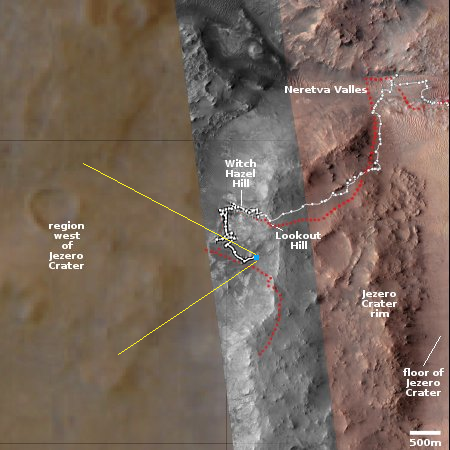
Click for interactive map.
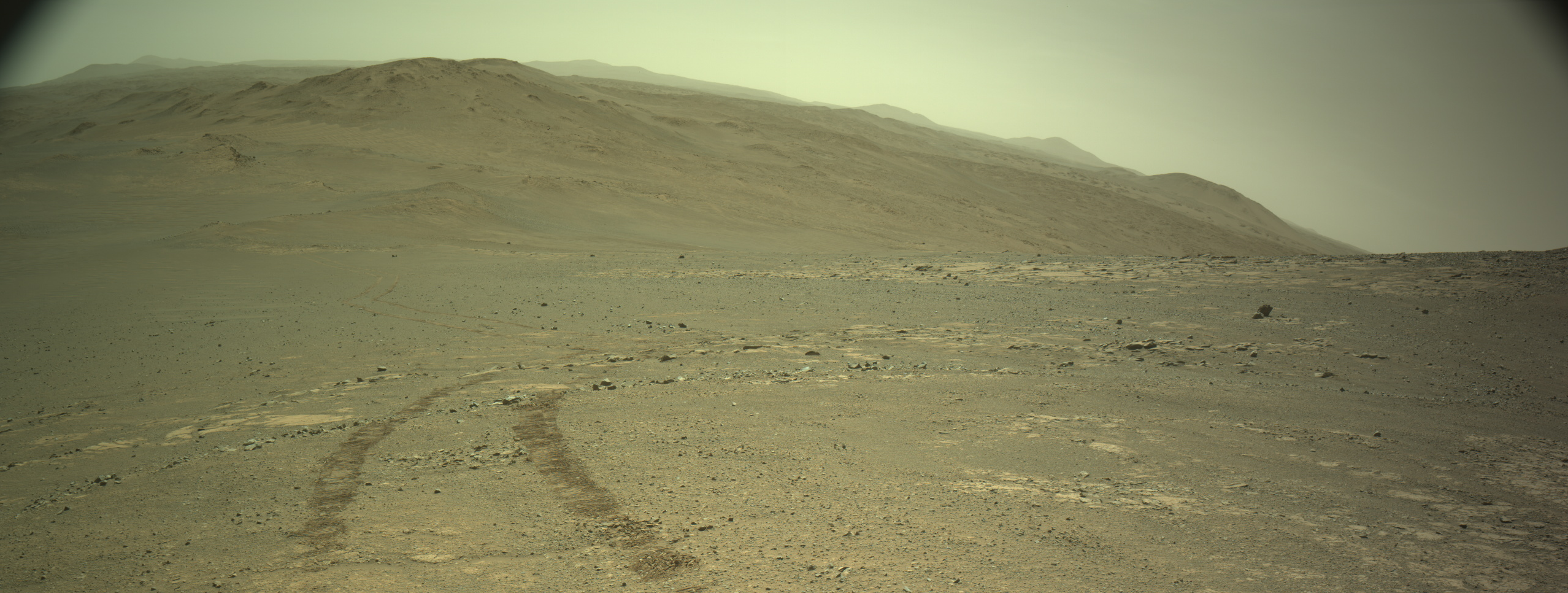
Cool image time! The panorama above, reduced and sharpened to post here, was created using two pictures taken on August 28, 2025 by the left navigation camera on the Mars rover Perseverance (here and here).
The blue dot on the overview map to the right marks Perseverance’s location when it took these pictures. The yellow lines indicate the approximate area covered by the panorama. The red dotted line indicates the rover’s planned route, with the white dotted line its actual travels.
The recent geological research focused on the lighter-colored ridge on the right center, dubbed Soroya. From the August 27, 2025 update by the science team:
Soroya was first picked out from orbital images as a target of interest because, as can be seen in the above image, it appears as a much lighter color compared to the surroundings. In previous landscape images from the surface, Mars 2020 scientists have been able to pick out the light-toned Soryoa outcrop, and they noted it forms a ridge-like structure, protruding above the surface. Soroya was easily identifiable from rover images as Perseverance approached since it indeed rises above the surrounding low-lying terrain.
The view is looking downhill away from Jezero Crater. The curve of the horizon is an artifact of the navigation camera’s wide view, accentuated by the slope that the rover sits on. The low resolution of this western region on the overview map is because the science team has not yet had Mars Reconnaissance Orbiter (MRO) get highest resolution pictures there yet.
Note the utter barrenness of this terrain. This is Mars, a lifeless world that has only the future potential for life, once we humans start to colonize it. Whether there was ever any past life remains uncertain, but the nature of its terrain as seen by both Perseverance and Curiosity suggests strongly that past life never existed, or if it did it barely survived and was quickly wiped out, a long time ago.

The largest quakes detected by InSight, indicated
by the red dots.
Using archival quake data from the Mars lander InSight, scientists now believe that the upper layers in the interior of the red planet are not as coherently layered as the Earth’s, that its mantle is broken up in a much more chaotic manner. From the paper’s abstract:
We report the discovery of kilometer-scale heterogeneities throughout Mars’ mantle, detected seismically through pronounced wavefront distortion of energy arriving from deeply probing marsquakes. These heterogeneities, likely remnants of the planet’s formation, imply a mantle that has undergone limited mixing driven by sluggish convection. Their size and survival constrain Mars’ poorly known mantle rheology, indicating a high viscosity.
These “heterogeneities” are large blocks of material, some as large as two to three miles wide, that are thought left over from the planet’s initial formation. These initial pieces of the mantle were layered like the Earth, but subsequent impacts during the accretion process cracked them and shifted them about.
These results have some uncertainty, as so far only one seismometer, InSight’s, has be placed on Mars. It will require more sensors and years of data to fully map the interior with greater precision and reliability.

Trump’s war with the swamp continues
Fight! Fight! Fight! Trump this week issued a new executive order ending the union contracts for government employees at NASA and other agencies, continuing a March order aimed at reducing or eliminating union action in the federal government.
The president issued a new directive ending collective bargaining agreements at NASA, the International Trade Administration, the Office of the Commissioner for Patents, the National Weather Service, the US Agency for Global Media, hydropower facilities under the Bureau of Reclamation, and the National Environmental Satellite, Data, and Information Service.
Trump classified the agencies as having national security interests, exempting them from federal union laws.
Though lawsuits are on-going challenging Trump’s action, the public should know the context. » Read more
SpaceX earlier today launched another 28 Starlink satellites, its Falcon 9 rocket lifting off from the Kennedy Space Center in Florida.
The first stage completed its 30th flight, landing on a drone ship in the Atlantic. This is a new reuse record for a Falcon 9 first stage. At this moment only the space shuttles Discovery (39 flights) and Atlantis (33 flights) have flown more often.
The leaders in the 2025 launch race:
108 SpaceX
48 China
12 Rocket Lab
11 Russia
SpaceX now leads the rest of the world in successful launches, 108 to 84.
Courtesy of BtB’s stringer Jay. This post is also an open thread. I welcome my readers to post any comments or additional links relating to any space issues, even if unrelated to the links below.

Click for original image.
In honor of our just completed visit to the south rim of the Grand Canyon, today’s cool image takes us to another location on Mars that to me appears a perfect place to install some hiking trails. The picture to the right, cropped, reduced, and sharpened to post here, was taken on June 30, 2025 by the high resolution camera on Mars Reconnaissance Orbiter (MRO).
The image shows a two-mile wide canyon with a number of scattered narrow mesas within. The north and south rims rise about 550 feet above the canyon floor. The two mesas labeled “A” and “B” rise about 200 and 100 feet respectively.
The hiker in me immediately imagines what a great hike it would be to go up the western nose of either ridge and walk along its crest. The knife-edge nature of ridge “A” would mean that for a large majority of the hike you’d be at the north and south edges at the same time.
» Read more
Courtesy of BtB’s stringer Jay. This post is also an open thread. I welcome my readers to post any comments or additional links relating to any space issues, even if unrelated to the links below.
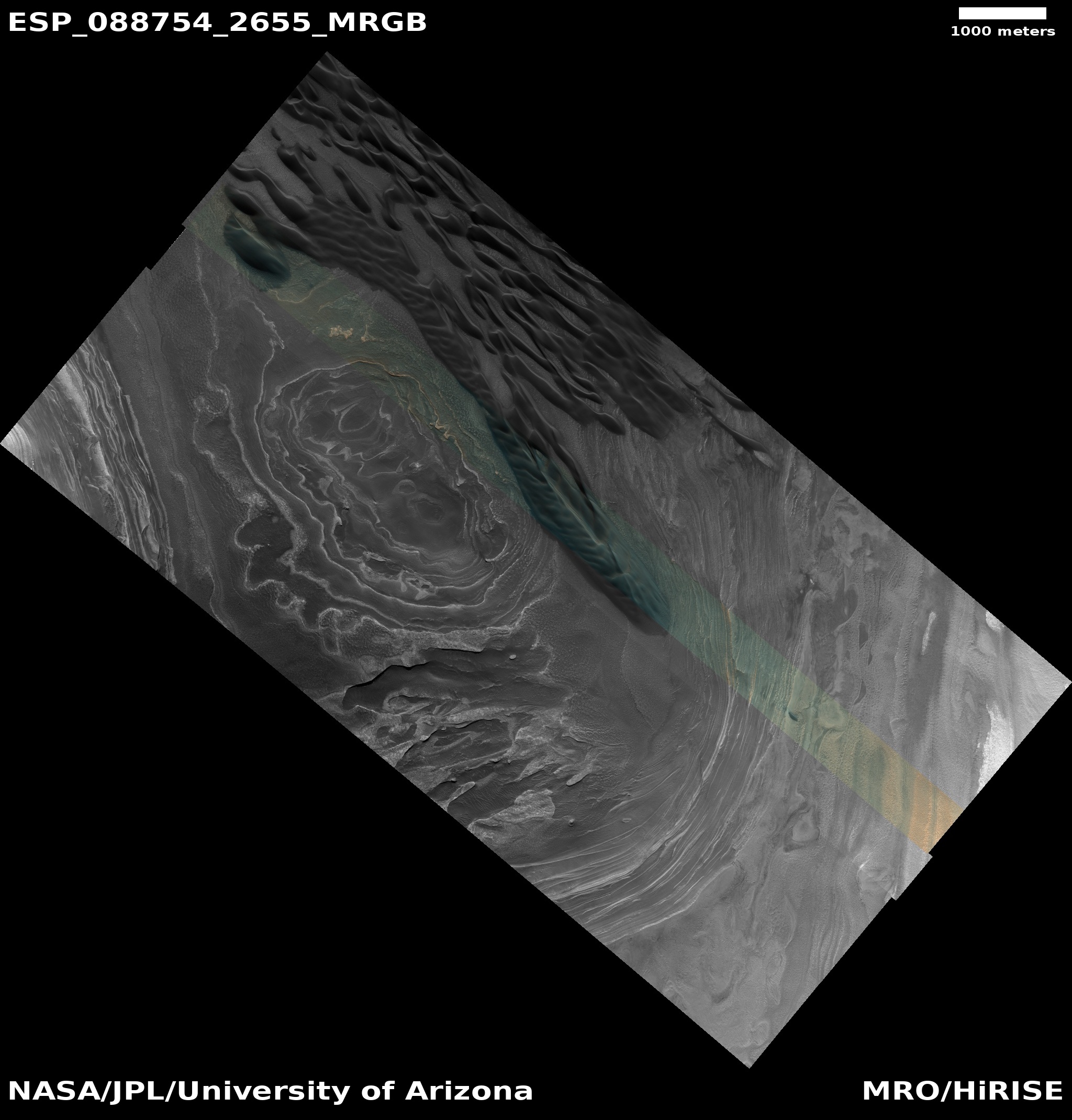
Click for original image.
Today’s cool image returns to the Martian north pole. The picture to the right, rotated, cropped, reduced, and enhanced to post here, was taken on July 3, 2025 by the high resolution camera on Mars Reconnaissance Orbiter (MRO). It shows the top of a ridge near the edge of that icecap, with dunes visible in the hollow several thousand feet below.
The angle of this picture does not show us the many layers on the cliff leading down to those dunes. It does show evidence, however, of the top few layers on the flat crest of that ridge. The white lines delineate those layers, each line marking the edge of a series of wide terraces.
The dunes in the canyon below are of interest because their source is likely the dust that is mixed into thick icecap’s ice. As that ice sublimates away on the face of the cliff, the dust falls into the canyon, where it is trapped.
» Read more
The past 24 hours SpaceX did more than complete its stunningly successful tenth launch of its Starship/Superheavy rocket. The company also launched its Falcon 9 rocket twice from opposite coasts.
First it launched a commercial Earth observation satellite, built by the European company OHB Italia for Luxembourg, its Falcon 9 lifting off from Vandenberg in California. The first stage completed its 27th flight, landing back at Vandenberg..The launch also placed several smallsats in orbit as well.
Then this morning, ten hours after the Starship/Superheavy launch, another Falcon 9 rocket lifted off from Cape Canaveral, placing another 28 Starlink satellites in orbit. The first stage completed its second flight, landing on a drone ship in the Atlantic.
After including all three SpaceX launches, this is the leader board for the 2025 launch race:
107 SpaceX
48 China
12 Rocket Lab
11 Russia
SpaceX now leads the rest of the world in successful launches, 107 to 84.
Courtesy of BtB’s stringer Jay. This post is also an open thread. I welcome my readers to post any comments or additional links relating to any space issues, even if unrelated to the links below.

Click for original image.
Cool image time! The picture to the right, rotated, cropped, reduced, and sharpened to post here, was taken on July 1, 2025 by the high resolution camera on Mars Reconnaissance Orbiter (MRO).
The science team labels it clumsily as “North Polar layered deposits structural geology in icy layers”. What we see are the many layers that make up the north polar cap, produced by the red planet’s many climate cycles that scientists think Mars has undergone over the eons as the red planet’s rotational tilt, or obliquity, rocked back and forth from 11 degrees inclination to as much as 60 degrees. At the extremes, the ice cap was either growing or shrinking, while today (at 25 degrees inclination) it appears to be in a steady state.
These layers are a mixture of ice and dust. The variations from dark to light likely indicate changes in the amount of dust in the atmosphere. Dark layers suggest the atmosphere was more dusty due to volcanic eruptions. Light layers suggest the planet’s volcanic activity was more subdued.
At least that’s one hypothesis.
» Read more
Diane and I are on the road today, leaving the Grand Canyon, which remains as grand as ever, and heading to Colorado to visit friends we haven’t seen since before the COVID panic.
Thus, I will likely not be able to watch today’s third attempt by SpaceX to complete the tenth launch of its Starship/Superheavy rocket, as it happens.. (Live stream can be found here.)
Once settled in Colorado I will catch up. Like you all, I have my fingers crossed that the launch will go off as hoped with a largely successful test flight.
One fortunate thing that has occurred during the previous two launch attempts in the past two days is that it appears the protest of boats proposed by a Mexico radical activist group to block the launch has so appeared to be a bust. There has been no indication of any boats entering the launch range in the Gulf of Mexico, and if any have tried, it appears they have been removed quickly.
China today successfully launched another ten satellites for its Guowang internet constellation, its Long March 8A rocket lifting off from its coastal Wenchang spaceport.
This was the tenth launch for the Guowang constellation, which eventually intends to compete with SpaceX’s Starlink with a constellation of 13,000 satellites. Today’s launch brings the number of satellites presently in orbit to 82.
The leaders in the 2025 launch race:
104 SpaceX
48 China
12 Rocket Lab
11 Russia
SpaceX now leads the rest of the world in successful launches, 104 to 84.
Both the Webb Space Telescope and the newer SPHEREx space telescopes have now been aimed by scientists at the interstellar comet 3I/Atlas.
According to the paper describing the Webb results, the comet’s coma is dominated by carbon dioxide gas.
The SPHEREx results [pdf] also show a strong signal of carbon dioxice in the coma, as well as a strong signal of water ice in its nucleus.
These results, along with all the observations by multiple other telescopes in space and on the ground, are in line with what is expected from a comet, with the kind of unique differences expected from each object. There is nothing seen so far from the data to suggest anything alien about it, despite the claims of some pubicity-seeking scientists who don’t even specialize in comet research.
The big scientific discovery here is that this interstellar comet is so much like comets that come from our own solar system. The implication is that other solar systems have great similarities to our own. .
The unmanned cargo Dragon that SpaceX launched on August 24, 2025 successfully docked with ISS earlier today.
At 7:05 a.m. EDT, the SpaceX Dragon spacecraft docked to the forward port of the International Space Station’s Harmony module. The spacecraft carried over 5,000 pounds of scientific investigations and cargo to the orbiting laboratory on SpaceX’s 33rd commercial resupply services mission for NASA.
It will remained docked for the next several months.
The tenth orbial test flight of SpaceX’s Starship/Superheavy rocket was scrubbed tonight due to bad weather.
The countdown got down to T-40 seconds before scrubbing. Mission control then ran the count down to T-10 to complete instead a full dress rehearsal countdown before fully scrubbing.
Expect them to try again tomorrow, though this has not yet been confirmed.
Courtesy of BtB’s stringer Jay. This post is also an open thread. I welcome my readers to post any comments or additional links relating to any space issues, even if unrelated to the links below.

