Aldrin condition stable
This update into Buzz Aldrin’s health condition says that his condition is stable and appears to recovering. Apparently the problem was “fluid in his lungs”, which suggests pneumonia.
The competiion heats up: A private Japanese company is developing a sub-orbital mini-shuttle capable of carrying up to eight people, and hope to fly it by 2023.
An unmanned trial run of the prototype to an altitude of 100 kilometers is scheduled for 2018, and if a manned mission is successfully achieved by 2020, the company hopes to commence its space travel enterprise by the end of 2023. The price of a trip into space is aimed to be about 14 million yen — which is approximately 70 percent of that announced by American company Virgin Galactic. PD Aerospace aims to take passengers to an altitude of 100 kilometers, where they will be able to enjoy a “zero-gravity floating experience” for about 5 minutes, before returning to Earth.
They are entering this competition very late. Considering how slowly Virgin Galactic has moved, though, they still might beat them into orbit.
On Christmas Eve 1968 three Americans became the first humans to visit another world. What they did to celebrate was unexpected and profound, and will be remembered throughout all human history. Genesis: the Story of Apollo 8, Robert Zimmerman's classic history of humanity's first journey to another world, tells that story, and it is now available as both an ebook and an audiobook, both with a foreword by Valerie Anders and a new introduction by Robert Zimmerman.
The print edition can be purchased at Amazon or any other book seller. If you want an autographed copy the price is $60 for the hardback and $45 for the paperback, plus $8 shipping for each. Go here for purchasing details. The ebook is available everywhere for $5.99 (before discount) at amazon, or direct from my ebook publisher, ebookit. If you buy it from ebookit you don't support the big tech companies and the author gets a bigger cut much sooner.
"Not simply about one mission, [Genesis] is also the history of America's quest for the moon... Zimmerman has done a masterful job of tying disparate events together into a solid account of one of America's greatest human triumphs."--San Antonio Express-News
The competition heats up: Canon has joined a new project by the Japanese space agency JAXA to develop a small rocket for commercial smallsats.
The three-stage rocket is an upgrade to JAXA’s two-stage SS-520, which carries instruments for research observations. Measuring 52cm in diameter and less than 10 meters in length, the new version will cost less than one-tenth as much to launch as leading rockets and is expected to be used to lift microsatellites in orbit. An initial launch is slated for early next year from the Uchinoura Space Center in Kagoshima Prefecture.
The competition heats up: TeamIndus, based in India, has signed a contract with ISRO to launch its Google Lunar X-Prize rover as a secondary payload on a Indian PSLV rocket.
This is the fourth X-Prize team to announce a launch contract. According to the rules, the teams have until the end of the year to obtain a contract or else they are out of the competition. We should therefore expect more of these announcements in the coming weeks.
Now available in hardback and paperback as well as ebook!
From the press release: In this ground-breaking new history of early America, historian Robert Zimmerman not only exposes the lie behind The New York Times 1619 Project that falsely claims slavery is central to the history of the United States, he also provides profound lessons about the nature of human societies, lessons important for Americans today as well as for all future settlers on Mars and elsewhere in space.
โZimmermanโs ground-breaking history provides every future generation the basic framework for establishing new societies on other worlds. We would be wise to heed what he says.โ โRobert Zubrin, founder of the Mars Society.
All editions are available at Amazon, Barnes & Noble, and all book vendors, with the ebook priced at $5.99 before discount. All editions can also be purchased direct from the ebook publisher, ebookit, in which case you don't support the big tech companies and the author gets a bigger cut much sooner.
Autographed printed copies are also available at discount directly from the author (hardback $29.95; paperback $14.95; Shipping cost for either: $6.00). Just send an email to zimmerman @ nasw dot org.
The American Astronomical Society (AAS) has launched both a new grant program and a astronomy webpage devoted to the Great American eclipse that will cross the entire lower 48 states next August.
The eclipse occurs on August 21, and will cut a strip from Oregon to South Carolina.
Embedded below the fold. The first half was devoted almost entirely in a discussion of the sad state of the Russian space program.
» Read more
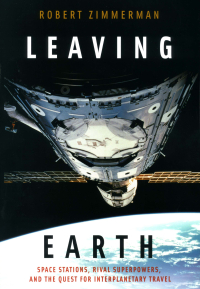
Leaving Earth: Space Stations, Rival Superpowers, and the Quest for Interplanetary Travel, can be purchased as an ebook everywhere for only $3.99 (before discount) at amazon, Barnes & Noble, all ebook vendors, or direct from my ebook publisher, ebookit.
If you buy it from ebookit you don't support the big oppressive tech companies and I get a bigger cut much sooner.
"Leaving Earth is one of the best and certainly the most comprehensive summary of our drive into space that I have ever read. It will be invaluable to future scholars because it will tell them how the next chapter of human history opened." -- Arthur C. Clarke
The fire experiments that were done on the Cygnus cargo freighter after it left ISS two weeks ago have been declared a success.
Saffire-II burned nine different samples, in an effort to gauge the flammability of various materials in a microgravity environment. These 12-by-2-inch (30 by 5 centimeters) samples included silicon of different thicknesses; a cotton-fiberglass blend; plexiglass; and Nomex, a commercially available material that’s used in spacecraft on cargo bags and as a fire barrier, NASA officials said. Everything went well during the experiment, they added: All nine samples burned as planned, and the Saffire-II team collected more than 100,000 images. All data had come back down to Earth by Friday (Nov. 25), at which point Saffire-II achieved “complete mission success,” NASA officials wrote in an update.
This was the second set of fire tests. There are plans for a third on a future Cygnus freighter.
SpaceX has tentatively scheduled December 16 as the date for its first launch since the September 1 Falcon 9 launchpad explosion.
The launch will place 10 Iridium satellites into orbit. It will also mean that the delay after the explosion was just over 3.5 months.
An evening pause: December has arrived, which to me is when the Christmas season should really begin. And what better way to start it but with this incredibly happy rendition of this classic.
Hat tip Edward Thelen.
Astronaut Buzz Aldrin was today evacuated from U.S. South Pole station due to a worsening health condition.
Aldrin, 86, is in stable condition after “his condition deteriorated” while visiting Antarctica, according to White Desert, which organizes luxury tourism trips to the icy continent. The group said Aldrin was evacuated on the first available flight out of the Amundsen-Scott South Pole Station to the McMurdo Station on the Antarctic coast under the care of a doctor with the U.S. Antarctic Program. He then was flown to Christchurch, New Zealand, and arrived at about 4:25 a.m. local time Friday (10:25 a.m. Thursday ET), according to the National Science Foundation, which provided the flight for Aldrin.
They have not released much information about his condition, other than saying that Aldrin is in good spirits.
Due to what appears to be the failure of the third stage of its Soyuz rocket, a Russian Progress freighter bringing supplies to ISS was lost.
The Russian space agency โ Roscosmos โ confirmed the demise of the Progress MS-04 cargo craft in a statement, saying the automated spaceship was lost as it flew nearly 120 miles (190 kilometers) over the Tuva Republic in Southern Russia. Engineers lost telemetry during the Soyuz rocketโs third stage engine burn, and most of the vehicleโs fragments burned up in the atmosphere, Roscosmos said.
The consequences of this failure are numerous:
It now becomes even more imperative for the U.S. to get its own manned spacecraft capability back.
After being shutdown for almost a full year for an upgrade to make it 25% more sensitive, the gravitational wave detector LIGO has resumed observations.
An evening pause: Orchestration by Maurice Ravel. Performed in Carnegie Hall, New York, July 22, 2014 by the National Youth Orchestra of the U.S.A. This long for an evening pause, but it is worth listening to every note.
Hat tip Edward Thelen.
Embedded below the fold. We talked a great deal about the failure of Schiaparelli, and the apparent dispute within ESA about it.
» Read more
Nancy Pelosi has fought off a challenge to her position as the House Democratic leader, winning 134 to 63.
Considering how badly the Democrats have fared in elections under her leadership, her victory here indicates strongly the bankrupt state of the Democratic Party. They seem unable at all to accept any blame for their losses, which would be the first step in reforming their increasingly corrupt party. Instead, they have been doubling down on the same rejected leftwing and race-based policies. Note also how the Democratic Party has become entirely dominated by its urban and coastal regions. While those areas have become almost one-party states run unopposed by the Democratic Party, their influence is very regionally limited and has been strongly rejected by most of the rest of the country. Even so, the Democrats continue to pick as their leader an extreme leftist from the extremely leftist San Francisco area.
None of this bodes well for either the Democratic Party, or the nation on the whole. To have a healthy democracy you need a healthy opposition party. Right now we do not have it.
The Russian government has now allocated a new budget for the next phase of construction at its new spaceport at Vostochny.
“The money has been allocated and specified by Prime Minister Dmitry Medvedev for 2017-2019 within the limits of about 25-30 billion rubles annually, i.e. these funds are not as large as it seemed to us earlier,” the vice-premier said. “These funds have been set aside on the basis of the so-called โoptimal scenarioโ proposed by [State Space Agency] Roscosmos,” Rogozin said.
Essentially, they have lowered the budget and pushed back some of the more costly construction at Vostochny until after 2019. Even with these trims, they also note that the budget will still depend on how the Russian economy does in the coming years.
The competition heats up: In a continuing re-organization to cut costs, Airbus yesterday announced plans to slash 1,164 jobs.
The initiative is part of [Airbus Chief Executive Tom] Endersโs four-year campaign to reshape the business in the wake of the failed attempt in 2012 to merge with BAE Systems PLC, Europeโs largest arms maker. After the deal with BAE faltered on German government opposition, he won shareholder backing for a new structure that reduced French, German and Spanish government involvement in company decision-making. The old structure was a legacy of the founding of the company in 2000 through the combination of European aerospace and defense assets.
Airbus in 2013 moved to merge its defense and space assets and shed some operations not central to its aerospace business.
This approach matches very well with the company’s joint partnership with Safran and their hard-nosed insistence that they own and control Ariane 6. They are pushing to get the government bureaucracy out of their business so that they can work more efficiently and make more money.
The Trump transition team has named its first member whose focus is NASA.
The pick is Chris Shank, who worked under Mike Griffin during the last Bush administration and has more recently been a staffer at the House science committee.
Shank is an experienced space policy professional. From 2001-2005, he served on what was then the House Science Committee staff specializing in human spaceflight and Earth science issues. After joining NASA as a special assistant to Griffin in 2005, he was appointed NASA’s chief of strategic communications in 2008. He left NASA in January 2009 at the end of the Bush Administration and worked first at the Applied Physics Lab and later Honeywell Aerospace. He returned to Capitol Hill in 2011 as Deputy Chief of Staff to Rep. Lamar Smith (R-TX), who is now chairman of House SS&T, and in 2013 was appointed policy and coalitions director for the full committee.
Link here. The Nature article clearly takes a partisan and opposition view of Trump’s pick, Congressman Tom Price (R-Georgia). Nonetheless, it does give good insight into Price himself. I especially like this quote, used by Nature to imply that Price is somehow hostile to science:
But Priceโs stance on biomedical research issues is harder to parse. He has taken few public positions on science, but has consistently pushed to cut overall federal spending. Last year, he voted against a bill that would overhaul FDA regulations and provide US$8.75 billion in mandatory funding to the NIH over five years.
Price also opposes President Barack Obamaโs proposed $755-million Cancer Moonshot, which seeks to double the pace of cancer research over the next decade. โWeโre all in favour of increasing funding for cancer research,โ Price told STAT News in January. โThe problem that the administration has is that they always want to add funding on, they never want to decrease funding somewhere else. Thatโs what needs to happen.โ [emphasis mine]
There was once a time where Price’s approach would have been considered plain common sense. In today’s mad leftwing world however the idea that resources are not unlimited and that people have to make careful choices is considered evil and anti-science.
Expect these kinds of attacks to continue nonstop throughout the entire Trump administration, especially if that administration and Congress continue to push for a bit of restraint on budget issues. This is what happened during Reagan’s first term in the 1980s. The result was that eventually Reagan was never able to trim costs or eliminate any federal agencies, as the attacks caused many of his more radical cabinet picks to resign and the Republicans in Congress to eventually back down.
Today, however, things are different in one major way. Then, there was no alternative to the liberal press. Today, there are such alternatives. Moreover, the bias of the liberal press today is much more evident. Many more people recognize it, and do not take their howls of indignation as seriously. If Trump and the Republicans have some courage and do not back down, they can win this battle. All it will take is some courage. We shall see if they have it.
The competition heats up: ULA today announced the creation of a new website, dubbed Rocketbuilder, where customers and the public and configure their own launch rocket.
ULA noted that the tool also provides insight into reliability, schedule assurance and performance, allowing users to make a true value comparison. โThe value of a launch is a lot more than its price tag,โ said Tory Bruno, ULA president and chief executive officer. โThrough our RocketBuilder website, customers are now empowered with pricing information that can be used to make decisions during their spacecraft development process, potentially helping customers keep program costs down. In addition, customers are able to build a rocket based on the needs they input, their spacecraft specifications and mission requirements.โ
Users have the flexibility to select a launch date, the satelliteโs orbit, rocket configuration and the customized service level needed for the mission. Finally, the site will capture savings in extra revenue or mission life, provide the true total cost of the specific mission requirements, and allow users to begin the contracting process.
This is great news, as it shows that Bruno and ULA are very serious about competing aggressively with SpaceX. For example, Bruno notes that the price of the cheapest Atlas 5 configuration has dropped from $191 million to $109 million in the last few years. And while this price remains significantly more expensive than SpaceX’s $62 million, this new tool should help to drive the costs down more. When ULA learns which configurations sell best, it will then be able to make those configurations cheaper.
The site is also cool. I tried it, and found that it strongly resembles the experience of buying an airplane ticket at sites like Travelocity. You pick various options (payload weight, payload size, orbit, etc) and the site automatically adjusts the rocket’s configuration and the price.