
April 26, 2016 Zimmerman/Batchelor podcast
Embedded below the fold.
» Read more
Embedded below the fold.
» Read more
An evening pause: Performed live in Vancouver, 2010.
Hat tip Edward Thelen.

On Christmas Eve 1968 three Americans became the first humans to visit another world. What they did to celebrate was unexpected and profound, and will be remembered throughout all human history. Genesis: the Story of Apollo 8, Robert Zimmerman's classic history of humanity's first journey to another world, tells that story, and it is now available as both an ebook and an audiobook, both with a foreword by Valerie Anders and a new introduction by Robert Zimmerman.
The print edition can be purchased at Amazon or any other book seller. If you want an autographed copy the price is $60 for the hardback and $45 for the paperback, plus $8 shipping for each. Go here for purchasing details. The ebook is available everywhere for $5.99 (before discount) at amazon, or direct from my ebook publisher, ebookit. If you buy it from ebookit you don't support the big tech companies and the author gets a bigger cut much sooner.
"Not simply about one mission, [Genesis] is also the history of America's quest for the moon... Zimmerman has done a masterful job of tying disparate events together into a solid account of one of America's greatest human triumphs."--San Antonio Express-News
My appearance on the Space Show yesterday is now available as a podcast. I strongly recommend people listen to it, especially the first hour. During that section I compared at length the cost and practicality of the Falcon Heavy with SLS/Orion, and noted how badly Congress and Presidents from both parties have served the American people these past twenty years in mismanaging our aerospace industry.
David Livingston called it a rant, and criticized me for it during the show, but I think the time has come for more Americans to rage in horror at the foolishness and possible corruption of our elected leaders in Washington.
Link here.
The analysis is interesting and thoughtful, though some of the negative comments quoted from a former NASA engineer only illustrate why NASA was unable to do this very well. Moreover, these comments from Arianespace’s chief suggest that Arianespace doesn’t understand basic economics.
Arianespace Chief Executive Stephane Israel, in an April 23 briefing at Europe’s Guiana Space Center here on the northeast coast of South America, said Europe’s launch sector can only guess at how much SpaceX will need to spend to refurbish its Falcon 9 first stages. Israel said European assessments of reusability have concluded that, to reap the full cost benefits, a partially reusable rocket would need to launch 35-40 times per year to maintain a sizable production facility while introducing reused hardware into the manifest.
…Israel’s argument, which he has made before, is that even if first stages can be recovered and refurbished in a cost-effective way, the launch rate needed for maximum cost savings – and hence price reductions to customers – is beyond Europe’s reach. The only nations today whose governments are launching sufficiently often to reach those rates are the United States and China, and even these government markets may be insufficient, in and of themselves, to close the business case.
The customer base is not static. If you lower the price, the customer base grows, a fact that Elon Musk understands and which has been driving his effort from day one.

Now available in hardback and paperback as well as ebook!
From the press release: In this ground-breaking new history of early America, historian Robert Zimmerman not only exposes the lie behind The New York Times 1619 Project that falsely claims slavery is central to the history of the United States, he also provides profound lessons about the nature of human societies, lessons important for Americans today as well as for all future settlers on Mars and elsewhere in space.
“Zimmerman’s ground-breaking history provides every future generation the basic framework for establishing new societies on other worlds. We would be wise to heed what he says.” —Robert Zubrin, founder of the Mars Society.
All editions are available at Amazon, Barnes & Noble, and all book vendors, with the ebook priced at $5.99 before discount. All editions can also be purchased direct from the ebook publisher, ebookit, in which case you don't support the big tech companies and the author gets a bigger cut much sooner.
Autographed printed copies are also available at discount directly from the author (hardback $29.95; paperback $14.95; Shipping cost for either: $6.00). Just send an email to zimmerman @ nasw dot org.
Scientists have used the data that Cassini has gathered in more than a hundred fly-bys of Titan to assemble a rough outline of the geology and make-up of Titan’s liquid lakes.
There are three large seas, all close to the north pole, surrounded by dozens of smaller lakes in the northern hemisphere. Just one lake has been found in the southern hemisphere. The exact make-up of these liquid reservoirs remained elusive until recently. A new study using scans from Cassini’s radar during flybys of Titan between 2007 and 2015 confirms that one of the largest seas on the moon, Ligeia Mare, is mostly liquid methane.
“We expected to find that Ligeia Mare would be mostly ethane, which is produced in abundance in the atmosphere when sunlight breaks methane molecules apart,” explains Alice Le Gall from the Laboratoire Atmosphères, Milieux, Observations Spatiales and Université Versailles Saint-Quentin, France, and lead author of the new study. “Instead, this sea is predominantly made of pure methane.”
The data is also giving them the first understanding of the weather and geology that forms the lakes, including why methane instead of ethane dominates.
The competition heats up: According to the head of Safran, their joint venture with Airbus to build Europe’s next rocket, Ariane 6, is on schedule to begin full operations by July 1.
He said in a press teleconference that the issues both with the French tax authorities and with the European Union about the merger are being resolved.
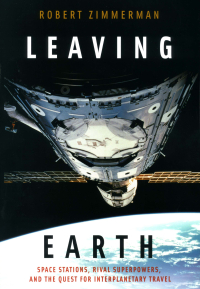
Leaving Earth: Space Stations, Rival Superpowers, and the Quest for Interplanetary Travel, can be purchased as an ebook everywhere for only $3.99 (before discount) at amazon, Barnes & Noble, all ebook vendors, or direct from my ebook publisher, ebookit.
If you buy it from ebookit you don't support the big oppressive tech companies and I get a bigger cut much sooner.
"Leaving Earth is one of the best and certainly the most comprehensive summary of our drive into space that I have ever read. It will be invaluable to future scholars because it will tell them how the next chapter of human history opened." -- Arthur C. Clarke
Worlds without end: Hubble has spotted a small moon orbiting the distant Kuiper Belt object Makemake.
The moon — provisionally designated S/2015 (136472) 1 and nicknamed MK 2 — is more than 1,300 times fainter than Makemake. MK 2 was seen approximately 13,000 miles from the dwarf planet, and its diameter is estimated to be 100 miles across. Makemake is 870 miles wide. The dwarf planet, discovered in 2005, is named for a creation deity of the Rapa Nui people of Easter Island.
The Dawn science team is proposing that NASA extend the mission by allowing them to use the remaining fuel on the spacecraft to send it away from Ceres and towards another asteroid.
Originally mission managers had planned to park it in a stable orbit around Ceres later this summer, creating a permanent artificial satellite. They could not crash the spacecraft into Ceres, as is customary with many similar missions, because Dawn has not been sterilized in accord with planetary protection procedures. But the extra xenon has created an additional opportunity.
Scientists involved with the spacecraft say they could visit a third object in the asteroid belt. “Instead, we want to go the other way, away from Ceres, to visit yet another target,” principal investigator Chris Russell told New Scientist. Russell would not name the destination without approval of the plan from NASA, but we should learn about it in a few months.
Up until now they had said that they didn’t have enough remaining fuel to do much more than remain in orbit at Ceres. It appears now that they have saved enough fuel to give them more options.
The competition heats up: A new rocket company, Vector Space Systems, has announced that it has obtained seed money to begin the development of a new rocket for launch very small satellites.
Vector is designed to provide dedicated launches of very small spacecraft. The vehicle is capable of placing satellites weighing up to 45 kilograms into a basic low Earth orbit, and 25 kilograms into a standard sun synchronous orbit. Those launches will cost $2–3 million each, with the higher price reserved for “first class” launches reserved as little as three months in advance.
This rocket would compete with Virgin Galactic’s LauncherOne and Rocket Lab’s Electron for the smallsat and cubesat business.
In an effort to funnel money to Aerojet Rocketdyne at the cost of every other rocket company in the nation, the House Armed Services Committee has written a bill that tells the Air Force exactly how it will build its future rockets.
“The Committee shares the concern of many members that reliance on Russian-designed rocket engines is no longer acceptable,” the committee said April 25. “The Chairman’s Proposal, as recommended by Chairman Rogers of the Subcommittee on Strategic Forces, denies the Air Force’s request to pursue the development, at taxpayer expense, of new commercial launch systems. It instead focuses on the development of a new American engine to replace the Russian RD-180 by 2019 to protect assured access to space and to end reliance on Russian engines. The Mark also holds the Air Force accountable for its awards of rocket propulsion contracts that violated the FY15 and FY16 NDAAs.”
…“The funds would not be authorized to be obligated or expended to develop or procure a launch vehicle, an upper stage, a strap-on motor, or related infrastructure,” says a draft of the 2017 defense authorization bill.
As presently written, the bill would leave the Air Force only one option: use engines built by Aerojet Rocketdyne.
If anything demonstrates the corruption or foolishness of our elected officials, it is this proposal. Not only are they telling the Air Force how to design rockets, they are limiting the options so much that they are guaranteeing that it will either cost us more than we can afford, or it won’t be doable at all. As I say, either they are corrupt (working to benefit Aerojet Rocketdyne in exchange for money), or they are foolish, (preventing the Air Force from exploring as many inexpensive future options as possible).
The competition heats up: China has begun assembly of its first Long March 5 rocket, set for launch in September.
Yang Hujun, vice chief engineer, has spoken about the next steps for the Long March-5 project. “After the assembly is finished in the first half of this year, it will take a little more than a month to test it to ensure that the product is in good shape. The first launch will be made after it is out of the plant in the latter half of the year. “
The rocket will be able to put about 25 tons into orbit, making it one of the most powerful rockets in the world. They plan to use it on its first launch to put their next space station into orbit.
In the heat of competition: Vulcan Aerospace, the company building the giant Stratolaunch airplane designed launch orbital rockets from its underbelly, does not yet have a rocket for this purpose.
Originally that rocket was to be built by SpaceX, but that partnership ended in 2012.
Stratolaunch then contracted out its rocket work to Orbital Sciences Corp. (now Orbital ATK). The company also contracted with Aerojet Rocketdyne for six RL10C-1 rocket engines with an option for six more for use in the launch vehicle’s third stage.
The agreement with Orbital ended without the production of a launch vehicle, with Beames saying the rocket was not economical. Stratolaunch officials said they were reassessing the project in light of the shift in the market recently toward smaller satellites.
In 2015, Beames said that Stratolaunch was examining more than 70 launch vehicles for use with the Stratolaunch aircraft. He indicated that the company might use multiple launch vehicles to serve different payload classes. Beames said the company would announce its launch vehicle strategy in fall 2015, but that time came and went with no announcement. [emphasis mine]
It is very worrisome for them to be hunting for a rocket at this point of design. I am reminded of Virgin Galactic and SpaceShipTwo, which changed engine designs midstream, causing them enormous engineering problems and delays.
After several launch delays, including a scrub because of a problem with the rocket’s navigation system, Arianespace successfully used a Russian Soyuz rocket to launch five satellites in a variety of orbits.
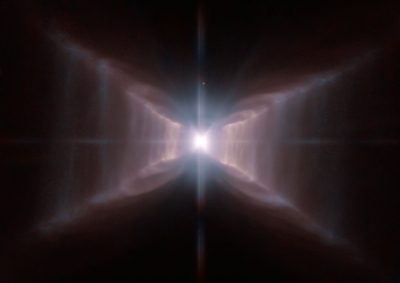
Cool image time! I think the Red Rectangle might be my favorite planetary nebula. The new image on the right, taken by the Hubble Space Telescope, is the best yet of this weirdly shaped object. And it continues to suggest, as I noted whimsically in an article about it for Sky & Telescope back in November 2014, that this is a web being spin by the universe’s largest spider.
By carefully improving the resolution of images taken by Mars Reconnaissance Orbiter of the landing site of the 2003 European Mars lander Beagle 2, scientists think the lander might have successfully landed but failed to deploy its solar shields completely.
Showing a bright blip in dusty terrain, the new picture is four times the resolution of previous images. The image adds weight to the theory that the diminutive spacecraft – just under a metre in diameter – landed as planned on Mars in 2003, but failed to fully unfurl its solar panels. “Given the size of Beagle 2, even with super-resolution images you are not likely to see more than a series of blobs because it is so small,” said Mark Sims, of the University of Leicester and former mission manager for Beagle 2. “What it does show is that it is on the surface and it is at least partially deployed.”
The technique they have developed for improving image resolution will also be useful to tease out new details about the Martian surface.
The competition heats up: The first rocket that will launch from Russia’s new spaceport, Vostochny, has reached the launchpad.
Launch is presently scheduled for April 27. The link has some nice pictures inside the assembly building as well as the rocket on the launchpad.
An evening pause: I must admit that the hard rock music of Kurt Cobain has interested me so little that, until this video was suggested to me, I had never listened to it. Though the music itself doesn’t do much for me personally, the lyrics and the history of the song were quite surprising. To quote from the second link,
Cobain said the song is about a man who, after the death of his girlfriend, turns to religion “as a last resort to keep himself alive. To keep him from suicide.” While Cobain said the narrative of “Lithium” was fictional, he said, “I did infuse some of my personal experiences, like breaking up with girlfriends and having bad relationships.” Cobain acknowledged that the song was possibly inspired in part by the time he spent living with his friend Jesse Reed and his born-again Christian parents. He explained to Azerrad, “I’ve always felt that some people should have religion in their lives [. . .] That’s fine. If it’s going to save someone, it’s okay. And the person in [‘Lithium’] needed it.”
The song was published in 1992. I suspect that even Cobain would be considered evil by the today’s modern generation for daring to express positive thoughts about religion.
Hat tip Wayne Devette.
Uh-oh: A Soyuz rocket launch from French Guiana was scrubbed an hour before launch on Sunday because of detected problems with the inertial measurement unit (IMU) in its navigational system.
Arianespace chief executive Stephane Israel tweeted Sunday that the faulty inertial measurement unit, or IMU, will be replaced overnight in time for a launch attempt Monday. The IMU is located on the Soyuz rocket’s third stage and is used to determine the heading and orientation of the vehicle in the first nine minutes of its mission, feeding critical attitude data to the launcher’s guidance computers, which transmit steering commands to the engines.
The venerable Soyuz booster flies more often than any other launcher in the world, and delays due to technical causes are rare. [emphasis mine]
This is not good news for Russia’s aerospace industry, as it suggests that the quality control problems Russia has experienced with the company that manufactures its Proton rocket are now beginning to appear with the different company that manufactures the Soyuz rocket.
If true, this is also very bad news for American astronauts, who must use this rocket to get to and from space.
The uncertainty of peer review: A new study has found that since 1995 as many as 5.5% of all biomedical research papers per year contain duplicate or faked images.
Bik, who is at Stanford University in California, spent two years looking at articles published from 1995 to 2014 in 40 different journals, hunting for instances in which identical images were used to represent different experiments within the same paper. She cross-checked the duplications that she found with her two co-authors, both microbiologists.
Overall, 4% of the inspected papers contained such images, the researchers found. But rates ranged from over 12% in the International Journal of Oncology, to 0.3% in the Journal of Cell Biology, which has since 2002 systematically scanned images in its accepted papers before publication. Journals with higher impact factors generally had lower rates of duplicated images.
…Many of the problems were probably sloppy mistakes where people selected the wrong photograph, says Bik. But half or more look deliberate — because images are flipped or rotated or the same features occur twice in the same photograph. [emphasis mine]
Essentially, a significant number of scientists in medical research are purposely faking data.
Embedded below the fold. I like John’s title for this podcast: “Bad Money, Big Space. Thrifty Space X Rolls Along”.
By the way, on Monday evening I will be doing another two hour appearance on the Space Show, with the podcast available there.