Scientists: First data from Europe’s Proba-3 satellites suggest the Sun’s slow solar wind is faster and more chaotic than expected

Figure 4 showing variable speeds of slow solar wind
Click for original image.

The uncertainty of science: According to the first published paper [pdf] from Europe’s two Proba-3 satellites, scientists have found the slow solar wind that comes from the Sun is sometimes far faster than expected, and is also far more chaotic. From the second link above:

Just like wind on Earth, solar wind can be fast or slow, smooth or gusty. Fast solar wind usually flows in a smooth current from magnetic structures called coronal holes. In contrast, slow solar wind is variable and gusty, making understanding how it works more difficult.

Scientists think that slow solar wind is generated by the Sun’s magnetic field lines changing how they are connected, merging and separating again. This process pushes out blobs of plasma (electrically charged gas) in so-called ‘streamers’: large, bright rays in the corona.

…Previously, scientists found that close to the Sun’s surface, slow solar wind should have speeds around 100 km/s. Instead, Andrei’s team tracked some blobs of plasma moving at 250–500 km/s.

The graph to the right, Figure 4 in the paper, shows Proba-3’s tracking of a variety of these blobs. Not only did some move faster than expected (the arrows above the gray line marking earlier data), their speeds changed with time, with some actually speeding up.

The reason the Sun’s fast wind is relatively stable is that it emanates from magnetic structures dubbed coronal holes because the magnetic field lines there are is somewhat calm and stable. The slow wind meanwhile comes out through much more active and unstable regions of the magnetic field, with its field lines jumping about as well as connecting and unconnecting from the field’s structure in a chaotic manner.

This research suggests that the slow wind is chaotic and thus unpredictable, almost like the weather on Earth.

2 comments

Update on Superheavy/Starship: Both ships doing final static fire testing

Link here. The report includes a lot of very interesting information about how SpaceX is evolving its launch platforms and the tank farms that fuel the stages in order to make them operate more efficiently. For example:

In the past, on Pad 1, SpaceX had only four Liquid Oxygen (LOX) Pumps and six subcoolers, and three Liquid Methane (LCH4) Pumps with three subcoolers. This setup allowed SpaceX to start booster load at T-41:15 on Flight 11.

On Pad 2, SpaceX has five pumps and about 10 subcoolers worth of capacity on the LOX side, and four pumps alongside about six subcoolers worth of capacity on the LCH4 side. With these upgrades, along with larger supply lines, SpaceX can now load a full booster within 30 minutes, and each LOX ring takes only about 90 seconds to load. This now means SpaceX can load the Superheavy booster faster than a Falcon 9 and carry over 10 times the propellant. [emphasis mine]

Many of the tests have been more to prove out the fueling systems and launchpad than to test Superheavy.

Other tests however have been to prove out the new Raptor-3 engine. The company have increased the number of engines step by step so that the next test will be the first to test all 33 engines. I suspect that test will also be the full dress rehearsal countdown prior to launch.

Starship meanwhile is undergoing testing on the company’s nearby Massey test stand, the one that I think was rebuilt after an explosion last year.

Stay tuned. It appears the next and 12th orbital test flight will not be long in coming.

6 comments

Genesis cover

On Christmas Eve 1968 three Americans became the first humans to visit another world. What they did to celebrate was unexpected and profound, and will be remembered throughout all human history. Genesis: the Story of Apollo 8, Robert Zimmerman's classic history of humanity's first journey to another world, tells that story, and it is now available as both an ebook and an audiobook, both with a foreword by Valerie Anders and a new introduction by Robert Zimmerman.

The print edition can be purchased at Amazon or any other book seller. If you want an autographed copy the price is $60 for the hardback and $45 for the paperback, plus $8 shipping for each. Go here for purchasing details. The ebook is available everywhere for $5.99 (before discount) at amazon, or direct from my ebook publisher, ebookit. If you buy it from ebookit you don't support the big tech companies and the author gets a bigger cut much sooner.


The audiobook is also available at all these vendors, and is also free with a 30-day trial membership to Audible.
 

"Not simply about one mission, [Genesis] is also the history of America's quest for the moon... Zimmerman has done a masterful job of tying disparate events together into a solid account of one of America's greatest human triumphs."--San Antonio Express-News

All is well

All is well but there are some minor complications that will take up my time for the next few days. I might get time to post soon, but the priority is dealing with my health.

My deepest thanks to everyone for their well wishes. I really appreciate it.

15 comments

Conscious Choice cover

Now available in hardback and paperback as well as ebook!

From the press release: In this ground-breaking new history of early America, historian Robert Zimmerman not only exposes the lie behind The New York Times 1619 Project that falsely claims slavery is central to the history of the United States, he also provides profound lessons about the nature of human societies, lessons important for Americans today as well as for all future settlers on Mars and elsewhere in space.

 
Conscious Choice: The origins of slavery in America and why it matters today and for our future in outer space, is a riveting page-turning story that documents how slavery slowly became pervasive in the southern British colonies of North America, colonies founded by a people and culture that not only did not allow slavery but in every way were hostile to the practice.  
Conscious Choice does more however. In telling the tragic history of the Virginia colony and the rise of slavery there, Zimmerman lays out the proper path for creating healthy societies in places like the Moon and Mars.


“Zimmerman’s ground-breaking history provides every future generation the basic framework for establishing new societies on other worlds. We would be wise to heed what he says.” —Robert Zubrin, founder of the Mars Society.


All editions are available at Amazon, Barnes & Noble, and all book vendors, with the ebook priced at $5.99 before discount. All editions can also be purchased direct from the ebook publisher, ebookit, in which case you don't support the big tech companies and the author gets a bigger cut much sooner.


Autographed printed copies are also available at discount directly from the author (hardback $29.95; paperback $14.95; Shipping cost for either: $6.00). Just send an email to zimmerman @ nasw dot org.

April 13, 2026 Quick space links

Courtesy of BtB’s stringer Jay. This post is also an open thread. I welcome my readers to post any comments or additional links relating to any space issues, even if unrelated to the links below.

I have also scheduled it earlier in the day because I am presently asleep, recovering from knee surgery.

11 comments

A pause in posting…

Readers!

Do not expect many posts by me today or for the next few days. I am undergoing knee replacement surgery today, and will not be in shape for any work for at least the next day or so. Depending on my recovery, I could be posting by tomorrow, but don’t bet on it. More likely I will begin to resume work later in the week.

Today’s quick links will go up mid-morning. I have also scheduled evening pauses, so enjoy these. Other than that you will have to wait for my return for much else. I will then make sure to catch up and put up posts covering all the space news that occurred during this pause.

Note that such surgery these days is almost routine, so all should be well. I am hoping it will allow me to once again hike as I have done for my whole life, before the bones in the left knee in November decided to kiss painfully with each bend.

28 comments

Leaving Earth cover

Leaving Earth: Space Stations, Rival Superpowers, and the Quest for Interplanetary Travel, can be purchased as an ebook everywhere for only $3.99 (before discount) at amazon, Barnes & Noble, all ebook vendors, or direct from my ebook publisher, ebookit.

If you buy it from ebookit you don't support the big oppressive tech companies and I get a bigger cut much sooner.


Winner of the 2003 Eugene M. Emme Award of the American Astronautical Society.

 
"Leaving Earth is one of the best and certainly the most comprehensive summary of our drive into space that I have ever read. It will be invaluable to future scholars because it will tell them how the next chapter of human history opened." -- Arthur C. Clarke

Three launches, two by SpaceX and one by China

Falcon 9 landing for its seventh time
Falcon 9 landing for its seventh time on today’s
third launch. See below.

Since last night there were three launches globally, two by SpaceX, and one by China.

First, in the wee hours of the morning SpaceX placed 25 more Starlink satellites into orbit, its Falcon 9 rocket lifting off from Vandenberg Space Force Base in California. The first stage (B1063) completed its 32nd flight, landing on a drone ship in the Pacific. With this flight, 43 days after the stage’s previous flight, it moved into a tie for fourth place in the rankings of the most reused launch vehicle:

39 Discovery space shuttle
34 Falcon 9 booster B1067
33 Atlantis space shuttle
32 Falcon 9 booster B1071
32 Falcon 9 booster B1063
30 Falcon 9 booster B1069
28 Columbia space shuttle
27 Falcon 9 booster B1077
27 Falcon 9 booster B1078

Sources here and here.

Next China launched a classified satellite to test “internet technology”, its Smart Dragon-3 (Jielong-3) rocket lifting off from a sea platform in international waters in the South China Sea. Though China has launched numerous times from this sea platform, previous launches were very close to the shore. This was the first time the platform was moved this far into the ocean.

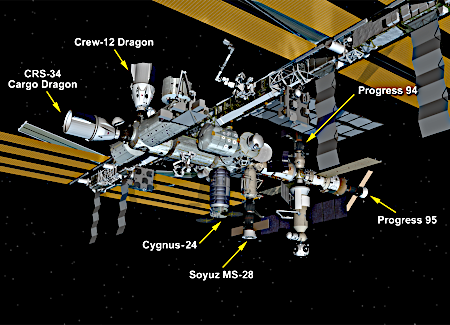
Finally, SpaceX completed its second launch in less than eight hours, sending Northrop Grumman’s Cygnus capsule on its way to ISS with 11,000 pounds of cargo, its Falcon 9 rocket lifting off from Cape Canaveral Space Force Station in Florida. The first stage completed its seventh flight, landing back at Cape Canaveral. Of the two fairings, one was making its first flight, while the other was on its fifth flight.

This was SpaceX’s fourth Cygnus launch for Northrop Grumman. The company originally launched Cygnus on its own Antares rocket, but when that rocket ran out of its Russian first stage engines it was grounded. The company hired Firefly to build a new first stage, but that project remains uncompleted.

Cygnus is scheduled to berth with ISS in two days, on Monday, April 13, at 12:50 pm (Eastern).

The leaders in the 2026 launch race:

44 SpaceX
19 China
5 Rocket Lab
5 Russia

For the third straight year SpaceX continues to lead the entire world combined in total launches, 44 to 34.

28 comments

A military pilot’s perspective on downed pilot rescue in Iran Easter weekend

An evening pause: The details of the amazing search & rescue effort to recover a downed American pilot in Iran last weekend has been covered quite thoroughly in the media, especially the alternative press. This video gives us the compelling perspective of the men and women who made that rescue happen. Even if you oppose Trump’s present actions against Iran, Steeve’s reveals a fundamental aspect of the American way of war that illustrates again the best part of America. The key quote, “Will you be worth the trip?”

Hat tip Mike Nelson.

18 comments

Orion survives re-entry, crew splashes down safe

Orion just after main parachute deployment

Orion successfully survived re-entry tonight with its questionable heat shield, with the capsule splashing down off the coast of California at 8:07 pm (Eastern).

All four astronauts are healthy and safe. As of posting they were still in the capsule, floating on the ocean, with recovery crews on their way to it. [Update: those recovery crews, six boats with more than 40 people, are taking an ungodly amount of time to latch onto the capsule and begin recovery. Over an hour after splashdown the crew is still in the capsule.]

The Artemis-2 mission is now over, though the final condition of that heat shield still needs to be analyzed. In addition, engineers need figure out how to fix a bunch of other issues that took place during the mission:

  • A leak in an internal helium tank on Europe’s service module
  • Communication drop-outs several times
  • the endless issues with Orion’s toilet

There were other minor issues that cropped up repeatedly, none significant but all of which should be fixed. And though it will be helpful to determine how this heat shield performed, it should be noted that the data is essentially irrelevant to future missions. The next mission, Artemis-3, will use a completely different design, and test it for the first time on a manned flight. That flight however will be in Earth orbit, so the stress on the shield will be far less than this return, even with the changed re-entry path.

Though many will call this lunar fly-by “historic,” it will likely be little remembered by future generations. It did little to move the settlement of the solar system forward. No truly useful engineering was tested. The rocket and capsule are engineering dead-ends. Neither will be of much use for establishing colonies on the Moon or Mars, as SLS is still too expensive and too difficult to stack and launch and Orion is too small for any interplanetary missions, being nothing more than an overweight and very expensive ascent/descent capsule.

The only plus of this mission is that it will likely give NASA’s administrator, Jared Isaacman, the political clout to institute major changes in the entire Artemis program, changes that could make the American colonization of the solar system more likely. There are strong indications that he wants to make better use of the private sector.

And that private sector is poised to bypass NASA, regardless of what NASA wants or tries to do, with capabilities far better then anything we have seen since the Apollo program.

56 comments

April 10, 2026 Quick space links

Courtesy of BtB’s stringer Jay. This post is also an open thread. I welcome my readers to post any comments or additional links relating to any space issues, even if unrelated to the links below.

5 comments

Orion’s risky return-to-Earth happens tonight at 8:07 pm (Eastern)

The Earth as seen by the Artemis-2 astronauts, from behind the Moon
The Earth and Moon during the lunar fly-by on April 6, 2026.
Click for original image.

After spending ten days in space, including a swing around the back of the Moon, the four-person Artemis-2 crew is now preparing for its return-to-Earth this evening, splashing down off the Pacific coast near San Diego.

At 10:53 p.m. EDT [last night], the Orion spacecraft ignited its thrusters for 9 seconds, producing an acceleration in velocity of 5.3 feet-per-second and pushing the Artemis II crew toward Earth. The crew is now more than halfway home.

About two hours before the burn, there was an unexpected return link loss of signal during a data rate change affecting the transmission of communications and telemetry from the spacecraft to the ground. Two-way communications were reestablished, and flight controllers resumed preparing for the upcoming burn with the crew shortly after.

…The third return trajectory correction burn is scheduled for April 10 at about 1:53 p.m. ahead of re-entry procedures.

This is I think the second time Orion has had a short loss of communications with ground control. In addition, the crew had to cancel a planned manual piloting demonstration of Orion while it flew past the Moon because of a leak in an internal helium tank, used to maintain pressure in the oxygen tank as the propellant is used. The leak was inside the European-built service module, which will be jettisoned before re-entry and burn up in the atmosphere.

Mission managers say this leak has not impacted any engine burns, but it will require attention before the next flight.

The return to Earth however carries the biggest risk of the entire mission. Orion’s heat shield is questionable. During its first use in the 2022 unmanned Artemis-1 flight around the Moon, it did not behave as expected, with large chunks breaking off instead of thin layers ablating away. Though mission engineers have adjusted the flight path through the atmosphere to mitigate stress, there is great uncertainty about that solution.

I have embedded NASA’s live stream of the return-to-Earth below. It begins at 6:30 pm (Eastern), though the first return event, jettison the service module, doesn’t occur until 7:33 pm (Eastern).
» Read more

21 comments
1 21 22 23 24 25 2,927