Amazon to begin commercial availability of Leo internet service in mid-2026

Amazon Leo logo

In an annual letter [pdf] to shareholders, Amazon’s CEO Andy Jassy announced the company plans on inaugurating its Leo internet constellation to customers in “mid-2026,” assuming the company can get a significant more satellites in orbit in the next few months.

Jassy’s wording was interestingly vague, however, suggesting this target date is very uncertain.

Over the last seven years, we’ve built a low Earth orbit satellite network (Amazon Leo) and put more than 200 satellites into space (which is the third-largest low Earth orbit network operating today). With a few thousand more satellites launching in the coming years, the constellation is expanding rapidly.

…While Amazon Leo is officially scheduled to launch in mid-2026, we already have meaningful revenue commitments from enterprises and governments.

To be precise, Amazon presently has launched 241 satellites, out of the 1,616 it needs to launch by July 2026 to meet its FCC license requirement. Because it is not expected to meet that requirement, the company has asked for a time extension, which the FCC is presently considering. The entire first generation constellation is supposed to have 3,232 satellites, so it seems unlikely Amazon will be able to provide internet service by mid-2026, as promised. It won’t have enough coverage with less than a fourth of its constellation in orbit.

0 comments

India conducts another parachute drop test for its Gaganyaan manned capsule

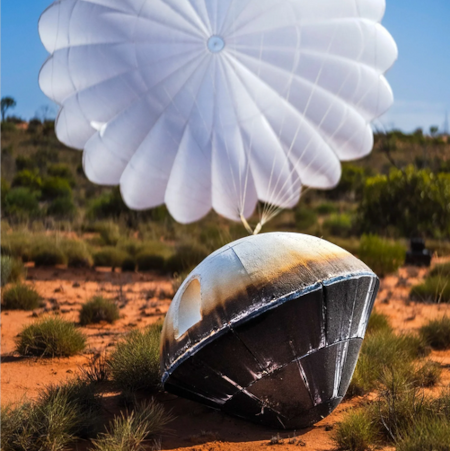
Gaganyaan drop test
Click to watch video of drop test.

India’s space agency ISRO today successfully completed its second helicopter drop test of a dummy capsule, testing the parachute release system that its Gaganyaan manned capsule will use on return to Earth.

In this test, a simulated Crew Module, weighing about 5.7 tonnes, that is equivalent to the mass of the Crew Module in the first uncrewed Gaganyaan mission (G1), was lifted by an Indian Air Force Chinook helicopter to an altitude of about 3km and released over a designated drop zone in sea, near to Sriharikota coast.

Ten parachutes of four types were deployed in a precise sequence during the descent of the Crew Module, gradually reducing the velocity for safe touchdown. Subsequently, the simulated Crew Module was successfully recovered in coordination with Indian Navy. The IADT-02 test validated the parachute-based deceleration systems in the Crew Module.

The manned mission is presently scheduled for early next year, after a series of unmanned orbital test flights are completed in ’26. This schedule is significantly later than ISRO’s original schedule. When the program was first proposed in 2018, ISRO said the manned mission would happen in 2022.

4 comments

Genesis cover

On Christmas Eve 1968 three Americans became the first humans to visit another world. What they did to celebrate was unexpected and profound, and will be remembered throughout all human history. Genesis: the Story of Apollo 8, Robert Zimmerman's classic history of humanity's first journey to another world, tells that story, and it is now available as both an ebook and an audiobook, both with a foreword by Valerie Anders and a new introduction by Robert Zimmerman.

The print edition can be purchased at Amazon or any other book seller. If you want an autographed copy the price is $60 for the hardback and $45 for the paperback, plus $8 shipping for each. Go here for purchasing details. The ebook is available everywhere for $5.99 (before discount) at amazon, or direct from my ebook publisher, ebookit. If you buy it from ebookit you don't support the big tech companies and the author gets a bigger cut much sooner.


The audiobook is also available at all these vendors, and is also free with a 30-day trial membership to Audible.
 

"Not simply about one mission, [Genesis] is also the history of America's quest for the moon... Zimmerman has done a masterful job of tying disparate events together into a solid account of one of America's greatest human triumphs."--San Antonio Express-News

China launches another set of satellites for its Guowang internet constellation

China yesterday successfully completed the 21st launch for its Guowang (Satnet) internet satellite constellation, its Long March 6A rocket lifting off from its Taiyuan spaceport in northeast China.

Though China’s state-run press provided no information on the number of satellites in the payload, all previous launches using the Long March 6A had carried five satellites. If so, that would mean the constellation now has 164 satellites in orbit, out of a planned 13,000. This fits with the information in the article at the link, which states the constellation now has “nearly 170 satellites” in orbit.

China’s state-controlled press also made no mention about where the rocket’s core stage (using very toxic hypergolic fuels) and its four solid-fueled strap-on boosters crashed inside China.

Another launch attempt today by the German rocket startup Isar Aerospace was scrubbed due to “a leak in a composite overwrapped pressure vessel (COPV).” COPV tanks are used inside the main tanks. As the propellant in that main tank is used, the COPV releases helium to maintain the tank’s pressure. No new launch date has been announced.

The leaders in the 2026 launch race:

42 SpaceX
18 China
5 Rocket Lab
4 Russia

For the third straight year SpaceX continues to lead the entire world combined in total launches, 42 to 32. It has another Starlink launch scheduled for this evening.

1 comment

Now on Starlink!

Starlink logo

My posting this afternoon today was interrupted because I was spending the day going up and down from my roof as I and friend Ken worked to install my new Starlink antenna.

As always with these kinds of jobs, there were moments that reminded me of a motto of mine when I used to assembly Ikea furniture as a part-time job: “It’s ‘Do everything twice day!'” In the end, the problems were minor and quickly solved, such as discovering that the Starlink ethernet cable from the power supply to the router could only be plugged in in one direction. The plugs on either end looked identical, but we struggled for almost twenty minutes trying to get the plug to click into the router, to no avail. Then a light bulb went off, and we decided to flip the cable. Lo and behold, both ends clicked in instantly.

Setting up the account and the Wi-Fi and the computers went very quickly, mostly thanks to my lovely wife Diane. Starlink only allows you to do this stuff on a smart phone, and I won’t touch one of those with a 200-foot pole. She got it all going within a very short time.

I had hesitated doing this for the past two years, mostly because it involved a lot of other non-Starlink-related time-consuming stuff too boring to describe but that we both wanted to avoid. We finally got that stuff taken care of in the past month and could make the switch.

The Zimmerman household is linked to the world, through space. Seems entirely appropriate.

14 comments

Conscious Choice cover

Now available in hardback and paperback as well as ebook!

From the press release: In this ground-breaking new history of early America, historian Robert Zimmerman not only exposes the lie behind The New York Times 1619 Project that falsely claims slavery is central to the history of the United States, he also provides profound lessons about the nature of human societies, lessons important for Americans today as well as for all future settlers on Mars and elsewhere in space.

 
Conscious Choice: The origins of slavery in America and why it matters today and for our future in outer space, is a riveting page-turning story that documents how slavery slowly became pervasive in the southern British colonies of North America, colonies founded by a people and culture that not only did not allow slavery but in every way were hostile to the practice.  
Conscious Choice does more however. In telling the tragic history of the Virginia colony and the rise of slavery there, Zimmerman lays out the proper path for creating healthy societies in places like the Moon and Mars.


“Zimmerman’s ground-breaking history provides every future generation the basic framework for establishing new societies on other worlds. We would be wise to heed what he says.” —Robert Zubrin, founder of the Mars Society.


All editions are available at Amazon, Barnes & Noble, and all book vendors, with the ebook priced at $5.99 before discount. All editions can also be purchased direct from the ebook publisher, ebookit, in which case you don't support the big tech companies and the author gets a bigger cut much sooner.


Autographed printed copies are also available at discount directly from the author (hardback $29.95; paperback $14.95; Shipping cost for either: $6.00). Just send an email to zimmerman @ nasw dot org.

April 9, 2026, Quick space links

Courtesy of BtB’s stringer Jay. This post is also an open thread. I welcome my readers to post any comments or additional links relating to any space issues, even if unrelated to the links below.

4 comments

Leaving Earth cover

Leaving Earth: Space Stations, Rival Superpowers, and the Quest for Interplanetary Travel, can be purchased as an ebook everywhere for only $3.99 (before discount) at amazon, Barnes & Noble, all ebook vendors, or direct from my ebook publisher, ebookit.

If you buy it from ebookit you don't support the big oppressive tech companies and I get a bigger cut much sooner.


Winner of the 2003 Eugene M. Emme Award of the American Astronautical Society.

 
"Leaving Earth is one of the best and certainly the most comprehensive summary of our drive into space that I have ever read. It will be invaluable to future scholars because it will tell them how the next chapter of human history opened." -- Arthur C. Clarke

Martian mountains on Mount Sharp

Panorama looking up Mount Sharp
Click for larger full resolution image. For original images go here and here.

Overview map
Click for interactive map.

Cool image time! The panorama above was created using two pictures taken by the high resolution camera on the rover Curiosity on Mars (here and here).

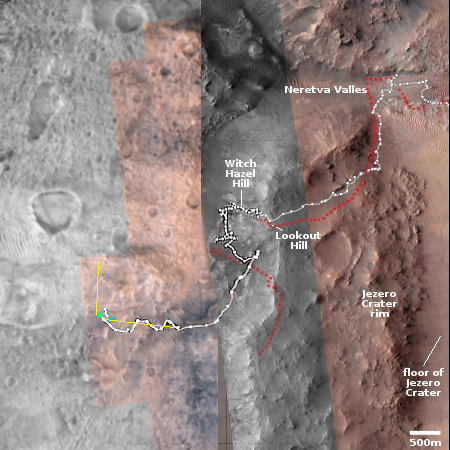
The overview map to the right gives the context. The blue dot marks Curiosity’s position on the day before these pictures were taken, climbing through the foothills on the flanks of Mount Sharp. I do not know if it traveled again before taking these two pictures above. The white dotted line its past travels, while the red dotted line its planned future route. At present Curiosity has climbed about 3,500 feet up the mountain. It is still about 15,000 feet below the peak, which is about 25 miles away and not visible from here.

The yellow lines indicate where I think the panorama is looking, though I admit that I am not sure. The view is distant, since this is high resolution camera. This panorama might actually be looking in a completely different direction, downhill at one of the hills that Curiosity previously drove past. The air is very dusty, which means if the rim of Gale Crater is in the background, 20-30 miles away, we can’t see it.

Regardless, the science team has finally finished its many nine-month-long survey of the boxwork geology, and has sent Curiosity climbing again. I think these pictures are part of their review of the future terrain, as they plan the rover’s route through the lighter-colored sulfate terrain higher on the mountain. If instead they are looking downhill, they were taken both to review previously viewed geology as well as to measure the dustiness of the atmosphere.

0 comments

European Union to restructure its space bureaucracy

The European Union
This label would be more accurate if it read
“NOT made in the European Union”

The European Commission of the European Union (EU) announced earlier this week that it is renaming its “European Union Agency for the Space Programme” to the “European Union Space Services Agency (EUSPA)”, with the new agency aimed at running the EU’s various satellite projects, including its Galileo GPS-type constellation, its proposed communications constellations, and its various European security satellite projects.

The proposed regulatory document can be read here [pdf]. More details can be found here:

In the text of the draft regulation, the Commission says the agency is expected to play a crucial role in implementing Union space systems and wider space policy from 2028 to 2034 as part of the European Competitiveness Fund. That places the agency firmly inside the next generation of EU planning for satellite navigation, Earth observation, secure connectivity, space situational awareness and related civil and defence applications.

One of the clearest elements in the proposal is the agency’s planned renaming. The draft regulation states that the current European Union Agency for the Space Programme would become the European Union Space Services Agency. The Commission says this is meant to reflect more accurately the body’s current and future role as an operational actor supporting the delivery of Union space systems rather than simply administering a programme framework. That change in title is therefore intended to signal a broader institutional shift rather than a cosmetic rebranding.

The language above as well as the actual regulation itself I think illustrates well why the European Union is increasingly falling behind the rest of the world in space. The wording is obtuse, complex, and jargon-filled, often aimed at making things seem more significant than they really are.

The number of different bureaucracies involved is also a bad sign. On top is the EU. Under that is the European Commission. Below that is this new agency EUSPA. On the side is the European Space Agency, which though it will have a representative at all EUSPA meetings the division of responsibilities between it and EUSPA is very unclear.

All told, everything about this document and the government bureaucracies involved seems designed to do things slowly and in a manner guaranteed to cost more.

No wonder many member nations of the EU and ESA have decided to go their own way, even as they politely maintain membership in these organizations. Germany, France, Spain, and Italy are all now pushing the development of new commercial independent space companies within their borders, all attempting to launch similar space assets, but with the ability to eventually do it faster and cheaper.

I would expect those new private companies will soon eclipse anything proposed by EUSPA in the coming decade.

5 comments

ESA paid Arianespace about $96 million for an Ariane-6 launch

According to a story today on European Spaceflight, the European Space Agency (ESA) paid its commercial division Arianespace €82 million [about $96 million] for its Ariane-6 launch in November 2025 of ESA’s Earth observation Sentinel-1D satellite.

The European Space Agency has disclosed that launching the Sentinel-1D Earth observation satellite aboard an Ariane 62 rocket in November 2025 cost €82,070,773. As part of its involvement in the development of the European Union’s Copernicus Earth observation satellite constellation, ESA is responsible for placing contracts with European industry for the development, launch, and operation of satellites. As part of this responsibility, the agency publishes an annual list of all contracts awarded with a value of more than €15,000. In 2025, this included the disclosure of the cost of launching Sentinel-1D aboard an Ariane 6 rocket in its two-booster variant [dubbed Ariane-62].

This is the first time ESA or Arianespace have revealed any price figures for using Ariane-6, and shows that Arianespace is attempting to price Ariane-6 competitively with SpaceX’s Falcon 9 rocket. The article notes that SpaceX charged ESA about $90 million for an earlier Sentinel launch.

Because Falcon 9 is mostly reusable, SpaceX’s profit margin is far higher than Arianespace’s. Ariane-6 is expendable, and thus costs more. Thus, if necessary SpaceX could significantly lower its price, but hasn’t because it hasn’t yet felt any competitive pressure to do so. When the new reusable rockets from Stoke Space and Rocket Lab begin launching sometime this year, then launch prices will drop considerably, and Ariane-6 will find itself very over-priced, with no way to lower its cost enough to compete.

3 comments

Saxavord spaceport lost about $7 million in both ’23 and ’24; Andoya launch scheduled for today

Proposed or active spaceports in North Europe

According to a report in the Times of London yesterday, the Saxavord spaceport on the Shetland Islands lost about $7 million in both ’23 and ’24.

Annual accounts for Shetland Space Centre, the SaxaVord operating company, show a near 32 per cent rise in revenue to £2.5 million for 2024. The document, recently lodged at Companies House, shows a £5.4 million [$7.25 million] pre-tax loss, compared to £5.1 million [$6.85 million] in 2023.

The spaceport is controlled by billionaire Anders Holch Povlsen, who had been instrumental in using the courts to block launches from the other proposed spaceport in Sutherland, Scotland. Saxavord meanwhile was first proposed about four years ago, but it has also not yet had its first launch. In both cases, the major obstacle has been the United Kingdom’s regulatory bureaucracy run by its Civil Aviation Authority, which has taken years to issue permits and licenses. Those delays have bankrupted two rocket companies, Virgin Orbit and Orbex, because they were unable to launch as scheduled.

Saxavord hopes its first launch will occur later this year, from the German rocket startup Rocket Factory Augsburg. That company had hoped to launch in 2024 — after more than a year delay due to red tape — but an explosion during the final static fire test of the first stage ended those plans.

Meanwhile, the first orbital launch from Norway’s Andoya spaceport is now expected later today by the German rocket startup Isar Aerospace. This will be the second launch of its Spectrum rocket, the first failing just after lift-off in 2025. This second attempt had been scrubbed in January and March, and is now scheduled for 1 pm (Pacific) today. I have embedded its live stream below.
» Read more

1 comment

Russia’s latest plans for its post-ISS space station

The present Russian plans to transition from ISS to its Russian Orbital Station
Click for full resolution image.

Anatoly Zak yesterday posted the picture to the right, showing a presentation by Russian officials of Roscosmos’ latest plans for its transition from ISS to their own Russian Orbital Station (ROS). Though it is in Russian, I think I can glean from it some significant take-aways about Russia’s future space plans.

First, if these plans proceed as planned (doubtful based on Russia’s track record in the past three decades), at some point in the next four years they will attach a new module to ISS, docking with the Prichal docking hub, launched in 2021. Then in 2030 they will undock this new module as well as Prichal and the Nauka module, which also launched in 2021, and use these three modules as the core of their new station.

That 2030 date is significant, as it is an admission by Russia that it intends to stay with ISS until then. Up till now Roscosmos has only committed to ISS through 2028, even though NASA and its partners at ESA and Japan have set 2030 as ISS’s present retirement date.

Second, they plan to add more modules to this core station, beginning in 2031, and by 2034 to have completed a four-module cross-shaped station with Prichal as the central hub. That completion date is one year later than the timeline Russia announced in 2024, when it claimed ROS would be completed in 2033. That 2024 timeline also said ROS’s first module would be launched in 2027, but the graphic to the right no longer gives any date for that launch. I suspect 2027 is extremely unlikely.

Finally, don’t expect the new modules promised in the 2031-2034 timeframe to launch on schedule either. As I note above, all Russian space projects in this century have routinely been delayed repeatedly, with most never launching at all.

This plan also makes no mention of an agreement with India in December 2025 to coordinate the construction of its station with Russia’s, flying both in the same inclination presently used by ISS. This is not really a surprise, as both projects will operate independently, so that delays in one do not impact the other.

Hat tip BtB’s stringer Jay.

1 comment
1 22 23 24 25 26 2,927