No contact with Mars’ rovers for the next month

The Sun is about going to cause a month-long break in communications with Curiosity and Perseverance, the two rovers on Mars.

This communications pause occurs every two years, when the orbits of Earth and Mars align with the Sun in between.

This holiday season coincides with conjunction — every two years, because of their different orbits, Earth and Mars are obstructed from one another by the Sun; this one will last from Dec. 27 to Jan. 20. We do not like to send commands through the Sun in case they get scrambled, so we have been finishing up a few last scientific observations before preparing Curiosity for its quiet conjunction break.

This is not a unique situation. Both rovers have gone through conjunction several times previously. The science teams will place the rovers in secure positions to hold them over during the break.

As for the orbiters circling Mars, it isn’t clear how much their operations will be impacted. The update at the link above makes no mention of them, and my memory says communications with them is less hampered, though reduced somewhat.

6 comments

Curiosity’s exploration of boxwork on Mount Sharp

Curiosity panorama, December 18, 2025
Click for high resolution panorama. For original images, go here, here, and here.

Overview map
Click for interactive map.

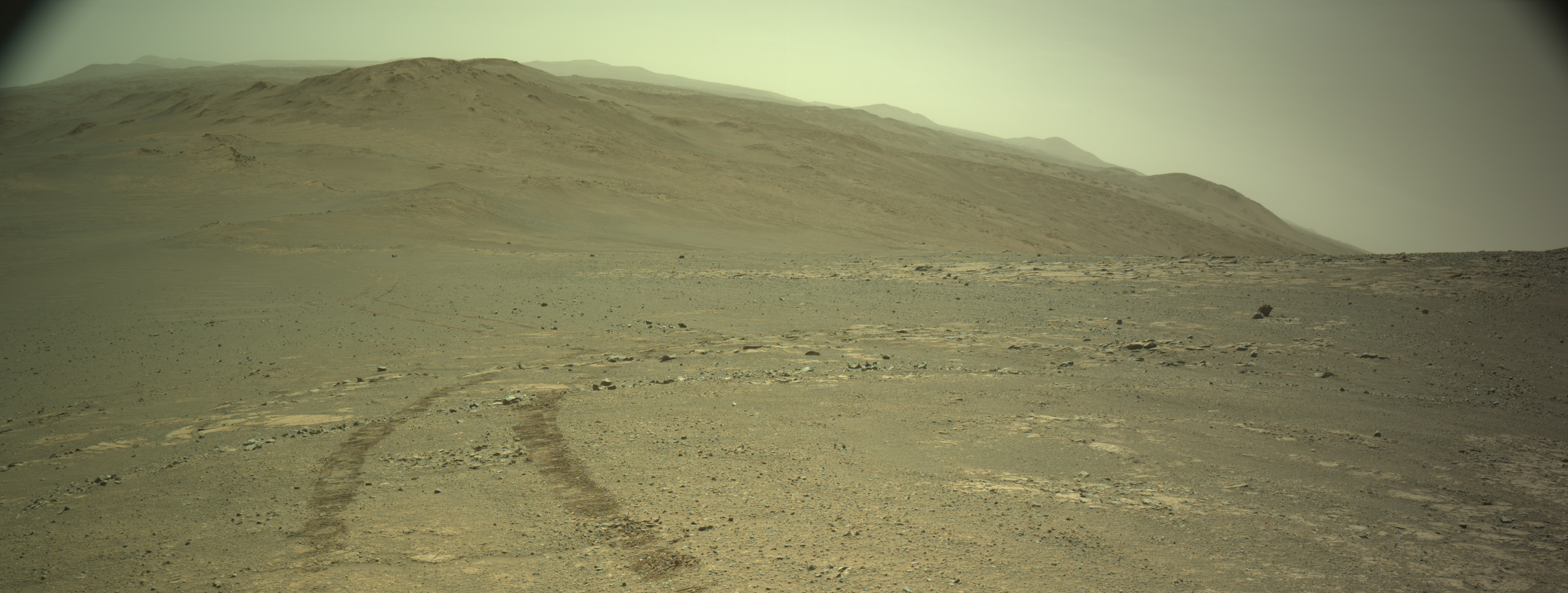
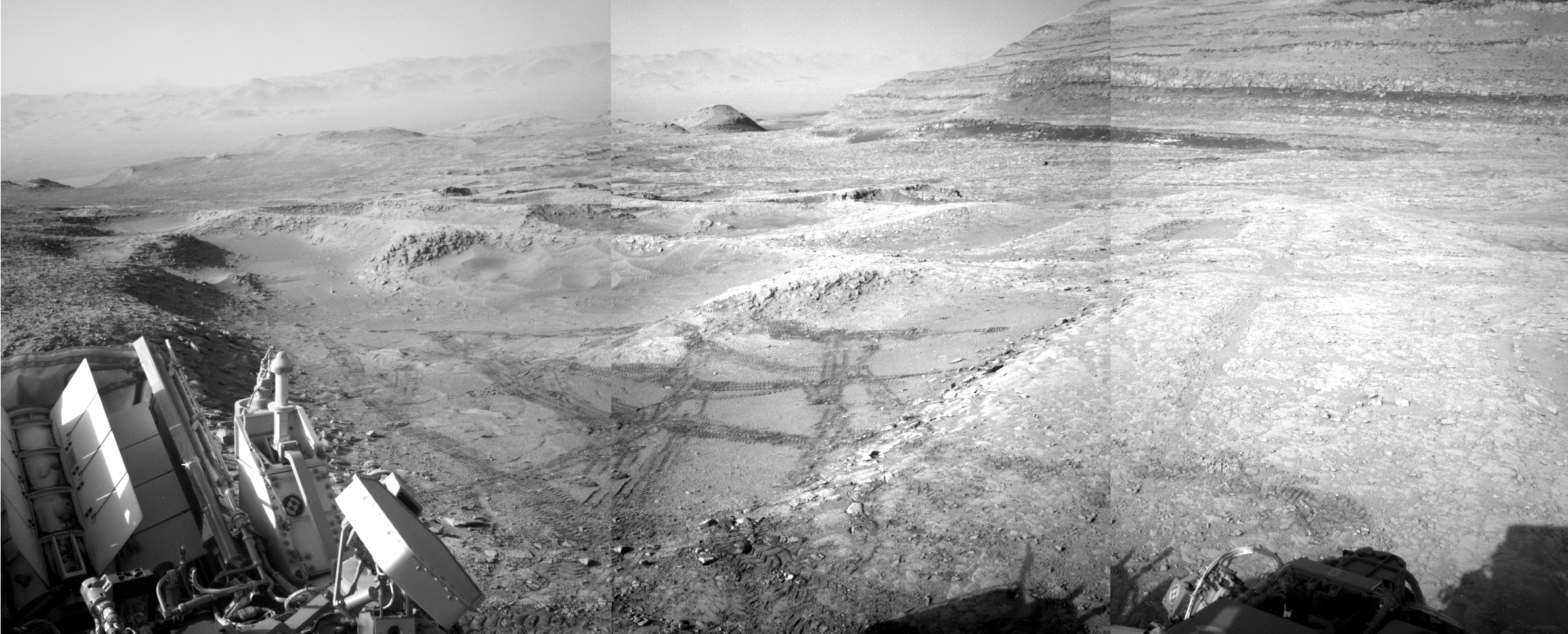
Cool image time! The panorama above was created from three photographs taken on December 18, 2025 (here, here, and here) by the right navigation camera on the Mars rover Curiosity.

The view is north, looking down the flanks of Mount Sharp and across the floor of Gale Crater to its rim about 20 to 30 miles away. In comparing this view with a similar one taken in July, it is obvious that the Martian atmosphere has become far dustier during the last six months. The rim and the mountains beyond are hardly visible now through the haze.

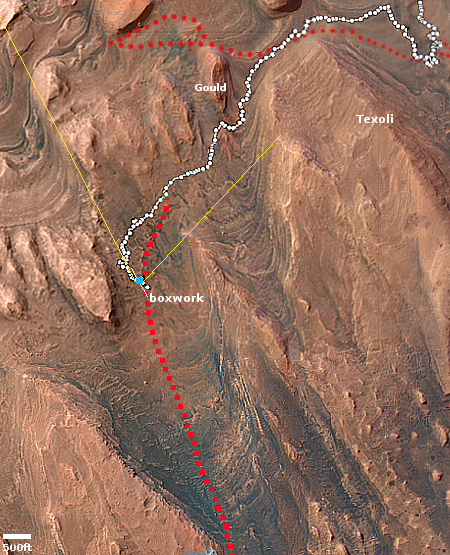
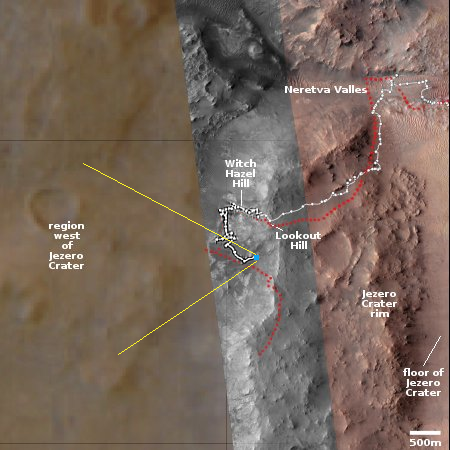
The blue dot on the overview map to the right marks Curiosity’s present position. The yellow lines indicate roughly the area covered by this panorama. The while dotted line indicates the rover’s travels, while the red dotted line its planned routes.

As you can see by both the rover’s tracks in the panorama above and the white dotted line in the overview, Curiosity has been traversing back and forth across the boxwork formation of criss-crossing ridges for more than half a year, as the science team attempts to decipher what caused these ridges and hollows. They have also done some drilling in this effort.

The science team has been getting close to the day it will move on, resuming Curiosity’s climb of Mount Sharp, but they keep finding things amidst this boxwork that requires additional study. For example, consider this from yesterday’s update:
» Read more

2 comments


Curiosity_Location_Sol4752

» Read more

Updates on the status of two Mars missions, Maven and Escapade

NASA today posted two separate updates on the status of two of its missions to or at Mars.

First, it appears there is an issue with one engine on one of the two Escapade orbiters on their way to their parking orbit where they will await the right moment to head to Mars.

During trajectory correction maneuvers for NASA’s twin ESCAPADE spacecraft on Dec. 8 and Dec. 12, the mission operations team noticed low thrust during the burn for one of the spacecraft. The team is working to identify the cause and will attempt a trajectory correction maneuver in the coming weeks.

The other spacecraft has successfully completed its two trajectory correction maneuvers, as planned. Both spacecraft are operating normally otherwise, and currently there are no long-term impacts from the trajectory correction delay.

While not the best news, this issue does not at this moment appear critical.

The second update however was even more negative. It appears engineers have not yet been able to re-establish contact and control of the Mars orbiter Maven.

To date, attempts to reestablish contact with the spacecraft have not been successful. Although no spacecraft telemetry has been received since Dec. 4, the team recovered a brief fragment of tracking data from Dec. 6 as part of an ongoing radio science campaign. Analysis of that signal suggests that the MAVEN spacecraft was rotating in an unexpected manner when it emerged from behind Mars. Further, the frequency of the tracking signal suggests MAVEN’s orbit trajectory may have changed. The team continues to analyze tracking data to understand the most likely scenarios leading to the loss of signal. Efforts to reestablish contact with MAVEN also continue.

It appears the loss of Maven is also impacting communications with the two Mars rovers Curiosity and Perseverance. While NASA has use of three orbiters at present, Mars Reconnaissance Orbiter, Mars Odyssey, and Europe’s Trace Gas Orbiter, to relay data from the ground to Earth, the loss of Maven reduces that communications network by 25%. Engineers are revising plans to make up some of the loss, but operations for both rovers will be for the time being reduced somewhat.

15 comments

What might be the weirdest crater on Mars

What might be Mars' weirdest crater
Click for original.

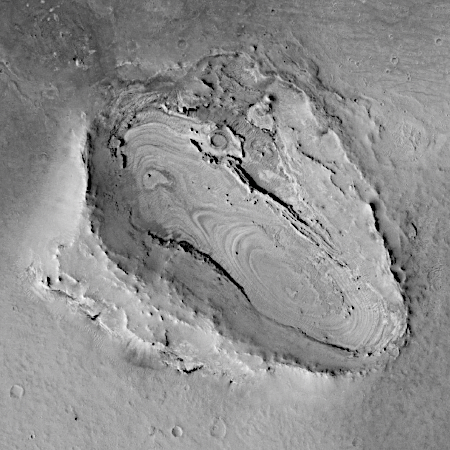
Cool image time! The picture to the right is taken from a global mosaic created from images taken by the wide-view context camera on Mars Reconnaissance Orbiter (MRO). The original source image was probably a photograph taken on February 15, 2020.

I normally begin with an image from MRO’s high resolution camera, but the only images that camera took of this crater did not show it entirely. This context camera shows it in all its glory, what to my eye appears to be one of the weirdest craters I’ve seen on Mars.

First, note its oblong shape — 5.5 miles long and 3.7 miles wide — which appears to narrow to the southeast. It certainly appears that if this crater was caused by an impact, the bolide came in at a very low angle from the northwest, plowing this 700-foot-deep divot as it drove itself into the ground. Research has shown that an impact has to come in almost sideways to do this. Even at slightly higher angles the resulting craters will still appear round.

But wait, there’s more!
» Read more

4 comments

Curiosity looks downhill at past travels

Curiosity looks downhill
Click for original image.

Cool image time! The picture to the right, cropped, reduced, and sharpened to post here, was taken on November 6, 2025 by the left navigation camera on the Mars rover Curiosity.

The picture looks north across Gale Crater, its distant rim about 20-30 miles away barely visible in the dusty atmosphere. In the foreground can be seen Curiosity’s recent tracks, showing how the science team had it travel back and forth several times, probably to check out several different interesting nearby ground features, as well as see how the ground changed by that travel. The rover has been traveling in an area called boxwork, a series of small intercutting ridges and hollows. Several of those ridges can be seen just beyond the tracks.

The red dotted line indicates my rough estimate as to the rover’s route uphill to get to this point, traveling up and to the left and following ridges just out of view.
» Read more

0 comments


Curiosity_Location_Sol4711

» Read more

Crazy layers inside a Martian crater

Crazy layers in a Martian Crater
Click for original image.

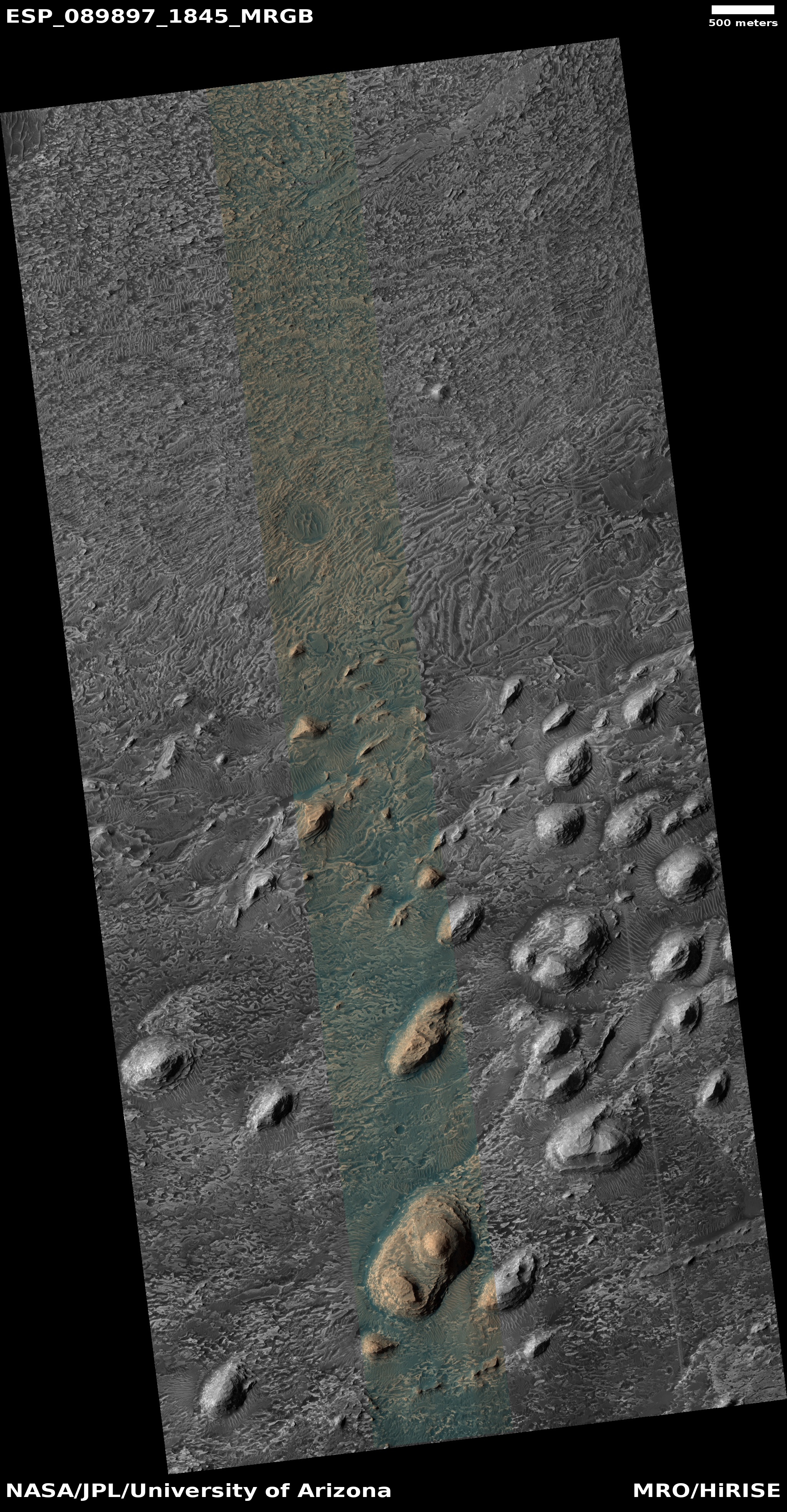
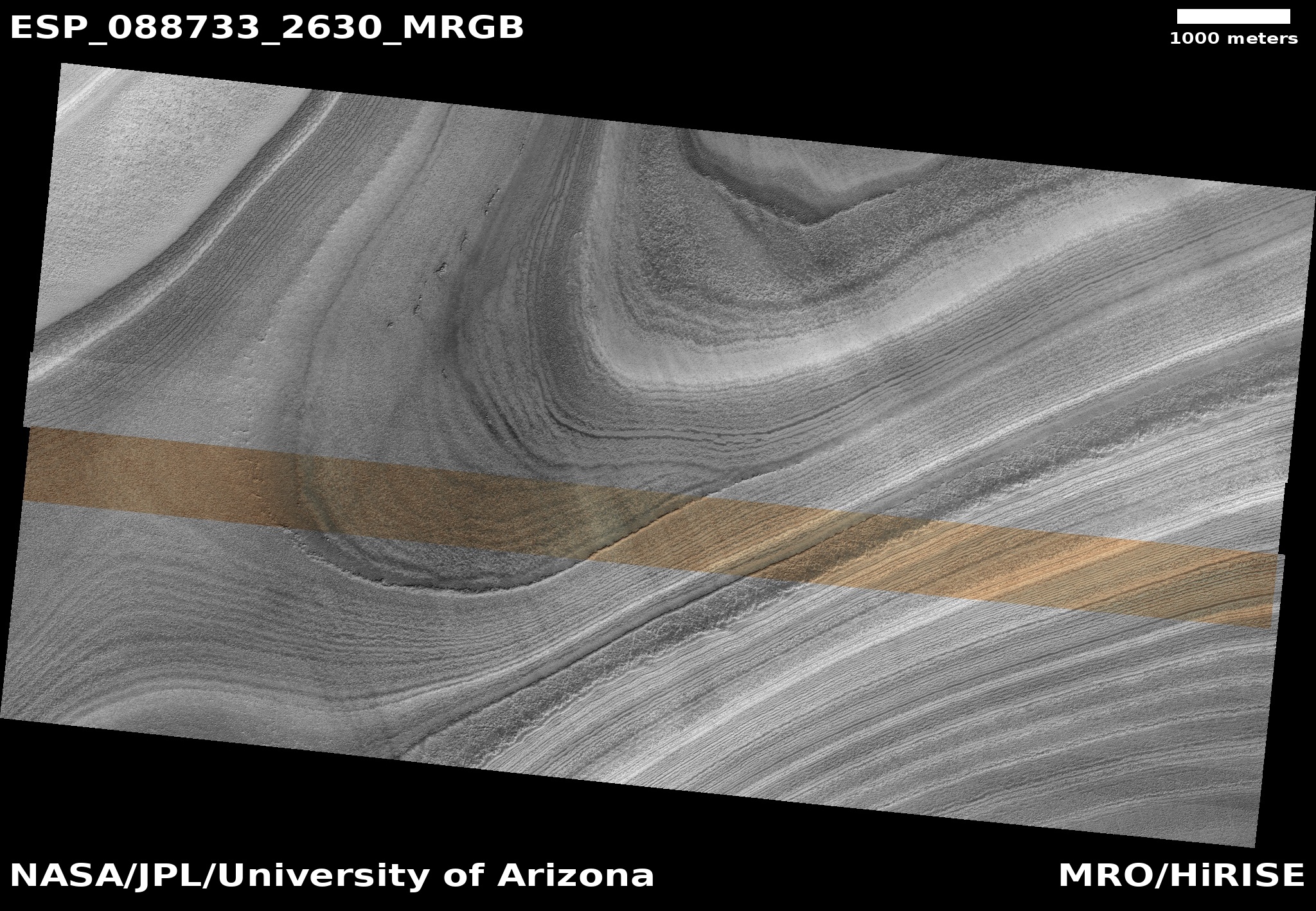
Cool image time! The picture to the right, cropped, reduced, and sharpened to post here, was taken on September 30, 2025 by the high resolution camera on Mars Reconnaissance Orbiter (MRO).

The scientists label this image with the term “layers”, but to my eye this is kind of an understatement. The geology in the top half of this picture is more than simply layers, it is an example of that unique Martian geological feature dubbed “brain terrain”, but on steroids.

No one yet knows what causes brain terrain, though scientists think it is related to the sublimation of near surface ice. Normally the tubelike formations are much smaller, only ten to thirty feet long, not hundreds of feet as we see here.

In this case the location of these features makes their formation even more puzzling, as there is no near surface ice found here.
» Read more

1 comment

If there is any microbiology on Mars, new research says it will be found in the red planet’s ample ice

The uncertainty of science: New research that attempted to simulate conditions in the ice on Mars has determined that ancient microbes are more likely survive there for very long periods, as much as fifty million years, rather than the red planet’s dry sediments.

The research team, led by corresponding author Alexander Pavlov, a space scientist at NASA Goddard — who completed a doctorate in geosciences at Penn State in 2001 — suspended and sealed E. coli bacteria in test tubes containing solutions of pure water ice. Other E. coli samples were mixed with water and ingredients found in Mars sediment, like silicate-based rocks and clay.

The researchers froze the samples and transferred them to a gamma radiation chamber at Penn State’s Radiation Science and Engineering Center, which was cooled to minus 60 degrees Fahrenheit, the temperature of icy regions on Mars. Then, the samples were blasted with radiation equivalent to 20 million years of cosmic ray exposure on Mars’ surface, vacuum sealed and transported back to NASA Goddard under cold conditions for amino acid analysis. Researchers modelled an additional 30 years of radiation for a total 50-million-year timespan.

In pure water ice, more than 10% of the amino acids — the molecular building blocks of proteins — from the E. coli sample survived the simulated 50-million-year time span, while the samples containing Mars-like sediment degraded 10 times faster and did not survive. A 2022 study by the same group of researchers at NASA found that amino acids preserved in a 10% water ice and 90% Martian soil mixture were destroyed more rapidly than samples containing only sediment.

In other words, if there was ever microbiology on Mars, it is very unlikely Perseverance or Curiosity will ever find any, roving as they are in the dry Martian tropics.

Though this work has many uncertainties, especially in its assumption that it successfully simulated a 50-million-year time span, the result is hardly an earth-shaking discovery. If anything, it confirms the obvious, which is why NASA’s ludicrous claim that Perseverance’s prime mission is to look for life has always been a lie. It is traveling in the wrong place, a fact that was self-evident from the start.

Whether any microbiology might exist in Mars’ ice however is unknown. The odds are very very low, but not zero. If it does, it is even less likely it is living, based on orbital data.

13 comments

Martian boxwork on the flanks of Mount Sharp

The boxwork on Mars
Click for original image.

Cool image time! The picture to the right, cropped, reduced, and sharpened to post here, was taken on October 5, 2025 by the left navigation camera on the Mars rover Curiosity.

The picture looks north and downhill from the lower flanks of Mount Sharp, inside Gale Crater. In the far distance on the horizon can be seen the crater’s northern rim, about 20 to 30 miles away. As it is now moving into the dusty season on Mars, the haze has increased from only a month ago, making it hard to see many distant details.

In the foreground can be seen clearly the light-colored ridges of the boxwork that the rover has been traversing for the past three months, with one rover track visible on the nearest ridge. Unlike the very rocky and boulder-strewn terrain the rover has seen in most of its travels on Mount Sharp, this boxwork seems smoother.
» Read more

2 comments


Curiosity_Location_Sol4680

» Read more

September 25, 2025 Quick space links

Courtesy of BtB’s stringer Jay. This post is also an open thread. I welcome my readers to post any comments or additional links relating to any space issues, even if unrelated to the links below.

7 comments

NASA promotes the non-discovery of life on Mars by Perseverance

It's all a game of Kibuki theater
It’s all a game!

In what can only be called a kabuki theater stunt, NASA today held a press conference and issued a press release promoting what is essentially the non-discovery of life on Mars by the science team operating the rover Perseverance.

Agency officials, led by acting NASA administrator Sean Duffy, proudly claimed the discovery justified the oft-stated goal of Perseverance, to find life on Mars.

“This finding by Perseverance, launched under President Trump in his first term, is the closest we have ever come to discovering life on Mars. The identification of a potential biosignature on the Red Planet is a groundbreaking discovery, and one that will advance our understanding of Mars,” said acting NASA Administrator Sean Duffy.

This is all garbage. First, Perseverance’s real objective has never been to find life on Mars. It is there to study the planet’s geology. If it should happen to detect a biosignature that would be great, but doing so has always been highly unlikely.

Second, the discovery that Duffy touts is itself quite underwhelming. The key quote from the press release that immediately precedes Duffy’s claim is very telling:

A potential biosignature is a substance or structure that might have a biological origin but requires more data or further study before a conclusion can be reached about the absence or presence of life.

Furthermore, the biosignature that Duffy touts is actually not really a biosignature. They found “a distinct pattern of minerals” that might be sometimes be related to life processes, but not always.

The combination of these minerals, which appear to have formed by electron-transfer reactions between the sediment and organic matter, is a potential fingerprint for microbial life, which would use these reactions to produce energy for growth. The minerals also can be generated abiotically, or without the presence of life. [emphasis mine]

In other words, the data is very uncertain. It certainly doesn’t merit the loud push NASA and Duffy is giving it.

I suspect this push is the result of NASA’s fundamental lie about Perseverance’s so-called search for life, a lie that can never really be fulfilled. It is also related to hiding Perseverance’s limited capabilities. For example, Curiosity has a small lab allowing scientists to analyze samples in great detail. If Curiosity came across a real biosignature, it would be able to identify it.

Perseverance lacks this ability, because in its stead it has equipment for preserving core samples for later pick-up. All it really was designed to do was to gather those core samples. It can’t really do the same kind of ground analysis as Curiosity.

10 comments

Has Curiosity stumbled upon a small slope streak?

Is that a slope streak in the lower right?
Click for original.

Overview map
Click for interactive map

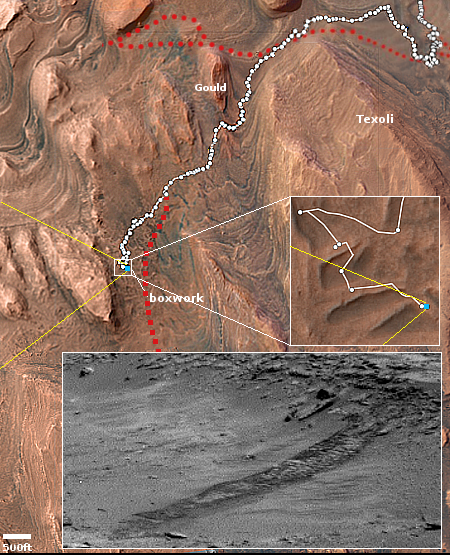
In reviewing the pictures downloaded today by the Mars rover Curiosity, I noticed something very intriguing in the pictures taken by rover’s two navigation cameras. One such picture is above, taken by the right navigation camera and looking west across the boxwork ridges that Curiosity has been traversing for the past two months. You can see two such ridges in the right foreground, cutting diagonally from left to right.

The overview map to the right gives the context, with the blue dot marking Curiosity’s position. The white and red dotted lines indicate its actual and planned routes respectively, with the top inset zooming in to show the recent travels more clearly. The yellow lines show the approximate area covered by the picture above.

Note the dark streak in the lower right of the picture. The bottom inset on the overview map shows this streak more closely. To my eye, it strongly resembles a slope streak, a strange geological feature unique to Mars.

If I am right, expect the rover team to focus in on this streak. The cause of slope streaks remains unknown. From orbit, the streaks look like avalanches at first glance, but they don’t change the topography, have no debris pile at their base, and sometimes even travel up and over rises as they head downhill. They can occur randomly throughout the year, can be bright or dark, can occur anywhere, and fade with time.

There are a number of theories (see here, here, and here) attempting to explain their cause, but none has been confirmed. If this is a streak, it will be the first that any scientist can see up close.

It is also very likely my guess is wrong, and this is not a streak. Stay tuned for updates.

2 comments


Curiosity_Location_Sol4650

» Read more

Perseverance looks west

Perseverance looks west
Click for full resolution. For original images go here and here.

Overview map
Click for interactive map.

Cool image time! The panorama above, reduced and sharpened to post here, was created using two pictures taken on August 28, 2025 by the left navigation camera on the Mars rover Perseverance (here and here).

The blue dot on the overview map to the right marks Perseverance’s location when it took these pictures. The yellow lines indicate the approximate area covered by the panorama. The red dotted line indicates the rover’s planned route, with the white dotted line its actual travels.

The recent geological research focused on the lighter-colored ridge on the right center, dubbed Soroya. From the August 27, 2025 update by the science team:

Soroya was first picked out from orbital images as a target of interest because, as can be seen in the above image, it appears as a much lighter color compared to the surroundings. In previous landscape images from the surface, Mars 2020 scientists have been able to pick out the light-toned Soryoa outcrop, and they noted it forms a ridge-like structure, protruding above the surface. Soroya was easily identifiable from rover images as Perseverance approached since it indeed rises above the surrounding low-lying terrain.

The view is looking downhill away from Jezero Crater. The curve of the horizon is an artifact of the navigation camera’s wide view, accentuated by the slope that the rover sits on. The low resolution of this western region on the overview map is because the science team has not yet had Mars Reconnaissance Orbiter (MRO) get highest resolution pictures there yet.

Note the utter barrenness of this terrain. This is Mars, a lifeless world that has only the future potential for life, once we humans start to colonize it. Whether there was ever any past life remains uncertain, but the nature of its terrain as seen by both Perseverance and Curiosity suggests strongly that past life never existed, or if it did it barely survived and was quickly wiped out, a long time ago.

0 comments

The beauty of Mars’ many-layered northern icecap

The beauty of Mars' ice cap
Click for original image.

Cool image time! The picture to the right, rotated, cropped, reduced, and sharpened to post here, was taken on July 1, 2025 by the high resolution camera on Mars Reconnaissance Orbiter (MRO).

The science team labels it clumsily as “North Polar layered deposits structural geology in icy layers”. What we see are the many layers that make up the north polar cap, produced by the red planet’s many climate cycles that scientists think Mars has undergone over the eons as the red planet’s rotational tilt, or obliquity, rocked back and forth from 11 degrees inclination to as much as 60 degrees. At the extremes, the ice cap was either growing or shrinking, while today (at 25 degrees inclination) it appears to be in a steady state.

These layers are a mixture of ice and dust. The variations from dark to light likely indicate changes in the amount of dust in the atmosphere. Dark layers suggest the atmosphere was more dusty due to volcanic eruptions. Light layers suggest the planet’s volcanic activity was more subdued.

At least that’s one hypothesis.
» Read more

0 comments

Strange rocks on Mars

Coral on Mount Sharp!
Click for original image.

Float rock in Jezero Crater
Click for original image.

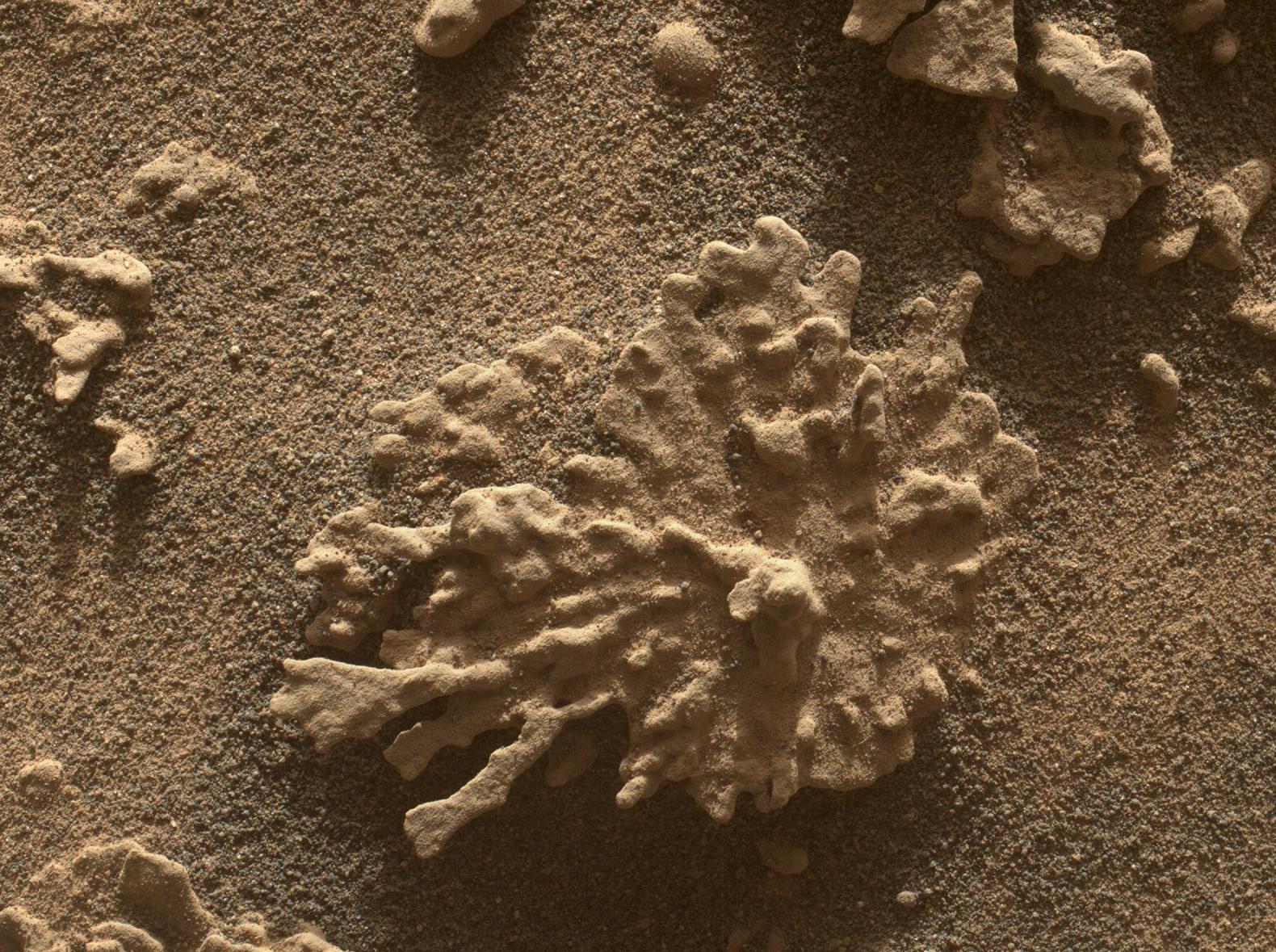
Time for two cool images, from two different craters separated by thousands of miles on Mars! The first image to the right, cropped, reduced, and sharpened to post here, was taken on July 24, 2025 by the Mars Hand Lens Imager (MAHLI) at the end of the robot arm of Mars rover Curiosity, and shows a really strange rock formation that resembles a piece of coral on Earth.

Curiosity has found many small features like this one, which formed billions of years ago when liquid water still existed on Mars [in this region]. Water carried dissolved minerals into rock cracks and later dried, leaving the hardened minerals behind. Eons of sandblasting by the wind wore away the surrounding rock, producing unique shapes.

The second image, cropped, reduced, and sharpened to post here, was taken on August 5, 2025 by the left high resolution camera on the rover Perseverance. It shows what appears what geologists call a “float rock”, something that was created geologically somewhere else and transported to this location later.

In this case the rock appears lavalike in nature. Since Perseverance is exploring the exterior rim of Jezero Crater, we could be looking at the impact melt created when the bolide hit the ground to create the crater. Material would be instantly melted as well as flung outward as ejecta, with this strangely shaped rock an example.

The problem with this theory however is that the rock appears to have solidified well before it hit the ground at this location. Its shape also suggests it solidified within a crack, thus molding it to this shape, with its top once at the bottom, the lava flowing downward. The mystery then is how it ended up as we see it, upside down and exposed.

7 comments

August 5, 2025 Quick space links

Courtesy of BtB’s stringer Jay. This post is also an open thread. I welcome my readers to post any comments or additional links relating to any space issues, even if unrelated to the links below.

Sorry this is so late, but I was on my way home this evening and only just got in.

8 comments

Curiosity looks back

Curiosity looks back
Click for original image.

Cool image time! The picture to the right, reduced and enhanced to post here, was taken on July 28, 2025 by the left navigation camera on the Mars rover Curiosity. It looks to the north, down the flanks of Mount Sharp and across the floor of Gale Crater to its mountainous rim about 30 miles way, seen on the horizon.

The view is so clear because of the season, as noted in the science team’s blog post today:

We’re still in the time of year where the atmosphere at Gale is reasonably dust-free (at least, compared to later in the year), allowing us to look all the way out to and beyond the Gale crater rim. The upper slopes of Mount Sharp have also re-emerged to our east after spending months hidden behind the walls of Gediz Vallis. There’s a bit more sand and dust in this location than we’ve seen recently, so we can also see the trail left behind by the rover’s wheels as we drove to this location

The ridge in the foreground is an example of the boxwork Curiosity is presently traversing. It is now on one of those ridges, and will be moving along it in short drives as the science team studies the geology here. The rover’s tracks leading up to this position can be seen clearly.
» Read more

1 comment
1 2 3 4 5 … 37