Dried up lake beds on Mars?

A paper published on Saturday in the Journal of Geophysical Research – Planets of the American Geophysical Union, scientists suggest that the polygonal shaped cracks seen in the crater floors on many Martian craters could be evidence of ancient lakes. The evidence also suggests that the lakes were formed by the impact that created the crater. The energy of the impact melted underground ice to form a temporary lake inside the crater, which eventually dries out, leaving behind the polygons. From the abstract:

We propose desiccation to be a dominant mechanism for the formation of Crater Floor Polygons without ruling out thermal contraction as a possible contributor in some cases. This implies that lakes or water-rich sediments occupied the craters in the past. Many such aqueous environments have no apparent external source of water, and thus, hydrothermal processes occurring shortly after the impact event may be viable explanations for the observed evidence.
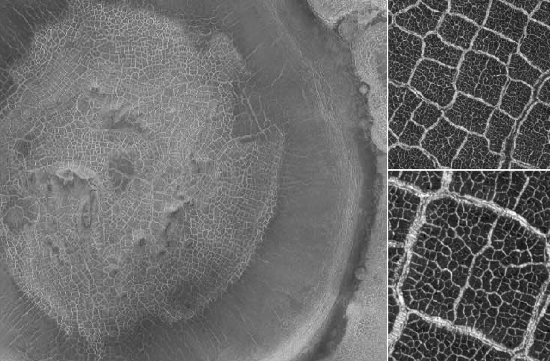
Crater floor polygons on Mars

0 comments

The crumbling cliffs of Mars

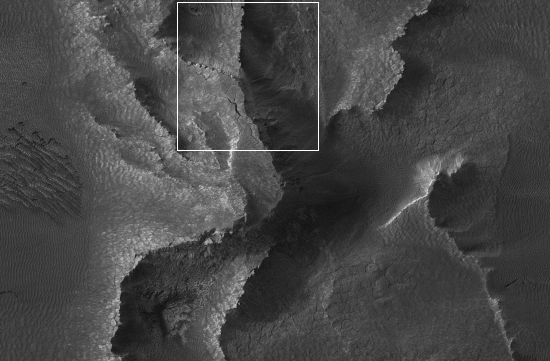
Among the new images posted last week by the HiRise camera on Mars Reconnaissance Orbiter is a picture showing the layered and looping ridgelines within Galle Crater. A close-up of these ridgelines revealed the precarious nature of those crumbling cliff tops.

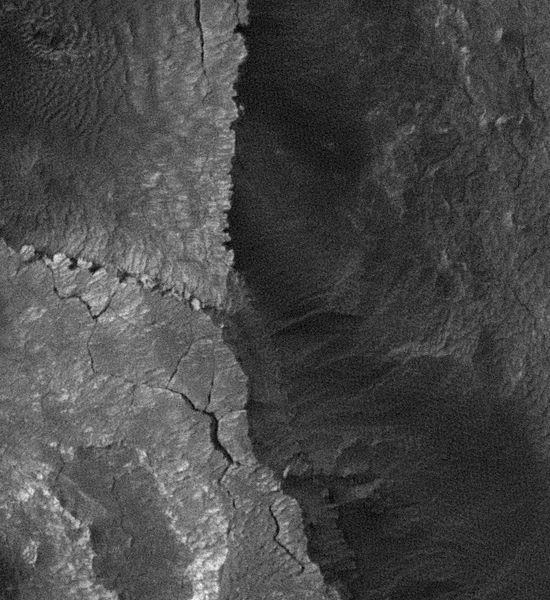
Below is a low resolution version of the image, with a high resolution cropped inset below that, showing a close-up of the most interesting looking area. In the inset you can see that the top of the cliff has separated away. It almost looks as if several large pieces are about to break off. You can also see that the top of the cliff to the north is made up of hanging rocks that appear to almost float in the air. They too look as if they are about to break off.

What makes this even more intriguing is that there are no boulder piles at the bottom of any cliff. All we can see on the valley floor is a pattern of polygonal fractures, possibly “due to ground ice, or regional tectonic stresses.” If large pieces of these ridge lines are breaking off periodically, as they surely appear to be doing, where has the debris gone?

Martian cliffs

crumbling cliffs

0 comments
1 2 3