Three launches today from three continents and three nations

The global launch pace continues, with three launches today. First, Russia launched a new Progress cargo capsule to ISS, its Soyuz-2 rocket lifting off from its repaired launchpad at Baikonur. That launchpad had experienced serious damage to an access platform during the previous launch in November 2025, and since it was the only pad that Roscosmos could launch payloads and crews to ISS, Russia committed heavy resources to get it fixed quickly.

Once Progress reached orbit, however, one of the antennas used by its Kurs automatic docking system failed to deploy. If engineers can’t get it opened by the time of docking, scheduled for March 24, 2026, the Russian astronauts on ISS will use the back-up TORU system, whereby they control the spacecraft manually from inside ISS.

Next, SpaceX placed another 29 Starlink satellites into orbit, its Falcon 9 rocket lifting off from Cape Canaveral Space Force station in Florida. The first stage (B1078) completed its 27th flight, landing on a drone ship in the Atlantic, only 20 days after its previous flight. This flight also moved the booster up to just behind the space shuttle Columbia in the rankings of the most reused launch vehicles, tying it with SpaceX booster B1077:

39 Discovery space shuttle
33 Atlantis space shuttle
33 Falcon 9 booster B1067
32 Falcon 9 booster B1071
31 Falcon 9 booster B1063
30 Falcon 9 booster B1069
28 Columbia space shuttle
27 Falcon 9 booster B1077
27 Falcon 9 booster B1078

Sources here and here.

At the pace SpaceX is reusing its fleet of Falcon 9 boosters, expect Columbia to drop off this list in about two months.

Finally, China launched 10 smallsats, according to China’s state-run press, for a planned 160-satellite GPS-type constellation, its Smart Dragon-3 rocket (also called Jielong-3) lifting off from an ocean platform off the northeast coast of China. Video here of launch.

The leaders in the 2026 launch race:

37 SpaceX
13 China
4 Rocket Lab
3 Russia

SpaceX continues to lead the entire world combined in total launches, as it did in both ’24 and ’25.

2 comments

Canada cancels small lunar rover that was to fly on Firefly’s Blue Ghost lander in ’29

Even as Canada has increased its government space spending in Europe and in Canada — mostly it appears to prop up bureaucracies or failing businesses — its space agency has at the same time cancelled its first lunar rover project, scheduled to brought to the south pole of the Moon by a Firefly Blue Ghost lander in 2029.

As part of its 2026-2027 departmental plan, the Canadian Space Agency (CSA) has cancelled its ambitious lunar rover mission. The lunar rover was announced in 2022. It would have been Canada’s first rover, built by Canadensys, and hitching a ride to the moon on a commercial launch vehicle built by a private U.S. company, Firefly Aerospace.

…The principal investigator of the mission, Gordon Osinski, a planetary geologist from Western University, said that he found out about a month ago, and that he was “devastated” by the news.

Note that this rover was hardly “ambitious.” It was a small unmanned rover comparable to similar rovers deployed by India, Japan, and others, mostly aimed at testing the engineering for later larger rovers.

The real issue however is how this decision illustrates Canada’s leftist government misplaced priorities. Increasingly it appears it is canceling actual space research or planetary missions and shifting the money to other uses, either European projects or bureaucracies in Canada or failing Canadian businesses.

8 comments

Genesis cover

On Christmas Eve 1968 three Americans became the first humans to visit another world. What they did to celebrate was unexpected and profound, and will be remembered throughout all human history. Genesis: the Story of Apollo 8, Robert Zimmerman's classic history of humanity's first journey to another world, tells that story, and it is now available as both an ebook and an audiobook, both with a foreword by Valerie Anders and a new introduction by Robert Zimmerman.

The print edition can be purchased at Amazon or any other book seller. If you want an autographed copy the price is $60 for the hardback and $45 for the paperback, plus $8 shipping for each. Go here for purchasing details. The ebook is available everywhere for $5.99 (before discount) at amazon, or direct from my ebook publisher, ebookit. If you buy it from ebookit you don't support the big tech companies and the author gets a bigger cut much sooner.


The audiobook is also available at all these vendors, and is also free with a 30-day trial membership to Audible.
 

"Not simply about one mission, [Genesis] is also the history of America's quest for the moon... Zimmerman has done a masterful job of tying disparate events together into a solid account of one of America's greatest human triumphs."--San Antonio Express-News

Private mission to Apophis gets another customer, two student-built landers

Apophis' path past the Earth in 2029
A cartoon (not to scale) showing Apophis’s
path in 2029.

The orbital tug startup Exlabs has signed up a second payload customer to fly on its private ApophisExL mission to rendezvous with the potentially dangerous asteroid Apophis when it makes its April 13, 2029 close fly-by of the Earth.

ExLabs has announced its partnership with Japan’s Chiba Institute of Technology (ChibaTech) and its Planetary Exploration Research Center (PERC) to send university-led payloads to the surface of asteroid Apophis during its rare near-Earth flyby in 2029. ApophisExL is the world’s first commercial deep-space rideshare and is supported by mission design and operations collaboration with NASA’s Jet Propulsion Laboratory (JPL) operated by Caltech.

Under the leadership of planetary scientist and PERC Director, Dr. Tomoko Arai, ChibaTech students and researchers are developing two landing payloads to be deployed on the asteroid’s surface.

An Australian satellite startup, Fleet Space Technologies, had already signed on to fly a mapping instrument on ApophisExL.

Though the press release at the link calls this private mission “a new model,” using private enterprise rather than relying on the government for doing planetary missions, it actually harks back to the way things were done in the U.S. before World War II, when the private sector did most of this pure research. In fact, as late as the 1960s there was at least one company, American Science and Engineering, doing the first X-ray astronomical observations flying suborbital rockets. It later won contracts from NASA and other agencies to help build several later orbiting X-ray telescopes.

Over time the government space agencies became dominant, so that most of this design work was either done by them or by universities, with private companies relegated to the roles of minor subcontractors.

This new model is simply an extension of the capitalism model that is taking over the entire space industry, shifting power and ownership from big, expensive, and inefficient government programs to small, cheap, and economical private missions. Those space agencies can still do missions, but they do it by buying payload space on these private missions.

Below is a list of the missions going to Apophis in 2029:
» Read more

2 comments

Sweden’s Esrange spaceport signs launch deal with Swedish military

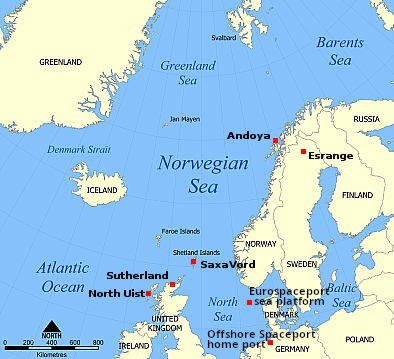
Proposed or active spaceports in North Europe

Sweden’s Esrange spaceport, used for decades for suborbital test launches but now trying to become an orbital spaceport, this past week signed a launch agreement worth about $22 million with Sweden’s military.

The contract covers systems and infrastructure that ensure protection, availability, and execution of satellite launches for the Swedish Armed Forces, as well as for partners and allies. The capability is scheduled to be operational by 2028.

…The initiative is part of a government decision from 2023 to allocate approximately [$100 million] to the Swedish Armed Forces through 2032 to develop Sweden’s space capabilities. The decision includes, among other things, improved space situational awareness, expansion of infrastructure at Esrange in cooperation with SSC Space, and the ability for the Swedish Armed Forces to carry out multiple satellite launches.

It seems unlikely Sweden’s military will be able to produce its own rockets for this amount of money. More likely they will buy the services from others. The American rocket company Firefly in 2024 signed a deal to launch its Alpha rocket from Esrange, but it appears there might be regulatory issues blocking any launches, some of which might stem from opposition by Norway. Esrange has an interior location, so any orbital launch has to fly over territory belonging to other countries. It appears Sweden is having problems getting permission to do so.

My guess is that this deal is mostly aimed at keeping Esrange open. Or to put it more bluntly, use the earnings of Swedish taxpayers to support a government-controlled spaceport with little financial promise.

1 comment

Conscious Choice cover

Now available in hardback and paperback as well as ebook!

From the press release: In this ground-breaking new history of early America, historian Robert Zimmerman not only exposes the lie behind The New York Times 1619 Project that falsely claims slavery is central to the history of the United States, he also provides profound lessons about the nature of human societies, lessons important for Americans today as well as for all future settlers on Mars and elsewhere in space.

 
Conscious Choice: The origins of slavery in America and why it matters today and for our future in outer space, is a riveting page-turning story that documents how slavery slowly became pervasive in the southern British colonies of North America, colonies founded by a people and culture that not only did not allow slavery but in every way were hostile to the practice.  
Conscious Choice does more however. In telling the tragic history of the Virginia colony and the rise of slavery there, Zimmerman lays out the proper path for creating healthy societies in places like the Moon and Mars.


“Zimmerman’s ground-breaking history provides every future generation the basic framework for establishing new societies on other worlds. We would be wise to heed what he says.” —Robert Zubrin, founder of the Mars Society.


All editions are available at Amazon, Barnes & Noble, and all book vendors, with the ebook priced at $5.99 before discount. All editions can also be purchased direct from the ebook publisher, ebookit, in which case you don't support the big tech companies and the author gets a bigger cut much sooner.


Autographed printed copies are also available at discount directly from the author (hardback $29.95; paperback $14.95; Shipping cost for either: $6.00). Just send an email to zimmerman @ nasw dot org.

Two launches today by Rocket Lab and SpaceX

The launch pace continued today with two American commercial launches.

First Rocket Lab placed a Synspective radar satellite into orbit, its Electron rocket lifting off from one of its two launchpads in New Zealand. This was the company’s eighth launch for Synspective, out of a 27-launch contract.

Next, SpaceX placed 25 more Starlink satellites in orbit, its Falcon 9 rocket lifting off from Vandenberg Space Force Base in California. The first stage completed its fourth flight, landing on a drone ship in the Pacific.

The leaders in the 2026 launch race:

36 SpaceX
12 China
4 Rocket Lab
2 Russia

SpaceX continues to lead the entire world combined in total launches, as it did in both ’24 and ’25.

5 comments

Leaving Earth cover

Leaving Earth: Space Stations, Rival Superpowers, and the Quest for Interplanetary Travel, can be purchased as an ebook everywhere for only $3.99 (before discount) at amazon, Barnes & Noble, all ebook vendors, or direct from my ebook publisher, ebookit.

If you buy it from ebookit you don't support the big oppressive tech companies and I get a bigger cut much sooner.


Winner of the 2003 Eugene M. Emme Award of the American Astronautical Society.

 
"Leaving Earth is one of the best and certainly the most comprehensive summary of our drive into space that I have ever read. It will be invaluable to future scholars because it will tell them how the next chapter of human history opened." -- Arthur C. Clarke

Space Force shifts another ULA Vulcan launch to SpaceX

Unexpected debris falling from rocket at about T-1:00
Nozzle failure during February 12, 2026 Vulcan launch

As expected, the Space Force has taken its next GPS satellite launch from ULA’s Vulcan rocket and given it to SpaceX’s Falcon 9.

The reason for the change is the repeated problems with the solid-fueled side boosters used on Vulcan and built by Northrop Grumman. The nozzles on two different launches failed. Though the rocket’s core stage in both cases was able compensate and get the payload into the proper orbit, the Space Force decided in late February to suspend further launches on Vulcan until ULA gets the problem fixed and proves it by launching other commercial payloads.

The Space Force however is not yet reducing the number of launches it has purchased from ULA, merely delaying them.

If all goes to plan, the satellite — the 10th and final one in the GPS III line — will lift off no earlier than late April from Space Launch Complex 40 at Cape Canaveral Space Force Station in Florida [on a Falcon 9].

Vulcan Centaur, in return, will launch USSF-70, a national security mission that had been manifested on a SpaceX Falcon Heavy. USSF-70 will fly no earlier than summer 2028, according to Space Force officials.

Nonetheless, the situation is not good for ULA. This is the third such ULA launch the Space Force has shifted to SpaceX. At some point, if ULA doesn’t get the problem fixed the military it will be forced to reduce its reliance on Vulcan.

16 comments

March 20, 2026 Quick space links

Courtesy of BtB’s stringer Jay. The last link also comes from reader Gary. This post is also an open thread. I welcome my readers to post any comments or additional links relating to any space issues, even if unrelated to the links below.

6 comments

The FCC’s agenda at its next meeting includes an item for “Weird Space Stuff”

FCC logo

In releasing its agenda for its upcoming March 26, 2026 open meeting, the Federal Communications Commission (FCC) included one very intriguing item entitled “Spectrum Abundance for Weird Space Stuff.”

In reviewing the fact sheet [pdf] for this particular agenda item, it appears the commission is focused on finding ways to maximize the use of some communications spectrum for more than one purpose. The commission wants to do this because it is anticipating a lot of new demand coming from what it calls “emergent space activities or emergent space operations.” As the fact sheet then notes:

In the geopolitical race to commercialize and dominate the Final Frontier, historic levels of private investment have paved the way for the engineering marvels and daring endeavors that now take place in outer space. Once the province of science fiction, American companies are now upgrading, relocating, and servicing satellites; 1. manufacturing pharmaceuticals in space; 2. building private inhabitable spacecraft; 3. and conducting private robotic missions to the surface of the Moon. 4. Emergent space operations like these depend on the use of radiocommunications for their spacecraft, but they are not the type of communications satellites that have traditionally commanded much of the Commission’s regulatory attention.

Spectrum is a critical component of all space operations. Even for spacecraft that do not provide radiocommunications services to the public, reliable spectrum access is mandatory for safety functions like telemetry, tracking, and command (TT&C) to control spacecraft in orbit. American innovators, however, currently face an acute shortage of usable and readily accessible spectrum for TT&C, and that spectrum crunch threatens to delay — or even prevent — the growth of domestic space technologies and jeopardize U.S. leadership in the booming global space economy. [emphasis mine]

In other words, the FCC is trying to find other spectrum, allocated for other purposes but available at other times, that can be provided to these new in-space operations for this telemetry, tracking, and command functions. To do this it appears it will need to rewrite some of its regulations, and this agenda item raises the issues involved in doing so.

And most interestingly, it is even considering allowing the marketplace solve the problem, by allowing licensees to lease their allocated spectrum to others. The FCC would limit such actions to the spectrum the FCC determines best for these multiple uses, but it is considering setting up rules to allow such freedom.

What an idea! Let free enterprise find a way to use the electromagnetic spectrum in the most efficient way possible.

No decision has been made, and we should expect the Democrats on the commission to oppose this, simply because. Nonetheless, it is a refreshing policy proposal.

Hat tip to reader Steve Golson, who notes quite correctly, “It’s good to see FCC trying to help rather than hinder.” Amen to that.

5 comments

Uranus: one glimpse and that was forty years ago

Uranus as seen by Voyager-2, natural colors on left, false color on right
Uranus as seen by Voyager-2, natural colors on left, false color on right. Click for original.

I close today our week-long tour of Voyager-2’s fly-by of Uranus in January 1986 with three cool images, the two images of the planet itself above and a close-up of its rings. All three illustrate that though Voyager-2 gave us our first very good first close-up view of this distant world, it also gave us only a tiny glimpse, very superficial and lacking in any larger context.

The two images above were taken on January 17, 1986 when Voyager 2 was till 5.7 million miles away, on approach.

The picture at left has been processed to show Uranus as human eyes would see it from the vantage point of the spacecraft. The picture is a composite of images taken through blue, green and orange filters. The darker shadings at the upper right of the disk correspond to the day-night boundary on the planet. Beyond this boundary lies the hidden northern hemisphere of Uranus, which currently remains in total darkness as the planet rotates. The blue-green color results from the absorption of red light by methane gas in Uranus’ deep, cold and remarkably clear atmosphere.

The picture at right uses false color and extreme contrast enhancement to bring out subtle details in the polar region of Uranus. Images obtained through ultraviolet, violet and orange filters were respectively converted to the same blue, green and red colors used to produce the picture at left. The very slight contrasts visible in true color are greatly exaggerated here. In this false-color picture, Uranus reveals a dark polar hood surrounded by a series of progressively lighter concentric bands. One possible explanation is that a brownish haze or smog, concentrated over the pole, is arranged into bands by zonal motions of the upper atmosphere. The bright orange and yellow strip at the lower edge of the planet’s limb is an artifact of the image enhancement. In fact, the limb is dark and uniform in color around the planet.

The third cool image below of Uranus’s rings was taken just after the closest approach, when Voyager-2 was in Uranus’s shadow and looking back at its rings from a distance of 142,000 miles.
» Read more

2 comments

Ursa Major test flies a new liquid-fueled missile engine for Air Force

Ursa Major's Draper engine being tested in flight

The rocket engine startup Ursa Major last week announced it had successfully completed for the Air Force a test missile launch of its new Draper liquid-fueled rocket engine.

As shown on the right, the Air Force’s Affordable Rapid Missile Demonstrator (ARMD) suborbital rocket was used to fly the engine. More information here.

On January 27, 2026, AFRL and Ursa Major launched the Draper liquid rocket engine on a demonstrator flight. While many details remain classified, the company says the test vehicle reached supersonic speeds during its flight. The test marked a transition from ground-based validation to in-flight evaluation, allowing engineers to study propellant stability, engine throttling performance, and how the system behaves under real flight conditions.

The Draper engine is designed to address key limitations of current hypersonic systems by making them cheaper, more scalable, and easier to operate. It runs on hydrogen peroxide and kerosene, fuels that are safer to store and handle compared to traditional alternatives.

The War Department’s hypersonic testing program has certainly heated up since the military switched to the capitalism model in the past five years. Beforehand, when the military tried to do its own testing, it took it years to get little done, while spending a fortune. Now it is flying suborbital rocket tests with Rocket Lab, Stratolaunch, and Firefly. It is testing new engines on flights such as Ursa’s above. And it testing hypersonic avionics on Varda’s orbiting capsules upon their return to Earth. Based on this commercial activity, it appears the U.S. military might get some real hypersonic capabilities in the very near future.

0 comments
1 31 32 33 34 35 2,927