Uranus: one glimpse and that was forty years ago

Uranus as seen by Voyager-2, natural colors on left, false color on right
Uranus as seen by Voyager-2, natural colors on left, false color on right. Click for original.

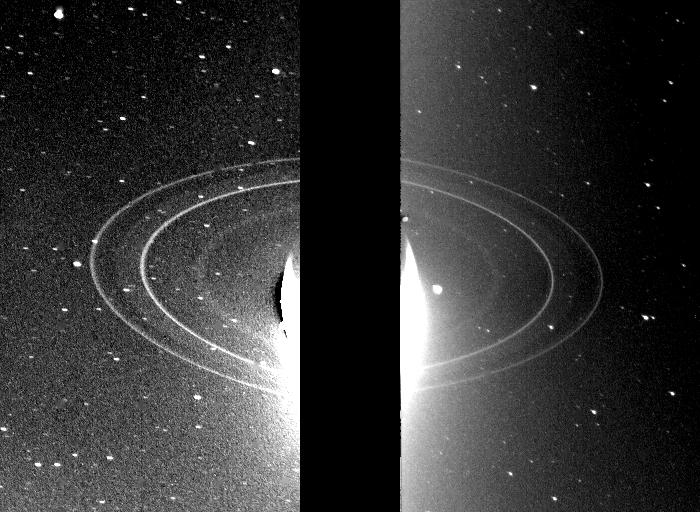
I close today our week-long tour of Voyager-2’s fly-by of Uranus in January 1986 with three cool images, the two images of the planet itself above and a close-up of its rings. All three illustrate that though Voyager-2 gave us our first very good first close-up view of this distant world, it also gave us only a tiny glimpse, very superficial and lacking in any larger context.

The two images above were taken on January 17, 1986 when Voyager 2 was till 5.7 million miles away, on approach.

The picture at left has been processed to show Uranus as human eyes would see it from the vantage point of the spacecraft. The picture is a composite of images taken through blue, green and orange filters. The darker shadings at the upper right of the disk correspond to the day-night boundary on the planet. Beyond this boundary lies the hidden northern hemisphere of Uranus, which currently remains in total darkness as the planet rotates. The blue-green color results from the absorption of red light by methane gas in Uranus’ deep, cold and remarkably clear atmosphere.

The picture at right uses false color and extreme contrast enhancement to bring out subtle details in the polar region of Uranus. Images obtained through ultraviolet, violet and orange filters were respectively converted to the same blue, green and red colors used to produce the picture at left. The very slight contrasts visible in true color are greatly exaggerated here. In this false-color picture, Uranus reveals a dark polar hood surrounded by a series of progressively lighter concentric bands. One possible explanation is that a brownish haze or smog, concentrated over the pole, is arranged into bands by zonal motions of the upper atmosphere. The bright orange and yellow strip at the lower edge of the planet’s limb is an artifact of the image enhancement. In fact, the limb is dark and uniform in color around the planet.

The third cool image below of Uranus’s rings was taken just after the closest approach, when Voyager-2 was in Uranus’s shadow and looking back at its rings from a distance of 142,000 miles.
» Read more

2 comments

Ursa Major test flies a new liquid-fueled missile engine for Air Force

Ursa Major's Draper engine being tested in flight

The rocket engine startup Ursa Major last week announced it had successfully completed for the Air Force a test missile launch of its new Draper liquid-fueled rocket engine.

As shown on the right, the Air Force’s Affordable Rapid Missile Demonstrator (ARMD) suborbital rocket was used to fly the engine. More information here.

On January 27, 2026, AFRL and Ursa Major launched the Draper liquid rocket engine on a demonstrator flight. While many details remain classified, the company says the test vehicle reached supersonic speeds during its flight. The test marked a transition from ground-based validation to in-flight evaluation, allowing engineers to study propellant stability, engine throttling performance, and how the system behaves under real flight conditions.

The Draper engine is designed to address key limitations of current hypersonic systems by making them cheaper, more scalable, and easier to operate. It runs on hydrogen peroxide and kerosene, fuels that are safer to store and handle compared to traditional alternatives.

The War Department’s hypersonic testing program has certainly heated up since the military switched to the capitalism model in the past five years. Beforehand, when the military tried to do its own testing, it took it years to get little done, while spending a fortune. Now it is flying suborbital rocket tests with Rocket Lab, Stratolaunch, and Firefly. It is testing new engines on flights such as Ursa’s above. And it testing hypersonic avionics on Varda’s orbiting capsules upon their return to Earth. Based on this commercial activity, it appears the U.S. military might get some real hypersonic capabilities in the very near future.

0 comments

Genesis cover

On Christmas Eve 1968 three Americans became the first humans to visit another world. What they did to celebrate was unexpected and profound, and will be remembered throughout all human history. Genesis: the Story of Apollo 8, Robert Zimmerman's classic history of humanity's first journey to another world, tells that story, and it is now available as both an ebook and an audiobook, both with a foreword by Valerie Anders and a new introduction by Robert Zimmerman.

The print edition can be purchased at Amazon or any other book seller. If you want an autographed copy the price is $60 for the hardback and $45 for the paperback, plus $8 shipping for each. Go here for purchasing details. The ebook is available everywhere for $5.99 (before discount) at amazon, or direct from my ebook publisher, ebookit. If you buy it from ebookit you don't support the big tech companies and the author gets a bigger cut much sooner.


The audiobook is also available at all these vendors, and is also free with a 30-day trial membership to Audible.
 

"Not simply about one mission, [Genesis] is also the history of America's quest for the moon... Zimmerman has done a masterful job of tying disparate events together into a solid account of one of America's greatest human triumphs."--San Antonio Express-News

Kratos wins $446 million contract to build/operate ground system for Space Force satellite constellation

The military contractor Kratos Defense & Security Solutions was yesterday awarded a $446 million contract by the Space Force to build and operate the ground systems used to control the military’s missile warning satellite constellation.

The contract covers ground management and integration for the service’s Resilient Missile Warning and Tracking program, according to a March 19 statement from Space Systems Command. Kratos will provide the systems used to operate the satellites after launch, including sending commands, receiving sensor data and processing that information for delivery to military operators.

The work supports a constellation being deployed in phases. The first 12 satellites, known as Epoch 1, are being built by Millennium Space Systems, a Boeing subsidiary. A second set of 10 satellites, called Epoch 2, is under contract to BAE Systems. Launches are expected over the next several years.

The method in which this entire constellation is being built and operated once again highlights the profound transformation that has occurred in how the Pentagon works in space since the formation of the Space Force. Beforehand, when the Air Force ran the military’s space operations, it would attempt to design and build everything, and the satellites built would be big and expensive, and take years to complete. Generally, little got built for a lot of money. Moreover, the upper management of the Air Force was in general not interested in space projects, and often gave these projects lower priority.

The Space Force was created during Trump’s first term to change this, giving the military an agency focused on its space needs. It was also designed to put those in charge who had been advocating going from these big gold-plated satellites that were few in number to many small satellites built quickly and cheaply by the private sector.

This new missile warning and tracking constellation demonstrates that this transition is largely complete. It is being built quickly by two different satellite companies, and will be maintained on the ground by a third.

Note: Kratos also builds the hypersonic test vehicles that Rocket Lab launches on its HASTE suborbital rocket. It will soon also fly those vehicles on a Firefly rocket.

1 comment

India’s second spaceport to be completed next year

The existing and proposed spaceports in India

According to officials in India, the nation’s second spaceport at Kulasekarapattinam is on schedule to be completed by next year, when it will become available for polar launches of the SSLV rocket as well as other commercial rocket launches.

India is moving ahead with plans to operationalise a new launch facility at Kulasekarapattinam in Tamil Nadu. It is expected to be commissioned during the 2026–27 financial year, according to information shared in the Lok Sabha by Jitendra Singh.

The new facility, officially called the Small Satellite Launch Vehicle (SSLV) Launch Complex, is being developed as the country’s second space launch site. The Kulasekarapattinam complex will primarily handle launches of SSLV missions to Sun-synchronous Polar Orbit, a trajectory widely used for Earth observation satellites.

The SSLV rocket is at present controlled by India’s space agency ISRO, though there has been an effort by the Modi government to transfer it to the private sector. It is not clear whether that effort has been successful. ISRO and India’s large space bureaucracy has been resistant. There have also been indications that this new spaceport will be made available to the handful of Indian rocket startups that are developing their own rockets.

The Sriharikota spaceport is ISRO’s main launch site. The Hope Island site is a proposed commercial and private spaceport, whose future remains very uncertain.

0 comments

Conscious Choice cover

Now available in hardback and paperback as well as ebook!

From the press release: In this ground-breaking new history of early America, historian Robert Zimmerman not only exposes the lie behind The New York Times 1619 Project that falsely claims slavery is central to the history of the United States, he also provides profound lessons about the nature of human societies, lessons important for Americans today as well as for all future settlers on Mars and elsewhere in space.

 
Conscious Choice: The origins of slavery in America and why it matters today and for our future in outer space, is a riveting page-turning story that documents how slavery slowly became pervasive in the southern British colonies of North America, colonies founded by a people and culture that not only did not allow slavery but in every way were hostile to the practice.  
Conscious Choice does more however. In telling the tragic history of the Virginia colony and the rise of slavery there, Zimmerman lays out the proper path for creating healthy societies in places like the Moon and Mars.


“Zimmerman’s ground-breaking history provides every future generation the basic framework for establishing new societies on other worlds. We would be wise to heed what he says.” —Robert Zubrin, founder of the Mars Society.


All editions are available at Amazon, Barnes & Noble, and all book vendors, with the ebook priced at $5.99 before discount. All editions can also be purchased direct from the ebook publisher, ebookit, in which case you don't support the big tech companies and the author gets a bigger cut much sooner.


Autographed printed copies are also available at discount directly from the author (hardback $29.95; paperback $14.95; Shipping cost for either: $6.00). Just send an email to zimmerman @ nasw dot org.

ESA to rent SpaceX Dragon capsule to do a European manned mission to ISS

ESA logo

Capitalism in space: At a European Space Agency (ESA) this week in Switzerland, agency officials announced that it is purchasing use of a Dragon capsule from SpaceX in order to do an extended manned mission to ISS in 2028.

Member states endorsed the concept of EPIC — short for ESA Provided Institutional Crew — a proposed mission intended to provide a medium-duration stay for ESA astronauts aboard the ISS.

The plan foresees acquiring a Crew Dragon mission in the first quarter of 2028 in collaboration with “interested international partners.” Crew Dragon is the crew spacecraft built by US company SpaceX.

According to those officials, this mission will be for at least one month, and include astronauts from ESA and some as yet undetermined international partner astronauts.

This contract illustrates the fundamental shift in power and control in manned space in the past decade. Until 2011, all manned missions were flown on government-built rockets and spacecraft. The agencies controlled everything, and actually acted to stymie competition from the private sector.

Now, those agencies are dependent on that private sector for their manned missions. They are instead merely customers, buying services from competing commercial companies that own the rockets and spacecraft, and rent them out for profit. That SpaceX at present is the only one capable of doing these manned missions for hire makes no different. Soon others will enter the fray.

Moreover, this capitalism model actually gives these agencies more flexibility. Beforehand, ESA had to go through NASA to do such a manned mission, and that would involve a lot of negotiations. Now it simply buys the mission from SpaceX, and flies it when ready.

7 comments

SLS/Orion have begun 12-hour trip from VAB to launchpad

Artemis-2 mission flight path
The Artemis-2 flight path. Click for full animation.

NASA engineers today began the long and slow 12-hour trip of the SLS rocket from the Vehicle Assembly Building (VAB) to the launchpad in preparation for a targeted April 1, 2026 launch date of this Artemis-2 mission around the Moon.

NASA’s Artemis II SLS (Space Launch System) rocket and Orion spacecraft slated to send four astronauts around the Moon began rolling to Launch Pad 39B at 12:20 a.m. EDT on Friday, March 20. Rollout operations at the agency’s Kennedy Space Center in Florida were delayed earlier in the day due to high winds in the area.

The trek to the pad is expected to take up to 12 hours, as NASA’s crawler-transporter 2 carefully carries the rocket on top of the mobile launcher approximately 4 miles along the crawlerway.

The launch will send four astronauts on a ten-day mission swinging around the Moon and back to Earth, using a questionable heat shield and a life support system not yet been tested in space. On the first unmanned Artemis-1 mission around the Moon in 2022, the shield experienced far more damage than predicted, with large chunks breaking off. NASA engineers think they understand why this happened, and have decided that they can mitigate the problem by using a less stressful flight path upon return into Earth’s atmosphere.

They don’t really know if this is so, but they hope so. As for the life support system, the plan is to remain in a high Earth orbit for the mission’s first day to test it. If it has problems then, the crew will be able to return to Earth somewhat quickly. If it has problems after heading to the Moon, however, that won’t be possible.

If a private company tried to convince NASA to do this mission with these issues, the agency would say “Hell no!” It is proceeding because, like the Challenger and Columbia failures, it is a NASA-built project and politics and schedule have superseded safety and good engineering procedures

3 comments

Leaving Earth cover

Leaving Earth: Space Stations, Rival Superpowers, and the Quest for Interplanetary Travel, can be purchased as an ebook everywhere for only $3.99 (before discount) at amazon, Barnes & Noble, all ebook vendors, or direct from my ebook publisher, ebookit.

If you buy it from ebookit you don't support the big oppressive tech companies and I get a bigger cut much sooner.


Winner of the 2003 Eugene M. Emme Award of the American Astronautical Society.

 
"Leaving Earth is one of the best and certainly the most comprehensive summary of our drive into space that I have ever read. It will be invaluable to future scholars because it will tell them how the next chapter of human history opened." -- Arthur C. Clarke

Engineers regain contact with Proba-3’s Coronagraph probe

The Proba-3 mission
The Proba-3 mission. Click for original.

A month after all contact was lost with the Coronagraph probe of Europe’s two-spacecraft Proba-3 solar observatory, engineers have regained contact with it this week, and have been able to place it in safe mode in preparation for re-establishing science operations.

After more than a month of silence, ESA’s ground station in Villafranca, Spain, received telemetry from the Coronagraph spacecraft. Telemetry is a package of data sent by a spacecraft including information on its temperature, voltages, and health of onboard systems.

The Coronagraph is now in safe mode and stable, and the mission team and operators are running health checks on the spacecraft to understand if any parts of it have been damaged.

The spacecraft’s solar panel is facing the Sun, powering the essential electronics on board, and charging the battery with the remaining power.

Before it can resume observations engineers need to get the spacecraft back up to operating temperature after a month without power.

As shown in the graphic to the right, the Coronograph satellite is the heart of this mission. It records the data, available because the Occulter blocks the Sun from view so that the corona, the Sun’s atmosphere, can be seen. It is almost a miracle that it has survived that month, and can soon resume observations.

1 comment

Blue Origin files FCC application for its own 51,600 data center satellite constellation

Blue Origin yesterday filed with the Federal Communications Commission (FCC) an application to launch 51,600 satellites, dubbed Project Sunrise, aimed at creating its own data center constellation in orbit.

The proposed constellation includes up to 51,600 satellites operating in sun-synchronous orbits at altitudes ranging from 500 to 1,800 kilometers. To manage data traffic, the system will primarily use optical links and mesh backhaul networks, supplemented by Ka-band spectrum for telemetry, tracking, and command operations. The spacecraft will utilize multiple antenna variations to maintain efficient coverage across various orbital planes.

You can read the full application here [pdf].

Jeff Bezos
Jeff Bezos, maybe the world’s leader in chutzpah.

Blue Origin also requests several waivers from the FCC’s normal new satellite license requirements, including what I think is a request to waive the FCC’s normal requirement that the applicant launch half its constellation within six years of license approval and complete the constellation three years later. Failure to do so results in financial penalties. The rules were created to prevent companies from getting licenses to grab spectrum from competitors with no intent to launch.

That this Jeff Bezos company is requesting this waiver is what in Yiddish is called chutzpah! Bezos’ other company, Amazon, is clearly going to fail to meet its own license timetable in launching its Leo internet constellation, and was recently lambasted by FCC chairman Brenden Carr for doing so. For Blue Origin to now request this waiver truly is an example of unbelievable gall. I can’t imagine the FCC will do so.

Either way, the competition to put up a lot of satellites continues to grow, with SpaceX and Blue Origin in the best position to make their constellations profitable, because both have their own launch vehicles.

0 comments

March 19, 2026 Quick space links

Courtesy of BtB’s stringer Jay. This post is also an open thread. I welcome my readers to post any comments or additional links relating to any space issues, even if unrelated to the links below.

7 comments

SpaceX completes a Starlink launch

UPDATE: It appears The Russian launch described below did not occur as indicated by the story I linked to. There is no confirmation anywhere on the web that the launch occurred. If it had, the nature of the payload would have guaranteed some story in Russia’s state-run press. See also this X post, which suggests the lack of information about the scrub is related to Russian concerns about Ukrainian drone attacks.

Original post
———————-
There were two launches today, both of which sent up a cluster of satellites for broadband internet constellations.

First, Russia launched the first 16 satellites in its proposed 700+ satellite Russvet internet constellation, its Soyuz-2 rocket lifting off from its Plesetsk spaceport in northeast Russia. The satellites are built by the Russian company Bureau-1440, which hopes to have the entire constellation in orbit by 2035. Considering that this constellation is designed to compete with Starlink, its pace of launch is ridiculously low. SpaceX can generally launch 700 Starlink satellites in about a month, not ten years. By the time Russia gets this constellation in orbit it will be woefully obsolete.

SpaceX meanwhile proved this point today by continuing its brisk pace in Starlink launches. It successfully placed 29 more Starlink satellites in orbit, its Falcon 9 rocket lifting off from Cape Canaveral Space Force Station in Florida.

The first stage (B1077) completed its 27th flight, landing on a drone ship in the Atlantic, only 26 days after its previous flight. This flight also moved the booster up to just behind the space shuttle Columbia in the rankings of the most reused launch vehicles:

39 Discovery space shuttle
33 Atlantis space shuttle
33 Falcon 9 booster B1067
32 Falcon 9 booster B1071
31 Falcon 9 booster B1063
30 Falcon 9 booster B1069
28 Columbia space shuttle
27 Falcon 9 booster B1077

Sources here and here.

The leaders in the 2026 launch race:

35 SpaceX
12 China
3 Rocket Lab
2 Russia (corrected)

SpaceX continues to lead the entire world combined in total launches, as it did in both ’24 and ’25.

5 comments

Scientists compile catalog of the 69 known rocky exoplanets in the habitable zone

Graph of the 45 most habitable known exoplanets
Credit: Gillis Lowry / Pablo Carlos Budassi.
Click for original at full resolution.

Scientists reviewing the more than 6,000 exoplanets so far discovered have now compiled a detailed catalog describing the 69 known rocky exoplanets that are also in the habitable zone.

The graph to the right, cropped and reduced to post here, shows the 45 exoplanets most likely to be habitable, with the amount of energy they get from their star measured relative to that of Earth and the Sun (shown center top). You can read their paper here. From the press release:

The researchers pinpointed 45 rocky worlds that may support life in the habitable zone, and another 24 in a narrower 3D habitable zone that makes a more conservative assumption of how much heat a planet can take before it loses its habitability.

They include some famous exoplanets, including Proxima Centauri b, TRAPPIST-1f and Kepler 186f, as well as others that are not as well known, such as TOI-715 b. The most interesting planets of those listed, according to the authors, are TRAPPIST-1 d, e, f and g, which are 40 light-years from Earth, as well as LHS 1140 b, which is 48 light-years away. Whether these planets could have liquid water depends in part if they can hold an atmosphere.

The worlds that get light from their stars most similar to what modern Earth receives from the Sun are the transiting planets TRAPPIST-1 e, TOI-715 b, Kepler-1652 b, Kepler-442 b, Kepler-1544 b and the planets Proxima Centauri b, GJ 1061 d, GJ 1002 b, and Wolf 1069 b, which make their stars wobble.

The paper includes tables listing the best exoplanets that do transits of their stars, the best with the oldest estimated ages, and the best for testing the limits of the habitable zone itself. As the researchers say in their abstract:

The resulting list of rocky exoplanet targets in the HZ will allow observers to shape and optimize search strategies with space- and ground-based telescopes – such as the James Webb Space Telescope (JWST), Extremely Large Telescope (ELT), Habitable Worlds Observatory (HWO), and Large Interferometer For Exoplanets (LIFE) – and design new observing strategies and instruments to explore these worlds, addressing the question of the limits of exoplanet surface habitability.

In other words, the focus of exoplanet research is now shifting from simply finding these planets to studying them directly, with the potentially habitable worlds listed above the most interesting of all. Astronomers might not find alien life or civilizations on these worlds, but at a minimum they will be doing the first preliminary scouting for humanity’s the first interstellar missions, with the Trappist-1 solar system appearing to head the list.

2 comments
1 32 33 34 35 36 2,927