Today’s blacklisted American: Students condemn UConn student president for defending free speech

The cancelled Bill of Rights

They’re coming for you next: The Undergraduate Student Government (USG) Governing Board at the University of Connecticut has condemned its student president, Mike Hernández, because he is supporting campus legislation that would protect the free speech rights of students.

The bill, which was introduced by sixth semester junior political science and economics double major Isadore Johnson, aims to protect students and their right to freely express their opinions within student government and also at UConn as a whole.

Opponents of the bill, however, have argued the legislation gives students a free pass to express casual racism, homophobia and misogyny without consequence, and have expressed concern over Hernández’s support of the bill.

The board is using as its trigger to condemn Hernández a single comment he supposedly made privately to another student, where he allegedly said that affirmative action legislation as well as rules forbidding anyone from saying anything offensive about minorities is equivalent “to treating minorities like children.” From that board’s statement, which was approved by this board by a vote of 8-1, with one abstention:
» Read more

14 comments

Russia: Air leaks fixed on Zvezda

According to the Russian state-run press, Russian astronauts have completed their repair work on the ISS module Zvezda and are about to seal the module to test their work.

“The crew of the International Space Station has completed the repair and recovery work on the hull of the Zvezda module. In the coming days, Sergei Ryzhikov and Sergei Kud-Sverchkov will close the hatches in the Zvezda module to check the atmospheric level,” the press office said.

Previous reports suggested the astronauts had located a total of two cracks, both now sealed.

The larger question however remains. Are the cracks stress fractures, and if so do they suggest that Zvezda’s 20-year-old hull is beginning to fail? The Russians have been very silent about these questions, though they have admitted the possibility once or twice, almost as an aside.

Nor has NASA been forthcoming. The American space agency has apparently joined the Russians in keeping this problem out of the news, at all costs. Once, the employees at NASA were Americans who demanded openness from Russia and from themselves. No more. Increasingly our government workers are indistinguishable from Soviet apparatchiks, whose main goal was to protect the government from bad press.

If Zvezda’s hull is failing then ISS faces some very serious engineering issues. They can be solved, but not by silence and sticking one’s head in the sand.

5 comments

Genesis cover

On Christmas Eve 1968 three Americans became the first humans to visit another world. What they did to celebrate was unexpected and profound, and will be remembered throughout all human history. Genesis: the Story of Apollo 8, Robert Zimmerman's classic history of humanity's first journey to another world, tells that story, and it is now available as both an ebook and an audiobook, both with a foreword by Valerie Anders and a new introduction by Robert Zimmerman.

The print edition can be purchased at Amazon or any other book seller. If you want an autographed copy the price is $60 for the hardback and $45 for the paperback, plus $8 shipping for each. Go here for purchasing details. The ebook is available everywhere for $5.99 (before discount) at amazon, or direct from my ebook publisher, ebookit. If you buy it from ebookit you don't support the big tech companies and the author gets a bigger cut much sooner.


The audiobook is also available at all these vendors, and is also free with a 30-day trial membership to Audible.
 

"Not simply about one mission, [Genesis] is also the history of America's quest for the moon... Zimmerman has done a masterful job of tying disparate events together into a solid account of one of America's greatest human triumphs."--San Antonio Express-News

Hubble about to resume science operations even with new issues

Engineers have fixed the computer software issue that caused the Hubble Space Telescope to go into safe mode this week, and are preparing it to return to full science operations.

It appears the problem was caused by a software upgrade that caused a conflict.

More serious however was this problem, which could have damaged the telescope beyond repair had it had been randomly pointed at the Sun during safe mode.

In entering safe mode on Sunday, however, the team discovered that the aperture door located at the top of the telescope failed to automatically close. This door is a safeguard designed to keep the Sun’s damaging light and heat out of the telescope’s interior, protecting its sensitive instruments and their surroundings. It serves as a safety net if Hubble accidently points in the direction of the Sun due to an error or hardware problem.

…The team has looked at spacecraft engineering data, run various tests, and verified that the door did indeed remain open despite the commands and power being sent to close it. Additional attempts to move the door by sending commands from the ground to its primary motor also failed to make the door move. However, the same commands sent from the ground to its backup motor did indicate movement, and that motor is now set as the primary motor. The team is looking at options to further reduce any associated risk.

It appears the primary motor that moves the door has failed. Fortunately there is a backup motor, but this is just one more item where the telescope has lost redundancy. We are very lucky that during safe mode the telescope didn’t end up pointing at the Sun, even for a very short time, for that would have ended Hubble’s operation for good. I suspect the safe mode software includes protections against that occurrence, but the possibility nonetheless existed.

3 comments

Military band joke

An evening pause: One marching band from Britain is performing to an Italian audience when a band representing the Italian Bersaglieri (mobile light infantry who traditionally run at a trot instead of march) arrives to upstage them.

Silly and staged, but fun nonetheless.

Hat tip Jim Mallamace.

4 comments

Conscious Choice cover

Now available in hardback and paperback as well as ebook!

From the press release: In this ground-breaking new history of early America, historian Robert Zimmerman not only exposes the lie behind The New York Times 1619 Project that falsely claims slavery is central to the history of the United States, he also provides profound lessons about the nature of human societies, lessons important for Americans today as well as for all future settlers on Mars and elsewhere in space.

 
Conscious Choice: The origins of slavery in America and why it matters today and for our future in outer space, is a riveting page-turning story that documents how slavery slowly became pervasive in the southern British colonies of North America, colonies founded by a people and culture that not only did not allow slavery but in every way were hostile to the practice.  
Conscious Choice does more however. In telling the tragic history of the Virginia colony and the rise of slavery there, Zimmerman lays out the proper path for creating healthy societies in places like the Moon and Mars.


“Zimmerman’s ground-breaking history provides every future generation the basic framework for establishing new societies on other worlds. We would be wise to heed what he says.” —Robert Zubrin, founder of the Mars Society.


All editions are available at Amazon, Barnes & Noble, and all book vendors, with the ebook priced at $5.99 before discount. All editions can also be purchased direct from the ebook publisher, ebookit, in which case you don't support the big tech companies and the author gets a bigger cut much sooner.


Autographed printed copies are also available at discount directly from the author (hardback $29.95; paperback $14.95; Shipping cost for either: $6.00). Just send an email to zimmerman @ nasw dot org.

China successfully launches new Long March 7A rocket

The new colonial movement: China today successfully launched for the first time its new Long March 7A rocket, likely designed to replace its Long March 3B.

The Long March 7A is a 60.1-meter-long, 3.35-meter-diameter kerosene and liquid oxygen launch vehicle with four side boosters, capable of delivering up to 7 metric tons of payload to GTO [geosychronoous transfer orbit]. The launcher draws on new kerosene engine technologies along with a stage modified from the older Long March 3B series, China’s current workhorse rocket, boosting China’s launch options to GTO.

The Long March 7A is more capable than the Long March 3B, which can launch 5.5 tons to GTO. By launching from the coast, it also does not incur the cost and hazards of the inland 3B launches. [China] plans to carry out 3-5 Long March 7A launches a year by 2025. The first launch of the Long March 7A failed in March 2020. A loss of pressure occurred after first stage separation, which led to engine malfunction.

The 2021 launch race:

7 SpaceX
5 China
3 Russia
1 Rocket Lab
1 Virgin Orbit
1 Northrop Grumman
1 India

The U.S. still leads China 10 to 5 in the national rankings.

4 comments

Today’s blacklisted Americans: South Alabama University suspends 3 professors for 2014 Halloween costumes

The cancelled Bill of Rights

They’re coming for you next: The University of South Alabama this month suspended three professors for wearing Halloween costumes back in 2014, seven years ago.

The photos show “then-Mitchell College of Business dean Bob Wood dressed as a Confederate general and professors Alex Sharland and Teresa Weldy posing with a whip and a noose,” WKRG5 reports.

The three teach in the university’s Mitchell College of Business. Wood and Sharland, who have tenure, have apologized, while Weldy, who is not tenured, “chose not to apologize,” the news station reports.

University brass is reportedly taking heat from the campus community for being aware of the photos since 2020 but not doing more about it. With that, [university President Tony] Waldrop upped his efforts on the nearly 7-year-old matter, calling the costumes and poses “offensive” and “contrary to our core principles of diversity and inclusion.” He pledged in his statement that the university will “address this situation in a manner that demonstrates our unwavering commitment to diversity, inclusion, and a safe and welcoming environment for every member of our community.” [emphasis mine]

» Read more

14 comments

Leaving Earth cover

Leaving Earth: Space Stations, Rival Superpowers, and the Quest for Interplanetary Travel, can be purchased as an ebook everywhere for only $3.99 (before discount) at amazon, Barnes & Noble, all ebook vendors, or direct from my ebook publisher, ebookit.

If you buy it from ebookit you don't support the big oppressive tech companies and I get a bigger cut much sooner.


Winner of the 2003 Eugene M. Emme Award of the American Astronautical Society.

 
"Leaving Earth is one of the best and certainly the most comprehensive summary of our drive into space that I have ever read. It will be invaluable to future scholars because it will tell them how the next chapter of human history opened." -- Arthur C. Clarke

Curiosity faces the mountains

A cropped section from Perseverance's 1st panorama
A cropped section from Perserverance’s 1st panorama.
Click for full image.

Though the present excitement over the spectacular images and sounds coming down from Perseverance is certainly warranted, what must be understood is that this rover is presently only at the beginning of its journey, and is thus sitting on relatively boring terrain, from a merely visual perspective. The scientists might be excited, but to the general public, all we really are seeing is a flat dusty desert with some scattered rocks on the floor. In the far distance can be seen some hills and mountains (Jezero Crater’s rim), but they are very far away.

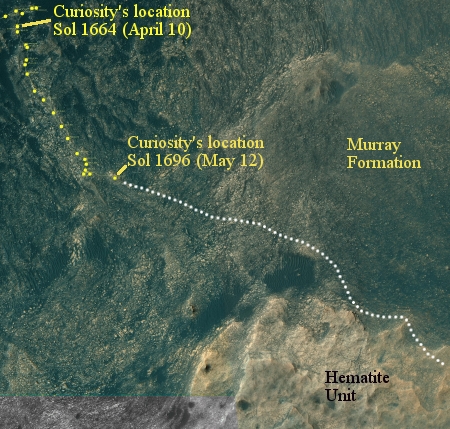
Curiosity, which the press and the public has largely forgotten about, is actually just beginning what will likely be the most breath-taking part of its journey. As I noted in my last rover update last week, Curiosity is now at the very base of Mount Sharp, and is about to enter the mountain’s canyons and initial slopes. For its past eight-plus years of roving it has been on the flat floor of Gale Crater, followed by some weaving among the smallest foothills of Mount Sharp. The views have been intriguing and exciting from a research perspective, but hardly breath-taking from a picture-taking point of view.

That is now changing. The picture below, taken by Curiosity just this week, gives us a taste of what is to come.
» Read more

11 comments

Space Force awards launch contracts (two each) to ULA and SpaceX

Capitalism in space: On March 9th the Space Force announced that it has awarded four new launch contracts, two each to ULA and SpaceX, for a total cost of just under $400 million, all to launch in ’23.

Under the task orders issued March 9, ULA and SpaceX will each launch two missions. ULA was awarded $225 million to launch and integrate the USSF-112 and USSF-87 missions on its Vulcan Centaur rockets while SpaceX was awarded $160 million to launch and integrate USSF-36 and launch NROL-69 on its Falcon 9 rockets.

Based on these numbers it appears ULA is charging about $113 million per launch for its new Vulcan Centaur rocket, while SpaceX is charging about $80 million using its Falcon 9.

For ULA, that is less that what it would charge using its Atlas 5 rocket, but not by much. For SpaceX this price is high, probably because the military might be demanding the company use new boosters for its launches.

These high prices for both are to me a sign of how little our federal government cares about saving any money for the taxpayer. While the competition brought on by SpaceX’s arrival is saving the military money, the way these contract awards are structured, with both ULA and SpaceX guaranteed to win them, neither company has an incentive to reduce its prices. Instead, they can overcharge and the military can do nothing about it.

In a more sane world the military would use the competition in the launch market to get an ever better deal. Instead, our federal government sees its budget as a blank check, and they are using it.

10 comments

MEV-2 about to dock with communications satellite to extend its life

Capitalism in space: Northrop Grumman’s second Mission Extension Vehicle (MEV-2) is presently doing the last rendezvous maneuvers in the vicinity of one of Intelsat’s operating geosynchronous communications satellites in anticipation to its docking, when it will extend that satellite’s life by up to five years.

This is the second MEV to fly. The first successfully docked with a defunct 19-year-old satellite and brought it back into operation.

Meanwhile, in the Ukraine a new startup is proposing to use an upgrade of the automatic rendezvous and docking system once used by Progress and Soyuz capsules to create its own variation of MEV.

Kurs Orbital is raising $6.5 million in its first investment round this summer to start the demonstration vehicle that will rendezvous with an uncooperative object in low Earth orbit, he said. “I think that we will be on schedule for 2023 with a demonstration mission.”

The company plans to raise more money over the next few years to build a fleet of four vehicles to start offering de-orbiting services by 2025. Usov said de-orbiting is the low hanging fruit because it is a way to immediately help satellite operators make money.

Operators currently take geostationary satellites out of service to a graveyard orbit six to eight months before they are out of fuel. De-orbiting services would allow operators to keep the satellites in operation for several additional months and continue to generate revenues, Usov said. Those extra revenues would more than pay for the $10 million to $15 million de-orbiting service.

If successful, this company will be the third attempting to enter the robotic satellite serving business, with a number of others also aiming to make money removing space junk.

1 comment

A proposal to rebuild Arecibo as a better radio telescope

Even as the National Science Foundation (NSF) proceeds with the disassembly of the destroyed Arecibo radio telescope in Puerto Rico, some astronomers are proposing that a new radio telescope be built in its place, with a new design that will not require the instrument platform floating above a single dish.

Here’s the idea as outlined in a white paper circulated by Roshi and his colleagues: The Next Generation Arecibo Telescope would pack hundreds, maybe even more than 1,000 smaller radio dishes into the same space now occupied by the single 305-meter dish. Those smaller antennas would combine forces to act like a single larger telescope (no suspended instrument platform required).

Ideally, those dishes would be on a single, tiltable platform to access more of the sky from the Arecibo site; it’s possible multiple platforms could do the same.

The revamped telescope would have twice the sky coverage of the legacy dish, 500 times the field of view in individual images, at least double the sensitivity, and five times the radar power.

The cost for this new radio telescope is presently estimated to be about half a billion. Considering that the NSF didn’t have the money to operate the old Arecibo telescope, which was why it wasn’t properly maintained and collapsed, I doubt it has the cash to build this replacement. Congress, which likes printing money it doesn’t have, might step in and fund it, but if so that will only add to the national debt that is certainly going to cause the bankruptcy of the nation at some point in the future, a point that is getting closer and closer with each new trillion that Congress nonchalantly spends, on almost a monthly schedule.

4 comments

NASA sets March 18th for next SLS static fire test

NASA has now scheduled the next static fire test of the core stage of its SLS rocket for March 18th.

The background:

NASA attempted the hot fire test on January 16, but computers terminated the test after 67 seconds instead of 485 seconds because of the conservative test parameters that were set. This is not a test vehicle, but the actual core stage that will be used for the first SLS launch. NASA needs to ensure the testing does not damage it.

NASA decided to redo the test and scheduled it for February 25, but a problem with a pre-valve forced another delay.

If this March test is successful, it will take a month to prep the core stage for shipment by barge to Florida, where it will take several months to prep it for launch linked to its two solid rocket boosters now stacked and ready for launch. If that schedule moves fast, NASA is still aiming for a late ’21 launch, though most industry experts expect that date to shift into early ’22.

If the March test has any problems however this schedule goes out the window. Worse, it increases the chance that the two boosters will have reached the end of their 12-month use-by date (approximately December ’21), and will have to be dissembled and inspected. If that happens the launch will certainly be delayed by many months.

There is another possibility. NASA might waive that 12-month use-by date requirement for the boosters. If the agency does this, however, it will be another example of the same management mistakes that caused both the Challenger and Columbia shuttle failures, a desire to put aside proper engineering to meet a schedule.

One more thought: That it takes about four months to assemble the solid rocket boosters for SLS illustrates well the cumbersome and inefficient nature of this rocket. Launches not only cannot happen within days, they really cannot happen for months. Depending on such a rocket with such a low launch cadence will make the exploration of the solar system practically impossible.

3 comments

SpaceX successfully launches 60 more Starlink satellites

Capitalism in space: SpaceX last night successfully launched another sixty Starlink satellites, raising the total launched to 1,265, with more than a thousand operating.

The company also landed the Falcon 9’s first stage for the sixth time while reusing both fairings.

The 2021 launch race:

7 SpaceX
4 China
3 Russia
1 Rocket Lab
1 Virgin Orbit
1 Northrop Grumman
1 India

The U.S. now leads China 10 to 4 in the national rankings. In fact, SpaceX alone has as many launches as China and Russia combined.

0 comments
1 967 968 969 970 971 2,928