President of Cornell College Republican club attacked

Fascists: The president of the Cornell College Republican club was called a “racist bitch” and attacked the night after the presidential election.

Her description of the attack is strong evidence that she was attacked merely because she was a Republican and a supporter of Trump. Nor was this attack a one time event.

This incident also does not mark the first time she has been harassed for her Republican identity. “People yell in my face all the time. I get random messages telling me what I should and should not be doing on Facebook, in my email,” Corn told the Voice. “I’ve had a history of people not liking me so much.” She added that after she was quoted in a Cornell Daily Sun article in May saying she would vote for Donald Trump over Hillary Clinton, she received death threats.

I would also add that this story is typical today on most college campuses, especially the ivy league ones. The fascists now rule at these universities, will tolerate no opposition or dissent, and often enforce that rule with violence.

For further evidence, see this paper, which documents the dominance of the left within the field of social psychology. Since the 1960s the left has worked tirelessly to blackball conservatives from the field, and has succeeded remarkably, producing today a modern ratio of 14 liberals for every 1 conservative. The result has been a warped research field that can only see one perspective — a liberal one — in every research problem.

6 comments

Lunar lava tubes could be big

New research now suggests that the lava tubes on the Moon have the potential to be very large, much larger than found on Earth.

On Earth, such structures max out at around 30 meters across, but the gravitational data suggest that the moon’s tubes are vastly wider. Assessing the sturdiness of lava tubes under lunar gravity, planetary geophysicist Dave Blair of Purdue University in West Lafayette, Ind., and colleagues estimate that the caves could remain structurally sound up to 5 kilometers across. That’s wide enough to fit the Golden Gate Bridge, Brooklyn Bridge and London Bridge end to end.

This isn’t really news, merely a confirmation of what other scientists have been theorizing for decades. What it tells us again is that the first permanent and successful lunar colonies will almost certainly be located in such tubes, since they provide ready-made radiation shielding as well as protection from the wild swings of temperature seen on the lunar surface. In the lava tube, the temperature will likely remain quite stable, making environmental control a much simpler problem.

14 comments

Genesis cover

On Christmas Eve 1968 three Americans became the first humans to visit another world. What they did to celebrate was unexpected and profound, and will be remembered throughout all human history. Genesis: the Story of Apollo 8, Robert Zimmerman's classic history of humanity's first journey to another world, tells that story, and it is now available as both an ebook and an audiobook, both with a foreword by Valerie Anders and a new introduction by Robert Zimmerman.

The print edition can be purchased at Amazon or any other book seller. If you want an autographed copy the price is $60 for the hardback and $45 for the paperback, plus $8 shipping for each. Go here for purchasing details. The ebook is available everywhere for $5.99 (before discount) at amazon, or direct from my ebook publisher, ebookit. If you buy it from ebookit you don't support the big tech companies and the author gets a bigger cut much sooner.


The audiobook is also available at all these vendors, and is also free with a 30-day trial membership to Audible.
 

"Not simply about one mission, [Genesis] is also the history of America's quest for the moon... Zimmerman has done a masterful job of tying disparate events together into a solid account of one of America's greatest human triumphs."--San Antonio Express-News

Vector successfully test fires its rocket engine

The competition heats up: Vector Space Systems has announced the successful first test firing of the first stage engine to be used on its Vector-R rocket.

The engine test, which took place in Mojave, Calif. on Dec. 8, featured a single piece, 3D AM printed injector developed in partnership with NASA’s Science, Technology, and Mission Directorate (STMD) Flight Opportunities, a program which extends research labs into space-relevant environments by partnering with small satellite launch companies. Earlier this year, NASA provided a grant to Vector to design and test the injector.

Vector continues to push the envelope by being the first in the industry to pursue the LOX/Propylene propellant combination, which created the highest thrust to date from a LOX/Propylene fueled engine. This test of the 5K-lbf on flight fuels serves as a stepping stone to Vector’s first launch of the Vector-R slated for 2017, and moves the company one step closer to its mission of connecting space startups and innovators with affordable, reliable access to space.

They have also signed the land lease for the Tucson site where they plan to build their rocket factory.

1 comment

Judge: NASA cannot confiscate an Apollo 11 artifact that was sold by mistake

A federal judge has ruled that NASA has no right to confiscate an Apollo 11 lunar rock sample bag that had been purchased legally, even though the sale itself had been in error.

udge J. Thomas Marten ruled in the U.S. District Court for Kansas that Nancy Carlson of Inverness, Illinois, obtained the title to the historic artifact as “a good faith purchaser, in a sale conducted according to law.” The government had petitioned the court to reverse the sale and return the lunar sample bag to NASA. “She is entitled to possession of the bag,” Marten wrote in his order.

This court case will hopefully give some legal standing to the private owners of other artifacts or lunar samples that NASA had given away and then demanded their return, decades later.

10 comments

Conscious Choice cover

Now available in hardback and paperback as well as ebook!

From the press release: In this ground-breaking new history of early America, historian Robert Zimmerman not only exposes the lie behind The New York Times 1619 Project that falsely claims slavery is central to the history of the United States, he also provides profound lessons about the nature of human societies, lessons important for Americans today as well as for all future settlers on Mars and elsewhere in space.

 
Conscious Choice: The origins of slavery in America and why it matters today and for our future in outer space, is a riveting page-turning story that documents how slavery slowly became pervasive in the southern British colonies of North America, colonies founded by a people and culture that not only did not allow slavery but in every way were hostile to the practice.  
Conscious Choice does more however. In telling the tragic history of the Virginia colony and the rise of slavery there, Zimmerman lays out the proper path for creating healthy societies in places like the Moon and Mars.


“Zimmerman’s ground-breaking history provides every future generation the basic framework for establishing new societies on other worlds. We would be wise to heed what he says.” —Robert Zubrin, founder of the Mars Society.


All editions are available at Amazon, Barnes & Noble, and all book vendors, with the ebook priced at $5.99 before discount. All editions can also be purchased direct from the ebook publisher, ebookit, in which case you don't support the big tech companies and the author gets a bigger cut much sooner.


Autographed printed copies are also available at discount directly from the author (hardback $29.95; paperback $14.95; Shipping cost for either: $6.00). Just send an email to zimmerman @ nasw dot org.

Orbital ATK’s Pegasus launches successfully

Orbital ATK’s Pegasus rocket was successfully launched today from the bottom of its L-1011 airplane, placing in orbit a NASA constellation of eight smallsat satellites designed to study hurricanes.

he use of an eight-satellite constellation will allow for more frequent observations, allowing for a better characterization of the early stages in a cyclone’s formation and of the storm’s eventual decay. Once in orbit, the satellites will be spaced evenly around their orbital plane, achieving an angular separation of around 45 degrees from each other. The CYGNSS satellites were built by the Southwest Research Institute and the University of Michigan, while their deployer was developed by Sierra Nevada Corporation. Each satellite has a mass of 28.9 kilograms (63.7 lb), with an overall payload mass of 345.6 kilograms (761.8 lb) including the deployer. The CYGNSS mission is expected to last a minimum of two years.

This was the first Pegasus launch since 2013. I’m not sure why it has not been getting more business, but it does have another launch now scheduled for June.

1 comment

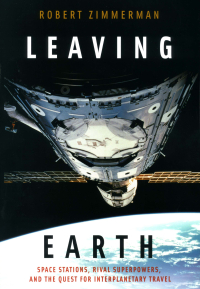
Leaving Earth cover

Leaving Earth: Space Stations, Rival Superpowers, and the Quest for Interplanetary Travel, can be purchased as an ebook everywhere for only $3.99 (before discount) at amazon, Barnes & Noble, all ebook vendors, or direct from my ebook publisher, ebookit.

If you buy it from ebookit you don't support the big oppressive tech companies and I get a bigger cut much sooner.


Winner of the 2003 Eugene M. Emme Award of the American Astronautical Society.

 
"Leaving Earth is one of the best and certainly the most comprehensive summary of our drive into space that I have ever read. It will be invaluable to future scholars because it will tell them how the next chapter of human history opened." -- Arthur C. Clarke

Flying over Occator Crater on Ceres

Cool movie time! Using data from Dawn the German Aerospace Center (DLR) has produced a short animation that gives a 3D flyover of Occator Crater on Ceres.

The animated flyover includes topographic and enhanced-color views of the crater, highlighting the central dome feature. The central area has been named Cerealia Facula. Occator’s secondary group of bright spots is called Vinalia Faculae.

The movie is definitely worth watching, especially the sections that show in close-up the bright areas near the crater’s center.

0 comments

Lots of ice on Ceres

New data from Dawn now suggests that Ceres contains a large amount of ice on or near its surface.

“On Ceres, ice is not just localized to a few craters. It’s everywhere, and nearer to the surface with higher latitudes,” said Thomas Prettyman, principal investigator of Dawn’s gamma ray and neutron detector (GRaND), based at the Planetary Science Institute, Tucson, Arizona. Researchers used the GRaND instrument to determine the concentrations of hydrogen, iron and potassium in the uppermost yard (or meter) of Ceres. GRaND measures the number and energy of gamma rays and neutrons coming from Ceres. Neutrons are produced as galactic cosmic rays interact with Ceres’ surface. Some neutrons get absorbed into the surface, while others escape. Since hydrogen slows down neutrons, it is associated with a fewer neutrons escaping. On Ceres, hydrogen is likely to be in the form of frozen water (which is made of two hydrogen atoms and one oxygen atom).

Rather than a solid ice layer, there is likely to be a porous mixture of rocky materials in which ice fills the pores, researchers found. The GRaND data show that the mixture is about 10 percent ice by weight.

6 comments

Back from Vandenberg

In my trip to Vandenberg Air Force Base yesterday to give a lecture to their local AIAA chapter, I got a quick drive around the southern parts of the base where the Atlas 5, Delta, and SpaceX launchpads are located. This is the same area I toured when I last visited the base back in March 2015.

I had been curious to see the fire damage from the fall wildfires. Unfortunately, a fog bank had rolled in and made it impossible to see the hills behind the launchpads where the fires had raged. I did see some fire damage within several hundred feet of a liquid nitrogen storage facility, but otherwise the clouds prevented me from seeing any of the wildfire damage.

The one item of interest that I did see was at the SpaceX launchpad. While we could not enter the facility, we could see in plain sight the first stage of the next planned Falcon 9 launch. They had hoped to lift off this week, but delayed the launch last week until January to complete the investigation into the September 1 launchpad explosion. Nonetheless, the first stage was there, lying horizontal out in the open air. Several nozzles were removed from the engine array at the stage’s base. Whether they were removed as part of the investigation, or as part of standard maintenance, I do not know.

3 comments

Obamacare subsidies to go up almost $10 billion next year

Finding out what’s in it: According to a new report, the Obamacare subsidies that are paid to large number of Americans so that they can afford the costly Obamacare health insurance policies will cost taxpayers almost $10 billion in 2017.

The new study estimates that the cost of premium subsidies under the Affordable Care Act will increase by $9.8billion next year, rising from $32.8billion currently to $42.6billion. The average monthly subsidy will increase by $76, or 26 per cent, from $291 currently to $367 in 2017, researchers found.

Currently more than eight in ten consumers buying private health insurance through HealthCare.gov and state markets receive tax credits from the government to help pay their premiums.

Not only can’t we can’t afford the Obamacare premiums, we can’t afford the subsidies either.

12 comments

NASA begs out of first SpaceX’s Mars mission

NASA has decided to hold off contributing any science instruments for SpaceX’s first Dragon mission to Mars.

NASA wants to wait until SpaceX proves it can pull off a soft landing on the Red Planet before committing millions of dollars’ worth of equipment to the spaceflight company’s “Red Dragon” effort, said Jim Green, head of the agency’s Planetary Science Division. “Landing on Mars is hard,” Green said during a talk Tuesday (Dec. 13) here at the annual fall meeting of the American Geophysical Union (AGU). “I want to wait this one out.”

15 comments

Rocket Lab rocket ready for first test flights

The competition heats up: Rocket Lab announced Monday that their new rocket, Electron, is on schedule for its first test flights early in 2017.

Launch startup Rocket Lab says it is ready to begin test flights of its Electron launch vehicle early next year, having concluded flight qualification and acceptance of the first stage booster.

Rocket Lab announced completion of these final milestones Dec. 12, saying in a press release that the company is waiting on international launch licensing before kicking off full vehicle testing. Spokesperson Catherine Moreau-Hammond told SpaceNews the company is imminently anticipating licenses from the U.S. and New Zealand — a requirement due to its status as a U.S. company launching out of New Zealand.

It appears right now that this company is in the lead to be the first smallsat rocket company in operation. I would guess that Vector Space Systems is second.

1 comment

Juno completes third Jupiter flyby

On December 11 Juno successfully completed its third close flyby of Jupiter.

They have released one quite spectacular image taken during the close approach. Expect more to follow soon.

Though they continue to say that they are still considering firing the spacecraft’s main engine to lower and shorten the orbit, I am getting the impression that they are increasingly leaning to leaving things as they are. While this longer orbit will produce larger gaps in their data of the gas giant’s atmosphere (53 days between close approaches versus 14 days), it will also allow them to tract changes over a much longer time period. Considering the risk of a catastrophic failure should they fire the questionable engine, this choice seems quite reasonable.

15 comments

In Santa Barbara

I am now in Santa Barbara, California. Tomorrow I drive up to Vandenberg Air Force to give a lecture for the local chapter of the AIAA. This is why posting today and tomorrow will be light. I might get some posts in later tonight, but don’t expect a lot. When I return I plan on an essay on the subject of squealing pigs.

I will let my readers guess as to the subject matter. I suspect many of you will be able to.

3 comments

Another Obamacare co-op shuts down

Finding out what’s in it: With Maryland’s Obamacare co-op closing on December 8, 20 of the original 24 Obamacare co-ops have gone out of business.

With the near-collapse of Maryland’s co-op — called Evergreen Health — at least 989,000 individuals nationwide have lost their health insurance coverage when the nonprofit co-ops stopped selling insurance to customers, according to TheDCNF’s tally. The losses cost taxpayers at least $2.2 billion in upfront federal loans awarded by the Obama administration to 24 nonprofit co-ops under Obamacare. The co-ops were intended to help keep health care costs down by providing non-profit competition with commercial for-profit insurers. The losses do not include statewide costs where the state or local governments were forced to cover doctor and hospital bills that the failed co-ops could not pay from remaining revenues.

In many cases, those losses were substantial. In New York alone, state taxpayers face at least $200 million in costs owed to medical providers that the bankrupt Health Republic co-op could not cover, according to the Albany Business Review.

The remaining four are all barely surviving, and will likely fail themselves in the next few years, even if the Republican leadership goes chicken and delays the repeal of Obamacare while they haggle over what to do to replace it. What they should do is repeal it outright, and let that very weird and forgotten concept of freedom operate freely. I’ve heard it has worked very well in the past, though unfortunately most elected officials today are ignorant of that history.

6 comments
1 990 991 992 993 994 1,759