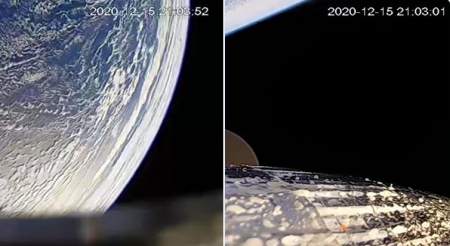
The twin asteroid Janus probes, stranded by Psyche delay, might go to Apophis

Apophis' path past the Earth in 2029
A cartoon showing Apophis’s path in 2029

The science team that built the twin Janus spacecraft, designed to fly past an asteroid but stranded when its launch got canceled, are now considering the potentially dangerous asteroid Apophis as a new target.

If the Janus spacecraft can find a ride by early 2028, scientists could use one or both of the spacecraft to scout out the large asteroid Apophis before its super-close approach to Earth in April 2029. (If only one spacecraft visits Apophis, scientists would see only about half of the asteroid but could send the second spacecraft elsewhere; if both spacecraft fly past the same object they can be arranged to reveal the whole surface.)

Initially the entire Janus mission had been designed on the assumption it would launch as a secondary payload when the Psyche mission to the asteroid Psyche launched last fall. When that launch had to be canceled because Psyche was not ready, Janus lost its mission. The science team has since been struggling to find a replacement, handicapped by the fact that it must go as a secondary payload.

There is a serious issue however with arriving ahead of Apophis’s close approach in 2029. The science community has discouraged such missions, because they fear a spacecraft arriving then could shift Apophis’s trajectory and actually increase the chance it will hit the Earth during a later close approach. Instead, all planetary probes presently going to Apophis in 2029 are planning to arrive after the flyby.

The risk is extremely small, but it must be considered before sending Janus to Apophis.

3 comments

A Martian bear!

A Martian bear!
Click for original image. Full image here.

Silly image time! Today the science team for the high resolution camera on Mars Reconnaissance Orbiter posted the photo to the right, which I have cropped, reduced, and annotated to post here. It was taken on December 12, 2022, and was rotated so that north is to the right in order to make its resemblance to a bear’s face obvious. As noted in the caption by Alfred McEwen of the Lunar & Planetary Laboratory in Arizona:

There’s a hill with a V-shaped collapse structure (the nose), two craters (the eyes), and a circular fracture pattern (the head). The circular fracture pattern might be due to the settling of a deposit over a buried impact crater. Maybe the nose is a volcanic or mud vent and the deposit could be lava or mud flows?

Maybe just grin and bear it.

If you have red-green glasses you can see a 3D anaglyph of this image here. The feature itself is located in the southern cratered highlands of Mars at 41 degrees south latitude, so the presence of near surface ice that would cause a mud volcano is definitely possible.

7 comments

NASA and Russian engineers meeting to discuss status of leaks on ISS’s Zvezda module

According to Russia’s state-run press, NASA and Russian engineers have been reviewing the status of the repairs on the cracks in the Zvezda module on ISS.

Repairs to the various cracks in Zvezda’s hull, done by Russian astronauts in ’20 and ’21, have reduced the leakage from 1,140 grams per day to 300 grams per day. Normally ISS is expected to lose 325 grams per day, across the entire station, so the Zvezda leak doubled this loss, even after the repair. Thus, the hatch to Zvezda is kept closed in order to maintain the atmosphere of ISS at its normal levels, and opened only when there is need to enter it. In addition, its port is no longer used for dockings.

The engineering review is also looking into the cause of the cracks, which are believed to be stress fractures caused by the age of Zvezda (ISS’s second oldest module) combined with the many dockings that had occurred at its port. The review is also discussing ways to reduce the problem, until ISS’s retirement in 2030.

3 comments

German rocket startup Isar Aerospace gets first American customer

The German rocket startup Isar Aerospace, which hopes to complete the first launch of its Spectrum rocket this year, has signed its first launch contract with an American company, the satellite broker and space tug company Spaceflight.

U.S.-based launch services provider Spaceflight said Jan. 25 it has booked a dedicated launch in 2026 from Isar Aerospace, the German rocket developer aiming to perform the first test flight of its Spectrum vehicle this year. The mission is slated to lift off from Isar’s launchpad in Andøya, Norway, to sun-synchronous orbit (SSO).

Their agreement also includes an option for an additional dedicated launch in 2025, which Isar chief commercial officer Stella Guillen told SpaceNews could also use a launchpad it is developing at the Guiana Space Center near Kourou, French Guiana.

Spaceflight has been scrambling to find rockets for its tugs, since SpaceX announced in March 2022 it would no longer carry them. It signed a deal with Arianespace to fly on its Vega rocket, but launch failures have delayed its launch.

Isar is one of three German rocket startups vying for business. The race to be the first to launch remains very tight.

1 comment

Lucy team adds 10th asteroid to the spacecraft’s tour

Lucy's route through the solar system
Lucy’s route through the solar system

The Lucy science team has now added a tenth asteroid to the spacecraft’s tour of the solar system, planning its route so that it will pass within 280 miles on November 1, 2023.

The Lucy mission is already breaking records by planning to visit nine asteroids during its 12-year tour of the Jupiter Trojan asteroids, which orbit the Sun at the same distance as Jupiter. Originally, Lucy was not scheduled to get a close-up view of any asteroids until 2025, when it will fly by the main belt asteroid (52246) Donaldjohanson. However, the Lucy team identified a small, as-yet unnamed asteroid in the inner main belt, designated (152830) 1999 VD57, as a potential new and useful target for the Lucy spacecraft.

The asteroid is about 2,300 feet wide. The primary goal of this visit however will be engineering, testing Lucy’s new method of tracking an object as the spacecraft flies past. On the map to the right the dots along Lucy’s path indicate the asteroids to be visited.

0 comments

SpaceX successfully launches a record 56 Starlink satellites

SpaceX early today successfully launched a record 56 Starlink satellites on a single Falcon 9 rocket, which also carried a record mass for the rocket.

The first stage successfully landed on a drone ship in the Atlantic, completing its 9th flight. The fairing halves completed the 6th and 7th flights.

The 2023 launch race:

6 SpaceX
5 China
1 Rocket Lab
1 Japan

American private enterprise now leads China 7 to 5 in the national ranks, and the entire world combined 7 to 6.

3 comments

Japan’s H2A rocket successfully launches radar surveillance satellite

Japan’s space agency JAXA today successfully launched a radar surveillance satellite using its H2A rocket, built by Mitsubishi.

This was Japan’s first launch since December 2021, a gap of more than a year, with no launches in 2022. JAXA hopes to finally launch its unimaginatively named H3 rocket, the replacement for the H2A, on February 12, 2023, after a two year delay because of cracks found in the engines.

The 2023 launch race:

5 China
5 SpaceX
1 Rocket Lab
1 Japan

0 comments

A dry lakebed on Mars?

Evidence of a past lake in a crater on Mars
Click for original image.

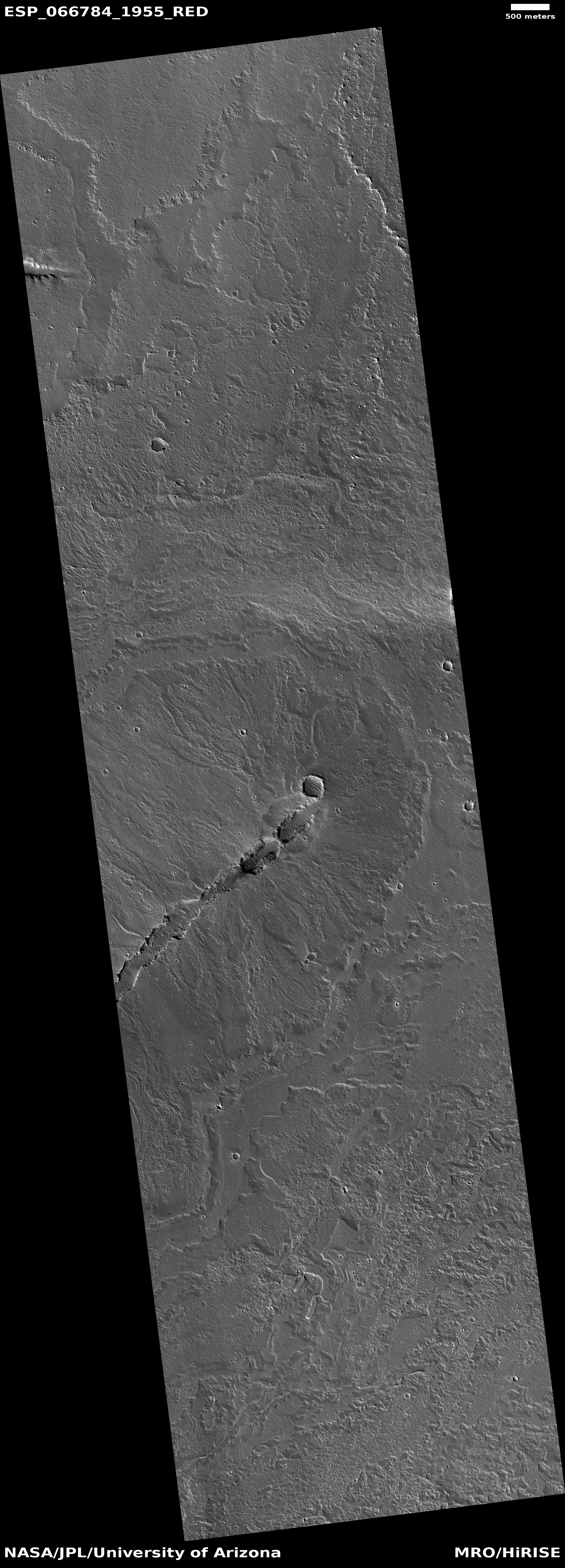
Today’s cool image illustrates in some ways the uncertainty of science. The photo to the right, rotated, cropped, reduced, and sharpened to post here, was taken on December 1, 2022 by the high resolution camera on Mars Reconnaissance Orbiter (MRO). The science team intriguingly labeled it “Small Candidate Lake Deposit Downstream of Alluvial Fan.” I am not sure what they consider that lake deposit in the full image, so I have focused on the area of stucco-like ground, which resembles bedrock that has been corroded by some water process.

This area is just to the east of the central peaks of an unnamed 25-mile-wide crater in the southern cratered highlands. Many of the craters in this region are believed by scientists to have once harbored lakes formed by run-off from the glaciers that once existed on the craters’ inner rim. In this case it appears this stucco area is the head of an alluvial fan, coming down from the crater’s central peaks. You can see its beginning in this MRO high resolution image of the central peaks, taken in November 2016. As defined geologically,

An aluvial fan is an accumulation of sediments that fans outwards from a concentrated source of sediments, such as a narrow canyon emerging from an escarpment. They are characteristic of mountainous terrain in arid to semiarid climates, but are also found in more humid environments subject to intense rainfall and in areas of modern glaciation.

In this case the terrain is now arid, but shows evidence it once was icy wet.
» Read more

0 comments

ISRO about to test land a prototype of India’s own version of the X-37B

ISRO's own X-37B copy

According to S. Somanth, the head of India’s space agency ISRO, it will attempt the first flight on January 28, 2023 of a prototype reusable launch vehicle, similar to the Space Force’s X-37B.

According to ISRO’s website, Saturday’s landing demonstration will involve a “landing experiment (LEX)” in which the RLV will be carried using a helicopter to an altitude of 3-5 km and released at approximately 4-5 km from the runway with a horizontal velocity.

After the release, the RLV glides and navigates toward the runway, and carries out a conventional autonomous landing. This is planned in a defence airfield near Chitradurga in Karnataka.

The graphic to the right shows the flight profile of earlier tests that landed in the ocean. If this runway test is successful, it appears ISRO will next attempt an orbital flight and return.

6 comments

Arianespace’s chief condemns the idea of independent private European rocket companies

Stéphane Israël, the head of Arianespace, the European Space Agency’s (ESA) commercial rocket division, yesterday strongly condemned the idea of allowing independent private European rocket companies to develop and compete with his government operation.

“It is not possible to copy-paste the US model,” he said. “It is not possible. The level of space spending in the United States is five times higher than in Europe, and the private capital is not the same. So if the answer is to say let’s do what the US has done, I think we will not manage to do it.”

Moreover, Israël said the European Space Agency must resist supporting microlaunchers to the point where these companies might compete with the existing capabilities.

“A huge mistake would be that this focus on microlaunchers destabilizes Ariane 6 and Vega C—it would be a historic mistake,” he said. “Microlaunchers can be of support to boost innovation. But we should not make any confusion. This launcher will never give autonomous access to space to Europe. They’re on a niche market representing maybe 10 percent of the market, and less than that when it comes to European needs.”

He said this in Brussels at the 15th European Space Conference, where it appears he was trying to convince the ESA to block any competition with Arianespace.

Israël might say this, but not only has his track record in predicting the success of commercial space in the U.S. been bad, other European governments are not taking his advice. Both Germany and the United Kingdom have several rocket startups gearing up for their first launches this year, with others in Spain and France not far behind. Moreover, Israël doesn’t have much to offer in competition. Arianespace’s Vega rocket, intended to be a low cost option, has failed on three of its last eight launches. The Ariane 6 rocket is years behind schedule, and has not yet launched. And both are overpriced and cannot compete, not only with the American rocket startups but with India’s government rockets.

Moreover, those European governments have in recent years been taking control and power away from Israël and Arianespace. Unlike earlier rockets, the Ariane 6 rocket is not controlled or owned by Arianespace. Instead, it belongs to ArianeGroup, the partnership of Airbus and Safran that is building it. Arianespace’s role in operating it will be greatly limited, once it begins flying.

11 comments

Roscosmos predicts Russia’s new space station will launch by 2027

Wanna bet? Yuri Borisov, the head of Roscosmos, yesterday predicted that Russia’s new space station, dubbed the Russian Orbital Station, will launched and deployed by 2027.

“We will create sovereign infrastructure for human space flights to low near-Earth orbit. Its key element will be the Russian orbital station whose deployment we have scheduled for 2027,” he said.

The Russian space agency will carry out all the required feasibility studies by Cosmonautics Day celebrated in Russia on April 12, the Roscosmos chief said.

Based on Russia’s track record for the past three decades, this prediction will fail. Since the fall of the Soviet Union Russia’s space industry has consistently made many such predictions, none of which launched on time, with most never launching at all. Yet, that was during a time when Russia’s economy was booming, it was getting lots of revenue from the international markets, and wasn’t saddled with a draining war in the Ukraine. Now, international sanctions limit what it can get from that market, and its oil revenues have declined considerable due to the war. Moreover, the war prevents Russia from obtaining many cutting edge space components it needs for such a project. Replacing these with home-built components will take time.

If this station gets built, its launch will likely not happen before 2030.

2 comments

Stacked Starship and Superheavy complete first full wet dress rehearsal countdown

SpaceX yesterday successfully completed a full wet dress rehearsal countdown of its stacked Starship prototype #24 and Superheavy prototype #7, fueling both completely and taking the countdown down to T-0.

On this rehearsal however the Superheavy engines were not fired. From two SpaceX tweets:

Starship completed its first full flight-like wet dress rehearsal at Starbase today. This was the first time an integrated Ship and Booster were fully loaded with more than 10 million pounds of propellant

Today’s test will help verify a full launch countdown sequence, as well as the performance of Starship and the orbital pad for flight-like operations

Next step: Another full wet dress rehearsal countdown that includes a short static fire test of all 33 Superheavy Raptor-2 engines. Once that is done successfully, the company will be ready for that first orbital launch.

Meanwhile, SpaceX awaits its launch license from the FAA. I remain pessimistic that it will be issued on a timely manner, as there are clear signs the Biden administration wants to use its power against Musk, whom it now sees as an enemy.

16 comments
1 389 390 391 392 393 1,327