Scientists claim rocket launches are going to damage ozone layer

Junk science: This week NOAA government scientists published a paper claiming that the upcoming increase in rocket launches worldwide is a threat to the ozone layer and will also — my heart be still — promote climate change!

The study found that a tenfold increase in the amount of soot injected into the stratosphere every year would after 50 years lead to an annual temperature increase in that layer of 1 to 4 degrees Fahrenheit (0.5 to 2 degrees Celsius). The stratosphere is the layer of the atmosphere just above the lowest troposphere. The study found that the projected warming would slow down subtropical jet streams, bands of strong wind circling the planet at the lower edge of the stratosphere that influence the African and Indian summer monsoons.

Warmer temperatures in the stratosphere would also degrade the protective ozone layer, which blocks harmful ultraviolet radiation from the sun from reaching the planet’s surface.

The paper’s abstract also said this:

We show that the rocket black carbon increases stratospheric temperatures and changes the global circulation, both of which cause a reduction in the total ozone column, mainly in the northern high latitudes. Comparing the amplitude of the atmospheric response using different emission rates provides insight into stratospheric adjustment and feedback mechanisms. Our results show that the stratosphere is sensitive to relatively modest black carbon injections.

This is garbage science, and I wouldn’t bother posting a link to it if other news sources weren’t promoting it. These predictions — based on a very simple computer model — are nothing more than guesses, and are apparently designed to both attack the growing space industry as well as garner funding for more such junk science, as illustrated by this quote from the NOAA press release:

“We need to learn more about the potential impact of hydrocarbon-burning engines on the stratosphere and on the climate at the surface of the Earth,” said lead author Christopher Maloney, a CIRES research scientist working in NOAA’s Chemical Sciences Laboratory. “With further research, we should be able to better understand the relative impacts of different rocket types on climate and ozone.”

For almost a half century climate scientists — many working for government agencies like NASA and NOAA — have been publishing junk papers like this, predicting climate doom in only a few decades unless we do as they say, while funneling boatloads of cash into their pockets. Almost none of those predictions have turned out to be correct.

This report is equally suspect, especially because it touts the false statistic that “launch rates have tripled in recent decades.” The number of launches has not tripled from its long-term average since Sputnik. The only way you can get manufacture that fake statistic is if you compare last year’s total (134) with the launch numbers from the early 1960s, before the space race had even begun. And while the launch numbers are likely to rise dramatically in the coming years, the numbers will still be infinitesimal compared to other industries. Going from 50-100 launches to 200-500 launches is hardly the end of the world.

It really is far past time for the press and the general public to stop listening to these fake papers.

19 comments

Virgin Orbit signs deal to launch from Brazil

Capitalism in space: Virgin Orbit yesterday announced that it has signed an agreement with the Brazil Space Agency (AEB) to establish facilities and conduct launches from that nation’s long unused Alcântara spaceport.

The license is granted to Virgin Orbit Brasil Ltda. (VOBRA), a newly formed and wholly owned Brazilian subsidiary dedicated to bringing the LauncherOne air-launch rocket system to the Alcântara Launch Center (Centro de Lançamento de Alcântara, CLA).

The formation of the VOBRA entity for dedicated Brazilian space activities is designed to bring an important new capability to the country and economic value to the region. Virgin Orbit’s LauncherOne system, which uses a customized 747 aircraft, Cosmic Girl, as its flying and fully reusable launch pad, will conduct launches from the existing airbase at the Brazilian site, flying hundreds of miles before releasing the rocket directly above the equator — a global sweet spot — or at other optimal locations identified for each individual mission.

Being able to launch smallsats from the equator gives Virgin Orbit the ability to place those satellites in any orbit around the Earth for far less fuel, an advantage not available to spaceports at higher latitudes.

4 comments

China and Rocket Lab complete successful launches

Two launches this morning herald the upcoming busy launch schedule for the last few days of June.

First China launched from its Jiuquan interior spaceport an Earth observation satellite using its Long March 4C rocket. As is usual with China, the first stage crashed on land, though no details have been provided.

Next, Rocket Lab used its Electron rocket to send NASA’s CAPSTONE cubesat lunar probe on its way to the Moon. More information here.

CAPSTONE is currently in low-Earth orbit, and it will take the spacecraft about four months to reach its targeted lunar orbit.

…CAPSTONE is attached to Rocket Lab’s Lunar Photon, an interplanetary third stage that will send CAPSTONE on its way to deep space. Shortly after launch, Lunar Photon separated from Electron’s second stage. Over the next six days, Photon’s engine will periodically ignite to accelerate it beyond low-Earth orbit, where Photon will release the CubeSat on a ballistic lunar transfer trajectory to the Moon. CAPSTONE will then use its own propulsion and the Sun’s gravity to navigate the rest of the way to the Moon. The gravity-driven track will dramatically reduce the amount of fuel the CubeSat needs to get to the Moon.

Once at the Moon, the spacecraft will enter a polar orbit varying from 1000 to 43,500 miles from the surface, with its prime mission to test operations in that lunar orbit.

Not only did NASA hire a private company, Rocket Lab, to launch it, the agency also hired a private company, Terran Orbital, to build it.

The leaders in the 2022 launch race:

26 SpaceX
21 China
8 Russia
4 Rocket Lab

American private enterprise still leads China 36 to 21 in the national rankings, and the entire world combined 36 to 34.

For the rest of June, the American companies SpaceX, Virgin Orbit, and ULA all have planned launches, as well as India. If all succeed, that would put the total launches in the first half of ’22 at 74, a pace that would almost reach 150 launches by the end of the year, smashing the annual record set last year. The U.S.’s pace in turn is likely to exceed the number of launches it completed in all of ’22 in July, with the possibility it could complete 75-80 launches by the end of the year, exceeding the U.S. annual record of 70 set in 1966.

1 comment

Did pieces of a Chinese upper stage land in middle of Mediterranean last week?

According to a tweet from a Twitter account that specializes in reporting on the Chinese space program, at least one piece of the upper stage from the Long March 2F rocket that launched the present Tiangon space station crew on the Shenzhou-14 crashed into the middle of Mediterranean Sea when the stage’s orbit decayed.

Most parts burned during the reentry while small debris splashed in Mediterranean Sea around E5.2° N39.1°

According to both this Twitter site as well as the Aerospace Corporation’s re-entry site, the event occurred on June 20, 2022. The latter site however says the stage burned up over the Atlantic, though it also indicated a one hour margin of error both before or after that time. If the stage thus stayed up just a bit longer, its orbit would have brought it down exactly where the former site states.

If this is so, it indicates that the Chinese either could not or made no effort to control the de-orbit, something that should be standard for any upper stage that has mass that could hit the ground.

Hat tip from reader Jay.

1 comment

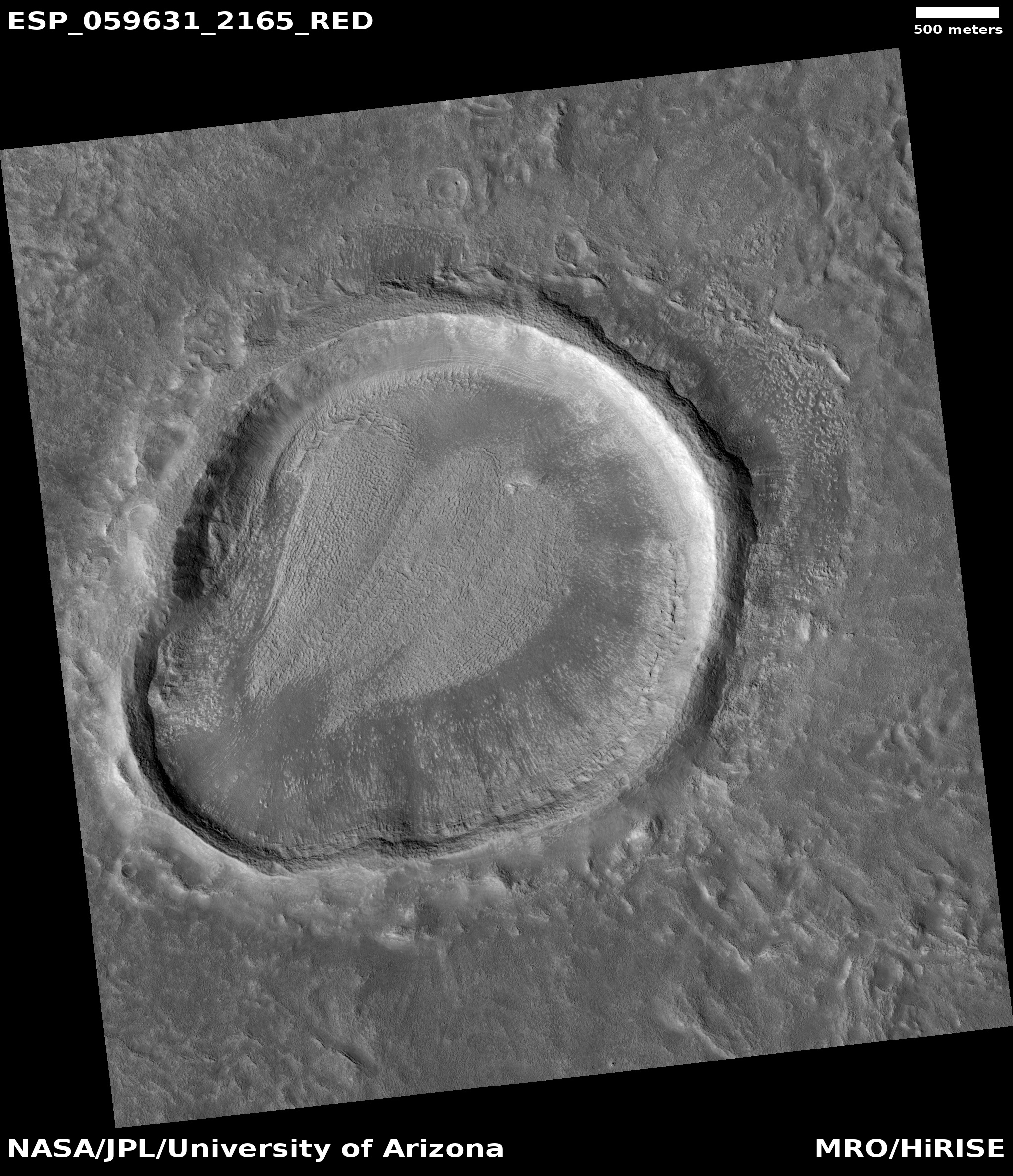
A thick and syrupy flow on Mars

A thick and syrupy flow on Mars
Click for full image.

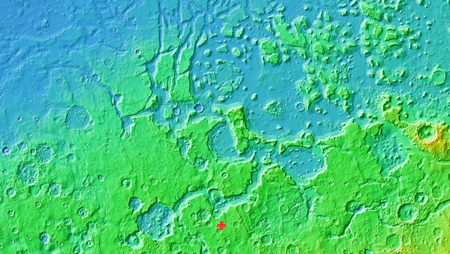
Overview map

Cool image time! The photo above, rotated, cropped, and reduced to post here, was taken on March 5, 2022 by the high resolution camera on Mars Reconnaissance Orbiter (MRO). It shows what the scientists label as a “viscous flow feature,” which is another way of saying the flow was thick and syrupy.

Nor is such a flow unusual in this area of Mars. It is located in a region of chaos terrain dubbed Protonilus Mensae, which is also the central mensae region in the 2,000-mile-long strip in the northern mid-latitudes of Mars I label glacier country. The overview map above of Protonilus Mensae — covering about 500 miles in width — shows how common such flows are in this place. The black rectangles mark the locations of other cool images I have featured, as follows:

The red rectangle indicates the location of today’s cool image.

The glacial aspect of everything in this region is even more emphasized by the wider view provided by MRO’s context camera below.
» Read more

1 comment

New research suggests flowing water existed intermittently on Mars from 2.5 to 3.6 billion years ago.

Based on a study of alluvial fans on Mars, river sediment thought to have been placed at the foot of mountains, scientists have concluded that liquid water could have been flowing from as 2.5 to 3.6 billion years ago.

“We’ve known for decades that Mars had rivers and lakes around 3.5 billion years ago, but in the past few years there has been a growing body of evidence that substantial amounts of liquid water continued to erode the Martian surface for hundreds of millions of years,” said Morgan, lead author on “The global distribution and morphologic characteristics of fan-shaped sedimentary landforms on Mars” that appears in Icarus. “Water-formed landforms, such as river deltas and alluvial fans, are the most unambiguous markers of past climate. So we conducted a global survey for these features and explored patterns in their distribution and morphologic properties.”

Morgan and co-authors including PSI Senior Scientist Alan Howard found that alluvial fans are found at lower elevations than the more ancient valley networks, suggesting that stable liquid water became restricted to lower, warmer regions as Mars cooled and dried.

…What is particularly interesting about the Martian fans is that many formed much later than the valley networks, which have long been considered the strongest evidence for surface water on early Mars. Valley networks largely date to around 3.6 billion years ago, but alluvial fans date to 2.5 to 3 billion years ago.

This research merely increases the fundamental geological mystery of Mars. While the surface evidence strongly tells us that liquid water once flowed on the surface, no climate model exists that satisfactorily makes that possible. The atmosphere appears to have always been too cold and thin for liquid water.

1 comment

NASA completes suborbital launch from commercial spaceport in Australia

Early this morning NASA successfully completed its first rocket launch from Australia since 1995, launching a suborbital payload from a new commercial spaceport on the northern coast of Australia.

The rocket is Nasa’s first of three to blast off from the newly constructed Arnhem Space Centre on the edge of the Northern Territory. Scientists hope it will help them study the impact of a star’s light on the habitability of nearby planets.

Onlookers who travelled to the remote site glimpsed the rocket for only about 10 seconds before it shot out of view.

After a short fifteen minute flight the sounding rocket and payload were recovered. The next suborbital launch is scheduled for July 4th.

2 comments

Iran claims it has completed a second suborbital test of new rocket

According to Iran’s state-run press, it yesterday successfully completed the second suborbital test of its new Zuljanah rocket.

The announcement said nothing about where or when the launch took place. According to this Iranian report, the rocket “has two solid propulsion phases and a single liquid propulsion phase.”

The rocket had completed a suborbital test in January 2021. In March 2022 satellite imagery suggested a second test had exploded on the launchpad sometime in late February.

Since the video of the launch provides no specific information about where or when, it is quite possible it is simply footage from the January 2021 launch. It will require orbital imagery to confirm this claim.

0 comments

German smallsat rocket startup signs orbital tug startup as launch customer

Capitalism in space: Isar, one of three German smallsat rocket companies hoping to launch their own rockets, has won a launch contract from D-Orbit, one of three companies building orbital space tugs designed to provide in-orbit transportation to cubesats.

Isar Aerospace announced today that it has entered into a firm launch services agreement with space infrastructure pioneer D-Orbit. The company’s launch vehicle Spectrum, which is developed for small and medium satellites and satellite constellations, will launch D-Orbit’s ION Satellite Carrier as a primary customer to a Sun-synchronous orbit from its launch site in Andøya, Norway with a launch term starting in 2023.

This is Isar’s third launch contract. The company has also raised almost $200 million in investment capital in the past year and a half.

0 comments

Blue Origin abandons plans to land New Glenn first stages on purchased cargo ship

Capitalism in space: This week it was revealed that Blue Origin has abandoned its plan to use a purchased and refurbished cargo ship as an ocean landing platform for the first stages of its New Glenn rocket.

The company had bought the ship in 2018, when it thought New Glenn would be flying by 2020, and planned to reconfigure it by covering it with a giant landing pad. It appears the company abandoned that plan because of cost. What it plans to do instead to provide New Glenn first stages a place to land remains unclear.

Some historical details that provide some context and might explain the change in plans. In 2016 Blue Origin was launching test flights of its New Shepard suborbital craft on almost a monthly basis. It appears to have an aggressive attitude towards development, with New Glenn aiming for a 2020 launch.

In 2017 Jeff Bezos hired Bob Smith to take over as Blue Origin’s CEO. At that point development slowed to a crawl. For the next four years New Shepard test flights dropped to about one per year. Also at that time development of the BE-4 rocket engine needed for both New Glenn and ULA’s Vulcan rocket also slowed to a crawl, apparently because the company’s management would not commit funds to buy extra engines for testing.

In 2018 Blue Origin signed a deal with the Air Force, thus delaying New Glenn’s first launch by a year. The deal appeared to stem from a desire of Blue Origin management to get government contracts and money first rather than committing any company money to development, the approach used by older big space companies for decades. While it reduces risk, this approach also makes the government a partner in development, which has historically slowed all development while significantly raising costs.

That same year it bought this ship as the rocket’s landing pad, though relatively little work is done on it for years.

In 2021 Jeff Bezos stepped down as Amazon CEO to focus more time on Blue Origin. Suddenly, New Shepard ups its launch rate, and finally starts flying passengers. At the same time, the testing of the BE-4 engine appears to accelerate.

Now Blue Origin is abandoning this ship that was purchased after Bob Smith took over.

Does one get the feeling that Bezos might have finally realized that the management under Smith was not very effective? Smith is still Blue Origin’s CEO, but one wonders how long this will last.

8 comments

Psyche will not launch as scheduled

NASA officials yesterday confirmed that because of software issues its asteroid mission Psyche will not launch as scheduled this year.

Due to the late delivery of the spacecraft’s flight software and testing equipment, NASA does not have sufficient time to complete the testing needed ahead of its remaining launch period this year, which ends on Oct. 11. The mission team needs more time to ensure that the software will function properly in flight.

…As the mission team at NASA’s Jet Propulsion Laboratory in Southern California began testing the system, a compatibility issue was discovered with the software’s testbed simulators. In May, NASA shifted the mission’s targeted launch date from Aug. 1 to no earlier than Sept. 20 to accommodate the work needed. The issue with the testbeds has been identified and corrected; however, there is not enough time to complete a full checkout of the software for a launch this year.

NASA management will conduct a review to understand what caused the problem.

As for when Psyche can next launch and reach the asteroid Psyche, the next launch windows in ’23 and ’24 will not arrive at the asteroid until ’29 or ’30 respectively, a flight time that is about two years longer than what the ’22 launch would have been.

10 comments

Perseverance’s first climb

Perseverance's first climb
Click for full image.

Cool image time! The photo to the right, rotated, cropped, and reduced to post here, was taken by the high resolution camera on the Mars rover Perseverance on June 16, 2022, shortly after it began its first climb up from the generally flat floor of Jezero crater and onto the delta that once in the far past flowed through a gap into that crater.

I have rotated the image about 8.5 degrees to make horizontal the crater floor and the distant rim of the crater (barely visible through the atmosphere’s thick winter dust). This shows that the rover was then climbing what appears to be a relative low angle grade, hardly as challenging as the serious grades that Curiosity has been dealing with now for the past two years in the foothills of Mount Sharp. Nonetheless, Perseverance has begun climbing.

To see where the rover is see the overview map from the start of this week. Unfortunately, I have been unable to determine the direction of this photo. It could be looking west, south, or east, based on features inside Jezero Crater. I therefore cannot tell you the distance to the rim, which depending on the direction, could be from five to twenty-five miles away.

3 comments
1 466 467 468 469 470 1,327